
Selecting Transduction Principles for High Precision Industrial Sensor Applications
Match physical transduction mechanisms to target material limits, thermal loop expansion, and analog noise ceilings before selecting specific sensor vendors.

Match physical transduction mechanisms to target material limits, thermal loop expansion, and analog noise ceilings before selecting specific sensor vendors.

Polymer encapsulation ingress shifts sensor zero baselines through hygroscopic swelling stress and permittivity drift, requiring pre-conditioned calibration.

Primary lithium battery passivation causes severe voltage drops during current transducer bursts, requiring energy buffers or active depassivation routines.

Active energy overhead in battery transducer nodes is governed by analog stabilization latency rather than pure conversion clock speed.

Dynamic hysteresis and moisture drift demand coupled viscoelastic-diffusion filters to preserve sensor accuracy limits within unconditioned process media.

Sensor power evaluation requires calculating energy per bit of resolution across the temperature envelope rather than relying on room-temperature active current claims.

Evaluating piezoresistive humidity cross-sensitivity requires isothermal stepped chamber dwells that decouple packaging swelling strain from bridge thermal drift.

Mitigating sub-micro-g thermal hysteresis requires balanced differential resonator topologies, low-creep eutectic die bonding, and wafer-level thermal RC filtering.

Relative humidity drives zero offset drift through polymer swelling strain on silicon diaphragms and surface leakage across unpassivated bridge resistors.

Direct bonded copper shunt drift stems from viscoplastic relief of residual bonding stress, resolvable by geometric isolation and post-bond stabilization.

Viscoelastic epoxy relaxation locks residual strain into shunt elements after thermal excursions, shifting zero-point resistance and corrupting current readings.

Viscoelastic adhesive relaxation in ceramic LCC packages causes time-dependent zero drift, requiring master-curve Prony modeling to quantify long-term offset shift.

Measuring accelerometer offset drift requires thermal soak stabilization and multi-position gravity inversion to decouple mechanical stress from true bias shift.

Mechanical strain from expansion mismatch creates apparent TCR drift exceeding material limits unless terminals incorporate flexural decoupling relief.

Mitigating component obsolescence requires balancing upfront redesign costs against the physical reliability risks of intermetallic solder degradation.

Central PSA nitrogen generators reach capital payback over bulk liquid tanks within thirty-eight months when storage volume exceeds twenty cubic meters.

Mitigate component obsolescence by balancing last-time-buy capital against redesign fees, resolving footprint and bus timing changes before production freezes.

Dynamic elasticity tensor tracking uses embedded piezoresistive rosettes and recursive inversion to cancel interposer viscoelastic warpage in real time.

Controlling moisture-induced shear strain below 80 microstrain in epoxy-molded foil elements requires compliant silicone buffers to hold sub-5 ppm stability.

Wafer-level package parasitic inductance variance shifts serial channel return loss and eye margins, requiring strict standoff height controls during assembly.

Packaging thermal gradients break quad-symmetric vibratory degeneracy, splitting eigenmodes and degrading bias stability unless isolated by central anchors.

Evaluating substrate stress relaxation requires continuous four-terminal monitoring to isolate solder viscoplastic creep from chemical film aging mechanisms.

Interposer substitutions demand matched expansion coefficients, controlled solder paste volume, and structural underfill to prevent thermal fatigue fracture.

Packaging and thermal expansion stresses transmit through silicon anchors to shift modal stiffness, generating quadrature errors and uncalibrated bias drift.

Quantifying hygrothermal relaxation demands accelerated aging at elevated humidity to isolate polymer modulus decay from silicon transducer drift.
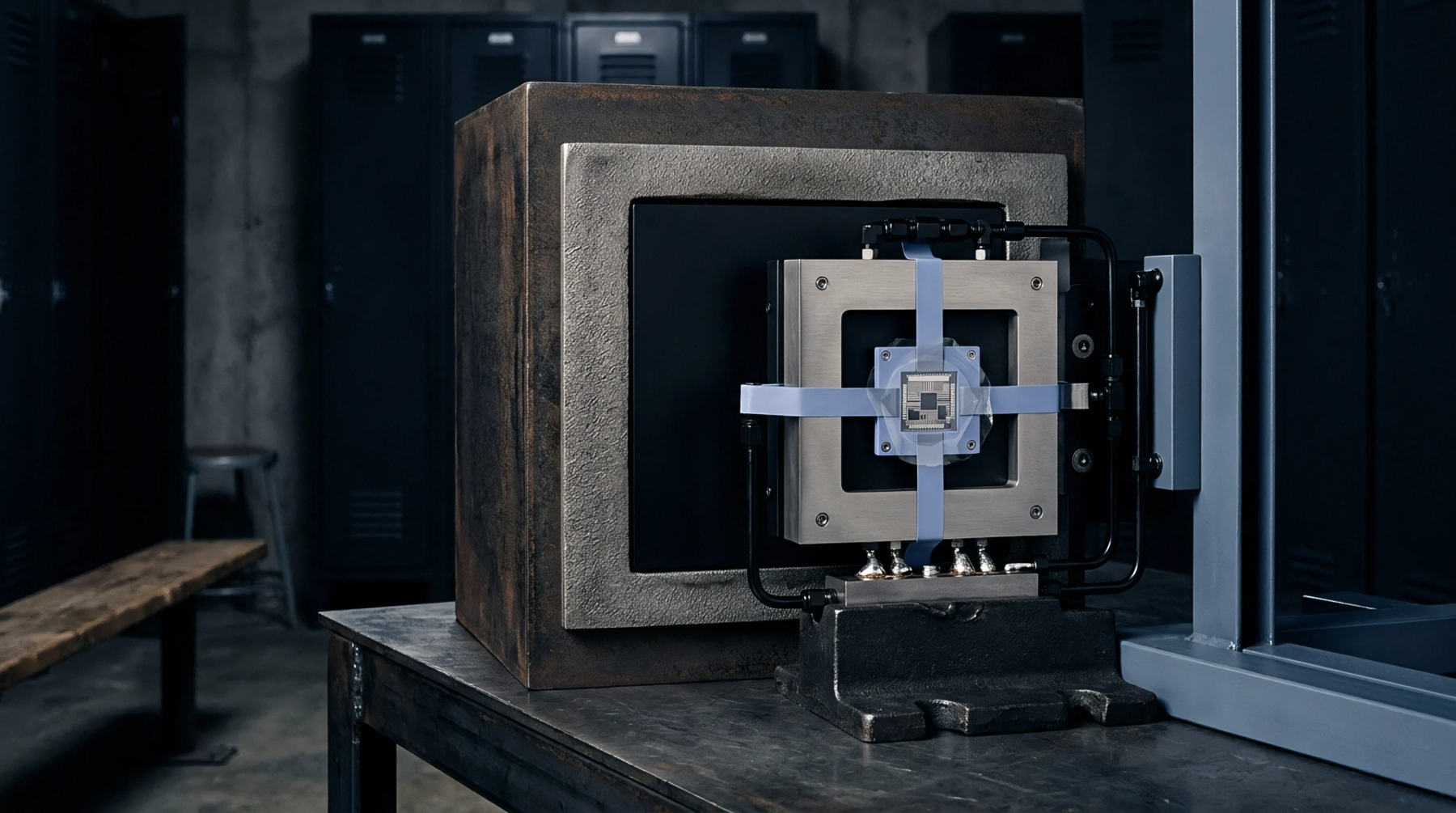
Bulk metal foil divider drift in precision voltage references is driven by viscoelastic adhesive creep, demanding monolithic hermetic packaging and pre-aging.

Semiconductor allocation engines balance client margins, past intake accuracy, and packaging bottlenecks to ration components through linear programming rules.

Unnotified sensor obsolescence triggers severe technical requalification expenses that buyers reallocate through rigid advance notice covenants and direct indemnity terms.

Dynamic multiphase fluid velocities shift external film coefficients by two orders of magnitude, expanding thermowell soak delays from 8 to over 180 seconds.

Maintain long-term component stock below 1% relative humidity in nitrogen cabinets and verify terminal solderability via wetting balance testing before assembly.
Expertise is a utility, not a secret. sentiention™ publishes its working knowledge as open reference: intelligence layer covering the materials it sources, the markets it enters, and the reference that serves both.