Quad Symmetric Resonator Frequency Splitting under Packaging Thermal Gradients
Packaging thermal gradients break quad-symmetric vibratory degeneracy, splitting eigenmodes and degrading bias stability unless isolated by central anchors.
Heat
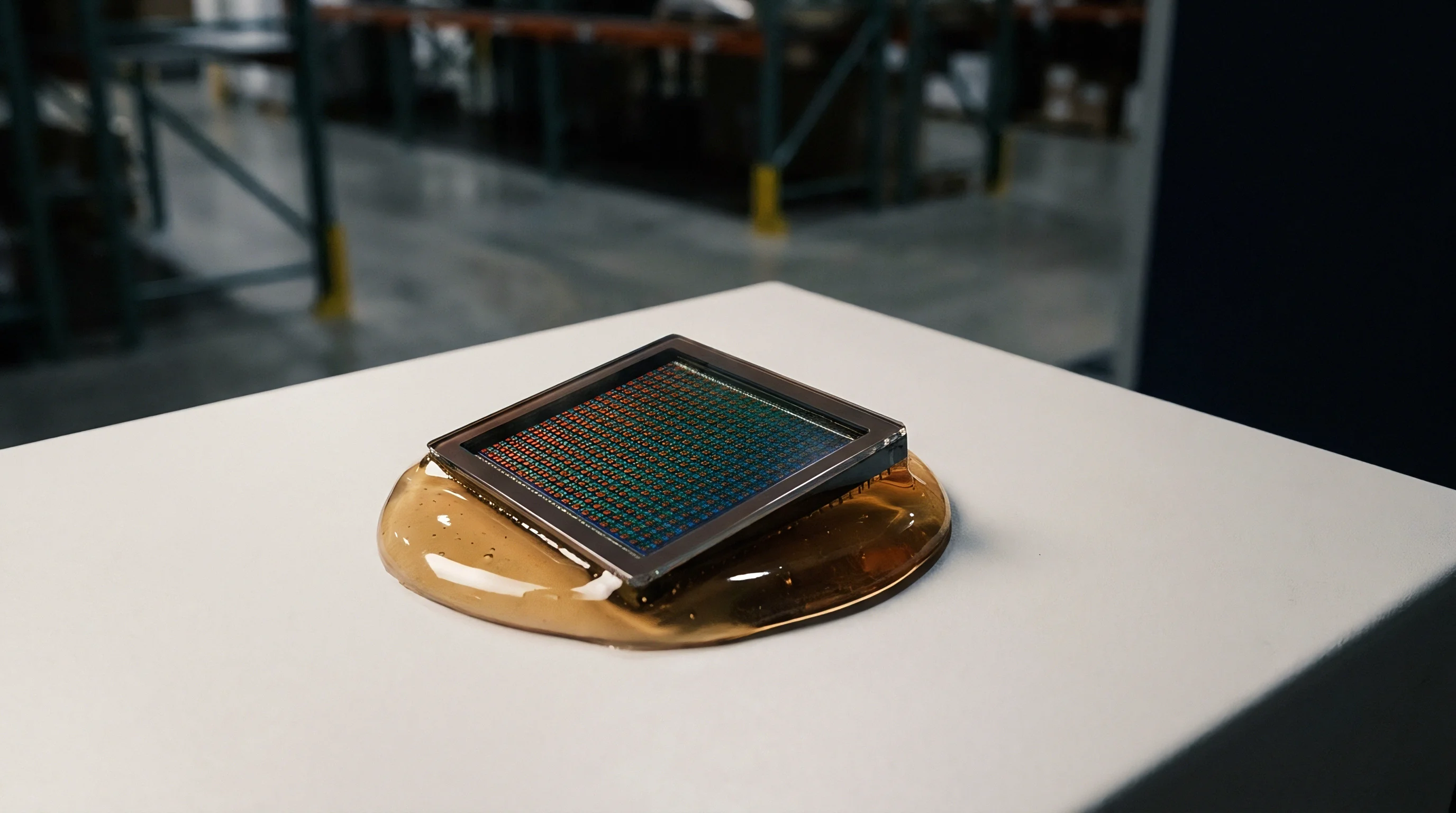
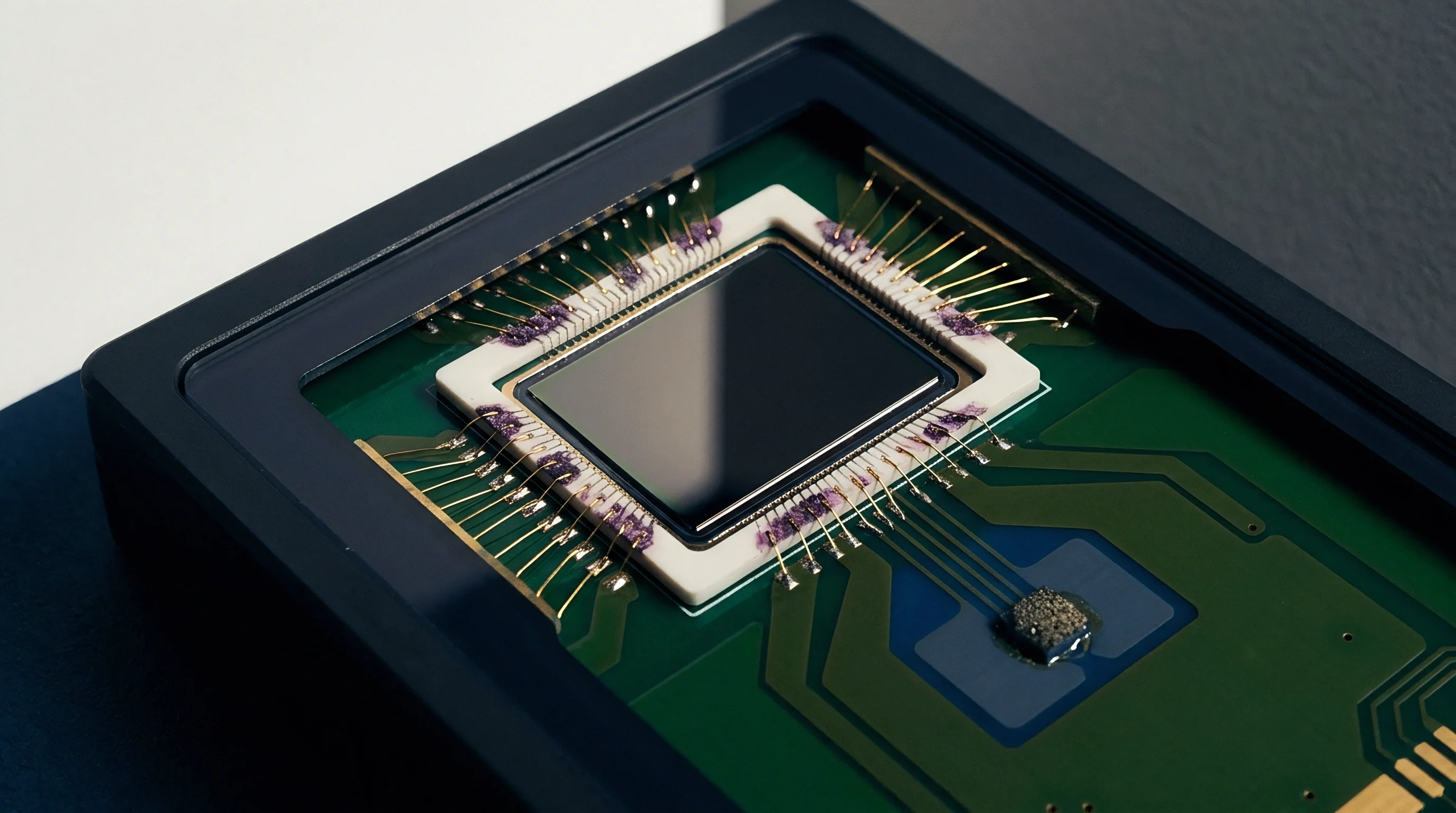
Thermal distributions across hermetic sensor cavities depart from uniform equilibrium whenever active electronics operate adjacent to sensing structures. A power management integrated circuit dissipating two hundred milliwatts at a distance of three millimeters establishes a localized conduction path through copper traces, FR4 fiberglass, and solder ball matrices. This thermal energy enters the sensor package through corner contacts, propagating laterally toward the die attach pad.
The temperature field across the silicon device layer loses structural balance.
In degenerate vibratory devices governed by four-fold geometric symmetry, balanced orthogonal modes share an identical eigenfrequency. When an uncompensated spatial temperature differential of 0.1 kelvin develops across a five-millimeter silicon die, structural equilibrium collapses. The temperature coefficient of elasticity in single-crystal silicon induces localized variations in mechanical compliance along specific crystallographic directions.
Differential thermal expansion between the packaging carrier, the adhesive interface, and the micromachined frame introduces directional shear forces across the suspension anchors.
Silicon exhibits a negative thermo-elastic coefficient.
A lateral temperature variation of 0.05 kelvin across a quad-mass suspension shifts structural eigenfrequencies by more than 1.2 hertz at 25 degrees Celsius.
Internal energy transfer within ceramic and metal chip-scale enclosures follows three primary physical pathways:
- Asymmetric substrate conduction channels localized heat from high-density interconnect routing through distinct anchor pads at non-uniform rates.
- Adhesive boundary resistance varies with void distribution in epoxy preforms, creating localized thermal choke points across the structural base.
- Differential radiative exchange between internal cavity walls and suspended mass surfaces generates minor transverse heat fluxes across high-vacuum cavities.
Direct conduction through mechanical support posts dominates the thermal impedance network. Silicon boundary anchors transmit packaging strains directly to elastic flexures. Thermal expansion of the ceramic carrier exerts compressive lateral loads along one axis while leaving the orthogonal axis unaffected.
Non-uniform boundary displacements bend the suspension beams, altering the differential mechanical stress profile before external angular motion reaches the proof mass.
Unbalanced packaging thermal paths elevate zero-rate output walk and degrade angular random walk by an order of magnitude, triggering mission-level navigation failures in guidance systems reliant on uncompensated dead reckoning.

Stiffness
Mechanical elasticity in crystalline silicon depends directly on lattice temperature and intrinsic crystallographic orientation. Single-crystal material sliced along the (100) plane exhibits four-fold planar elastic anisotropy, with the compliance matrix dictating mechanical response under external loading. Young’s modulus varies between 130 gigapascals along the <100> axis and 169 gigapascals along the <110> axis.
Quad-symmetric vibratory gyroscopes utilize symmetric suspension springs aligned along these crystallographic axes to establish matched drive and sense frequencies.
Thermal gradients break modal degeneracy.
When localized heat sources introduce temperature asymmetries across the suspension springs, the effective elastic constant of each flexure shifts independently. Single-crystal silicon exhibits a temperature coefficient of Young’s modulus ranging from -30 to -60 parts per million per kelvin. A warm beam becomes mechanically softer than an opposing cold beam.
The stiffness matrix loses its four-fold rotational symmetry, developing off-diagonal coupling terms that split the degenerate eigenmodes into two separated frequencies.
What Thermal Gradient Induces Mode Splitting?
Calculations based on linear thermoelasticity quantify the relationship between localized heating and modal frequency deviation. Consider a quad-mass vibratory gyroscope operating at a nominal resonance of 20 kilohertz, supported by sixteen folded-beam flexures with an anchor footprint of four square millimeters. An uncompensated packaging gradient of 0.25 kelvin per millimeter aligns at a 45-degree angle to the principal vibration axes.
The resulting temperature variance across opposing flexure sets reaches 0.5 kelvin. Using a temperature coefficient of elasticity of -45 parts per million per kelvin, the relative difference in beam stiffness evaluates to 22.5 parts per million. The corresponding mechanical frequency shift between the orthogonal drive and sense eigenmodes evaluates according to perturbation theory:
The fractional change in resonant frequency equals half the fractional change in stiffness. Multiplying half of 22.5 parts per million by the base frequency of 20 kilohertz yields an open-loop eigenmode splitting of 0.225 hertz. While numerically modest, this split disrupts rate-integrating mode-matched operation, where maximum energy transfer requires frequency splitting below 0.05 hertz.
| Material Designation | Elastic Modulus (GPa) | Thermal Conductivity (W/m-K) | Expansion Coefficient (ppm/K) | Modulus Thermal Shift (ppm/K) |
|---|---|---|---|---|
| Silicon (100) Axis | 130 | 148 | 2.6 | -48 |
| Silicon (110) Axis | 169 | 148 | 2.6 | -42 |
| Fused Silica Carrier | 72 | 1.4 | 0.5 | +80 |
| Alumina Package (96%) | 300 | 24 | 6.7 | -65 |
| Aluminum Nitride (AlN) | 310 | 170 | 4.5 | -52 |
| Eutectic Au80Sn20 Preform | 59 | 57 | 16.0 | -120 |
Gold-tin solder yields higher residual stress.
Thermal stress distributions within the die layer do not derive solely from internal silicon properties. The packaging stack contains structural layers with dissimilar thermal expansion coefficients. Alumina chip carriers expand at 6.7 parts per million per kelvin, whereas silicon expands at 2.6 parts per million per kelvin.
Die attach solder or adhesive interfaces absorb this expansion mismatch, generating shear stress at the die perimeter that propagates inward toward central anchor locations.
The physical mechanisms responsible for stress-induced frequency shifts encompass three distinct structural phenomena:
- Stress-optical photoelastic deformation shifts interatomic spacing, producing localized changes in dynamic shear moduli across beam geometries.
- Anchor boundary displacement rotates fixed support joints relative to the substrate plane, introducing non-linear geometric stiffening.
- Buckling tendencies in long beams reduce lateral spring constants under axial compressive loading induced by packaging shrinkage.
Packaging vendors typically assert that post-assembly thermal cycling and high-temperature burn-in relieve all residual bonding strains, leaving the internal mechanical structure immune to board-level thermal distortions.

Error
Degradation of quad-symmetric modal degeneracy manifests immediately within the electronic readout architecture. Mode-matched Coriolis gyroscopes depend on complete frequency alignment between drive and sense axes to maximize the mechanical quality factor amplification. When a packaging thermal gradient forces the sense mode frequency away from the drive excitation frequency, the mechanical scale factor decreases rapidly according to a second-order resonant transfer function.
Phase margins erode under modal separation.
A frequency split of 1 hertz inside a system possessing a mechanical quality factor of 100,000 attenuates the sense axis response by more than 80 percent. The phase relationship between proof mass velocity and sense displacement shifts away from the nominal 90-degree resonance condition. Demodulation references within synchronous baseband detectors lose orthogonality, causing large in-phase drive signals to leak directly into the angular rate output channel.
This cross-coupling mechanism generates massive quadrature error and shifts zero-rate bias. A mechanical quadrature displacement exceeding five nanometers saturates front-end charge amplifiers unless compensated by active electromechanical feedback. Packaging thermal gradients alter this quadrature signal dynamically, rendering static factory temperature lookup tables ineffective.
| Cross-Die Gradient (K/mm) | Eigenmode Splitting (Hz) | Bias Walk (deg/hr) | Quadrature Drift (mV) | Scale Factor Shift (ppm) |
|---|---|---|---|---|
| 0.01 | 0.02 | 0.04 | 1.2 | 18 |
| 0.05 | 0.11 | 0.28 | 6.5 | 140 |
| 0.10 | 0.23 | 0.85 | 14.8 | 580 |
| 0.25 | 0.58 | 3.10 | 38.2 | 2,400 |
| 0.50 | 1.24 | 12.40 | 92.0 | 9,800 |
| Values reflect a 25 kHz disk vibratory gyroscope with a quality factor of 80,000 in a leadless ceramic package. | ||||
Quadrature tones saturate readout preamplifiers.
The time-dependent nature of environmental thermal gradients introduces severe low-frequency noise. External convection currents, variable processor workloads, and solar heating cycles generate thermal diffusion waves across circuit boards with characteristic time constants ranging from 10 to 300 seconds. These diffusion waves produce rate bias drifts that directly overlap the bandwidth of precision navigation loops.
Split frequencies exceed thirty Hertz.
Thermal symmetry across central anchor structures preserves mechanical mode degeneracy better than edge-clamping geometries under severe environmental shocks.
Under MIL-STD-883 Method 1010 thermal cycling specifications, contracts that omit maximum permissible die-level lateral thermal gradient limits permit vendors to deliver packages that pass bulk temperature soak tests while failing operational performance under dynamic printed circuit board thermal flux.
Trim
Electrostatic spring-softening provides the primary electronic mechanism for eliminating modal frequency splitting. Applying an adjustable direct-current polarization voltage between moving proof mass combs and fixed substrate electrodes creates an attractive force proportional to displacement. This electrostatic force opposes the mechanical restoring spring force, effectively lowering the resonant frequency of the targeted vibration axis.
Differential drive cancels common-mode expansion.
Precise control of orthogonal electrostatic tuning electrodes enables post-packaging alignment of drive and sense modes. Dedicated tuning combs positioned along the 0-degree, 45-degree, and 90-degree axes allow closed-loop architectures to correct both the diagonal stiffness mismatch and the off-diagonal coupling terms. When packaging thermal gradients shift mechanical resonance, feedback loops adjust the direct-current voltages to restore degeneracy.
Can Electrostatic Tuning Restore Mode Degeneracy?
Electrostatic tuning exhibits distinct physical boundaries established by electrode geometry and available power supplies. The frequency reduction achieved through electrostatic spring softening follows the relationship where the change in stiffness is proportional to the square of the applied bias voltage divided by the third power of the capacitive gap. Transducers designed with three-micrometer capacitor gaps achieve tuning authorities typically bounded between 0.1 and 1.5 hertz per volt of trim bias.
Electrostatic tuning voltages reach forty volts.
When packaging thermal gradients induce frequency splits exceeding 5 hertz, the required direct-current compensation voltage approaches the electrostatic pull-in boundary. Operating near pull-in degrades displacement linearity and heightens susceptibility to shock-induced collapse. Thermal gradients also introduce spatial variations in capacitive pickoff gaps, modifying the pickoff scale factor across opposing electrodes and introducing parasitic drive-sense cross-talk that tuning loops cannot eliminate.
| Compensation Topology | Correction Authority (Hz) | Response Bandwidth (Hz) | Power Consumption (mW) | Board Area Penalty (mm²) |
|---|---|---|---|---|
| Electrostatic Comb Tuning | 0.5 to 12.0 | 500 | 0.5 | 0.0 |
| Thermo-Electric Heat Pumps | 2.0 to 35.0 | 0.2 | 450.0 | 25.0 |
| On-Chip Resistor Heaters | 1.0 to 18.0 | 2.5 | 85.0 | 2.0 |
| Stress-Isolated Post Anchors | 0.1 to 2.5 | Passive | 0.0 | 4.5 |
Thermal time constants exceed twenty seconds.
Mitigation architectures therefore combine electrical tuning with specialized physical isolation. Designers deploy four structural strategies to attenuate thermal gradient propagation:
- Single-point central anchoring locates all structural attachments at the symmetry center of the die, allowing the surrounding silicon frame to expand freely.
- Symmetric micro-trench thermal barriers etched through the device silicon interrupt lateral heat conduction lines before thermal waves reach suspension flexures.
- High-conductivity interposer shims fabricated from aluminum nitride distribute point-source board heat uniformly across the package base.
- Differential dummy heating resistors embedded within the ASIC perimeter deposit balancing heat opposite to external hot spots under closed-loop control.
Phase lock loops lose tracking lock.
The unresolved engineering dispute centers on whether active closed-loop thermal balancing using micro-heaters introduces more high-frequency electronic noise than the low-frequency mechanical drift it is deployed to suppress.

Audit
Incoming inspection procedures for quad-symmetric vibratory devices must verify susceptibility to external thermal gradients rather than relying solely on uniform thermal chambers. Standard environmental chambers ramp air temperature uniformly across all package pins at rates between 1 and 5 kelvin per minute. This conventional qualification approach masks lateral thermal gradient sensitivity, confirming zero-rate output performance only under spatial equilibrium conditions that never occur in tightly packed multi-layer avionics assemblies.
Ceramic packages isolate lateral thermal transients.
Verification requires specialized bench fixtures incorporating localized thermal perturbation sources. A calibrated infrared laser spot or a precision micro-machined ceramic heater pad applied to one corner of the device under test establishes a repeatable lateral temperature differential of 1.0 kelvin across the package header. During this localized thermal exposure, digital frequency counters monitor drive and sense resonant peaks, tracking mode splitting variations in real time.
Alumina carriers conduct heat predictably.
Procurement dossiers must contain specific numerical criteria for thermal gradient cross-rejection. Engineering teams establish acceptance thresholds defining maximum permissible frequency separation per unit temperature gradient. Parts exhibiting modal splitting exceeding 0.15 hertz under an applied lateral gradient of 0.5 kelvin per millimeter across the exterior package boundary undergo immediate rejection at the lot sampling stage.
Incoming inspection rejects uncompensated drift.
Rigorous purchase specifications include four mandatory contractual documentation requirements: finite-element thermo-mechanical stress maps of the package-to-die stack, raw mode splitting distributions recorded across five-point dynamic thermal tests, measured drift values for electrostatic tuning voltages across the operating range, and certified material declarations confirming die attach fillet height uniformity. Deficiencies in adhesive fillet symmetry indicate uneven thermal conduction paths that inevitably degrade operational scale factor stability under field conditions.
Symmetric mechanical boundaries always outlast firmware compensation when dynamic heat flows across an enclosure.