Mathematical Compensation Models for Dynamic Hysteresis and Water Permeation in Encapsulated Silicon Pressure Micro-Sensors
Dynamic hysteresis and moisture drift demand coupled viscoelastic-diffusion filters to preserve sensor accuracy limits within unconditioned process media.

Die
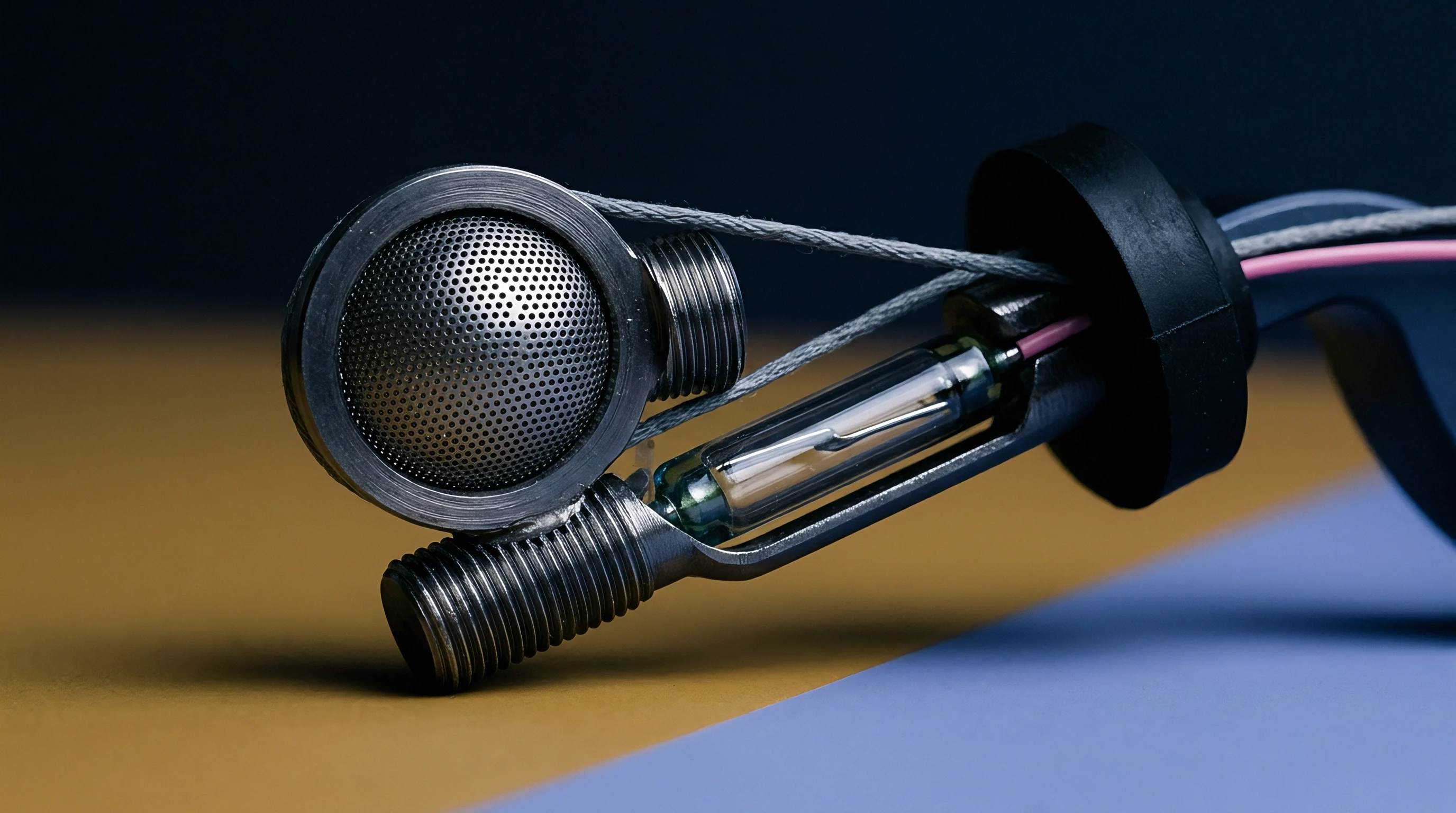
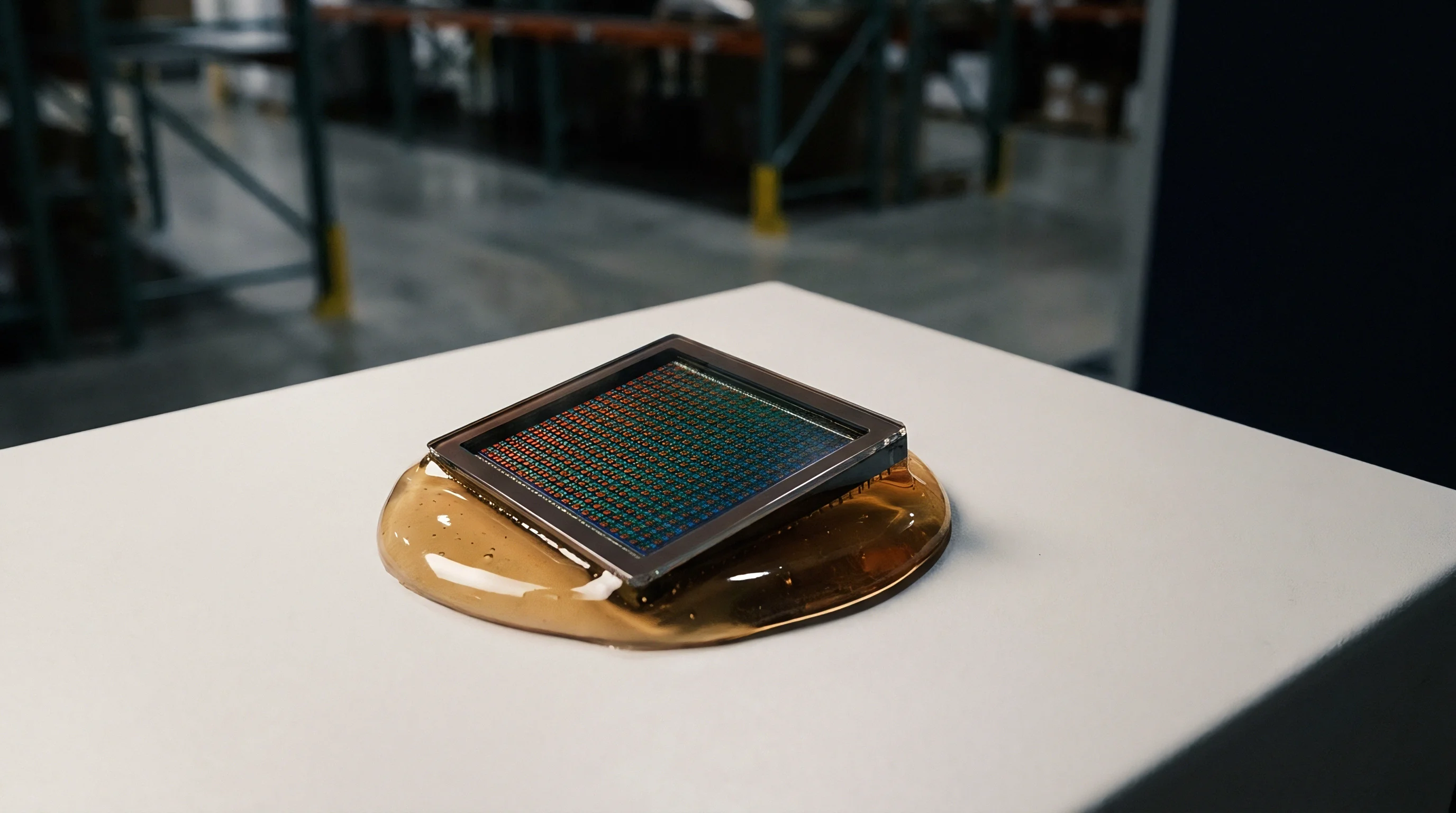
Micromachined silicon pressure elements convert mechanical deflection into electrical potential through four piezoresistors diffused into a thin monocrystalline diaphragm. When process media contain moisture, ionic species, or harsh condensates, bare silicon surfaces suffer chemical corrosion and surface charge accumulation that degrade insulation resistance. Packaging engineers isolate the diaphragm with soft potting compounds, typically polydimethylsiloxane gels or fluorosilicones, positioned beneath a housing port.
The silicone medium transmits hydrostatic pressure directly from the process fluid to the silicon surface while presenting a physical barrier against gross liquid contamination. Mechanical compliance in the gel prevents excessive thermal stress transmission during operating temperature swings, preserving the baseline bridge sensitivity established at factory calibration.
Piezoresistors demand stable mechanical coupling.
Packaging compliant media above a flexible plate introduces two distinct, concurrent perturbation pathways. Water vapor molecules permeate the intermolecular voids of silicone matrices, plasticizing the polymer chains and altering the bulk modulus. Simultaneously, moisture adsorption at the passivated die boundary establishes parasitic surface strains.
These hygroscopic volume expansions exert normal and shear forces on the micromachined diaphragm edges, directly superimposing a pseudo-pressure offset on the piezoresistive bridge. Dynamic pressure cycling exposes the viscoelastic character of both the encapsulation elastomer and the die-attach adhesive, resulting in rate-dependent mechanical hysteresis where sensor electrical output depends on the pressure history and loading velocity.
A zero-point shift of 0.42 percent full-scale occurs after 48 hours at 85 degrees Celsius and 85 percent relative humidity in uncompensated silicone-potted piezoresistive units.
Standard static compensation coefficients stored in application-specific integrated circuit registers fail to correct these time-dependent phenomena. Factory calibration typically records sensor output across five stabilized pressure setpoints at two or three uniform temperatures within dry air. Such protocols capture thermal zero shift and span coefficients under quasistatic, moisture-free conditions.
In field service, rapid pressure transients generate phase-lagged stress distributions through the encapsulation thickness, while ambient humidity slowly alters gel preload over weeks. When these two mechanisms overlap, the calibrated bridge balance drifts beyond certified limits, misleading industrial process controllers and medical ventilators.
- Interfacial delamination initiates along the die passivation boundary when absorbed water lowers the adhesive fracture energy below the local shear stress generated by differential thermal expansion.
- Piezoresistive bridge offset wanders as moisture-induced isotropic swelling inside the potting gel transforms into anisotropic normal stress across the clamped diaphragm periphery.
- Viscoelastic relaxation lag causes transient zero offsets following rapid decompression cycles, persisting for hundreds of seconds while crosslinked siloxane networks settle toward mechanical equilibrium.
- Dielectric shunting paths form across exposed bond wire pads as condensing water vapor interacts with ionic contaminants trapped during module potting.
Operating specifications frequently treat sensor hysteresis as an unvarying scalar percentage of full-scale span. Silicon itself exhibits negligible mechanical hysteresis below 500 degrees Celsius because monocrystalline lattices undergo elastic deformation without dislocation motion. The encapsulating media, die-attach elastomers, and housing materials generate the observed hysteretic loops.
Slower pressure cycling allows molecular chains within the elastomer to relax during stroke progression, shrinking the loop width. Rapid load cycling suppresses chain rearrangement, elevating effective stiffness and shifting apparent pressure sensitivity. A transducer cycled at ten hertz produces an output profile distinct from the same component tested under static deadweight pressures.
Suppliers often state that package-induced zero wander represents an inevitable material trait beyond firmware control.
Swell
Moisture absorption in crosslinked potting materials follows mass transport mechanisms governed by concentration gradients and polymer free-volume fractions. When an encapsulated pressure transmitter enters humid service environments, water molecules diffuse across the exposed gel surface according to concentration boundaries defined by surrounding relative humidity. Fickian transport models describe mass uptake during early exposure stages, where the moisture mass ratio scales with the square root of elapsed time.
As polar water molecules cluster around silanol groups or residual crosslinking catalysts, non-Fickian relaxation occurs. The polymer network dilates, producing a volumetric strain directly related to absorbed moisture mass through the coefficient of hygroscopic expansion.
Thick gels prolong sorption time constants.

How Do Diffusion Fronts Perturb Piezoresistive Bridges?
Concentration gradients produce uneven spatial stress distributions throughout the potting column until saturation equilibrium occurs. The top surface of the gel expands freely into the open port volume, while material adjacent to the silicon die face remains kinematically constrained by adhesion to the die passivation, wire bonds, and ceramic header. This spatial constraint converts unconstrained volumetric dilation into localized biaxial compressive stress.
The stress field couples through the silicon dioxide or silicon nitride passivation layers directly into the buried piezoresistors. Because the piezoresistors occupy distinct crystal orientations to maximize the longitudinal piezoresistive coefficient while canceling transverse stress, any package-induced shear or asymmetric normal stress unbalances the Wheatstone circuit.
Moisture alters the silicone shear modulus.
| Polymer Formulation | Diffusion Coefficient (m²/s) | Water Saturation (wt %) | Hygroscopic Swelling (ppm/%RH) | Equilibrium Modulus (kPa) |
|---|---|---|---|---|
| Standard Dimethyl Silicone Gel | 1.85 × 10⁻¹⁰ | 0.14 | 12.5 | 45 |
| Fluorosilicone Potting Gel | 0.92 × 10⁻¹⁰ | 0.08 | 7.2 | 82 |
| Low-Modulus Polyurethane | 0.34 × 10⁻¹⁰ | 1.45 | 68.0 | 320 |
| Anhydride-Cured Die Epoxy | 0.05 × 10⁻¹⁰ | 2.10 | 115.0 | 2400000 |
Mathematical formulation of moisture transport begins with the three-dimensional diffusion equation incorporating variable boundary conditions. Let concentration C(x, y, z, t) denote the local water mass density within the potting volume. The diffusion behavior obeys the continuity relationship where the partial derivative of concentration with respect to time equals the divergence of the diffusion flux.
For an isotropic potting medium with diffusion coefficient D, this relation takes the classical differential form:
∂C/∂t = D · (∂²C/∂x² + ∂²C/∂y² + ∂²C/∂z²)
Boundary conditions at the outer exposure surface depend on ambient vapor pressure and temperature according to Henry solubility law. The concentration at the outer boundary equals the product of the solubility coefficient and the ambient water vapor partial pressure. At the inner boundary defined by the silicon die, impervious crystalline silicon enforces a zero-flux Neumann boundary condition, dictating that the spatial derivative of concentration normal to the die surface vanishes.
Hygroscopic volumetric strain ε_h scales with local concentration relative to dry baseline conditions. Defining β_h as the coefficient of hygroscopic expansion, linear swelling strain follows:
ε_h(x, y, z, t) = β_h ·
Mechanical stress σ_ij inside the gel volume depends on the combined strain tensor including elastic compliance and hygroscopic expansion components. The constitutive relationship under linear elasticity assumptions expresses stress through the fourth-order stiffness tensor C_ijkl multiplied by the difference between total mechanical strain and hygroscopic strain:
σ_ij = C_ijkl ·
Polymer swelling induces parasitic biaxial strain.
Here δ_kl represents the Kronecker delta. Stress transmitted to the silicon diaphragm integrates these local stress tensors along the gel-die interface area. The resulting vertical traction force alters diaphragm deflection, while radial shear stresses shift the piezoresistor values via piezoresistive coupling coefficients π_11, π_12, and π_44.
When relative humidity steps from 20 percent to 80 percent, diffusion kinetics delay full stress development over dozens or hundreds of hours depending on gel fill depth. A sensor recalibrated midway through an environmental transition will record an artificial sensitivity shift once moisture reaches internal equilibrium.
Packaging thickness dictates the diffusion time constant according to quadratic dimensional scaling.
Water uptake also degrades the electrical insulation properties of the sensor package. Silicon gel purity determines the concentration of mobile ionic carriers such as sodium and chlorine. Absorbed moisture dissolves these trace salts, increasing electrolyte mobility and elevating dielectric loss factors inside the cavity.
Parasitic shunting across the silicon bridge resistors lowers effective bridge impedance and generates false common-mode voltage offsets that analog front-end amplifiers misinterpret as pressure variations. Silicone matrices saturated with water exhibit accelerated bond degradation under sustained hydrostatic stress.

Lag
Viscoelastic materials exhibit mechanical strain responses that lag applied stress inputs in time. Silicon sensing elements packaged with silicone gels, fluorosilicone barriers, or elastomeric seals inherit this time-dependent lag, manifesting as dynamic hysteresis during pressure transients. In a pure elastic solid, stress and strain remain strictly in phase, tracing identical trajectories during pressurization and depressurization cycles.
In encapsulated micro-sensors, molecular chains within the elastomer disentangle and slide past one another under shear deformation, dissipating mechanical energy through internal viscous friction. This energy loss creates an open hysteresis loop whose geometry changes with pressure rate, cycle amplitude, and ambient temperature.
Viscoelastic creep mimics true pressure trends.

Do Dual Timescale Filters Isolate Viscoelastic Lag?
Dynamic hysteresis differs fundamentally from static hysteresis. Static hysteresis arises from dry friction or structural play, yielding an error loop largely independent of cycle frequency. Dynamic hysteresis in polymer-encapsulated pressure dies exhibits pronounced rate sensitivity.
At extremely slow pressurization rates, the encapsulation gel remains in quasistatic thermodynamic equilibrium, generating minimal hysteretic separation between loading and unloading branches. Under high cycle frequencies, polymer chains lack sufficient time to undergo conformational changes, causing the gel to behave as a stiffened elastic solid with reduced loop width. Maximum loop area develops at intermediate cycle frequencies where the excitation period matches the characteristic relaxation times of the crosslinked polymer chains.
Thermal cycling steepens the relaxation curve.
| Slew Rate (kPa/s) | Peak Loop Separation (%FS) | Relaxation Time Constant (s) | Bouc-Wen Parameter α | Bouc-Wen Parameter β |
|---|---|---|---|---|
| 1.0 | 0.08 | 42.5 | 0.12 | 0.85 |
| 10.0 | 0.34 | 38.1 | 0.28 | 1.42 |
| 50.0 | 0.62 | 31.4 | 0.54 | 2.10 |
| 200.0 | 0.45 | 22.8 | 0.48 | 1.95 |
Formulating mathematical compensation models for rate-dependent hysteresis requires operators capable of tracking memory states across arbitrary loading paths. The classical Preisach model superimposes independent bistable relay operators characterized by switching thresholds. While capable of representing non-congruent hysteresis loops, classical Preisach architectures demand extensive calibration grids and lack direct physical links to rate-dependent viscous damping.
Modern compensation architectures employ modified Prandtl-Ishlinskii operators or differential formulations based on the Bouc-Wen model to reduce computational storage on embedded microcontrollers.
The generalized Prandtl-Ishlinskii model constructs hysteretic output through a linear superposition of elementary play operators. Let r define the threshold parameter of a single play operator, and let x(t) represent the applied input pressure. The response of the play operator H_r (t) satisfies the recursive inequality:
H_r (t) = max(x(t) – r, min(x(t) + r, H_r (t – Δt)))
Output pressure y(t) sums the contributions of n distinct play operators weighted by density function values w_i, augmented by an elastic polynomial term g(x(t)):
y(t) = g(x(t)) + Σ (t)]
Rate dependence enters the Prandtl-Ishlinskii operator by making the threshold values r_i dynamic functions of input velocity dx/dt, or by coupling the operator output with a fractional-order linear transfer function. Fractional-order derivatives provide a compact mathematical structure for modeling anomalous viscoelastic relaxation in polymer gels, replacing high-order lumped Maxwell networks with two fractional parameters.
- Memory wiping properties ensure that minor hysteresis loops collapse into dominant major loops following large-amplitude pressure excursions, preventing unbounded accumulation of compensation offsets.
- Temperature-dependent threshold scaling accounts for accelerated molecular relaxation times by contracting the play operator deadbands as operating temperatures rise.
- Asymmetric weight distributions accommodate distinct mechanical compliance curves observed between positive diaphragm deflection and vacuum pullout modes.
International standard IEC 61298-2 specifies that dynamic error evaluations must measure both ascending and descending cycles across three consecutive test runs.
An alternative differential formulation uses the Bouc-Wen model to generate smooth hysteretic states through an auxiliary nonlinear state variable z(t). The measured pressure signal P_meas links to true applied pressure P_true and internal hysteretic state z through the expression:
P_meas(t) = k_e · P_true(t) + (1 – k_e) · z(t)
The time evolution of the hysteretic state variable z(t) obeys the nonlinear first-order differential equation:
dz/dt = A · (dP_true/dt) – β · |dP_true/dt| · |z|^(n-1) · z – γ · (dP_true/dt) · |z|^n
Parameters A, β, γ, and n govern loop amplitude, sharpness, and loading-unloading asymmetry. In embedded sensor firmware, inverting this relationship enables real-time reconstruction of true applied pressure from measured piezoresistive bridge signals. The primary technical hurdle involves maintaining mathematical stability during signal noise reversals without triggering numerical divergence in the state observer.

Arithmetic
Implementing joint compensation for water permeation and dynamic hysteresis requires a dual-timescale mathematical architecture executed on the sensor digital signal processor. Dynamic hysteresis operates on millisecond-to-second timescales driven by pressure cycle velocity, while water permeation and hygroscopic swelling unfold over hours, days, or months governed by moisture diffusion. Decoupling these processes within the compensation engine prevents fast pressure transitions from distorting the slow diffusion estimator, while ensuring long-term swelling drift does not corrupt dynamic hysteresis inversion matrices.
The complete digital compensation pipeline processes raw digitization samples through four mathematical stages executed within fixed interrupt service routines.
- The high-speed analog-to-digital converter samples raw piezoresistive bridge voltage, auxiliary temperature diode voltage, and optional capacitive moisture monitoring channels at an execution frequency of one kilohertz.
- A high-order bivariate polynomial strips instantaneous static non-linearity and primary thermal zero shift based on initial dry calibration coefficients.
- The dynamic hysteresis observer processes the velocity of corrected pressure through an inverted modified Prandtl-Ishlinskii operator, reconstructing intermediate elastic pressure.
- A discrete state-space diffusion filter estimates internal gel moisture concentration at the die interface and subtracts the resulting parasitic swelling stress offset from the final pressure output register.
Bridge balance shifts under combined environmental loading.
The high-speed stage corrects rate-dependent viscoelastic lag using an inverted Prandtl-Ishlinskii representation. Let P_raw(k) denote the digitized, statically linearized bridge output at discrete sample time step k. The inverse operator maps P_raw(k) to dynamic pressure P_dyn(k) using an array of m discrete thresholds r_j and identified inverse weights w’_j:
P_dyn(k) = w’_0 · P_raw(k) + Σ (k)]
To eliminate computational division inside the high-frequency interrupt loop, threshold parameters and weights undergo pre-scaling into signed 32-bit fixed-point integers. Threshold values adapt dynamically to sensor temperature T(k) through a linear expansion around reference temperature T_0:
r_j(T) = r_j(T_0) ·
This formulation compensates for the contraction of the mechanical hysteresis loop as temperature elevates polymer chain mobility.
The slow-timescale estimator runs at a reduced sampling rate of 0.01 hertz to track moisture diffusion through the encapsulation gel. Direct measurement of moisture concentration inside the tiny cavity is rarely feasible in commercial designs. Instead, ambient relative humidity RH(k) and temperature T(k) measured by an adjacent environmental sensor, or derived from a specialized on-chip interdigitated capacitive electrode, feed a discrete state-space model representing Fickian transport.
Discretizing the one-dimensional diffusion equation along spatial depth z through finite differences yields a state vector C(k) = ^T representing moisture concentrations at N discrete nodes between the outer gel boundary and the die surface. The discrete state-space equation takes the form:
C(k + 1) = A_d(T) · C(k) + B_d(T) · u(k)
The input vector u(k) contains surface saturation concentration determined by ambient relative humidity and temperature-dependent solubility. The state transition matrix A_d(T) embeds temperature-dependent diffusion coefficients following the Arrhenius relationship:
D(T) = D_0 · exp(-E_a / (R · T))
Here D_0 is the base diffusion constant, E_a represents the activation energy of water diffusion in the polymer matrix, R is the universal gas constant, and T is absolute temperature in Kelvin. The output equation extracts the estimated moisture concentration at the bottom node adjacent to the silicon die, C_N(k):
C_die(k) = · C(k)
Parasitic swelling pressure P_swell(k) relates to die-surface moisture concentration through a second-order polynomial calibration model:
P_swell(k) = S_1 · C_die(k) + S_2 · ²
The final verified output pressure P_out(k) subtracts this estimated swelling stress from the dynamically compensated pressure signal:
P_out(k) = P_dyn(k) – P_swell(k)
Consider a worked calibration example for a 500 kPa piezoresistive absolute pressure micro-sensor potted with a 1.2 millimeter layer of standard dimethyl silicone gel. Assume an ambient operating step from dry conditions (0% RH) to severe humidity (85% RH) at 50 degrees Celsius, accompanied by cyclic pressure loading between 100 kPa and 400 kPa at a slew rate of 50 kPa/s. The material parameters are specified as follows:
Base diffusion coefficient D_0 = 2.10 × 10⁻⁴ m²/s, activation energy E_a = 38.5 kJ/mol, solubility S_H = 1.65 × 10⁻³ wt%/kPa, swelling coefficient S_1 = 3.25 kPa/wt%, and S_2 = 0.42 kPa/(wt%)².
At 50 degrees Celsius (323.15 K), the Arrhenius factor evaluates to:
exp(-38500 / (8.31446 · 323.15)) = exp(-14.328) = 6.00 × 10⁻⁷
The effective diffusion coefficient calculates as:
D(323.15) = 2.10 × 10⁻⁴ · 6.00 × 10⁻⁷ = 1.26 × 10⁻¹⁰ m²/s
The saturation vapor pressure of water at 50 degrees Celsius equals 12.34 kPa. At 85% relative humidity, ambient water vapor partial pressure evaluates to 0.85 · 12.34 = 10.49 kPa. The surface boundary concentration resolves to:
C_surface = S_H · p_H2O = 1.65 × 10⁻³ · 10.49 = 0.0173 wt%
For a gel layer thickness L = 1.2 × 10⁻³ m, the characteristic diffusion time constant τ_diff evaluates to:
τ_diff = L² / (π² · D) = (1.44 × 10⁻⁶) / (9.8696 · 1.26 × 10⁻¹⁰) = 1158 seconds
After an exposure time of t = 3600 seconds, the concentration ratio at the die interface C_die / C_surface, derived from the Fourier series solution for one-dimensional diffusion, reaches approximately 0.685. The local concentration at the die surface calculates as:
C_die(3600) = 0.685 · 0.0173 wt% = 0.01185 wt%
The resulting parasitic swelling pressure offset calculates through the second-order expansion:
P_swell = 3.25 · (0.01185) + 0.42 · (0.01185)² = 0.0385 + 0.00006 = 0.03856 kPa (38.56 Pa)
While an offset of 38.56 Pa appears modest against a 500 kPa range (0.0077% FS), after 72 hours of continued saturation exposure, the concentration ratio approaches 0.998, yielding C_die = 0.01727 wt%. The steady-state swelling offset escalates to:
P_swell_sat = 3.25 · (0.01727) + 0.42 · (0.01727)² = 0.0561 + 0.0001 = 0.0562 kPa (56.2 Pa)
Concurrently, dynamic pressure cycling between 100 kPa and 400 kPa at 50 kPa/s induces viscoelastic hysteresis. Experimental characterization identifies an uncompensated peak loop separation of 0.48% FS, corresponding to a dynamic error of 2.40 kPa. Applying the five-threshold modified Prandtl-Ishlinskii inverse filter reduces this dynamic error band from 2.40 kPa down to 0.18 kPa (0.036% FS).
If firmware execution omits the swelling compensation term, the sensor accumulates an uncorrected baseline drift of 56.2 Pa over extended service, corrupting precision low-pressure threshold detections.
Uncompensated sensors produce false leak alarms.
When firmware implementations discard cross-coupling terms between swelling and dynamic viscoelasticity, the resulting measurement error triggers unresolvable process alarms that force premature field replacement of operational transmitters.

Bench
Demonstrating compliance with accuracy specifications requires empirical evaluation inside automated calibration chambers capable of driving pressure and humidity independently. Standard industrial pressure calibrators deliver dry nitrogen directly to the sensor port, bypassing moisture absorption phenomena entirely. Verifying encapsulated sensor performance demands environmental chambers equipped with dry-piston pressure balances, closed-loop dewpoint generators, and multi-channel data acquisition systems capable of continuous sampling throughout multi-day thermal and hygroscopic soaking cycles.
Calibration benches run at controlled dewpoints.
Metrological traceability requires establishing an unbroken calibration hierarchy anchored to fundamental physical standards. Primary deadweight testers calibrate quartz reference pressure transducers under clean, dry conditions, providing an expanded measurement uncertainty of 0.003 percent of reading with coverage factor k = 2. These quartz references monitor test chamber pressure while humidity sensors calibrated against chilled-mirror hygrometers verify water vapor partial pressures with dewpoint uncertainties within 0.1 degrees Celsius.
Without verified control of ambient moisture during pressure characterization, distinguishing between silicone viscoelastic relaxation and moisture ingress remains impossible.
Laboratory deadweight testers provide primary traceability.
| Uncertainty Contribution Source | Standard Uncertainty (kPa) | Probability Distribution | Sensitivity Coefficient | Combined Uncertainty (kPa) |
|---|---|---|---|---|
| Primary Pressure Reference Standard | 0.015 | Normal (k=1) | 1.00 | 0.015 |
| Chamber Dewpoint Instability (±0.5°C) | 0.042 | Rectangular | 0.58 | 0.024 |
| Chamber Thermal Gradients (±0.2°C) | 0.035 | Rectangular | 0.58 | 0.020 |
| Dynamic Hysteresis Residual Error | 0.085 | Normal (k=1) | 1.00 | 0.085 |
| Swelling Model Parameter Estimation | 0.110 | Normal (k=1) | 1.00 | 0.110 |
| Analog Front-End Quantization Noise | 0.008 | Rectangular | 0.58 | 0.005 |
| Combined expanded uncertainty evaluates to 0.286 kPa (k = 2, 95% confidence level), establishing a baseline test uncertainty ratio of 3.5:1 against a 1.0 kPa total tolerance specification. | ||||
Executing incoming batch verification requires structured multi-cycle qualification routines designed to expose latent packaging defects before parts enter production assembly lines. Sourcing practices that rely solely on factory room-temperature calibration sheets accept unhedged warranty risks. Saturated salt chambers or active climate systems expose sample lots to accelerated stress testing according to international standard test sequences.
Incoming verification protocols evaluate stability across defined environmental limits.
Sample sizes drawn from incoming shipments undergo three consecutive pressure sweeps from minimum to maximum working pressure at slew rates of 10 kPa/s, 50 kPa/s, and 200 kPa/s while maintained at 25 degrees Celsius and 30 percent relative humidity to quantify baseline dynamic hysteresis loops. Following initial hysteresis extraction, the test chamber steps to 60 degrees Celsius and 90 percent relative humidity for a 168-hour soak period under constant baseline pressure. Real-time data capture records zero-point wander throughout the absorption transient.
Finally, the pressure sweeps repeat at elevated humidity to verify that firmware compensation models suppress both rate-dependent loop width and hygroscopic zero drift below 0.1 percent of span.
Field recalibration triples ownership costs.
Omitting dynamic compensation models escalates lifecycle operating costs through repeated service calls and shortened maintenance intervals. A pressure transmitter certified to 0.1 percent accuracy on a dry factory bench often degrades to 0.5 percent accuracy within three months of humid field operation. In critical applications such as custody transfer metering or semiconductor gas delivery, that uncompensated drift distorts volumetric billing calculations and process chemistry control.
Standard procurement agreements referencing ISO 17025 accreditation clauses reject shipments failing full-span moisture-pressure validation cycles, binding suppliers to traceable stability limits rather than unverified factory room-temperature claims.