Nitrogen Storage Capital Cost Modeling for Long-Term Component Preservation
Central PSA nitrogen generators reach capital payback over bulk liquid tanks within thirty-eight months when storage volume exceeds twenty cubic meters.

Vapor
Terminal pin solderability drops past acceptance limits when ambient relative humidity exceeds five percent over a four-year hold period. Sourcing practices preserving integrated circuits, fine-pitch ball grid arrays, and MEMS environmental sensors across ten-year to twenty-year life cycles confront moisture absorption, galvanic corrosion, and terminal finish oxidation. Preserving surface mount components requires continuous displacement of ambient air with high-purity dry nitrogen gas.
Gaseous nitrogen blankets the component lead frames, displaces atmospheric moisture, and drives oxygen levels below critical reaction thresholds. Moisture ingress degrades terminal plating. Pure nitrogen halts galvanic reactions.
Storage environments maintaining less than five percent relative humidity arrest copper-tin intermetallic compound diffusion and suppress tin whisker growth on pure tin finishes. Lowering the relative humidity below one percent halts hydrolytic breakdown of epoxy mold compounds, preventing internal delamination during post-storage board assembly. Nitrogen storage infrastructure protects components through either bulk liquid storage with atmospheric vaporization or on-site gas separation via pressure swing adsorption machinery.
Inert Gas Purge Mechanics
Displacing atmospheric oxygen below fifty parts per million halts oxide skin thickening on matte tin and immersion silver package terminations. Solderability retention depends on keeping lead finish oxide films thinner than five nanometers, allowing standard no-clean fluxes to activate the joint during surface-mount reflow. Uncontrolled ambient air exposure builds copper and tin oxide layers exceeding thirty nanometers within three years, forcing expensive terminal re-tinning or acid-flux strip operations before assembly lines can achieve standard yields.
Active purges clear volatile organics.
Dynamic storage systems introduce nitrogen gas at positive pressure, driving air through exhaust one-way check valves. Continuous low-flow purges consume between 0.5 and 2.0 normal cubic meters per hour per cubic meter of cabinet volume. Pulse-purge systems monitor interior oxygen and relative humidity levels with electrochemical sensors, injecting nitrogen only when sensor thresholds detect ambient air ingress following cabinet access cycles.
Pulse-purge automation reduces active nitrogen consumption by up to seventy percent compared to open-loop continuous bleed designs.
Maintaining oxygen concentrations below thirty parts per million limits intermetallic copper-tin compound growth to 0.12 micrometers across ten years at twenty degrees Celsius.
Atmospheric Displacement Thresholds
Surface mount sensor packages classified at moisture sensitivity level three absorb ambient water molecules within seventy-two hours of unsealed exposure. Entrapped water converts to high-pressure steam inside plastic body cavities during conventional 260-degree reflow soldering passes, cracking packaging resin and shearing internal gold bond wires. Storing components continuously below five percent relative humidity resets the allowable floor life clock, eliminating the need for periodic destructive bake-out cycles that accelerate brittle intermetallic crystal growth.
| Termination Metallurgy | Maximum Oxygen Content | Maximum Relative Humidity | Target Storage Horizon | Primary Failure Mode |
|---|---|---|---|---|
| Matte Pure Tin | 50 ppm | 5% RH | 15 Years | Tin whisker growth and SnO2 crust buildup |
| Immersion Silver | 10 ppm | 1% RH | 10 Years | Atmospheric sulfide tarnishing and silver migration |
| Electroless Ni / Au | 100 ppm | 10% RH | 20 Years | Nickel diffusion through thin immersion gold |
| Lead-Free Solder Spheres | 30 ppm | 3% RH | 12 Years | Intermetallic Cu6Sn5 boundary layer thickening |
Purity requirements dictate generator footprint. High-purity nitrogen containing less than ten parts per million oxygen demands larger carbon molecular sieve volumes during pressure swing adsorption, driving up primary equipment acquisition outlays. Standard industrial nitrogen delivering ninety-nine percent purity leaves ten thousand parts per million residual oxygen, which fails to protect sensitive silver-bearing lead frames across storage windows exceeding thirty-six months.
Procurement teams that underspecify atmospheric purge rates write off entire production lots when unseated solder balls bridge adjacent contact pads during reflow.
Apparatus
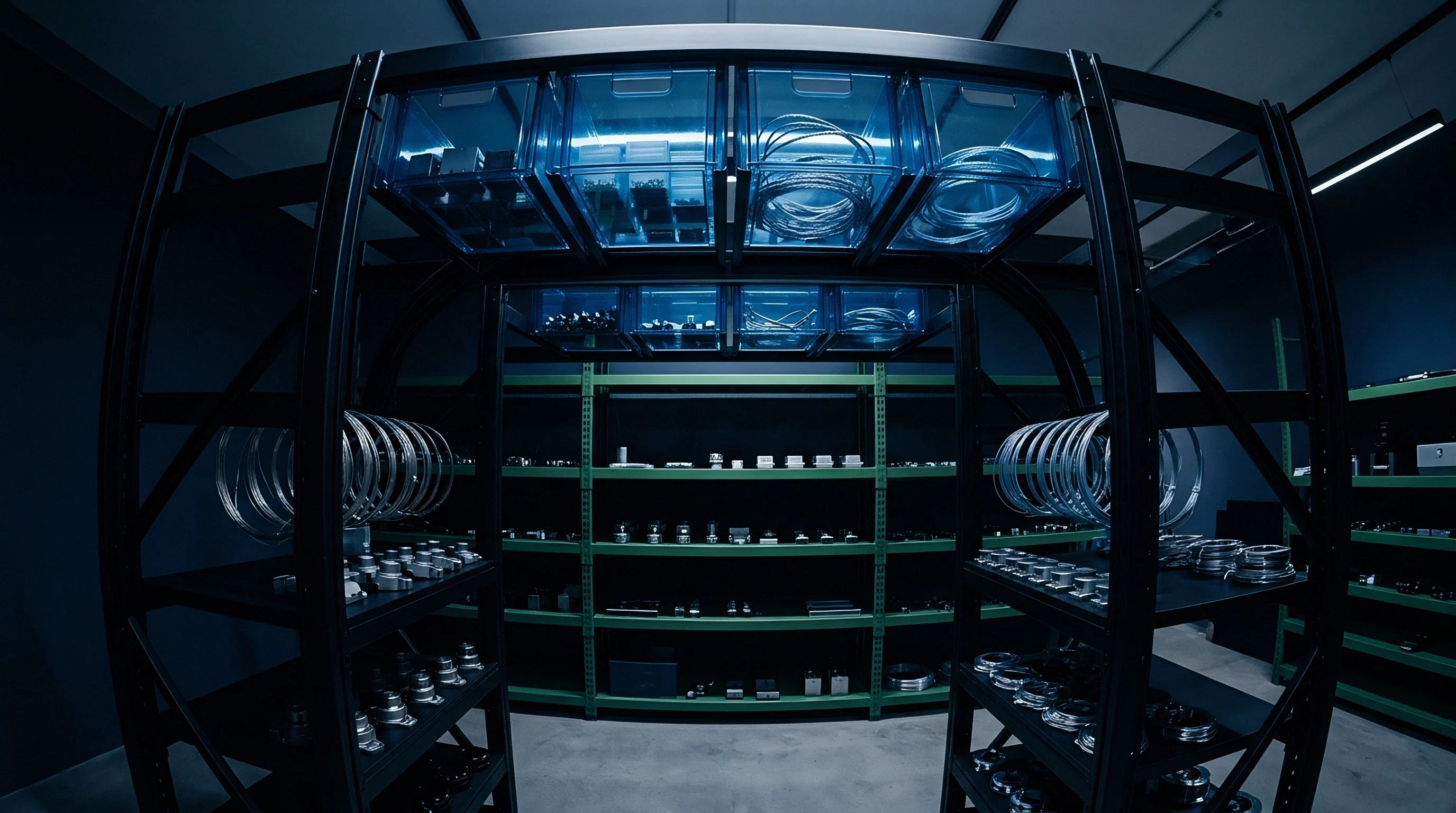
Separating atmospheric gases and containing them around electronic inventories demands dedicated mechanical skids, pressurized distribution manifolds, and sealed containment enclosures. Facility architects select between cryogenic bulk liquid delivery systems and autonomous on-site generation skids. Liquid storage systems vaporize cryogenic nitrogen stored inside vacuum-insulated pressure vessels at minus 196 degrees Celsius, feeding gaseous nitrogen into warehouse distribution loops at constant pressures between 0.5 and 0.8 megapascals.
On-site pressure swing adsorption generators extract nitrogen directly from ambient factory compressed air, venting waste oxygen through silencer stacks.
Cryogenic systems eliminate on-site rotating machinery noise while delivering gas purities exceeding 99.9995 percent. Bulk liquid installations demand continuous road tanker access, safety perimeter fencing, concrete foundation pads, and recurring monthly vessel leasing contracts. Pressure swing adsorption units operate within the building perimeter, demanding dedicated rotary screw air compressors, refrigerated air dryers, oil-mist coalescence filters, and pressurized nitrogen buffer receivers.
Compressors generate significant thermal loads.
Cryogenic Bulk Tank Infrastructure
Vacuum-insulated bulk vessels incorporate inner stainless steel pressure vessels encased within outer carbon steel jackets, separating the two shells with expanded perlite insulation under high vacuum. Ambient finned-tube vaporizers leverage convection currents to transfer atmospheric thermal energy into the liquid nitrogen stream, boiling liquid to gas without auxiliary electrical heating elements. High-draw conditions during summer operations demand oversized vaporizing towers to prevent frost bridging, which degrades heat transfer efficiency and risks liquid breakthrough into indoor copper piping headers.
Pressure vessels carry regulatory inspection penalties. Tank installations demand safety relief valves configured with dual three-way diverter manifolds, allowing valve recalibration without depressurizing the storage vessel. Vaporizer sizing accounts for maximum instantaneous purge spikes caused by simultaneous cabinet door openings across the warehouse floor.
Undersized vaporizers allow cryogenic gas to chill downstream distribution regulators, freezing elastomeric O-rings and causing distribution line leaks.
Adsorption Generator Mechanical Configuration
Twin-tower pressure swing adsorption systems route clean compressed air through carbon molecular sieve beds at cycle pressures between 0.7 and 1.0 megapascals. The molecular sieve preferentially traps oxygen, carbon dioxide, and trace moisture within its microporous structure, allowing pure nitrogen molecules to pass into the collection manifold. Cyclic tower depressurization releases trapped oxygen molecules into an exhaust silencer, regenerating the bed for the subsequent intake cycle.
Condensate drains fail quietly.
Maintaining air intake quality protects the carbon sieve against irreversible oil poisoning. Multi-stage filtration sequences incorporate particulate pre-filters, refrigerated air dryers pulling pressure dew points down to minus forty degrees Celsius, and activated carbon polishing towers capturing trace lubricating oil vapors down to 0.003 milligrams per cubic meter. Oil carryover from failed compressor seals destroys the adsorption capacity of molecular sieve beds within weeks, forcing expensive bed repacking operations.
Containment Cabinet Purge Automation
Component storage lockers incorporate electropolished stainless steel shelves, conductive glass doors, and static-dissipative perimeter gaskets rated for Class 100 cleanroom environments. Automated nitrogen management units meter gas flow through dual-stage mass flow controllers, regulating purge velocity to avoid generating static charges on plastic carrier tapes and reel packaging. Microprocessor controllers track door closure events, commanding high-volume flush cycles until internal sensors confirm relative humidity drops below the five percent operating ceiling.
- Pneumatic line pressure verification confirms the stainless steel header sustains 0.6 megapascals under peak drawer access cycles without line cavitation.
- Oxygen analyzer sensor calibration verifies electrochemical cell response times remain under four seconds, preventing unmonitored atmospheric ingress from spoiling stored silicon.
- Dual-stage pressure regulator tuning fixes downstream flow velocities across twenty drops, avoiding localized turbulence that dislodges delicate surface mount parts from tape carriers.
- Exhaust backpressure damper checkout prevents room air back-siphoning through relief ports whenever manifold supply pressures drop during scheduled compressor maintenance shifts.
Chamber seals degrade under ozone. Cabinet interiors integrate digital monitoring nodes linked via RS-485 or Ethernet networks, continuously logging temperature, relative humidity, and differential enclosure pressure into central quality management databases. Supply line manifolds feature emergency shut-off valves tied directly to ambient oxygen depletion monitors mounted on warehouse walls, preventing personnel asphyxiation risks during catastrophic pipe ruptures.
Equipment vendors frequently insist that baseline boil-off losses remain negligible even when ambient yard temperatures exceed thirty-five degrees Celsius.
Outlay
Procuring and deploying an industrial nitrogen preservation ecosystem involves primary machinery capital costs, mechanical piping infrastructure installation, and electrical distribution expansions. Sourcing directors modeling long-term component preservation evaluate twenty-year total cost of ownership models across competing technologies. Hardware depreciates over seven years.
The capital profile divides into gas generation equipment, fluid distribution networks, and point-of-use sealed storage cabinets.
Mechanical separation skids delivering twenty normal cubic meters per hour of 99.999 percent purity nitrogen command purchase prices between $45,000 and $75,000. Matching rotary screw compressors rated for 15 kilowatts, variable-speed drives, and air preparation skids add $28,000 to $42,000 in upfront mechanical capital. Turnkey bulk liquid tank installations bypass machinery purchase costs through supplier lease contracts, trading upfront equipment capital for recurring facility rental commitments and commodity gas delivery fees.

Primary Equipment Acquisition Schedules
Compressor and generator skids demand dedicated indoor floor space rated for mechanical loading and acoustic containment. Foundation pads, sound-dampening enclosures, and ventilation louvers routing rejection heat outside the building footprint add $12,000 to $25,000 in civil works. Civil engineering requirements for outdoor liquid storage mirror the foundation standards enforced for commercial brewery fermentation tanks, where frost heave and soil compaction dictate slab thickness.
Mechanical contractors pour thirty-centimeter steel-reinforced slabs to distribute localized weight before crane crews hoist the vacuum-insulated vessel into position. Electrical interconnects demand dedicated 480-volt, three-phase power drops feeding the compressor motor and thermal drying skids.
- Peak volumetric consumption rate dictates whether compressor capacity or liquid head volume sets facility footprint boundaries.
- Purity ceiling tolerance limits establish whether single-stage pressure swing adsorption systems suffice or if catalytic deoxo polishing stages enter the equipment roster.
- Cabinet manifold drop count sets the copper pipe run lengths, determining pressure drop calculations across secondary regulation stations.
- Backup gas cylinder reserves protect component lots against line freeze-ups or electrical utility downtime exceeding six continuous hours.
Piping runs alter pressure drops. Distribution loops deployed across cleanrooms and component staging zones utilize seamless, degreased Type L copper tubing or ASTM A269 electropolished 316L stainless steel tubing. Stainless steel installations joined via orbital welding eliminate mechanical joint leak paths, costing between $85 and $160 per installed linear meter, including pipe hangers, isolation ball valves, and point-of-use pressure regulating stations.
Copper systems brazed with nitrogen purge backfill lower mechanical installation costs to $45 to $75 per linear meter, though mechanical compression fittings carry higher long-term leak rates.
Piping installation expenditures routinely match the purchase price of the primary gas separation skid.
Distribution Plumbing and Facility Modifications
Secondary facility infrastructure accounts for twenty to thirty-five percent of overall capital outlays. Ambient oxygen depletion monitoring networks incorporating optical or electrochemical sensors, audible strobes, and emergency exhaust fan interlocks require $8,000 to $18,000 across a 500-square-meter component warehouse. Dedicated exhaust ducting routes cabinet purge relief ports and generator waste streams directly through the facility roof, isolating warehouse breathing zones from asphyxiation risks.
| Hardware Classification | Capacity / Rating | Equipment Purchase Band | Site Integration Band | Depreciation Schedule |
|---|---|---|---|---|
| Rotary Screw Compressor Skid | 15 kW (Variable Speed) | $18,000 to $26,000 | $4,000 to $8,000 | 7 Years |
| Compressed Air Treatment Skid | -40°C Dew Point, 0.003 mg/m³ | $10,000 to $16,000 | $2,000 to $5,000 | 7 Years |
| PSA Nitrogen Generator Skid | 20 Nm³/h @ 99.999% | $45,000 to $75,000 | $6,000 to $12,000 | 10 Years |
| High-Purity Distribution Loop | 150 Meters (316L Stainless) | $12,750 to $24,000 | $8,000 to $14,000 | 15 Years |
| N2 Dry Storage Cabinets (Qty 6) | 1,200 Liters Each, <1% RH | $54,000 to $84,000 | $3,000 to $6,000 | 10 Years |
| Facility Safety & Gas Monitoring | 8 Sampling Nodes + Exhaust | $9,000 to $15,000 | $4,000 to $7,000 | 5 Years |
| Estimates reflect 2024 pricing for indoor industrial installation with cleanroom-rated header piping and factory commissioning. | ||||
Point-of-use containment cabinets carry significant unit procurement costs. Industrial dry boxes delivering less than one percent relative humidity and active nitrogen purging cost between $9,000 and $14,000 per 1,200-liter dual-chamber cabinet. Outfitting a long-term component preservation staging area holding ten million components across reels, trays, and moisture barrier tubes demands an initial bank of six to twelve large-format cabinets, totaling $54,000 to $168,000 in containment apparatus alone.
Worked Capital Expenditure Construction
Evaluating an operational preservation facility holding 500,000 specialized analog and sensor packages establishes baseline capital financial commitments. The scenario assumes an on-site generation demand of fifteen normal cubic meters per hour at 99.999 percent purity, feeding eight 1,200-liter storage cabinets over an eighty-meter distribution run.
Primary equipment procurement incorporates a 15-kilowatt rotary screw compressor at $22,000, an air purification dryer skid at $13,000, and a twin-tower pressure swing adsorption unit at $58,000. Mechanical piping utilizes orbital-welded 316L stainless steel tubing along an eighty-meter header, logging $12,800 in materials and $8,400 in certified mechanical labor. Eight automated nitrogen dry cabinets at $11,500 per unit contribute $92,000.
Facility safety sensors, exhaust modifications, and local electrical service switchgear add $16,500. Total upfront capital expenditure reaches $222,700 before commissioning validation. PSA generator bed life reaches 120,000 operational hours when dry air intake dew points remain below minus forty degrees Celsius; oil aerosol bypass above 0.01 milligrams per cubic meter fouls the carbon molecular sieve in under 8,000 hours.
The $0.38 per 1,000-liter storage cost baseline for on-site nitrogen assumes industrial electricity rates holding at $0.09 per kilowatt-hour; utility rate hikes to $0.16 per kilowatt-hour shift the financial breakeven line against bulk cryogenic liquid by four calendar years. Facility engineers budget plumbing installation at parity with mechanical generation machinery to prevent mid-project scope adjustments.
Oxidation
Atmospheric exposure degrades electronic terminations through galvanic reactions, oxide passivation layer thickening, and grain boundary corrosion. Lead-free solder alloys containing high tin fractions undergo surface oxidation forming tin monoxide (SnO) and tin dioxide (SnO2). Oxide crusts raise the surface melting temperature during reflow, inhibit wetting spread, and increase contact angles, producing solder joint voids and non-wetting opens.
Copper reacts with trace sulfur. Silver terminations tarnish rapidly.
Nickel-palladium-gold finishes protect copper lead frames via barrier layers. Thin gold flash layers measuring twenty to fifty nanometers contain micro-pores that expose the underlying palladium or nickel boundary. Atmospheric oxygen diffusing through these porosity channels oxidizes the underlying nickel into nickel oxide (NiO).
Nickel oxide resists standard industrial flux activation, causing black pad phenomena, interface brittle fracture, and trace detachment during thermal cycling.
Termination Metallurgy Preservation
Lead-frame solderability preservation demands strict suppression of intermetallic compound growth. Copper lead frames coated with matte tin develop Cu6Sn5 intermetallic compounds at room temperature along the metal interface. At room temperature, this boundary layer grows between 0.3 and 0.8 nanometers per day in ambient conditions, consuming the pure tin layer from within.
When the intermetallic front reaches the surface, the lead becomes unsolderable using standard electronics assembly thermal profiles. Wetting balance curves expose oxidation.
- Kirkendall void formation separates gold wire bonds from aluminum die pads when elevated thermal profiles accelerate atomic vacancy coalescence.
- Silicone gel plasticizer migration coats internal piezoresistive diaphragms in analog pressure sensors, producing uncorrectable zero-scale voltage shifts after five years of containment.
- Intermetallic tin-copper growth consumes solderable boundary layers on matte tin leads, producing dewetting across automated assembly lines.
- Surface mount package popcorn cracking shatters mold compounds during reflow when absorbed atmospheric moisture vaporizes violently along internal copper paddle interfaces.
Gold bond wires resist corrosion. Aluminum die metallization pads remain vulnerable to halogen-induced galvanic corrosion when trace moisture combines with residual chlorine from molding compounds. Moisture concentrations below five percent relative humidity suppress the electrolytic medium necessary for aluminum corrosion cell operation.
Nitrogen blanketing arrests this chemical pathway, preserving bare die and ball-bonded silicone surfaces inside non-hermetic cavities.
Internal Sensor Die Package Stiction
Microelectromechanical systems incorporate suspended silicon beams, interdigitated comb-drive fingers, and flexible diaphragms vulnerable to mechanical surface adhesion. Stiction destroys microelectromechanical beams. Capillary forces exerted by condensed water vapor pull adjacent silicon microstructures into contact, where van der Waals forces lock surfaces permanently together.
Ambient relative humidity levels above forty percent trigger capillary condensation within micro-scale gaps under five hundred nanometers.
| Storage Environment | Storage Duration | Zero Cross Time | Maximum Wetting Force | Solderability Result |
|---|---|---|---|---|
| Ambient Air (45% RH, 25°C) | 2 Years | 2.8 Seconds | 0.82 mN/mm | Fail (Severe Dewetting) |
| Desiccant MBB Bag (<10% RH) | 5 Years | 1.4 Seconds | 1.45 mN/mm | Pass (Marginal Fillet) |
| Dry Cabinet (<1% RH, Air) | 8 Years | 1.1 Seconds | 1.68 mN/mm | Pass (Acceptable Fillet) |
| N2 Cabinet (<1% RH, <20 ppm O2) | 15 Years | 0.6 Seconds | 2.10 mN/mm | Pass (Optimal Wetting) |
Maintaining nitrogen containment prevents capillary liquid bridge formation, preserving mechanical spring-reset kinematics inside MEMS motion and acoustic sensor dies. For internal MEMS sensor diaphragm stiction rates after twelve years of continuous dry nitrogen containment, published accelerated aging data remains thin, with available industry test groups rarely exceeding forty individual die. Sourcing teams handle this uncertainty by writing mandatory five-year rolling pull-and-test clauses into long-term preservation agreements rather than banking on purely theoretical 20-year survival curves.
IPC J-STD-002 test method A mandates wetting balance immersion testing within five minutes of chamber removal to prevent atmospheric re-passivation from obscuring terminal degradation.
Wetting balance testing quantifies degradation by measuring wetting force against immersion time. Freshly plated components achieve zero-cross wetting times within 0.4 to 0.6 seconds, reaching maximum wetting forces exceeding 2.0 millinewtons per millimeter. As oxide layers thicken, zero-cross times stretch past 1.5 seconds, signaling degraded surface energy that generates solder bridging and head-in-pillow defects during SMT manufacturing runs.
Purchase contract clause Mil-Std-883 Method 2003 penalizes component suppliers directly whenever lead solderability coverage drops below ninety-five percent following steam aging preconditioning.
Balance
Financial breakeven modeling between bulk cryogenic liquid installations and autonomous pressure swing adsorption machinery depends on total consumed nitrogen volume over time. Bulk liquid nitrogen prices range from $0.35 to $0.85 per liquid liter, translating to $0.50 to $1.20 per normal cubic meter of vaporized gas after accounting for delivery surcharges, hazmat fees, and monthly storage tank lease rates. Bulk liquid demands road access.
On-site generators bypass commodity transaction fees, trading continuous operating expense for upfront capital amortization and electrical power inputs.
Compressor electrical consumption represents the dominant ongoing operating expenditure for on-site nitrogen generation. High-purity pressure swing adsorption units running at 99.999 percent purity consume between 0.28 and 0.42 kilowatt-hours per normal cubic meter of delivered gas. Assuming an industrial electrical rate of $0.10 per kilowatt-hour, direct generation energy costs average $0.035 per cubic meter.
Solderability governs manufacturing yields. Factoring in routine maintenance filter replacements, carbon sieve top-offs, and compressor overhaul reserves adds $0.045 per cubic meter, establishing a baseline operating expenditure of $0.080 per normal cubic meter.
Cryogenic Delivery against Onsite Generation
Cryogenic liquid installations incur structural evaporative losses regardless of whether factory equipment consumes gas. Passive thermal transfer through vacuum-jacketed vessel walls causes continuous boil-off venting between 0.5 and 1.5 percent of total vessel capacity daily. In low-volume or intermittent preservation operations, boil-off losses double the effective landed cost per cubic meter of consumed gas.
On-site generators eliminate idle venting losses, producing nitrogen strictly in response to cabinet sensor demand cycles.
Crossover modeling reveals that operations consuming over twelve normal cubic meters per hour achieve capital payback on on-site pressure swing adsorption skids within thirty-two to forty-four months compared to leased bulk liquid contracts. Below five cubic meters per hour, the capital amortization of dedicated compressors, dryers, and molecular sieve towers outpaces the operating premiums of mini-bulk or cylinder manifold packs. Capital amortization outlives component shelf life.
Liquid supply contracts carry hidden vapor loss charges that erode theoretical volume discounts.
Desiccant Bagging versus Active Gaseous Purging
Alternative preservation methods deploy moisture barrier bags combined with clay or silica desiccant pouches and vacuum heat sealers. Packaging capital costs remain minimal, involving heat sealers and nitrogen gas bag purge nozzles under $8,000 in total tooling. Desiccant bags leak over time.
Flexible packaging laminates exhibit water vapor transmission rates between 0.005 and 0.02 grams per square meter per twenty-four hours, allowing humidity levels inside sealed bags to creep past ten percent after three to five years of warehouse storage.
Component access labor alters preservation economics. Inspecting, sampling, or staging tape reels preserved inside sealed moisture barrier bags demands cutting the outer barrier, discarding spent desiccant packs, baking moisture-exposed components, and resealing the lot inside fresh barrier packaging. Active nitrogen cabinets allow immediate access through latching doors, recovering relative humidity below five percent within ninety seconds of closure without packaging waste or labor penalties.
Operations handling inventory access frequencies exceeding forty transactions weekly offset the higher capital outlay of automated nitrogen cabinets within twenty-four months through direct labor reductions. Careful buyers review facility nitrogen supply balance sheets annually to reallocate capacity between active dry boxes and bulk storage reservoirs as inventory age profiles shift.