Silicon Pressure Sensor Zero Offset Drift under Relative Humidity Exposure
Relative humidity drives zero offset drift through polymer swelling strain on silicon diaphragms and surface leakage across unpassivated bridge resistors.

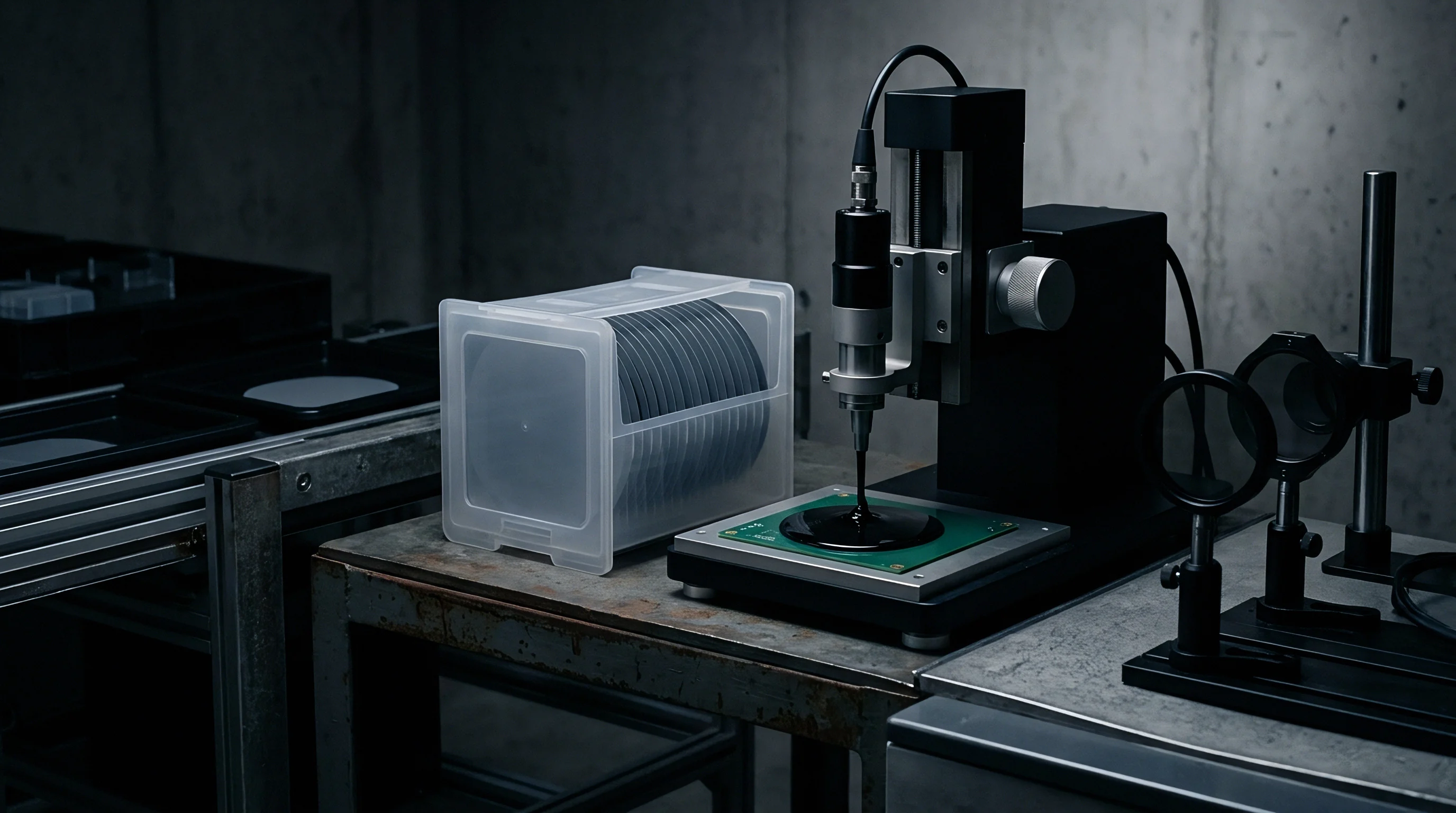
Gel
Polymeric potting materials transmit environmental swelling forces directly into micromachined silicon diaphragms. When relative humidity climbs from ambient room levels to continuous exposure at 85 percent, water vapor diffuses into the silicone elastomer matrix within minutes. Silicon absorbs no moisture.
The surrounding siloxane network incorporates water molecules into its free volume, producing volumetric expansion governed by the coefficient of hygroscopic expansion. This expansion exerts compressive and shear traction across the top face of the piezoresistive sensor die. Piezoresistors positioned along the crystallographic axes convert this mechanical strain into unbalanced electrical resistance through the piezoresistive effect.
The Wheatstone bridge detects this asymmetric packaging strain as a pressure signal, generating immediate zero offset shift.
Unpassivated or lightly gel-filled MEMS cavities experience the steepest initial shifts. A transducer rated for 100 kilopascals full scale often exhibits a zero offset wander between 0.15 percent and 0.85 percent of full scale when transferred from 30 percent relative humidity to 85 percent relative humidity at 25 degrees Celsius. The magnitude of this shift correlates with the elastic modulus and crosslink density of the protective compound.
Softer dimethylsilicone gels with a Shore 00 hardness below 35 produce lower interfacial shear stress than tougher fluoro-compounds. Water vapor penetrates silicone. The low modulus accommodates bulk expansion through free displacement at the exposed meniscus.
Harder conformal coatings and dense encapsulants restrict lateral relief, redirecting three-dimensional expansion downward against the micromachined membrane edge.
Silicone fluorosilicone gel barriers exposed to 85 percent relative humidity at 85 degrees Celsius transmit up to 0.45 percent of full-scale zero shift into unpassivated piezoresistive bridges within forty-eight hours.
The time constant for moisture equilibrium across a typical one-millimeter gel overcoat ranges between 20 and 60 hours at room temperature. Elevated temperatures compress this diffusion window. At 85 degrees Celsius and 85 percent relative humidity, saturation occurs within 12 hours.
Bridge imbalance tracks this sorption curve closely. The mechanical strain components generated by swelling include normal stress perpendicular to the die edge and out-of-plane shear stress. Piezoresistive bridge designs intended to reject common-mode thermal strain remain vulnerable to non-axisymmetric hygroscopic stresses generated by irregular meniscus geometries and uneven fill depths.
- Meniscus boundary asymmetry creates unbalanced shear gradients across parallel bridge resistors, converting uniform volume swelling into differential resistance vectors.
- Hydrolytic bond cleavage weakens crosslink junctions in low-purity organosilicon networks during long damp heat exposure, producing permanent mechanical relaxation.
- Interfacial moisture condensation forms microscopic liquid water pockets along the die boundary, generating localized hydrostatic pressure points against the diaphragm rim.
Evaluation of raw drift figures requires separating mechanical strain transmission from parallel electrochemical degradation. Piezoresistor bridge resistance ranges from 3 kilo-ohms to 10 kilo-ohms in commercial dies. A mechanical strain of 10 microstrain induces an offset shift equivalent to several pascals of indicated pressure.
Thicker protective barriers increase the time delay before external humidity changes reach the diaphragm, yet they also amplify total mechanical displacement once water saturation equilibrates throughout the polymer volume.
| Encapsulation Chemistry | Elastic Modulus (MPa) | Moisture Absorption (%) | Time to Saturation (h) | Zero Drift Span (%FS) |
|---|---|---|---|---|
| Ultra-Soft Dimethylsilicone | 0.08 | 0.12 | 18 | 0.12 to 0.28 |
| Standard Methylphenyl Gel | 0.45 | 0.19 | 26 | 0.35 to 0.62 |
| Fluoro-Modified Siloxane | 1.20 | 0.08 | 42 | 0.40 to 0.75 |
| Two-Part Potting Elastomer | 8.50 | 0.55 | 70 | 1.10 to 2.40 |
Softer encapsulants preserve zero stability under variable ambient humidity, whereas rigid protective barriers trade offset precision for chemical resistance.

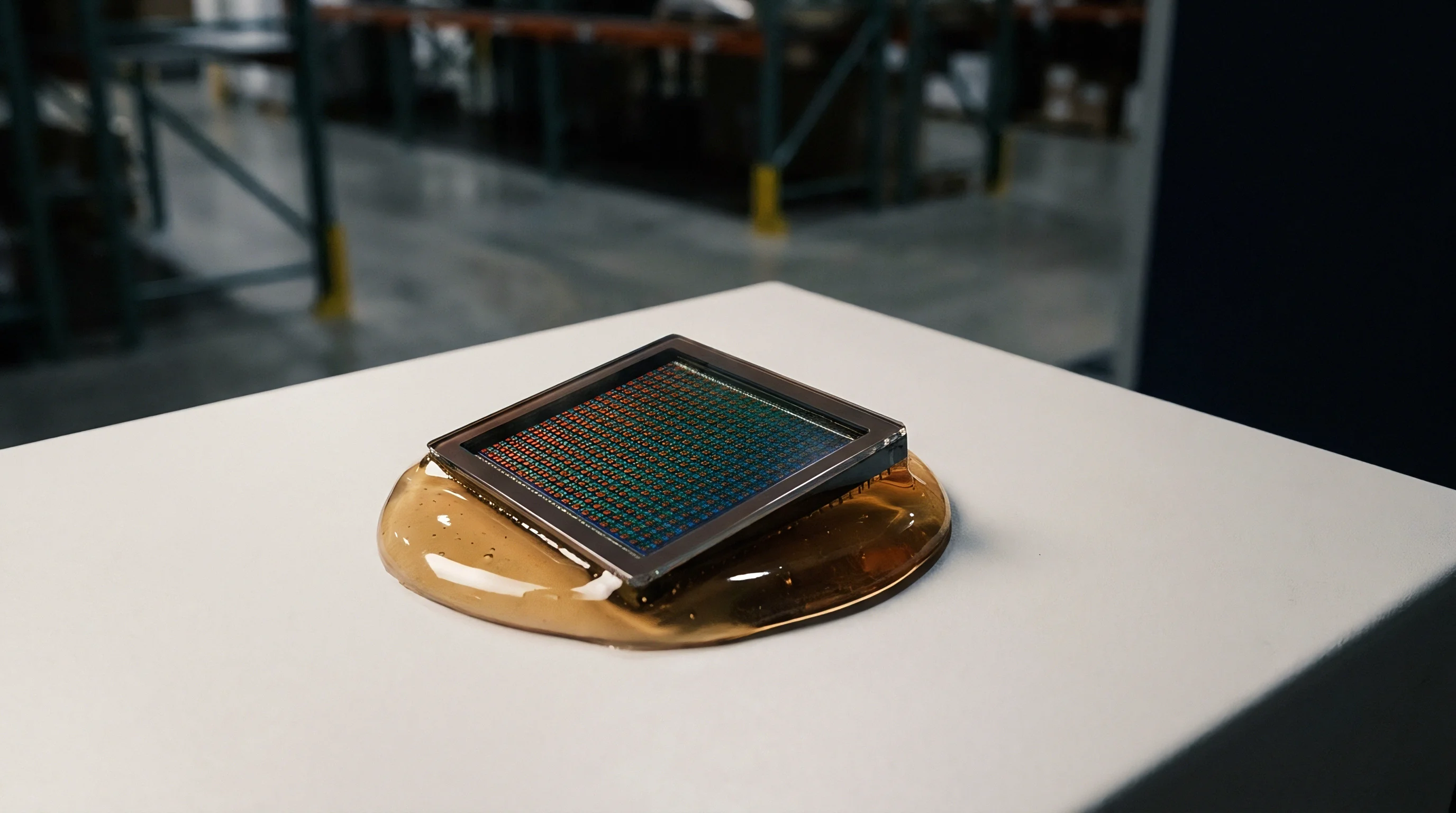
Surface
Dielectric passivation integrity establishes the electrical boundary against ambient moisture intrusion. Silicon dioxide and silicon nitride layers deposited by chemical vapor deposition cover the active piezoresistive traces on the front side of the die. Water molecules reaching this interface form adsorbed aqueous layers across the surface.
These thin moisture films carry dissolved ionic impurities, including sodium, potassium, and chloride residues left behind by wafer dicing and packaging assembly. The ionic solution creates parasitic conductive paths parallel to the integrated bridge resistors.
Leakage paths develop quickly. A bridge resistor holding an intrinsic value of 5,000 ohms shifts downward when bridged by an ionic surface path with an impedance of 50 mega-ohms. This parallel resistance reduces effective branch resistance by 0.01 percent, translating directly into a 100-microvolt bridge offset at a 1.0-volt excitation level.
Because ionic contamination distributes unevenly across the die surface, the four arms of the Wheatstone bridge experience asymmetric shunting. The resulting zero drift presents as an apparent pressure reading that tracks relative humidity fluctuations without mechanical diaphragm deflection.
Moisture films condense along the glass transition boundary of the passivation layer and bypass the bridge resistors through electrochemical surface paths.
Dielectric charge trapping accelerates zero-point degradation under bias voltage. Water molecules interact with dangling bonds at the silicon-dielectric interface, producing positive mobile charge carriers and fixed oxide charges. These electric charges alter carrier concentration in the shallow boron-doped piezoresistors through field-effect modulation.
Unpassivated piezoresistors or areas with thin native oxides suffer pronounced depletion or accumulation effects. The zero point drifts over tens of hours under constant direct-current bridge excitation, showing polarity-dependent wander that reverses when the excitation bias shuts down.
Thin oxide layers fail. Pinholes within plasma-enhanced chemical vapor deposition silicon nitride coatings allow localized moisture ingress directly down to the aluminum or gold bond pads. Galvanic corrosion pairs form between dissimilar trace metals, generating micro-galvanic potentials in the microvolt regime.
These potentials add vectorially to the bridge output signal, destabilizing the sensor baseline in warm, damp operating environments.
Manufacturers explain this behavior by stating that atmospheric moisture alters surface dielectric parameters within expected manufacturing tolerances.

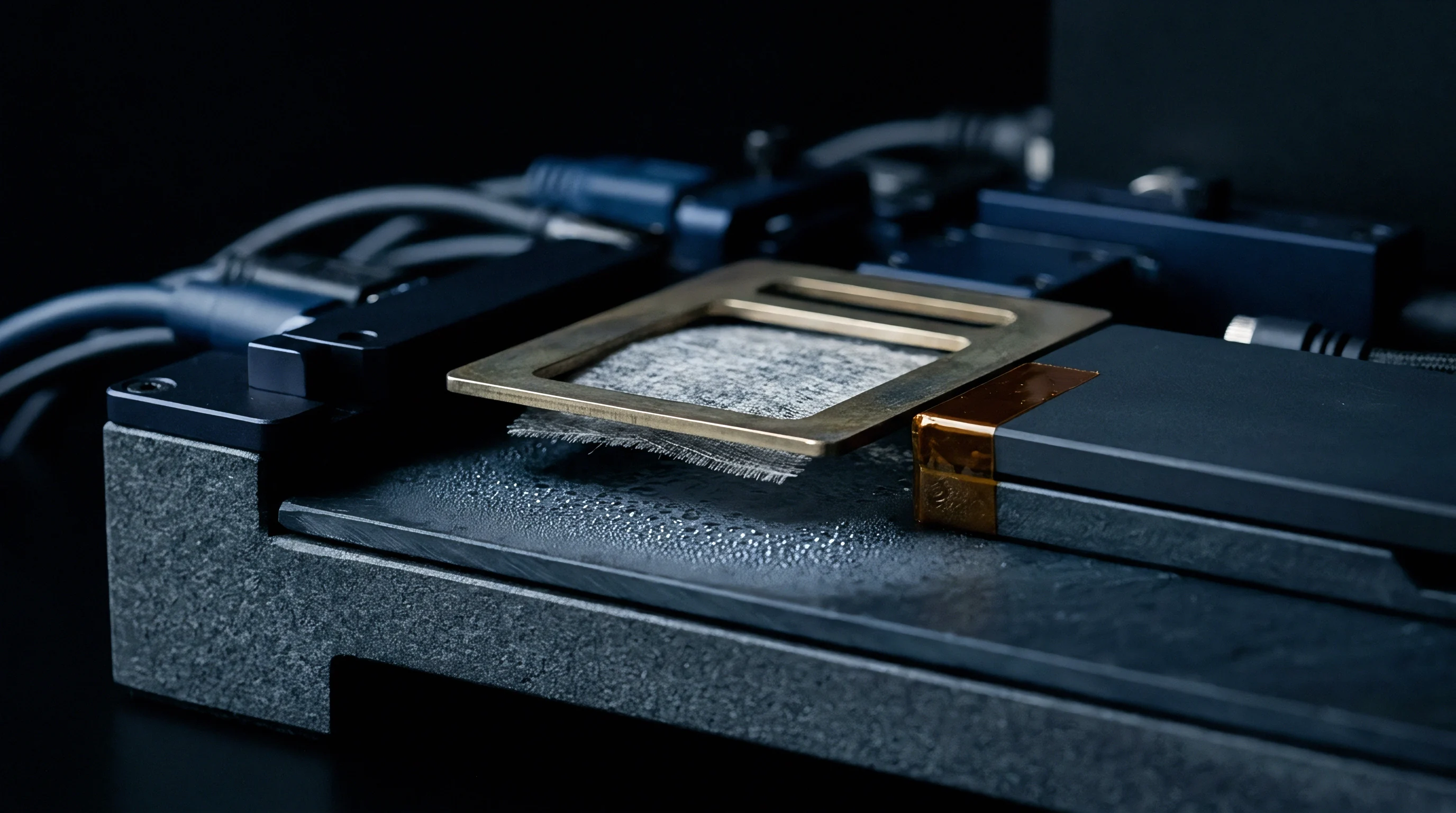
Substrate
Structural packaging materials surrounding the silicon element undergo hygroscopic expansion at rates distinct from the monocrystalline die. Pressure sensors mounted on ceramic thick-film substrates, printed circuit boards, or molded premolded leadframes experience multi-material mechanical coupling. Epoxy die-attach adhesives, potting shells, and glass-filled plastics absorb ambient humidity over extended operating periods.
The coefficient of hygroscopic expansion for standard conductive silver epoxies ranges from 150 to 350 parts per million per percent relative humidity. Monocrystalline silicon exhibits zero hygroscopic expansion. This extreme mismatch generates continuous bimetallic bending stresses along the adhesive joint.
Which Mechanical Pathways Transfer Package Swelling?
Swelling forces follow three distinct transmission paths into the piezoresistive bridge. Package warpage constitutes the primary pathway. When an FR4 circuit board or liquid crystal polymer housing absorbs atmospheric water, the structure bows upward or downward depending on asymmetric trace density and copper layer distribution.
This curvature transmits bending moments through the die-attach fillet into the bulk silicon substrate. The silicon substrate deforms, inducing secondary strain distributions in the suspended sensing diaphragm located hundred micrometers above the mounting plane.
Fillet creep represents the second pathway. Die-attach adhesives soften when exposed to moisture. The water molecules act as plasticizers inside the polymer network, depressing the glass transition temperature by 15 to 30 degrees Celsius.
Elastic modulus drops while viscoelastic creep compliance increases. Curing cycles govern shrinkage. Initial compressive stresses locked into the die during post-cure cool-down begin to relax unevenly as the adhesive absorbs moisture.
The relief of baseline assembly stress alters the static mechanical zero point of the transducer, producing offset wander that mimics an external applied pressure.
Thicker die-attach fillets balance curing shrinkage against moisture expansion while thin adhesive layers concentrate peel forces along the die perimeter.
Interfacial shear concentration forms the third pathway. Moisture wicking along the interface between the substrate and the adhesive induces microscopic delamination pockets. Stress concentrations migrate from the fillet perimeter inward toward the center of the silicon die.
Asymmetrical stress release changes the diagonal resistance ratios within the sensing bridge. In differential and gauge sensors with backside media exposure, humidity reaches both die faces, balancing ambient pressure while creating conflicting hygroscopic strain fields on opposite package faces.
An engineering calculation demonstrates the magnitude of these coupled strains. Consider a piezoresistive pressure die measuring 2.0 millimeters square and 0.4 millimeters thick, secured to an alumina substrate with a 50-micrometer layer of silver-filled epoxy adhesive. Assume an initial factory calibration performed at 25 degrees Celsius and 30 percent relative humidity, establishing an initial zero offset verified within plus or minus 0.05 percent of full scale.
Assume continuous field exposure at 25 degrees Celsius and 85 percent relative humidity across 500 operating hours. The adhesive absorbs 1.2 percent moisture by weight, expanding against the silicon die with an effective hygroscopic strain of 240 microstrain.
Finite element mechanical models indicate that roughly 4.5 percent of this interfacial shear strain couples through the bulk silicon into the surface piezoresistive bridge. The resulting strain at the piezoresistor locations reaches 10.8 microstrain. For a silicon transducer with a longitudinal piezoresistive gauge factor of 120, this induced strain generates a fractional resistance shift of 0.13 percent across the loaded bridge arms.
In a full-bridge configuration rated for a 20-millivolt full-scale output at 5.0 volts excitation, this mechanical imbalance produces a zero offset shift of 0.325 millivolts. The shift represents 1.62 percent of full-scale span. A specified device tolerance of plus or minus 0.50 percent full scale fails completely under these operational conditions.
Package architecture dictates how effectively these hygroscopic expansion forces are isolated from the sensing diaphragm. Glass pedestal mounts isolate the die from package warpage by lifting the active diaphragm several millimeters away from the adhesive plane. Silicon-to-glass anodic bonding provides a rigid, moisture-impermeable mechanical anchor.
Surface-mount packaging without isolation pedestals transfers substrate warpage directly into the active membrane.
- Glass pedestal isolation interposes a low-expansion borosilicate pillar between the package floor and the die, attenuating substrate bending stresses by roughly eighty percent.
- Symmetrical potting geometry equalizes lateral swelling forces across opposite die borders, converting destructive shear vectors into neutral hydrostatic compression.
- Silicone junction coatings seal exposed bond wire perimeters against liquid films, protecting micro-scale interconnection points from interfacial shear displacement.
- Premolded leadframe vent paths equalize ambient vapor diffusion between internal package voids and external reference ports, limiting pressure differentials from moisture-induced expansion.
The metrology community actively evaluates whether high-temperature environmental stabilization removes package stress or merely introduces new thermal hysteresis loops into the finished assembly.

Recovery
Desorption behavior separates reversible swelling artifacts from permanent baseline shifts. When a sensor saturated at 85 percent relative humidity returns to a dry environment of 10 percent relative humidity, absorbed moisture departs through outward diffusion. Silicone gels release water molecules rapidly, shedding up to 90 percent of absorbed moisture within 24 hours at 40 degrees Celsius.
Die-attach epoxies and plastic housings release bound water at substantially slower rates, requiring weeks to reach original moisture equilibrium. Zero offset values shift backward toward the factory baseline along a distinct desorption hysteresis path.

Is Moisture Drift Fully Reversible under Bakeout?
Bakeout cycles rarely restore the original calibration baseline. A 24-hour bakeout at 100 degrees Celsius drives off free and bound water molecules from encapsulation polymers and adhesive joints. Post-bake measurements reveal a persistent zero offset deviation known as unrecoverable drift.
This irreversible shift stems from three distinct material alterations: plasticizer extraction, permanent adhesive relaxation, and interfacial micro-cracking. Liquid water molecules diffuse into crosslinked polymers, swelling the chains and breaking secondary hydrogen bonds. The original crosslinked configuration does not reconstruct itself identically upon moisture extraction.
The unrecoverable fraction of zero offset drift typically accounts for 15 percent to 40 percent of total observed moisture drift. A device exhibiting a 1.0 percent full-scale offset shift at peak humidity retains between 0.15 percent and 0.40 percent full-scale permanent zero error after prolonged drying. In medical and industrial gas metering applications with strict annual drift limits of 0.10 percent full scale, this irreversible shift exhausts the total lifetime tolerance budget during a single humid summer season.
Offset wander corrupts calibration. Recalibration in the field becomes unavoidable unless the measurement system incorporates active zero-point auto-zeroing routines.
Characterization of this environmental vulnerability proceeds through a structured verification sequence conducted inside calibrated environmental chambers.
- Precondition the test lot inside a desiccated chamber at 25 degrees Celsius and less than 10 percent relative humidity for 48 hours to establish a dry baseline reference.
- Record zero pressure bridge offset and bridge input-output impedance at three discrete excitation voltages to verify electrical insulation integrity.
- Ramp chamber relative humidity to 85 percent at a controlled rate of 1.0 percent per minute while maintaining chamber temperature at 25 degrees Celsius.
- Dwell at 85 percent relative humidity for 168 hours, logging bridge offset output continuously at five-minute intervals to map the mechanical swelling sorption curve.
- Elevate chamber temperature to 85 degrees Celsius at 85 percent relative humidity for 240 hours to accelerate hydrolytic degradation and adhesive plasticization.
- Return the chamber environment to 25 degrees Celsius and 10 percent relative humidity, dwelling for 96 hours to measure immediate desorptive recovery.
- Execute a final stabilization bakeout at 85 degrees Celsius for 24 hours followed by room-temperature re-measurement to quantify unrecoverable baseline drift.
During automotive engine sensor trials, components undergo combined humidity and temperature shock cycles to accelerate material fatigue. Chemical processing plants and coastal monitoring stations present identical environmental combinations without the brief recovery intervals found in laboratory profiles. Continuous condensation cycles dissolve atmospheric trace gases into surface moisture layers, lowering pH and attacking metallization barriers directly beneath the gel.
Failure to quantify permanent baseline drift before deployment leads directly to unbudgeted field service calls, false out-of-tolerance process alarms, and premature warranty replacement cycles across installed measurement fleets.

Clause
Procurement specifications for piezoresistive pressure sensors frequently omit relative humidity boundaries from baseline accuracy statements. Standard datasheets quote zero offset stability as a function of operating life or temperature excursions, presenting annual drift figures derived exclusively from dry laboratory air. A vendor claiming a long-term stability of plus or minus 0.1 percent of full scale per year typically conducts burn-in tests at 25 degrees Celsius and uncontrolled factory humidity ranging between 30 and 45 percent.
When deployed into humid processing environments, these devices drift beyond their stated limits within hundreds of operating hours.
Purchasing agreements must define environmental drift acceptance criteria explicitly. A commercial contract that lists accuracy solely through terminal-based non-linearity, pressure hysteresis, and thermal span error leaves the buyer unprotected against moisture-induced offset wander. Sourcing teams eliminate this exposure by inserting dedicated environmental qualification gates into supply agreements.
These clauses link payment milestones directly to verified stability thresholds following standardized damp heat exposure.
IEC 60068-2-78 steady-state damp heat compliance clauses without defined post-test stabilization windows permit suppliers to mask reversible swelling drift as temporary ambient noise.
Test protocols defined by IEC 60068-2-78 specify steady-state exposure at 40 degrees Celsius and 93 percent relative humidity over durations of 21, 56, or 90 days. Suppliers frequently satisfy this standard by proving basic survival: the sensor functions, outputs a signal, and exhibits no catastrophic electrical open circuits. Survival tests tell the buyer nothing about measurement accuracy.
A compliant component may drift 3.0 percent off baseline during exposure and recover within 1.5 percent of nominal scale after drying, rendering it useless for precise metering. The supply specification must dictate maximum permissible zero offset wander during active exposure as well as unrecoverable drift limits evaluated after a 48-hour room-temperature recovery window.
Incoming inspection procedures require verification sampling based on statistical acceptance criteria. For high-reliability procurement, incoming lots undergo a 96-hour damp heat screening on an audit basis using ANSI/ASQ Z1.4 sampling plans. Units exceeding 0.25 percent full-scale drift under 85 percent relative humidity trigger immediate lot rejection or factory re-binning.
Factory calibration certificates that omit relative humidity levels during final zero trimming provide incomplete metrological traceability, because an offset trimmed at 20 percent relative humidity shifts the moment ambient warehouse conditions change.
Supply contracts specifying AEC-Q103-002 automotive sensor qualification establish standardized stress sequences for pressure transducers, yet commercial buyers must append explicit line-item limits defining maximum permissible unrecoverable zero drift to prevent suppliers from invoking baseline shift as acceptable material settling.