Humidity Swelling Shear Strain Limits in Epoxy Molded Precision Metal Foil Element Packaging
Controlling moisture-induced shear strain below 80 microstrain in epoxy-molded foil elements requires compliant silicone buffers to hold sub-5 ppm stability.
Hygroscopy
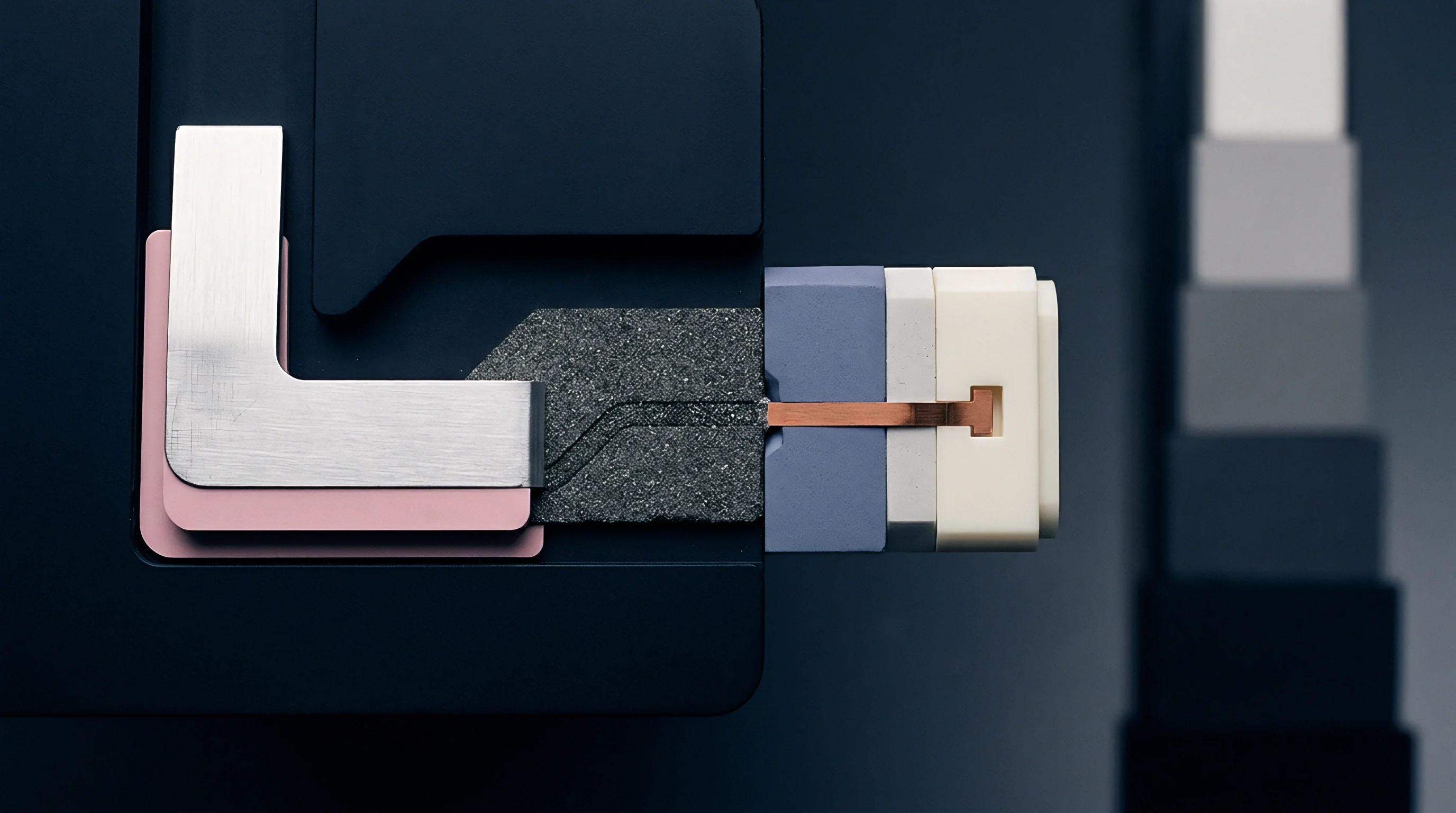
Transfer molded epoxy novolac resins absorb atmospheric moisture until the internal water concentration reaches equilibrium with ambient relative humidity. This sorption induces volumetric dilation across the polymeric network, commonly termed hygroscopic swelling. Precision bulk metal foil resistors rely on balanced planar strain states between a cold-rolled nickel-chromium alloy foil, typically etched to thicknesses between 2.5 micrometers and 5.0 micrometers, and an alumina or silicon carrier substrate.
When an encapsulating resin expands unevenly around this laminate structure, the moisture-induced dimensional change transfers into the active resistive path through interfacial shear stress. The resulting mechanical distortion alters electrical resistance through the piezoresistive effect, shifting calibration points outside stated uncertainty envelopes.
Foil elements exhibit typical gauge factors between minus two and plus four, depending on the metallurgical treatment and proprietary rolling schedules of the nickel-chromium ternary system. A relative volumetric expansion of the encapsulant generates lateral and transverse interfacial shear forces along the passivation layer. Standard datasheets frequently obscure this phenomenon by presenting moisture resistance data obtained under MIL-PRF-55342 or MIL-STD-202 Method 106 as an aggregate stability percentage, often quoted as plus or minus 0.02 percent.
That figure conflates ionic contamination leakage, end-cap metallization corrosion, and mechanical strain, concealing the recoverable portion of the value shift caused purely by package distension.
Transfer molded novolac packaging exhibits an equilibrium moisture expansion coefficient of approximately 0.00015 strain per unit moisture concentration at 85 percent relative humidity.
Foil packages exposed to fluctuating ambient relative humidity encounter reversible resistance wander dictated by the diffusion coefficient of water through the molding compound. Water transport follows classical Fickian mechanics below the glass transition temperature, establishing concentration gradients that peak at exterior package boundaries before saturating the inner core. Unequal swelling between the thick top encapsulant cap and the thinner backfill layer creates out-of-plane bending moments across the substrate.
These moments subject the delicate planar resistive serpentine grid to uncontrolled mechanical compression or tension. The metrologist tracking long-term drift observes a sensor zero-point that wanders with seasonal weather fronts, tracking outdoor absolute vapor pressure rather than true operational aging.
Incoming inspection procedures evaluate basic room-temperature DC resistance using seven-digit multimeters, yet these static checks miss interfacial displacement mechanics entirely. Resistors held in supplier stockrooms under uncontrolled ambient humidity absorb ambient moisture over months of storage. When these components are soldered into precision analog signal chains without a controlled dehydration bake, the sudden thermal shock of surface-mount assembly vaporizes trapped moisture, producing delamination along the foil-epoxy boundary.
Solder assembly stress compounds the package swelling, leaving the foil element in a permanently unpredictable strain state that voids the initial factory calibration certificate.
When environmental validation overlooks this swelling mechanism, field instruments face unexplained seasonal calibration drifts that force unscheduled depot maintenance campaigns and product recalls.

Kinetics
Fickian diffusion defines the velocity at which moisture fronts advance toward the buried foil element. The diffusion coefficient of standard semiconductor-grade epoxy molding compound spans from 1.0 multiplied by 10 raised to the power of minus eight to 5.0 multiplied by 10 raised to the power of minus eight square centimeters per second at 85 degrees Celsius. At standard room conditions of 23 degrees Celsius and 50 percent relative humidity, the coefficient drops by roughly an order of magnitude, slowing the transport rate while extending saturation time across several weeks.
Precision foil packages measuring two to four millimeters in total thickness require between 600 and 1,500 hours to reach 90 percent of saturation equilibrium under standard ambient deployment.

Where Ingress Alters Planar Stress
Moisture entering the package creates a time-dependent swelling gradient along the z-axis, generating localized shear stresses at the adhesive interface securing the alloy to the substrate. The coefficient of hygroscopic swelling quantifies the mechanical strain produced per unit weight gain of absorbed moisture. Typical values for silica-filled novolac epoxies range from 0.15 to 0.35 percent strain per percent moisture content by weight.
Because the ceramic carrier substrate possesses a moisture absorption value effectively equal to zero, a severe strain mismatch develops directly at the substrate-to-foil and foil-to-overmold bond planes.
The mathematical formulation for local hygroscopic strain expresses linear dilation as the product of the hygroscopic expansion coefficient and the local moisture concentration. As the outer envelope expands while the desiccated interior core resists movement, interfacial shear stress concentrates at the outer corners of the rectangular foil patch. This concentration produces asymmetrical resistance changes along the outer serpentine branches of the etched pattern, introducing localized hot spots and disrupting the intended current density uniformity.
Relative resistance drifts exceed fifteen parts per million when package moisture mass uptake reaches 0.35 percent by weight under steady environmental damp heat.
Polymer chemists counter this expansion by loading molding formulations with fused spherical silica particles up to 75 to 88 percent by weight. High filler loadings suppress both the coefficient of thermal expansion and the hygroscopic swelling rate by reducing the net polymer volume available for water molecule bonding. High filler fractions raise the flexural elastic modulus of the cured compound to values exceeding 18 to 25 gigapascals at room temperature.
The elevated modulus exerts higher mechanical clamping force against the planar foil structure whenever the package experiences moisture-induced deformation.
| Compound Chemistry Designation | Silica Filler Fraction By Weight | Equilibrium Water Uptake At 85% RH | Coefficient Of Hygroscopic Swelling | Room Temperature Flexural Modulus |
|---|---|---|---|---|
| Standard Novolac Industrial Grade | 72 percent | 0.55 percent weight | 0.32 percent strain per percent H2O | 14 gigapascals |
| High Purity Cresol Novolac | 78 percent | 0.42 percent weight | 0.26 percent strain per percent H2O | 19 gigapascals |
| Multi-Aromatic Low Moisture Resin | 84 percent | 0.28 percent weight | 0.18 percent strain per percent H2O | 24 gigapascals |
| Biphenyl Low Stress Molding Base | 88 percent | 0.19 percent weight | 0.12 percent strain per percent H2O | 28 gigapascals |
The tabulated physical values illustrate the trade-off confronting precision packaging designers. Reducing water absorption by escalating filler loading stiffens the cured compound, causing any residual swelling strain to generate substantially higher interfacial shear stress against the fragile foil grid. Sourcing specifications that demand minimal moisture absorption without capping the room-temperature modulus inadvertently purchase higher piezoresistive susceptibility during ambient humidity transients.
Component distributors often remark that military-grade parts maintain absolute environmental immunity once qualified to baseline qualification standards.

Strain
Mechanical shear strain at the interface translates directly into electrical drift via the alloy piezoresistive tensor. Foil elements manufactured from modified nickel-chromium alloys, such as Evanohm or Karma compositions, feature nominal sheet resistances calibrated by delicate thermal heat-treatment steps that optimize the bulk temperature coefficient of resistance toward zero. These metallurgical formulations retain sensitive crystal lattice orientations that respond immediately to biaxial planar tension and out-of-plane shear.
Interfacial shear strain exceeding 150 microstrain begins shifting calibrated resistance beyond five parts per million on ultra-precision grades.

Are Package Shear Limits Statistically Predictable?
Finite element calculations and empirical verification trials demonstrate that shear strain distributions across encapsulated foil elements peak near the outer termination pads. The maximum allowable interfacial shear strain before permanent calibration loss occurs is bounded by the yield strength of the intermediate polyimide or epoxy bonding adhesive. For typical high-temperature bonding adhesives, plastic deformation initiates between 800 and 1,200 microstrain, setting the absolute physical limit for package durability.
Reversible precision limits sit substantially lower, demanding that total elastic shear strain remain below 80 microstrain to preserve sub-ppm stability classes across operational instrument lifetimes.
Strain transfer efficiency depends heavily on the thickness and viscoelastic compliance of the compliant elastomer coat placed over the foil prior to bulk transfer molding. Uncoated foil elements receive the raw shear displacement of the expanding novolac shell, driving instantaneous drift rates as high as 50 to 100 parts per million upon saturation. Compliant silicone or soft polyimide conformal intermediate coatings decouple the rigid molding matrix from the underlying metal grid, buffering the foil against package breathing.
Soft silicone junction coatings decouple up to eighty-five percent of package-induced lateral shear from the active resistive grid.
The mathematical evaluation of total observed resistance drift sums the thermal, hygroscopic, and relaxation strain vectors within the active conductor paths:
Assume an encapsulated foil element measuring 3.0 millimeters long, 2.0 millimeters wide, and 3.8 micrometers thick, bonded to an alumina substrate using a 12-micrometer epoxy adhesive layer. The assembly receives an overmolded cresol novolac shell with an effective top thickness of 0.8 millimeters and a bottom thickness of 0.4 millimeters. Exposed to an environmental transition from 20 percent relative humidity to 80 percent relative humidity at 25 degrees Celsius, the compound gains 0.32 percent moisture by weight over a 500-hour exposure period.
Applying a coefficient of hygroscopic swelling of 0.22 percent strain per percent moisture content, the unconstrained linear strain of the polymer reaches 704 microstrain.
The rigid 96 percent alumina substrate, exhibiting an elastic modulus of 300 gigapascals, completely resists moisture expansion. The geometric asymmetry between top and bottom encapsulant thicknesses produces a calculated bending radius of 4.2 meters across the substrate assembly. The resulting interfacial shear strain along the foil plane reaches approximately 140 microstrain near the active resistive grid edges.
Multiplying this value by the longitudinal gauge factor of the nickel-chromium foil, measured at plus 1.8, yields a predicted fractional resistance shift of 252 parts per million. For a precision resistor purchased with a initial factory tolerance of plus or minus 0.005 percent (50 parts per million), this swelling-induced shift exceeds the entire tolerance budget by a factor of five.
Uncontrolled interfacial shear degrades precision performance through distinct mechanical pathways:
- Interfacial Adhesive Delamination propagates inward from the sharp outer corners of the etched foil pattern, causing localized loss of mechanical support and sudden step-function jumps in ohmic value.
- Piezoresistive Transverse Distortion alters the aspect ratio of individual narrow serpentine foil rungs, shifting the bulk resistance balance without generating catastrophic open-circuit electrical faults.
- Bond Wire Neck Fatigue results from repetitive cyclic expansion and contraction along the molding compound boundary, introducing variable micro-contact resistance at gold or aluminum stitch locations.
- Dielectric Loss Shunting emerges as water molecules accumulate inside microscopic voids along the debonded polymer-foil boundary, degrading insulation resistance across closely spaced conductor traces.
Environmental stress screening tests reveal these damage mechanisms as non-linear zero-point wander during subsequent thermal cycling. Once interfacial bonds slip plastically, the initial calibration state cannot be recovered through thermal dehydration. The device retains a permanent offset signature that corrupts precision balance bridges, digital-to-analog ladder networks, and high-side current sense amplifiers.
Unbuffered moisture swelling invalidates stated circuit tolerance bounds long before the host system completes its initial factory burn-in cycle.
Isolation
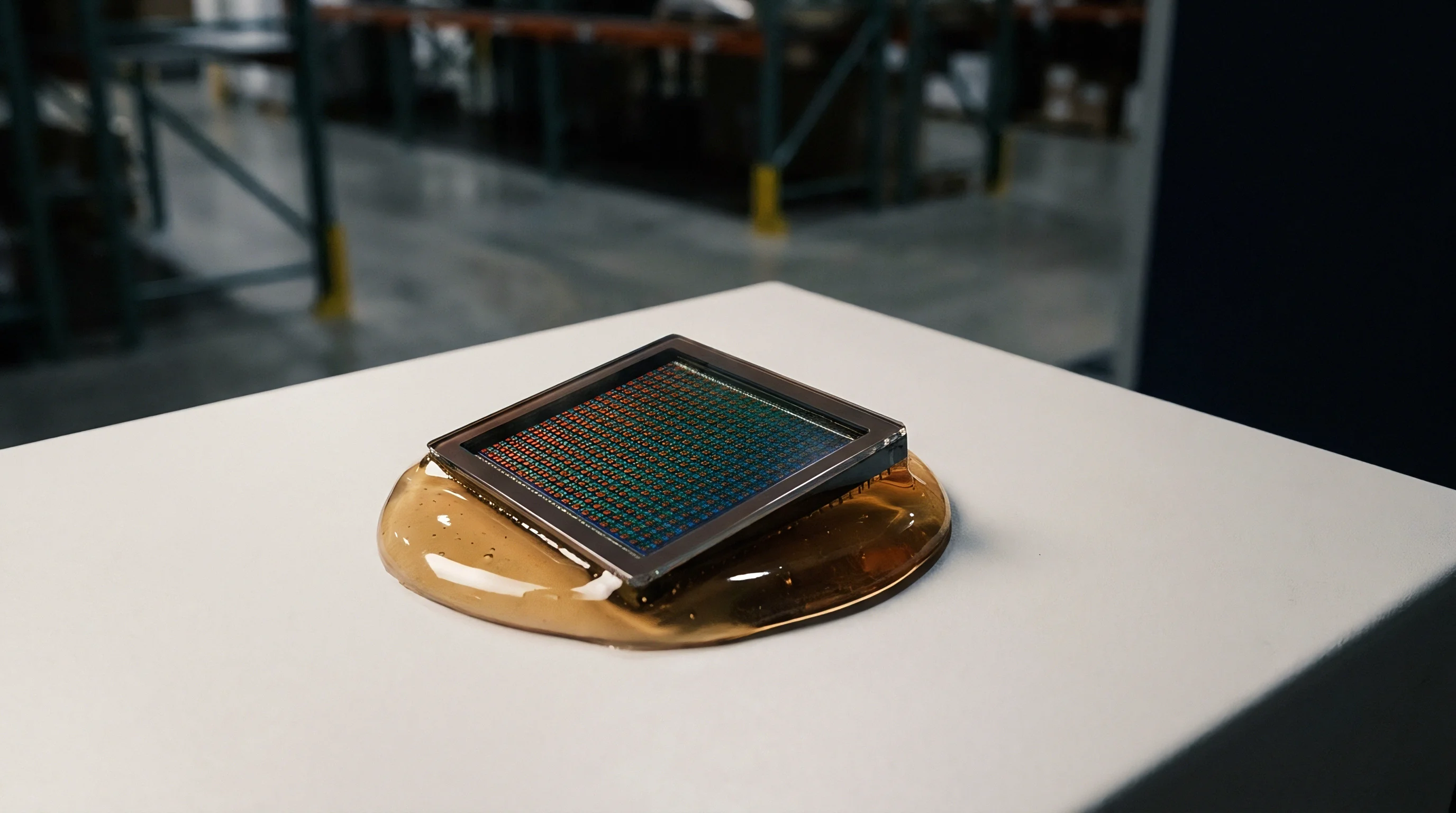
Eliminating humidity-driven interfacial shear requires isolating the resistive element from ambient environmental vapor. Packaging engineers implement two primary physical strategies: compliant internal buffering within molded packages or complete hermetic isolation using glass-to-metal and ceramic seals. While transfer-molded packaging provides low manufacturing cost and compatibility with high-speed automated pick-and-place equipment, true metrological stability under variable humidity environments demands hermetic enclosures.
Hermetic foil packaging encloses the calibrated resistive element inside an inert dry nitrogen atmosphere, sealed within a nickel-plated Kovar case or a brazed ceramic cavity. Solid glass-to-metal seals secure the terminal leads, establishing a leak rate lower than 1.0 multiplied by 10 raised to the power of minus nine atmospheric cubic centimeters per second of helium under standard tracer gas leak testing. Under these sealed conditions, exterior relative humidity fluctuations generate zero hygroscopic strain across the foil element, maintaining resistance stability within 0.5 parts per million per year regardless of ambient weather cycles.
Cost differentials between molded and hermetically sealed packaging remain stark across all precision supply chains. A precision molded foil resistor rated at 0.01 percent tolerance carries a production lot price between five and twelve dollars in volume procurement. A hermetically sealed version of the identical foil geometry packaged inside a hermetic oil-filled or nitrogen-backfilled brass case ranges between forty-five and one hundred twenty dollars per piece.
Sourcing teams seeking to optimize system component costs must evaluate whether environmental containment belongs at the component level or inside an environmentally sealed instrument housing.
| Package Construction Type | Standard Ingress Rating | Annual Drift Under 85% RH Exposure | Typical Unit Cost Range | Target Application Class |
|---|---|---|---|---|
| Standard Transfer Molded Epoxy | IP20 equivalent (Resin Porous) | 25 to 80 parts per million | $4 to $9 | Industrial instrumentation, office test equipment |
| Silicone-Buffered Transfer Molded | IP20 equivalent (Resin Porous) | 8 to 25 parts per million | $8 to $16 | Process transmitters, automated test equipment cards |
| Cavity Surface Mount Ceramic Lid | IP65 equivalent (Lid Bonded) | 3 to 10 parts per million | $18 to $35 | Downhole monitoring, aerospace sensor front-ends |
| Hermetic Kovar Metal Can Sealing | IP68 hermetic glass seal | 0.2 to 1.5 parts per million | $55 to $140 | Primary calibration standards, metrology reference benches |
Component selection requires mapping system-level environmental exposure against allowable calibration drift budgets. Systems deployed inside climate-controlled laboratories tolerate high-grade molded packaging provided that facility air handlers maintain humidity bands within 40 to 60 percent relative humidity year-round. Field instruments intended for maritime, outdoor industrial, or airborne deployments experience humidity swings from desiccation to condensing dew conditions, driving standard molded components completely through their error allocations within single operational seasons.
Procurement specifications that reference J-STD-020 moisture sensitivity classifications govern manufacturing handling rather than operational reliability in high-humidity service environments.
Screening
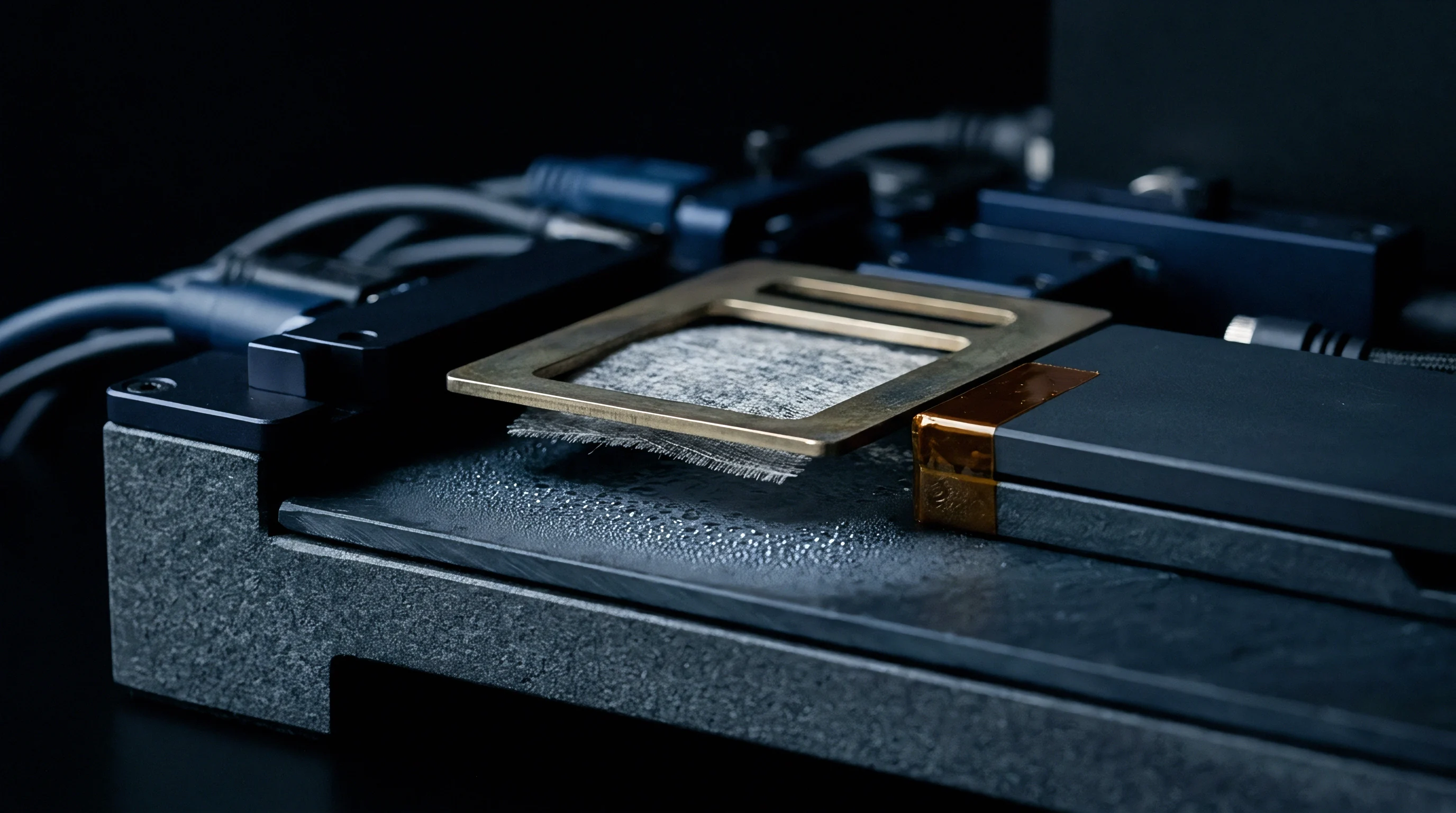
Validating whether an epoxy-molded foil component population meets strict stability criteria requires targeted qualification protocols that separate hygroscopic mechanical distortion from ionic degradation. Standard factory lot acceptance testing under commercial agreements rarely exercises package breathing mechanics over sufficient durations to expose latent shear vulnerabilities. Incoming verification programs must introduce sequential soak and desiccation profiling to establish the true hygroscopic coefficient of resistance for every procurement lot.
A rigorous verification sequence establishes baseline electrical parameters, applies moisture saturation under controlled vapor pressures, and tracks resistance progression during subsequent desiccation:
- Preconditioning Dehydration Bake drives out all residual moisture inside a convection oven at 125 degrees Celsius for 48 hours under dry nitrogen flow, recording zero-point reference resistances on a calibrated 8.5-digit digital multimeter after a four-hour stabilization period at 23 degrees Celsius.
- Controlled Humidity Chamber Saturation exposes test samples to 60 degrees Celsius and 75 percent relative humidity for 500 hours, monitoring in-situ resistance values every 24 hours to record swelling kinetic curves and detect sudden adhesive delamination events.
- Post-Exposure Thermal Recovery Check transfers parts back into the 23-degree measurement ambient, measuring the wet resistance value under four-wire Kelvin connections within fifteen minutes of chamber extraction to quantify peak reversible strain displacement.
- Secondary Desiccation Cycle returns components to the 125-degree dry nitrogen bake for 48 hours to remove all absorbed water, allowing verification of permanent, non-recoverable mechanical drift induced by interfacial bond relaxation or crack propagation.
Parts exhibiting permanent offsets greater than five parts per million following the secondary bake indicate plastic deformation along the bonding interface. This plastic movement reveals poor interfacial adhesion between the substrate and the encapsulant, signaling that the production lot contains latent reliability risks that will manifest as premature out-of-tolerance drift in the field.
A contract clause mandating post-bake permanent offset stability below three parts per million excludes substandard molding resin lots before production release.
Contractual documentation must define the exact testing conditions under which annual stability warranties operate. Stating an annual drift of five parts per million without defining accompanying ambient humidity boundaries allows suppliers to reject warranty claims by asserting that uncontrolled atmospheric moisture overstressed the molded package beyond reasonable operational conditions.
Can buyers resolve the gap between manufacturer datasheets and field drift performance?

Rectification
Engineering teams committed to molded packaging architectures can mitigate humidity-induced interfacial shear through disciplined printed circuit assembly design and localized protection. Board-level conformal coatings, moisture barrier potting compounds, and pre-assembly thermal conditioning protocols reduce the magnitude of moisture transients reaching the component envelope. These board-level interventions extend the time constant of diffusion, smoothing out sharp environmental spikes and stabilizing the measurement chain.
Applying a high-solids polyurethane or paraxylene (Parylene C) conformal coating across the assembled circuit card forms a continuous, pinhole-free barrier against environmental water vapor. Parylene C exhibits a water vapor transmission rate of roughly 0.08 grams per 100 square inches per 24 hours at standard atmospheric pressure, reducing moisture ingress kinetics by nearly two orders of magnitude compared to bare novolac packaging. This reduced transmission rate prevents fast seasonal humidity changes from creating sharp out-of-plane bending moments across the internal foil substrate.
Solder joint geometry and printed circuit footprint design also govern the transmission of exterior stresses into the component package. Thick surface-mount copper pads, excessive solder volumes, and dense FR4 glass-weave weave patterns expand under humidity, pushing upward on the resistor termination end-caps. Providing strain-relief solder pad geometries and specifying thin, uniform solder paste deposits minimizes the superposition of external printed circuit board warpage onto internal package swelling strain.
Purchasing clauses must explicitly address environmental packaging qualifications, lead-frame materials, and maximum allowable hygroscopic resistance coefficients:
- Hygroscopic Expansion Coefficient Thresholds specify that the bulk molding compound must not exceed 0.20 percent linear strain per percent absorbed moisture weight across the temperature range of 15 to 45 degrees Celsius.
- Silicone Interfacial Coating Verification requires the packaging assembler to certify the continuous presence of a compliant junction coating covering 100 percent of the active etched foil surface with an average thickness between 25 and 50 micrometers.
- Traceable Environmental Stability Guarantees bind the component manufacturer to a maximum total drift limit of 15 parts per million following 1,000 hours of 85 degrees Celsius and 85 percent relative humidity exposure.
Integrating these technical boundaries into master purchasing agreements forces packaging manufacturers to control molding resin formulations, post-mold cure cycles, and internal buffer coatings. The resulting components maintain their calibrated precision through real-world humidity cycles, safeguarding the operational accuracy of critical instrumentation.