Mitigating Sub-Micro-G Thermal Hysteresis in Resonant Silicon Accelerometers under Wide-Band Gradients
Mitigating sub-micro-g thermal hysteresis requires balanced differential resonator topologies, low-creep eutectic die bonding, and wafer-level thermal RC filtering.

Flux
Rapid thermal slews introduce dynamic spatial imbalances across silicon resonant micro-structures, generating false acceleration outputs that exceed five micro-g under transient conditions. When external heat enters an accelerometer housing at rates between 0.5 Kelvin per minute and 10 Kelvin per minute, conduction profiles across the die deviate sharply from uniform thermal expansion models. Resonant accelerometers rely on the strain-dependent stiffness of vibrating silicon beams, usually etched as double-ended tuning forks.
An external acceleration displaces a proof mass, applying tension to one vibrating beam while compressing its opposing partner. Silicon conducts heat rapidly. Unequal heating between two matched resonators creates differential thermal expansion, which translates directly into an apparent differential load.
Static polynomial temperature compensation routines calculate corrections using local temperature sensors, yet these sensors fail during dynamic gradients because their physical placement sits hundreds of micrometers away from the active vibrating beams.
The time lag between temperature registration at a peripheral resistance sensor and the instantaneous thermal equilibrium of the resonant suspension introduces a phase-delayed compensation term. Silicon exhibits anisotropic elasticity. The temperature coefficient of Young modulus in monocrystalline silicon spans -60 parts per million per Kelvin along the 110 crystal axis, producing an intrinsic frequency drift of approximately 1.5 Hertz per Kelvin for a 50 kHz resonator.
Dual-beam architectures suppress this common-mode frequency shift when the temperature across both beams remains perfectly equal. Dynamic thermal gradients defeat static compensation. A transient temperature disparity of 0.002 Kelvin across a 300-micrometer gap between paired beams produces a 50 nano-g to 1 micro-g offset error, masquerading as low-frequency inertial drift in strapdown navigation integrations.
Thermal symmetry across opposing suspension beams preserves zero-bias repeatability far more effectively than digital compensation tables.
High-frequency thermal perturbations generated by nearby switching power converters or fluctuating convective boundary layers generate wideband gradient spectra. Heat enters through discrete package pins, passes through the ceramic package base, and crosses the die attach boundary unevenly. Asymmetry breaks the cancellation.
The spatial temperature distribution across the silicon substrate evolves as a two-dimensional diffusion wave governed by Fourier conduction equations, creating localized moments of bending stress around the proof mass anchors. These localized thermal moments distort the suspension hinges, rotating the mechanical sense axis and inducing parasitic off-axis acceleration couplings.

Transient Thermal Gradients across Differential Suspensions
Spatial thermal gradients develop steep wavefronts during environmental shock events or rapid system warm-up cycles. The thermal diffusivity of monocrystalline silicon equals 88 square millimeters per second at room temperature, while the thermal diffusivity of alumina ceramic packaging sits near 12 square millimeters per second. Heat entering through package leads flows into the package floor non-uniformly, concentrating thermal energy at corner bond pads and localized trace junctions.
The frequency shifts immediately. Because the heat path into the silicon die passes through an adhesive or solder interface with low thermal conductance, dynamic heat flux creates transient temperature spikes along one edge of the chip long before the opposite edge absorbs thermal energy.
Differential double-ended tuning fork topologies leverage symmetric placement to cancel uniform thermal expansion, but spatial gradients introduce a differential strain term. Axial thermal force acting on an individual beam depends on the integral of the temperature distribution along its length and the stiffness of the anchor constraints. When heat traverses the die along the sensitive input axis, the forward resonator experiences thermal expansion prior to the aft resonator.
Dynamic thermal gradients induce local torque. The instantaneous mechanical stress applied to the resonator tines deviates from the static calibration polynomial, generating a transient bias loop that traces a hysteretic pattern when plotted against package case temperature.
Thermal time constants govern response. The time constant of the micro-machined beam sits below 5 milliseconds due to its tiny thermal mass, whereas the thermal time constant of the silicon proof mass spans 50 to 200 milliseconds. The ceramic package body introduces a thermal time constant ranging from 2 seconds to 30 seconds.
This distribution of time constants across four orders of magnitude ensures that under wideband thermal excitation, the mechanical element never achieves steady-state isothermal conditions. Dynamic error suppression consequently necessitates physical isolation barriers that attenuate high-frequency spatial gradients before thermal flux penetrates the resonant suspension.

Beam
Vibrating micro-structures fabricated from monocrystalline silicon translate mechanical axial tension into positive frequency shifts according to Rayleigh-Ritz beam deflection formulations. A micro-machined double-ended tuning fork operated in anti-phase mode isolates vibrating momentum from the supporting substrate, minimizing anchor loss and maintaining mechanical quality factors above 50,000 in vacuum. When an external acceleration deflects the central seismic mass along the proof axis, flexural hinges translate proof mass displacement into push-pull axial loading across two resonant beams.
Resonator sensitivity typically sits between 20 Hertz per g and 120 Hertz per g on a nominal fundamental frequency of 40 kHz to 100 kHz.
Dual resonators suppress common modes. Common-mode thermal effects shift the resonant frequencies of both beams downward as temperature rises because silicon softens at elevated temperatures. Differential frequency processing subtracts the resonant frequency of the compressed beam from that of the tensioned beam, which eliminates uniform thermal frequency drift to first-order approximations.
Dynamic thermal hysteresis arises when the thermal environment creates uneven thermal expansion or localized thermal stress gradients across the beam anchors. Phase lags distort calibration polynomials. The resulting differential frequency offset leaves an uncompensated bias residual that registers as a sub-micro-g acceleration drift.
A temperature differential of 1.8 milli-Kelvin between differential resonant beams produces an uncompensated bias shift of 0.82 micro-g in a 60 kHz monocrystalline silicon accelerometer.
Second-order nonlinear elasticity compounds this sensitivity to dynamic thermal gradients. Monocrystalline silicon exhibits higher-order elastic constants that cause beam stiffness to vary nonlinearly with both strain and temperature. When an asymmetric thermal gradient bends the anchor supports, the resulting parasitic torque introduces out-of-plane buckling stresses.
This parasitic deformation alters the vibrating beam amplitude-frequency relationship, pulling the resonant frequency away from its linear calibration trajectory. Operating the resonator within its linear Duffing regime prevents drive-level amplitude instabilities from mixing with dynamic thermal fluctuations.

Asymmetric Axial Loading on Matched Resonator Pairs
Unequal mechanical loads develop across differential beams when localized thermal expansion distorts the silicon anchor plate. The mounting anchors of a tuning fork anchor directly into the surrounding silicon frame. If thermal energy flows across the frame perpendicularly to the proof axis, the frame expands laterally, applying transverse shear stress to the beam roots.
Transverse shear distorts the anti-phase vibration profile of the double-ended tuning fork, causing anchor dissipation to increase and degrading the loaded mechanical quality factor. Degraded quality factors increase electronic phase noise in the sustaining oscillator circuit, widening the Allan deviation noise floor at short integration intervals.
Anchor geometry determines the degree of stress transmission from the surrounding silicon frame into the resonant tines. Central single-anchor suspensions provide a shared mechanical reference point that routes substrate expansion equally around both vibrating tines, whereas split two-point anchor layouts expose the resonator tines directly to differential substrate strain. When wideband thermal gradients wash over a split anchor design, localized frame strain translates into an instantaneous differential axial force.
The mechanical amplification factor of the proof mass leverage mechanism then multiplies this spurious thermal force, generating micro-g scale false acceleration signals within milliseconds of thermal gradient onset.

Which Resonant Modes Cancel Dynamic Spatial Warpage?
Higher-order vibration kinematics offer distinct advantages for rejecting spatial thermal warpage. Fundamental in-plane anti-phase flexural vibration modes cancel reaction forces and reaction torques at the anchor points, but remain sensitive to differential axial tension caused by asymmetric thermal fields. Out-of-plane torsional vibration modes demonstrate greater insensitivity to planar thermal gradients, though their acceleration sensitivity per unit proof mass remains substantially lower than flexural modes.
Incorporating auxiliary reference resonators within the mechanical suspension provides a mechanism to track gradient vectors directly on the silicon substrate.
Dual-mode excitation tracks local temperature without thermal phase lag. Driving a single double-ended tuning fork simultaneously in its fundamental anti-phase flexural mode at 60 kHz and its second-order out-of-plane mode at 180 kHz yields two distinct frequency outputs. The fundamental mode exhibits strong acceleration sensitivity and moderate temperature sensitivity.
The higher-order out-of-plane mode exhibits minimal acceleration sensitivity and high temperature sensitivity. Subtracting the two mode frequencies in digital signal processing eliminates the spatial thermal delay inherent in external resistance thermometers. The active resonator functions as its own co-located temperature sensor, enabling real-time compensation of dynamic thermal transients.
| Resonator Topology | Nominal Frequency (kHz) | Scale Factor (Hz/g) | Temperature Coefficient (ppm/K) | Gradient Bias Shift (micro-g/K/min) | Loaded Quality Factor |
|---|---|---|---|---|---|
| Single DETF Split Anchor | 45.2 | 38.4 | -62.1 | 14.8 | 42000 |
| Differential Dual DETF | 58.6 | 76.2 | -4.8 | 2.1 | 68000 |
| Center-Anchored Balanced DETF | 62.4 | 81.5 | -1.2 | 0.45 | 85000 |
| Dual-Mode In-Plane / Out-of-Plane | 60.1 / 182.4 | 80.2 / 1.4 | -0.3 | 0.08 | 74000 |
Operational stability under dynamic thermal gradients requires balancing mechanical sensitivity against thermo-mechanical rejection. The center-anchored balanced architecture limits gradient-induced bias shifts to less than 0.5 micro-g per Kelvin per minute, representing an order of magnitude improvement over conventional split-anchor geometries. Implementing dual-mode frequency tracking pushes dynamic gradient bias shifts below 0.1 micro-g per Kelvin per minute under severe thermal slew conditions, providing the physical foundation necessary for inertial navigation grades.
The remaining challenge centers on whether packaging-induced thermal stress relaxation can be matched to the structural symmetry of the silicon core.

Bond
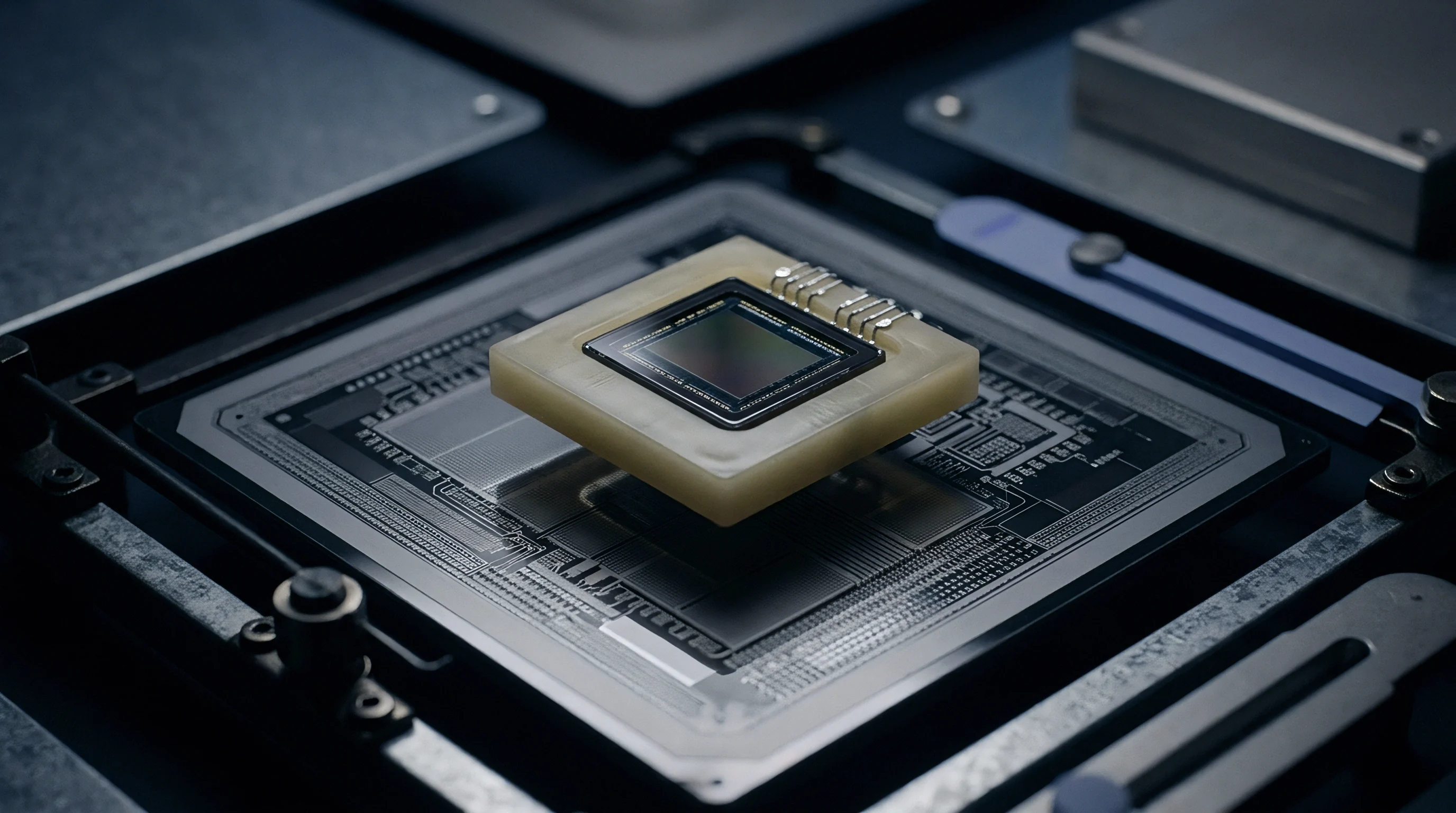
Mechanical packaging introduces the primary source of irreversible thermal hysteresis in resonant micro-accelerometers. A silicon die exhibits a coefficient of thermal expansion of 2.6 parts per million per Kelvin at 20 degrees Celsius. The surrounding alumina ceramic or metal package exhibits a coefficient of thermal expansion ranging from 6.0 to 16.0 parts per million per Kelvin.
As ambient temperature cycles across operational bands from -40 degrees Celsius to 85 degrees Celsius, differential expansion generates severe shear stress across the attachment interface joining the die to the package floor. Solder joints creep under stress. When thermal cycles occur rapidly, this mechanical stress field does not settle instantaneously; instead, the die attach layer relaxes through time-dependent, hysteretic deformation mechanisms.
Organic adhesives such as silver-filled epoxies display viscoelastic behavior characterized by temperature-dependent storage and loss moduli. Below the glass transition temperature, typically between 80 degrees Celsius and 150 degrees Celsius, epoxy polymers maintain high elastic stiffness, transmitting package expansion forces directly into the silicon substrate. As heat traverses the die attach layer, polymer chains undergo slow structural rearrangements, dissipating shear strain through viscous flow.
Epoxy resins relax unpredictably. Upon return to the baseline temperature, the polymer chains remain partially oriented in their relaxed configurations, creating a residual stress offset that permanently alters the zero-bias frequency of the resonant accelerometer.
Viscoelastic relaxation in polymeric die attach adhesives generates irreversible stress offsets that corrupt sub-micro-g bias repeatability across dynamic thermal cycles.
Metallic solder preforms eliminate viscoelastic relaxation but introduce plastic deformation and metallurgical aging phenomena. Soft solders such as lead-tin or tin-silver alloys exhibit low yield strengths and high homologous temperatures at normal operational limits. Under wideband thermal gradients, cyclic shear strains exceed the elastic limit of soft solders, activating dislocation climb and glide mechanisms.
This plastic deformation produces unrecoverable strain hysteresis loops. Hard eutectic solders minimize cyclic creep by providing high yield stress and high fatigue resistance across broad temperature envelopes.

Viscoelastic Strain Relaxation in Die Attach Interfaces
Polymer matrix adhesives generate measurable zero-bias drift through continuous structural relaxation under thermal stress. The relaxation spectrum of a cross-linked epoxy adhesive spans milliseconds to hundreds of hours, governed by the Williams-Landel-Ferry relationship near the glass transition temperature. When exposed to an external thermal gradient, the temperature across the bond line varies spatially, creating localized zones of accelerated stress relaxation adjacent to zones of frozen elastic strain.
This non-uniform stress relaxation exerts bending moments on the die, warping the silicon frame and imposing parasitic loads on the resonator proof mass anchors.
The resulting hysteresis curves reveal open loops during thermal cycling, where the accelerometer output at 25 degrees Celsius during an up-ramp deviates from the output at 25 degrees Celsius during a down-ramp. For precision resonant sensors, this loop width frequently spans 5 to 50 micro-g when using standard conductive epoxies. The magnitude of the hysteresis loop scales with adhesive bond line thickness, curing thermal profile, and filler particle size distribution.
Thicker bond lines reduce transmitted elastic stress through compliant mechanical cushioning, but amplify creep-induced directional drift over multi-hour thermal stabilization periods.
Creep Kinetics under Rapid Thermal Cycling
Metallic attachment layers avoid polymer viscoelasticity through crystalline atomic arrangements, yet remain subject to thermally activated dislocation mechanics. Gold-tin eutectic avoids this decay. Gold-tin alloy containing 80 percent gold and 20 percent tin by weight melts at 280 degrees Celsius, forming an intermetallic mixture of Au5Sn and AuSn phases that retains high rigidity up to 150 degrees Celsius.
Packaging stresses corrupt micro-g stability. Under wideband thermal gradients, the high shear modulus of gold-tin eutectic (approximately 59 Giga-Pascals) transfers package strain directly into the silicon die, necessitating dedicated strain-isolation cuts within the silicon die layout to isolate the resonant sensing core from packaging forces.
Thermal degradation across attachment interfaces proceeds through specific structural failure modes that defeat factory calibration polynomials:
- Intermetallic phase coarsening within eutectic layers shifts local stiffness matrices under sustained high-temperature exposure, introducing irreversible zero-bias calibration shifts over device operational lifetimes.
- Localized adhesive delamination along peripheral die boundaries alters mechanical heat conduction paths, distorting internal temperature distributions during rapid thermal transitions.
- Micro-void formation inside solder bond lines creates thermal bottlenecks that concentrate heat flux into asymmetric pathways across the silicon frame.
- Substrate warpage relaxation transfers package flexure directly into the proof mass hinges, generating false acceleration readings that persist after thermal equilibrium returns.
| Attach Material | CTE (ppm/K) | Elastic Modulus (GPa) | Glass Transition (°C) | Thermal Conductivity (W/m·K) | Thermal Hysteresis (micro-g) |
|---|---|---|---|---|---|
| Silver-Filled Epoxy | 45.0 | 5.5 | 110 | 1.8 | 22.5 |
| Cyanate Ester Adhesive | 35.0 | 4.2 | 240 | 2.5 | 8.4 |
| Lead-Tin Solder (63Sn37Pb) | 24.5 | 32.0 | N/A | 50.0 | 14.2 |
| Gold-Germanium (88Au12Ge) | 13.0 | 70.0 | N/A | 44.0 | 1.8 |
| Gold-Tin Eutectic (80Au20Sn) | 16.0 | 59.0 | N/A | 57.0 | 0.4 |
Selecting an inappropriate bonding alloy compromises sensor bias performance regardless of advanced digital calibration algorithms applied in downstream processing. Deploying soft polymer adhesives in strapdown inertial units guarantees thermal hysteresis levels above 5 micro-g during field thermal slews. Hard eutectic solders constrain hysteresis to sub-micro-g levels, but transmit excessive packaging stress unless the silicon die incorporates internal mechanical decoupling structures.
Failure to manage interface creep transforms every ambient thermal transient into permanent, uncorrectable inertial navigation errors.
Filter
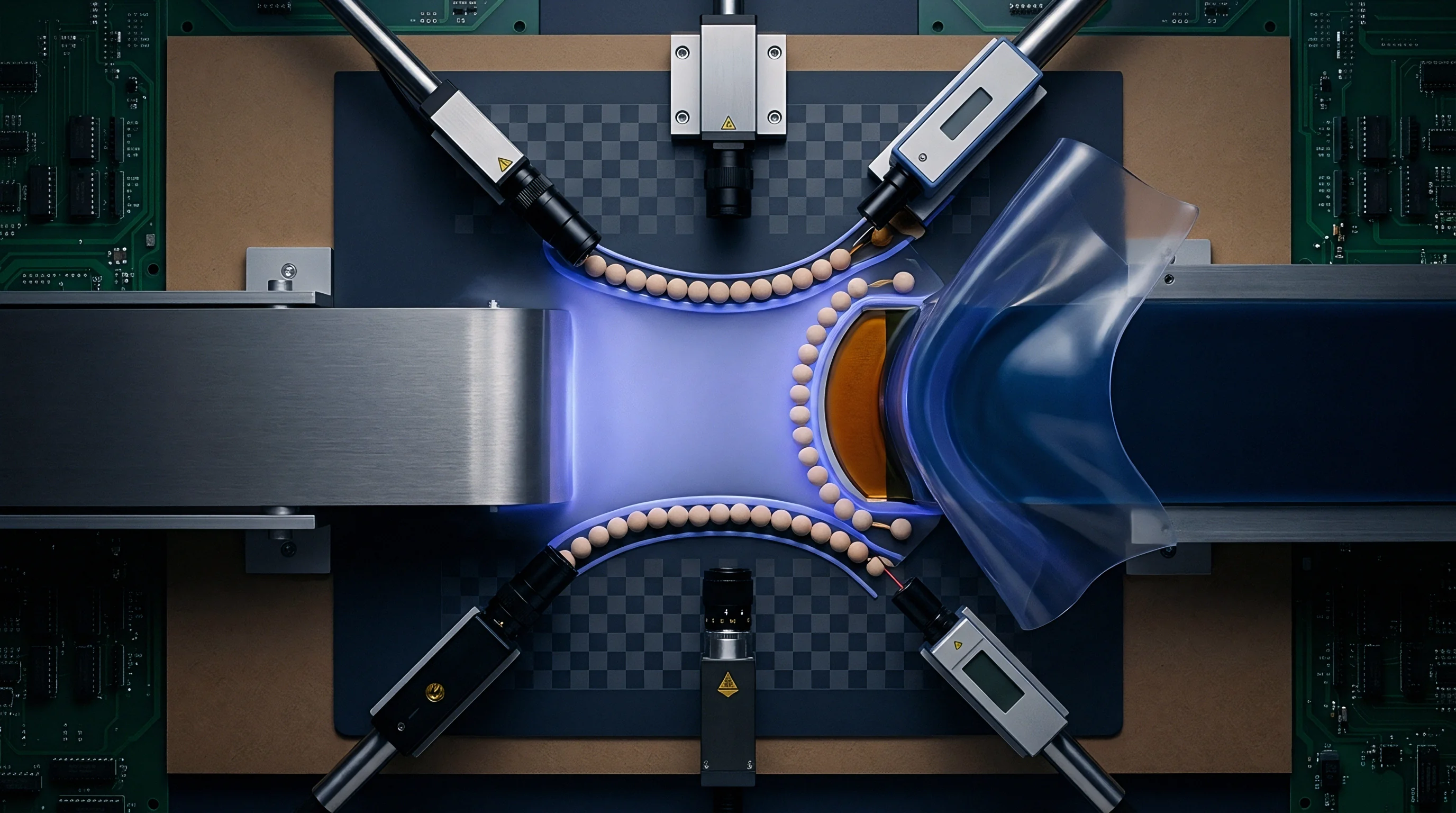
Mitigating sub-micro-g thermal hysteresis requires attenuating wideband thermal gradients before dynamic heat flux reaches the resonant beams. Thermal low-pass filtering integrates physical thermal resistance layers and high thermal capacitance elements directly into the sensor mounting path. A high-conductivity copper-tungsten or molybdenum heat spreader plate positioned beneath the ceramic package redistributes localized heat flux evenly across the package footprint, suppressing sharp spatial gradients.
In high-precision inertial systems, structural isolation frames etched into the silicon substrate provide an internal thermal barrier that enforces spatial uniformity across the proof mass suspension.
Micro-machined silicon isolation frames isolate the active sensor core from the outer die frame using slender folded-beam tethers. These silicon tethers exhibit high thermal resistance due to their long conduction path lengths and narrow cross-sectional areas. The active sensor core functions as a thermal capacitor, while the slender tethers function as thermal resistors, creating a lumped-parameter thermal RC low-pass filter with a cutoff frequency well below 0.05 Hertz.
Dynamic heat flux entering through package edges dissipates uniformly around the perimeter, ensuring that heat reaching the internal core diffuses isothermally across the differential resonant beams.
Under MIL-STD-883 Method 1012, thermal isolation structures that attenuate package-to-core conduction bandwidth below 0.02 Hertz eliminate transient thermal hysteresis within wideband environments.
Complementing passive low-pass thermal filters, active micro-ovenization stabilizes the immediate mechanical core temperature above ambient extremes. Integrated thin-film platinum heaters and resistive temperature detectors fabricated directly onto the silicon substrate maintain core temperature at 85 degrees Celsius with micro-Kelvin precision. Implementing active micro-ovens introduces severe power consumption challenges for battery-operated platforms, shifting system trade-offs toward ultra-low-power localized heating zones surrounding the resonant beams rather than heating the entire proof mass structure.

Mechanical Isolation Pedestals and Thermal Resistance Routing
Mounting the silicon sensor die on a micro-machined glass or silicon pedestal establishes an effective spatial buffer against package stress and thermal gradients. Borosilicate glass substrates, such as Schott Borofloat 33, offer thermal conductivities near 1.2 Watts per meter-Kelvin, approximately two orders of magnitude lower than silicon. Anodic bonding joins the glass pedestal to the silicon sensor wafer at 400 degrees Celsius under an electrostatic potential of 800 Volts, creating a rigid hermetic joint with minimal residual stress.
Heat entering through the package base must traverse the glass pedestal before reaching the accelerometer die, smoothing steep spatial gradients into a slow, uniform thermal rise.
The mechanical footprint of the pedestal must balance thermal resistance against shock survivability. A narrow central pedestal anchor limits the conduction area, maximizing the thermal time constant and decoupling the die from packaging warpage. However, an excessively narrow pedestal lowers structural resonance frequencies, making the accelerometer assembly vulnerable to cross-axis shock and acoustic vibration rectification.
Optimizing pedestal geometry via finite element analysis yields an anchor area between 15 percent and 25 percent of the total die area, preserving shock survival up to 1,500 g while attenuating dynamic thermal gradients.

Will Chip-Scale Evacuation Suppress Convective Gradient Coupling?
Gas-phase convective coupling across internal package voids introduces parasitic thermal paths that bypass structural conduction filters. Operating resonant silicon accelerometers at high vacuum levels below 0.01 Pascal serves two essential functions: suppressing squeeze-film air damping to sustain mechanical quality factors above 50,000, and eliminating gas conduction across the package cavity. At pressures below 0.1 Pascal, the mean free path of gas molecules exceeds the internal cavity dimensions, transitioning heat transfer from continuum conduction into free molecular flow governed by Knudsen formulations.
Chip-scale getter integration maintains high-vacuum hermeticity across multi-year operational lifespans. Non-evaporable getter thin films, deposited onto the inner cavity of a silicon or glass cap wafer, absorb outgassed hydrogen, water vapor, carbon monoxide, and oxygen following wafer-level vacuum sealing. Wafer-level encapsulation using gold-silicon eutectic bonding at 363 degrees Celsius creates an ultra-clean hermetic micro-environment.
Eliminating convective and gaseous conduction ensures that heat propagates exclusively through the engineered, mechanically isolated conduction tethers, preventing random air currents from projecting asymmetric thermal gradients onto the vibrating tines.
Real-Time Dual-Mode Frequency Tracking Architectures
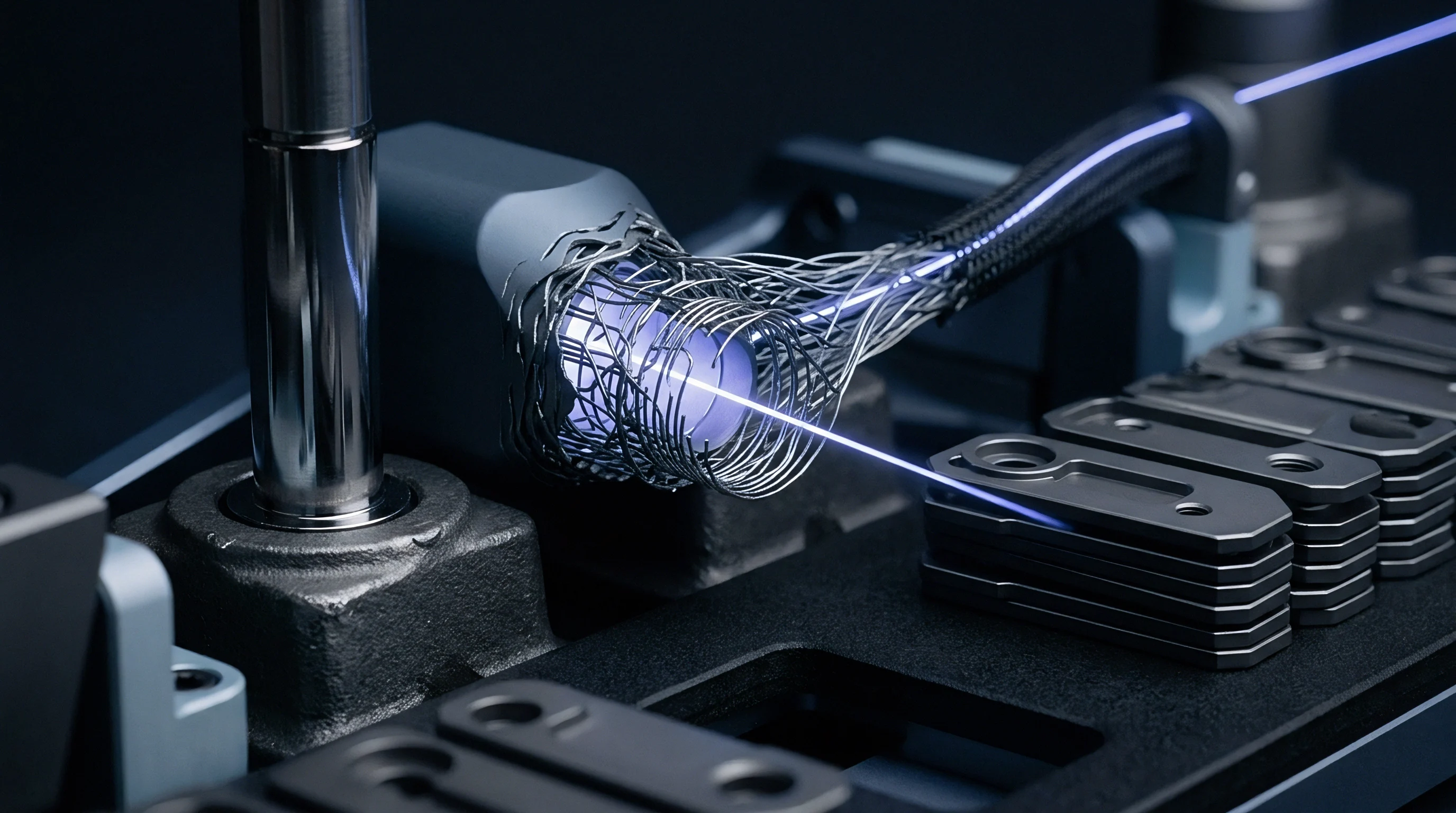
Electronic mitigation of gradient-induced hysteresis relies on tracking multiple mechanical modes within the resonant structure. Driving a single resonator in two simultaneous vibration modes eliminates the physical separation between sensor and thermometer. The signal processing chain executes a deterministic sequence to isolate inertial acceleration from gradient-induced stresses:
- Phase-locked resonance tracking locks the primary sustaining loop to the fundamental anti-phase flexural mode using automatic gain control, preserving mechanical linearity at high vibration amplitudes.
- Secondary modal interrogation drives the out-of-plane torsional resonance simultaneously via frequency-division multiplexing, measuring local beam temperature without introducing parasitic drive-axis cross-coupling.
- Differential frequency synthesis extracts the instantaneous temperature trajectory directly from the modal difference frequency, calculating localized thermal slew rates with millisecond response bandwidths.
- Real-time polynomial synthesis adjusts the acceleration output using dynamic differential time-derivative coefficients, neutralizing thermal hysteresis loops before readings enter the inertial navigation computer.
Combining dual-mode tracking with physical thermal low-pass filtering establishes a resilient defense against wideband thermal excitation. Passive filters attenuate high-frequency gradient components above 0.1 Hertz, while digital dual-mode compensation eliminates low-frequency residual offsets down to DC levels. This coordinated architecture maintains sub-micro-g bias stability even when external thermal gradients exceed 10 Kelvin per minute.
Engineering teams that skip wafer-level thermal filtering find their sensors failing flight qualification trials under ambient transition testing.


Verdict
Specifying resonant silicon accelerometers for sub-micro-g navigation platforms requires aligning physical transduction mechanisms with strict commercial procurement criteria. System designers evaluate resonant accelerometers against closed-loop capacitive micro-electromechanical sensors and high-performance quartz flexure instruments. Capacitive sensors exhibit low noise floors at low frequencies, but suffer from electrostatic spring softening and dielectric charge accumulation that induce unpredictable long-term bias drift.
Quartz flexure instruments provide excellent bias stability below 1 micro-g, but require complex manual assembly, high operating power, and individual precision calibration, resulting in unit costs exceeding 10,000 dollars.
Silicon resonant accelerometers manufactured via wafer-scale deep reactive ion etching provide an attractive balance between manufacturing scalability and navigation-grade performance. Monocrystalline silicon exhibits no intrinsic material dislocation creep at temperatures below 400 degrees Celsius, ensuring absolute mechanical stability of the sensing core. Sourcing difficulties emerge not from silicon fabrication, but from specialized packaging, die attach, and screening procedures required to guarantee sub-micro-g bias repeatability under wideband thermal transients.
Only a small group of specialized packaging facilities worldwide possess the automated tooling needed for fluxless gold-tin eutectic bonding and wafer-level getter activation.
Procurement dossiers must explicitly link bias stability specifications to quantified thermal gradient environments. Standard commercial datasheets frequently advertise bias stability of 0.5 micro-g measured under static isothermal conditions inside an oil bath or temperature-controlled test chamber. That same sensor demonstrates 20 to 50 micro-g bias hysteresis when subjected to a 2 Kelvin per minute thermal ramp in an open air environment.
Sourcing engineers ensure compliance by requiring suppliers to verify bias repeatability during continuous dynamic thermal cycling over the entire specified military or industrial temperature range.

Qualification Criteria for Strategic Navigation Accelerometers
Incoming inspection protocols for high-rel micro-accelerometers require screening procedures designed to weed out units with subtle die attach defects, internal voiding, or package seal imperfections. The procurement qualification matrix incorporates specific environmental and mechanical screening gates:
- Dynamic thermal slew testing subjects 100 percent of production units to continuous 5 Kelvin per minute ramps between -40 degrees Celsius and 85 degrees Celsius, rejecting components exhibiting bias hysteresis wider than 1 micro-g.
- Acoustic micro-imaging inspects the gold-tin eutectic bond line beneath the silicon die, verifying that total voiding remains below 5 percent of the total attachment area with zero perimeter voids.
- High-temperature bake stabilization bakes unpowered parts at 125 degrees Celsius for 168 hours to accelerate any residual viscoelastic relaxation within package sealants prior to final electrical calibration.
- Residual gas analysis punctures sample hermetic packages from each wafer lot under mass spectrometry, confirming cavity vacuum remains below 0.05 Pascal with zero detectable moisture content.
Dual-source procurement strategies face steep technical hurdles in navigation-grade resonant sensing. Because the thermal and mechanical behavior of the sensor die couples directly to its package layout, pin placement, and die attach geometry, substituting an alternate wafer foundry or packaging subcontractor alters the dynamic thermal response of the entire accelerometer subsystem. An alternate component qualifying under static isothermal temperature sweeps will exhibit divergent bias trajectories under transient thermal gradients, invalidating embedded navigation compensation firmware.
Sourcing teams handle this dependency by qualifying the entire sensor-package-firmware assembly as an indivisible functional unit, securing wafer lot reserves that cover full operational production lifecycles.