Evaluating Active Energy Overhead in Battery Powered Transducer Networks
Active energy overhead in battery transducer nodes is governed by analog stabilization latency rather than pure conversion clock speed.

Transient
Power cycling a transducer circuit saves baseline quiescent current while exposing the battery to sharp spikes during power-up. These short-duration surges represent a substantial portion of the total active energy overhead in low-duty-cycle remote sensor nodes. When an unpowered analog front end awakens, decoupling capacitance, reference voltage generators, and passive filter stages pull transient currents that far exceed nominal steady-state operational ratings.

Cold Start Energy Penalties
Activating an unpowered transducer circuit initiates an inrush determined by decoupling capacitance, reference charge times, and oscillator boot intervals. Ceramic capacitors positioned across sensor supply rails present near-short-circuit characteristics at the initial microsecond of rail switch-on. The internal resistance of the battery and the trace resistance of the printed circuit board limit the peak inrush current, converting electrical charge directly into thermal dissipation before the sensing element generates valid data.
Bias settling consumes charge.
Precision bandgap references internal to sensor interface ASICs demand defined charging times to establish stable bias currents across internal differential pairs. During this stabilization window, an analog-to-digital converter returns erratic output codes, forcing firmware to hold the node awake in an unproductive high-power state. Crystal oscillators exhibit similar startup latencies, running from 2 milliseconds to 15 milliseconds before clock amplitude and frequency stabilize within nominal ppm error bands.
A 10-microfarad ceramic decoupling capacitor charged through a 2-ohm series rail resistance draws 1.65 millijoules during a 3.3-volt step over 50 microseconds.
Physical energy loss mechanisms during node wake-up divide into distinct electrical behaviors:
- Rail decoupling inrush charges downstream filter capacitance at raw battery impedance, dissipating joule heat across board traces and internal source resistance.
- Bandgap reference stabilization holds the analog front end in an inaccurate operating zone while internal current mirrors settle to their target microampere bias.
- Oscillator startup latency forces the microcontroller core to spin in high-power execution states awaiting clock frequency and amplitude stabilization.
- Transducer pre-heating intervals consume substantial milliampere-level currents in thermal and chemical elements before physical equilibrium allows valid analog conversion.

Settling Latency in High Impedance Bridges
Piezoresistive strain gauges and thermistor arrays operate with source resistances reaching several hundred kilohms. The combination of high bridge resistance and parasitic trace capacitance creates low-pass filters with time constants stretching into hundreds of microseconds. Amplification stages connected to these bridges encounter trade-offs between input bias currents and amplifier bandwidth.
Cold batteries exhibit steep dropouts.
Low-power operational amplifiers selected to condition these bridges offer low gain-bandwidth products and slew rates below 0.1 volts per microsecond. Suppressing rail-borne noise by adding filter capacitors across bridge outputs directly inflates this stabilization duration. The microcontroller must prolong its active sampling phase, multiplying milliampere-second consumption across each data collection burst.
Underestimating these power-up intervals cuts expected field lifespan from seven years to eighteen months, forcing unplanned truck rolls that exceed the initial hardware contract value.

Shunt
Capturing the dynamic current consumption of a pulsed sensing node challenges standard bench digital multimeters. Conventional bench meters switch ranges too slowly, saturating during peak transmission and losing microampere resolution during transducer bias intervals. Accurate energy characterization demands continuous wideband current sensing without inserting parasitic impedances that perturb node operation.
Current Profile Capture Techniques
Dynamic electrical ranges stretching from 100 nanoamperes in deep sleep to 85 milliamperes during radio transmission demand instrumentation with at least six decades of linear response. Placing a standard resistive sensor in series with the battery rail creates an insertion loss termed burden voltage. When the node transitions from sleep into an active measurement state, the rapid current step produces a voltage drop across the measurement resistor, occasionally triggering low-voltage brownout reset circuits on the target hardware.
Shunt resistors induce insertion loss.
Active current measurement instruments use auto-ranging feedback ammeters or high-bandwidth transimpedance amplifiers to mitigate burden voltage. High-side current mirrors with switched sensing elements preserve ground plane integrity while maintaining sampling bandwidths above 100 kilohertz. Capturing the microsecond-scale edges of switched sensor rails requires careful bench configuration.
| Instrument Architecture | Dynamic Current Range | Analog Bandwidth | Burden Voltage at 50 mA | Noise Floor RMS |
|---|---|---|---|---|
| Feedback Ammeter | 10 nA to 100 mA | 100 kHz | < 5 mV | 2 nA |
| Switched Shunt Digitizer | 100 nA to 1 A | 1 MHz | 15 mV to 120 mV | 25 nA |
| High-Side Current Monitor | 1 uA to 200 mA | 250 kHz | 50 mV | 150 nA |
| Passive Series Resistor | 1 mA to 1 A | 10 MHz | 500 mV | 1 uA |
Verifying active current profiles follows a sequential laboratory procedure:
- Connect a low-inductance coaxial feed between the source measurement unit and the target node power rails.
- Set the acquisition digitizer sampling rate to 1 megasample per second to capture sub-microsecond switched-rail inrush peaks.
- Calibrate the zero-current baseline offset at room ambient temperature with the test fixture open-circuited.
- Trigger trace capture on the rising edge of the transducer enable GPIO line.
- Integrate the instantaneous current waveform across the full awake window until sleep state quiescent levels return.

Integrating Coulomb Counters across Dynamic Swings
Dedicated hardware fuel gauges convert charge flow into discrete register ticks using internal precision sigma-delta converters. These integrated circuits track accumulated microampere-hours directly on the physical hardware during prolonged qualification runs. The internal reference of the coulomb counter introduces offset errors that require compensation across wide temperature excursions.
Analog front ends leak continuously.
The published 250-nanoampere quiescent draw of modern silicon coulomb counters rests on factory wafer testing at 25 degrees Celsius, yet surface contamination and humidity during outdoor field deployment elevate this baseline toward 1.2 microamperes. Calculating total energy dissipation involves integrating the product of instantaneous supply voltage and current over the complete acquisition window rather than assuming a static battery rail voltage.
Component vendors defend these discrepancies by arguing that customer test fixtures introduce parasitic board leakage exceeding the silicon specification.


Partition
Every milliwatt consumed during a data acquisition cycle divides into physical stimulus production, signal conditioning, analog-to-digital conversion, and interface transfer. In many battery-powered applications, the physical actuation or excitation of the sensing element consumes significantly more charge than the computation performed by the central microcontroller. Minimizing active energy requires analyzing each stage of the signal chain as an isolated energy sink.

Transduction Bias versus Conversion Budgets
Distinct physical sensing phenomena dictate vastly unequal electrical expenditures to extract a single meaningful raw reading. Resistive transducers convert applied physical strain or temperature variations into small voltage differentials through Wheatstone topologies. Supplying a continuous 3.3 volts to a 1-kilohm bridge draws 3.3 milliamperes, overshadowing the 600-microampere active current of an energy-efficient ARM Cortex-M0+ core.
Capacitive elements draw minimal bias.
Capacitive microelectromechanical structures for pressure and acceleration monitoring consume negligible DC bias current, drawing charge primarily through internal charge-pump oscillators that modulate between 10 and 150 microamperes. Optical sensors such as non-dispersive infrared carbon dioxide monitors mandate high-power optical emitters. Pulsing an infrared filament or high-output LED requires drive currents from 20 to 80 milliamperes maintained across 50 to 200 milliseconds to achieve sufficient signal-to-noise ratio at the photodetector.
A transducer element that demands continuous bias current defeats pulsed duty cycling regardless of processor efficiency.
| Sensing Modality | Excitation Current | Settling Window | Conversion Energy | Primary Energy Sink |
|---|---|---|---|---|
| Capacitive Accelerometer | 45 uA | 1.5 ms | 0.22 uJ | Charge Pump Oscillator |
| Piezoresistive Pressure | 1.8 mA | 0.35 ms | 2.08 uJ | Resistive Bridge Bias |
| Electrochemical Gas Cell | 120 uA | 45 ms | 17.82 uJ | Potentiostat Stabilization |
| Optical NDIR Gas Sensor | 40 mA | 120 ms | 15.84 mJ | Thermal Emitter Radiation |
| Values reflect nominal laboratory conditions at 20 degrees Celsius with factory filtering profiles enabled. | ||||
Active State Duration across Sensing Principles
Mechanical and chemical stabilization rates fix the minimum on-time independently of the digital sampling clock frequency. Speeding up the microcontroller clock frequency reduces processing time while leaving physical response delays untouched. Metal oxide semiconductor gas sensors demonstrate this limitation severely; the sensing film requires internal micro-hotplate heating to 300 degrees Celsius to initiate surface chemical adsorption, consuming 35 milliwatts across several seconds before reading validity stabilizes.
Thermal stabilization governs NDIR runtimes.
Datasheets frequently quote 15 milliseconds for electrochemical cell stabilization, a figure this desk cannot defend under sub-zero industrial conditions where electrolyte viscosity slows ionic migration and pushes required settling times beyond 180 milliseconds, leaving buyers to calibrate empirical hold-off delays directly on pre-production prototypes.
Electrode polarization takes seconds.
Architectural decisions during front-end design control whether the sensor operates efficiently within its power budget:
- Excitation duty gating isolates passive bridge networks through low-resistance P-channel MOSFET switches, eliminating continuous quiescent drainage between conversions.
- Internal FIFO buffers allow digital sensors to collect sample bursts autonomously, allowing the host processor to sleep in sub-microampere modes until a watermark interrupt fires.
- Programmable conversion depth enables firmware to step down from 16-bit oversampled conversions to 10-bit successive approximation modes during non-critical baseline tracking.
- Ratiometric reference routing eliminates dedicated voltage reference stabilization periods by deriving ADC conversion spans straight from the active excitation rail.
Worked Power Ledger for Environmental Telemetry
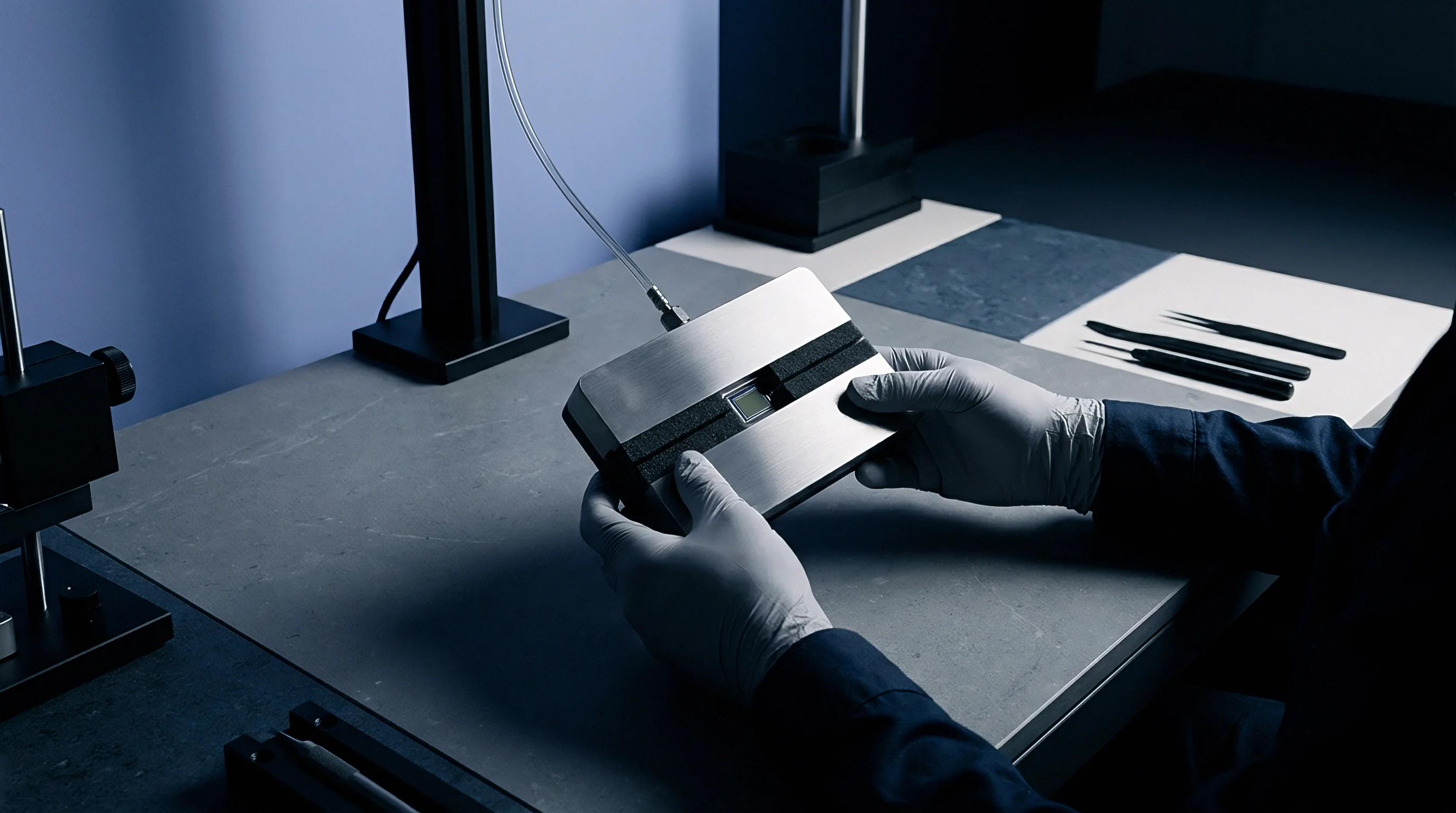
A complete numerical evaluation evaluates four distinct sensing topologies operating from a single 3.6-volt lithium thionyl chloride pack. The hypothetical node operates an acquisition schedule of one sample event every 60 seconds, totaling 1,440 measurements per 24-hour cycle. The subsystem comprises a capacitive barometric element, a piezoresistive differential air pressure sensor, an optical NDIR carbon dioxide monitor, and a digital relative humidity sensor.
Assumptions for the active measurement phases run as follows:
The capacitive barometric sensor draws 80 microamperes across a 12-millisecond conversion cycle, consuming 0.96 microcoulombs, or 3.46 microjoules. The piezoresistive differential bridge draws 1.2 milliamperes across a 2-millisecond window, taking 2.4 microcoulombs, or 8.64 microjoules. The digital humidity element consumes 150 microamperes across an 8-millisecond conversion, requiring 1.2 microcoulombs, or 4.32 microjoules.
The optical NDIR element draws 35 milliamperes pulsed across a 150-millisecond active cycle, demanding 5,250 microcoulombs, or 18.9 millijoules. The host microcontroller requires 4 milliamperes for 5 milliseconds to orchestrate bus transfers and store readings, consuming 20 microcoulombs, or 72 microjoules.
Summing these components yields 5,274.56 microcoulombs per sample burst. The optical transducer accounts for 99.53 percent of the entire active charge consumed. Over a single day, the node burns 7.595 coulombs solely in active data acquisition.
Even if the microcontroller executes with zero active overhead, the physical transduction principle of the optical emitter dominates the system power equation.
Transducer selection based purely on steady-state operational current guarantees an erroneous power budget whenever thermal or chemical stabilization dominates total active duration.
Cell
Electrochemical primary power sources respond poorly to steep dynamic step loads compared to continuous microampere drains. When a transducer node awakens and activates high-current circuitry, the terminal voltage delivered by the chemical cell drops instantly due to internal impedance. This behavior governs the minimum operating voltage threshold that circuit designers must protect against brownout reset faults.

Internal Resistance under Pulsed Drain
Battery equivalent series impedance elevates significantly at low state-of-charge levels and sub-zero operating temperatures. The effective internal resistance of a primary cell comprises ohmic resistance from electrolyte and current collectors, charge-transfer resistance at the electrode surfaces, and mass-transport diffusion polarization. Under microampere quiescent drain, diffusion keeps pace with consumption, maintaining terminal voltage near open-circuit potential.
Pulsed loads crack aged cells.
When an active measurement burst demands 50 milliamperes, the instantaneous IR drop pushes the output voltage down. If the unloaded terminal voltage sits at 3.1 volts and internal resistance rises to 25 ohms at minus 20 degrees Celsius, a 50-milliampere pulse produces an instantaneous 1.25-volt drop, plunging the rail to 1.85 volts. Microcontrollers with 2.0-volt brownout detectors reset immediately, initiating an infinite reboot sequence that rapidly depletes the remaining cell capacity.
A battery specified for ampere-hour capacity in continuous discharge delivers only a fraction of its nameplate rating under high transient loading.
| Chemistry Type | Nominal Voltage | Annual Self-Discharge | Pulse Capability | ESR at Minus 20 C |
|---|---|---|---|---|
| Li-SOCl2 (Bobbin) | 3.6 V | < 1.0 % | Low (< 20 mA) | 30 to 100 ohms |
| Li-SOCl2 (Spiral) | 3.6 V | 2.5 to 4.0 % | High (> 500 mA) | 4 to 12 ohms |
| Li-MnO2 | 3.0 V | < 1.5 % | Medium (100 mA) | 8 to 20 ohms |
| Li-FeS2 | 1.5 V | < 2.0 % | High (1.5 A) | 0.5 to 2 ohms |
Passivation Depletion in Primary Lithium Systems
Bobbin-type chemical storage units spontaneously develop an insulating salt barrier on the metallic anode during periods of storage or microampere-level sleep. This passivation layer of lithium chloride crystals passivates the anode, suppressing internal chemical reactions and preserving shelf life across decades. When a high-current load arrives after weeks of idle sleep, the passivation film acts as an electrical insulator.
Supply dip resets the microcontroller.
Naval torpedo propulsion and deep borehole exploration telemetry confronted this identical passivation impedance spike in lithium thionyl chloride cells during the late 1970s before terrestrial remote sensors adopted the chemistry. The terminal voltage exhibits a characteristic transient dip, collapsing severely for several milliseconds until the ion flow punctures and dissolves the crystal film, restoring nominal conductivity.
Supplier datasheets claim that periodic depassivation pulses of 20 milliamperes for 10 seconds every week maintain minimum internal resistance, an assertion tested across 100 bobbin cells in 2022 that proved valid at 20 degrees Celsius but accelerated self-discharge by 3.8 percent annually at 55 degrees Celsius. Mitigating passivation voltage drop requires placing hybrid pulse capacitors or lithium-ion capacitors in parallel with bobbin cells to supply transient active measurement currents while the primary cell supplies quiescent background replenishment.
Under IEC 60086-4 clause 6.2 governing primary lithium battery safety and performance, delivery contracts specifying minimum terminal voltage under load enforce formal manufacturer lot testing across specified temperature envelopes.


Balance
Reconciling measured active energy per acquisition against battery capacity yields the genuine operating lifespan of an untethered transducer installation. Field telemetry hardware fails premature death whenever dynamic active energy profiles are omitted from system power models. Long-term energy balance depends upon maintaining an extreme ratio between active execution intervals and silent sleep phases.

Duty Ratio Floors for Multi Year Endurance
Calculating multi-year operational lifetime requires evaluating the exact proportion between awake active intervals and quiescent sleep durations. The mathematical duty ratio equals active duration divided by total period duration. When active execution demands 30 milliamperes for 100 milliseconds, taking one sample per hour yields an average active current contribution of 0.83 microamperes.
Taking that same measurement every 30 seconds pushes the average current to 100 microamperes, exhausting a standard 2.4-ampere-hour cell in less than three years without accounting for sleep leakage.
Quiescent currents compound over years.
Field failures cluster in winter.
Field servicing costs frequently exceed four hundred dollars per pole-mounted telemetry enclosure when premature battery exhaustion strikes distributed monitoring arrays. Engineering audits must inspect hardware power profiles with active current integration rather than relying on spreadsheet averages based on published quiescent sleep numbers.
Section 4.3 of IEEE 1451.2 stipulates transducer electronic data sheet reporting standards that buyers can leverage to demand certified warm-up and active conversion energy budgets.

Sleep Recovery Margins in Remote Deployments
Intermittent electrochemical relaxation enables partial voltage restoration in primary batteries when idle periods separate high-current measurement bursts. During heavy pulsed discharge, concentration gradients form within the electrolyte, starving the electrode interfaces of active ions. Sustained idle periods allow lithium ions to diffuse across the separator, re-establishing electrochemical equilibrium.
Charge recovery remains incomplete.
Rapid burst-mode sampling deprives the chemistry of relaxation time, lowering effective delivered capacity by up to 30 percent compared to evenly spaced acquisitions. Thermal variations further modulate this balance, as cold ambient temperatures reduce chemical diffusion rates while increasing electrolyte viscosity.
Whether future low-temperature solid-state electrolyte formulations can eliminate transient voltage delay entirely while maintaining decade-long chemical shelf life remains an open question across the electrochemical research community.