
Establishing Measurement Traceability Chains for Industrial Pressure Transducers
Establishing pressure traceability requires calculating complete uncertainty budgets and enforcing accredited test ratios to prove sensor claims.
Establishing pressure traceability requires calculating complete uncertainty budgets and enforcing accredited test ratios to prove sensor claims.

Quantifying test uncertainty and parametric drift through guardbanding and thermal acceleration equations prevents field returns and secures accurate component tolerances.

Wafer trim establishes initial sensor accuracy classes, but package stress and thermal drift determine field performance and calibration costs.

Metrological verification of high-temperature piezoresistors requires quantified drift kinetics, four-wire thermal testing, and guardbanded uncertainty budgets.

Lot acceptance for high-temperature MEMS sensors requires GUM uncertainty budgets and guardbanding to mitigate consumer risk across severe thermal envelopes.

Optimizing thermal curvature parameters requires orthogonal polynomial regression across symmetrical bath temperatures to eliminate parameter covariance errors.

Ambient thermal calibration demands fitting parabolic alloy coefficients and correcting thermoelectric offsets to bound resistance drift under operational swings.

Borosilicate hermetic capacitive sensors exhibit non-Fickian hydration drift and mechanical swelling offsets that require kinetics modeling to hold tolerances.
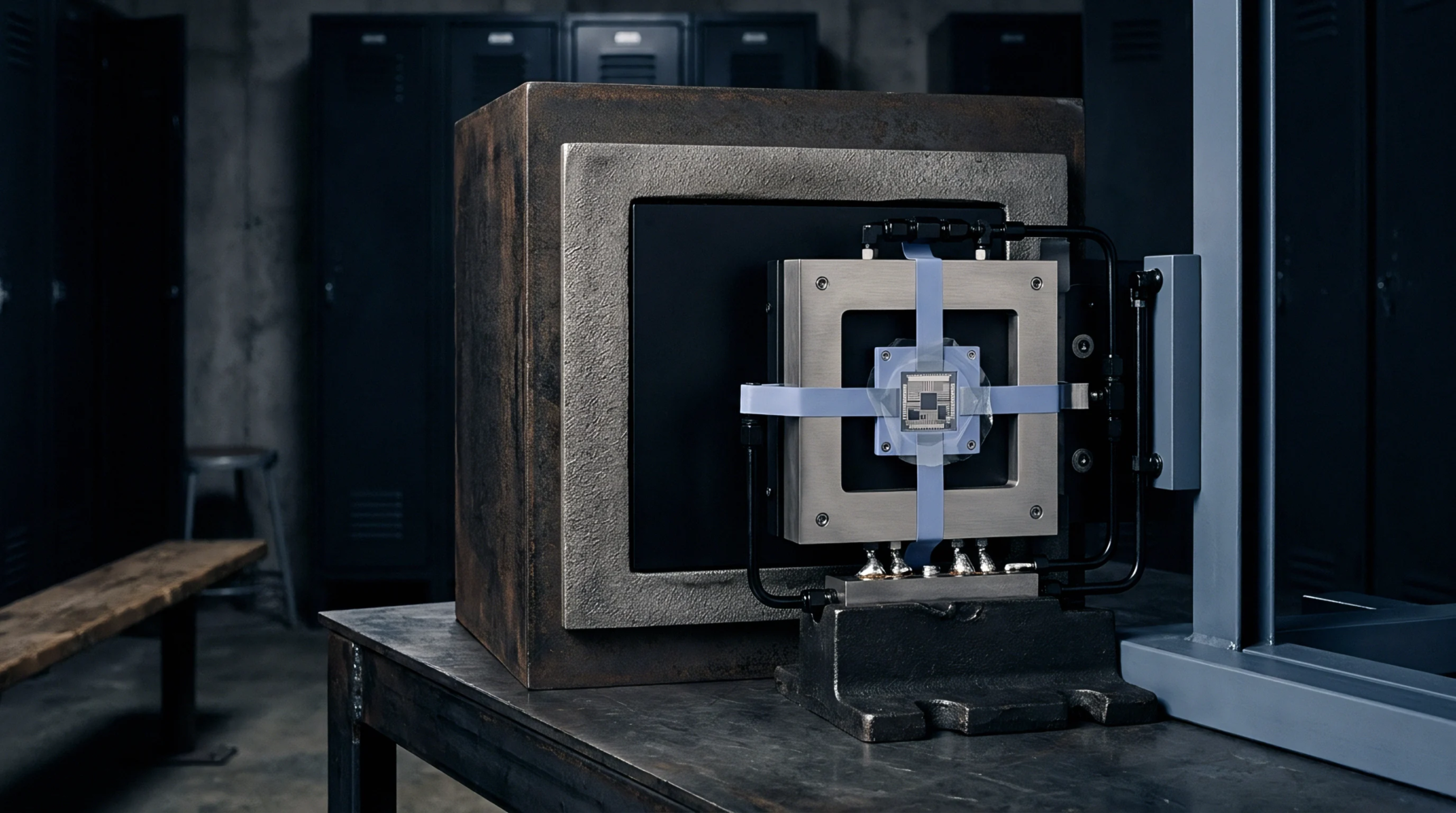
ISO/IEC 17025 uncertainty evaluation combines Type A and B inputs into expanded budgets and applies guardbanded decision rules to manage risk.

Calibration maps sensor error against traceable standards, while drift stems from physical aging, mechanical strain, and environmental stress over time.

Variable acceptance sampling under ANSI ASQ Z1.9 reduces sample size by 70 percent while enforcing strict consumer risk bounds on transducer lot audits.
Expertise is a utility, not a secret. sentiention™ publishes its working knowledge as open reference: intelligence layer covering the materials it sources, the markets it enters, and the reference that serves both.