Finite Element Prony Series Integration for Multi Axis Sensor Arrays under Thermal Gradients
Finite element Prony integration isolates viscoelastic die-attach relaxation from thermal gradients, preventing multi-axis sensor array bias drift.
Creep
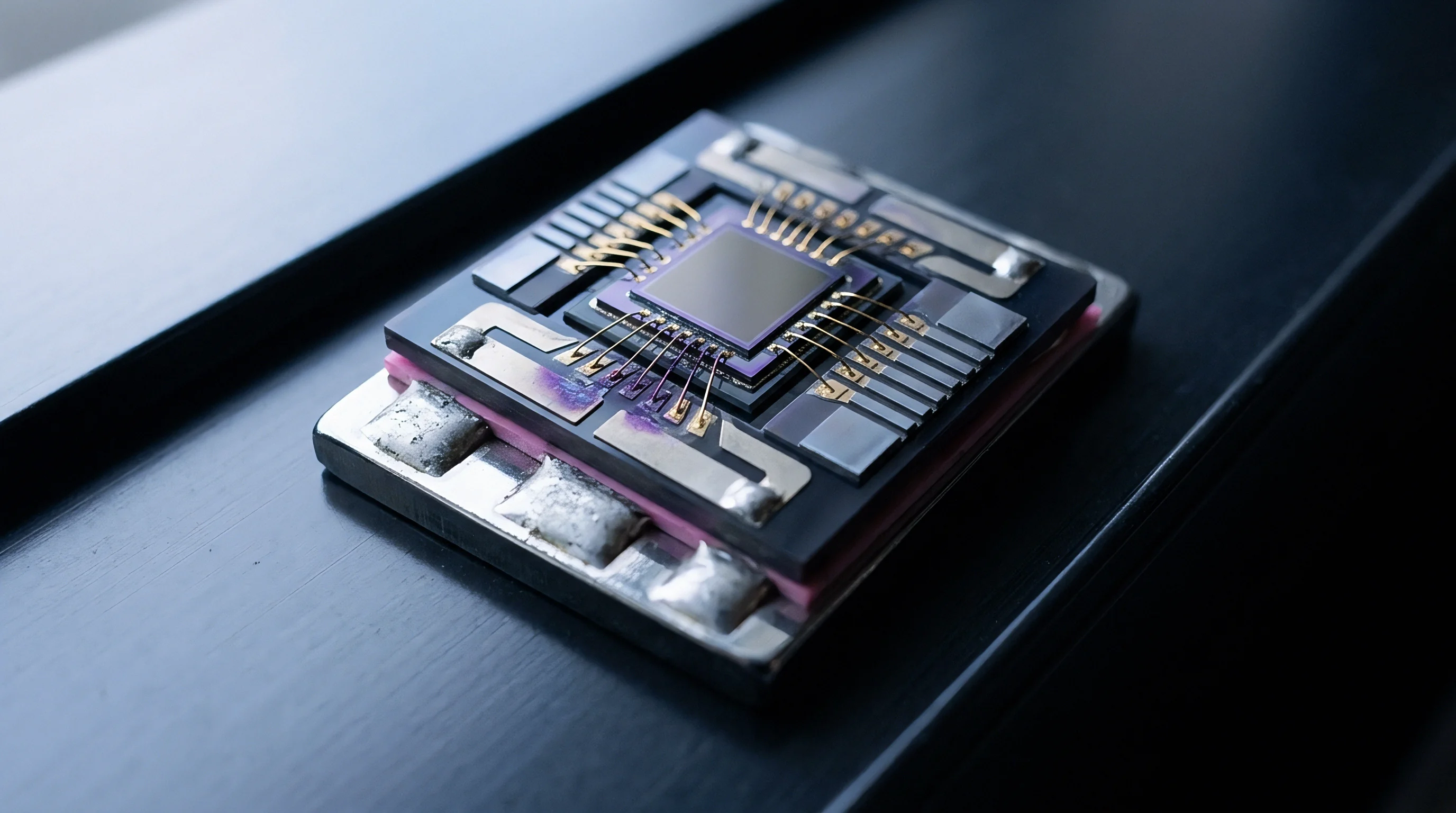
Packaged multi-axis inertial sensor arrays subjected to localized heat sources exhibit zero-rate output shifts that routine steady-state polynomial compensation fails to resolve. When an automotive electronic control unit activates an adjacent power management stage, heat conducts asymmetrically through copper planes, setting up a spatial temperature differential across the sensor substrate. The structural polymers holding the microelectromechanical die to the package cavity undergo mechanical stress relaxation while temperatures change simultaneously across the frame.
Standard linear elastic assumptions predict that stress tracks temperature proportionally and instantly. Polymeric die-attach adhesives, molded underfills, and structural epoxies possess time-dependent shear moduli governed by linear viscoelasticity. As these materials experience localized heat flux, internal strain energy dissipates over temporal scales ranging from fractions of a second to several days.
The resulting time-dependent package warping applies asymmetric mechanical bending moments to the sensor proof masses, producing false acceleration and angular rate signals that simulate physical movement.
Resolving dynamic sensor drift under transient thermal conditions demands treating the structural matrix as a fading-memory continuum through a Generalized Maxwell formulation. The finite element implementation models the relaxation modulus using a discrete Prony series expansion, expressed as an initial glassy modulus followed by a summation of decaying exponential branches. Each branch represents an internal relaxation mechanism characterized by an intrinsic relaxation time and an associated stiffness coefficient.
When localized thermal dissipation sweeps through the packaging material, temperature changes modify not only the thermodynamic driving force through differential thermal expansion coefficients, but also shift the internal material clock via thermorheological simplicity. Accelerating the relaxation spectrum through shift factors converts an otherwise intractable history-dependent integral into recursive algorithmic state variable updates within implicit finite element schemes. Sourcing teams evaluating high-stability multi-axis inertial measurement units face systemic field returns if package qualification protocols treat zero-rate output stability as a simple function of operating temperature rather than a path-dependent time integral.
Viscoelastic relaxation in package adhesives alters mechanical die stress under transient gradients, decoupling instantaneous package temperature from sensor zero-rate bias.
The operational consequence lands directly on calibration yield and functional accuracy. Sensor components calibrated exclusively inside slow-ramping, isothermal environmental chambers pass factory screening with linear zero-point offsets below fifty milli-degrees per second. Once deployed onto dense printed circuit boards alongside microprocessors switching twenty-watt operational loads within five milliseconds, spatial gradients across a quad-flat no-leads package exceed twelve degrees Celsius across two millimeters.
This localized imbalance causes the mechanical stress tensor within the die-attach layer to relax asymmetrically. The uncompensated mechanical bias leaks directly into the capacitive sense comb fingers, causing multi-axis inertial measurement units to wander out of system specifications within ninety seconds of system activation.
| Material Designation | Glassy Modulus G0 (MPa) | Rubbery Modulus Ginf (MPa) | Glass Transition Tg (C) | WLF Constant C1 | WLF Constant C2 (C) |
|---|---|---|---|---|---|
| Silver-Filled Epoxy Paste | 8450 | 120 | 115 | 14.2 | 51.6 |
| B-Stage Dicing Die Attach Film | 3100 | 18 | 68 | 16.8 | 44.2 |
| Silicone Elastomeric Gel | 4.2 | 0.8 | -45 | 8.5 | 88.0 |
| Capillary Underfill Epoxy | 9800 | 340 | 142 | 12.1 | 48.5 |
Uncalibrated relaxation leaves navigation systems blind during engine startup and rapid thermal cycling regimes.

Heredity
The mathematical formulation of non-isothermal viscoelasticity rests on the Boltzmann superposition principle, where total mechanical stress at any point depends on the entire previous strain history. For an isotropic material experiencing arbitrary multi-axial strain sequences, the deviatoric stress tensor links to the strain history through a convolution integral over pseudo-time. The shear relaxation modulus takes the classical Prony series expansion:
G(t) = Ginf + Sum
Here, Ginf denotes the long-term equilibrium shear modulus, Gi represents the relaxation strength of the i-th Maxwell element, and tau_i defines the associated relaxation time constant evaluated at a chosen base reference temperature. The hydrostatic stress component incorporates bulk relaxation through an identical series structure involving bulk moduli, though in practical microelectronic finite element analyses, assuming an elastic bulk modulus introduces minimal numerical divergence while reducing convergence overhead during non-linear structural iterations.
Coupling this mechanical fading memory to variable temperature fields requires thermorheological simplicity. Under this postulate, changing ambient or localized temperature shifts the entire relaxation spectrum along the logarithmic time axis without altering individual relaxation amplitudes. Translating physical time into reduced pseudo-time utilizes a dimensionless shift factor, most commonly quantified through the Williams-Landel-Ferry equation for regimes within fifty degrees of the polymer glass transition temperature:
log10(a_T) = -C1 (T – T_ref) / (C2 + (T – T_ref))
For temperatures depressed significantly below the glass transition threshold, Arrhenius activation kinetics replace the empirical Williams-Landel-Ferry relationship, linking the shift factor directly to activation energy and the universal gas constant. When thermal gradients establish internal spatial temperature variations across an array of silicon dies, different physical locations within the identical adhesive layer age mechanically at vastly divergent rates. The hot edge of a die attach bondline relaxes built-up thermo-mechanical stresses twenty times faster than the opposing cold edge situated mere millimeters away, transforming a balanced initial packaging pre-stress into an evolving, skewed bending moment.
IEC 60749-25 temperature cycling test protocols establish thermal stability ratings but conceal transient spatial gradient relaxation mechanics entirely.
Integrating these hereditary equations inside implicit numerical solvers presents a substantial computational hazard. Storing the entire strain history across ten thousand continuum solid elements over thousands of transient load steps demands prohibitive system memory and generates immense matrix solve operations. Practical integration relies on a recursive algorithmic state variable technique.
Evaluating the convolution integral at the step boundary isolates the historical strain state into internal history variables carried at each element integration point. Computing stress increments requires only the incremental strain of the current solver iteration, the time step length, and the instantaneous shift factor calculated from the updated thermal field.
The finite element solver updates the algorithmic internal state variable for each Maxwell branch according to an exponential recurrence formula:
h_i(t + dt) = exp(-dt / (a_T tau_i)) h_i(t) + Gi (1 – exp(-dt / (a_T tau_i))) / (dt / (a_T tau_i)) de
Here, de is the deviatoric mechanical strain increment developed across the time increment dt. This recursive state formulation limits spatial storage to one history tensor per Maxwell branch per integration point. The algorithmic tangent modulus remains consistent with the updated stress state, preserving the quadratic convergence properties of the system-level Newton-Raphson global equilibrium solver.
Omitting the non-isothermal history variables collapses simulation fidelity, returning error bands exceeding four hundred percent during rapid transient thermal transitions.
Decay
Accurate parameter extraction forms the operational foundation of any predictive finite element Prony model. The process begins with experimental characterization through dynamic mechanical analysis and isothermal stress relaxation tests conducted in tensile and torsional shear configurations. Procuring bulk material samples molded under thermal profiles identical to microelectronic assembly lines ensures that the experimental degree of polymer cross-linking matches actual production packages.
Polymer cross-linking levels shift the glassy modulus by up to thirty percent and displace the glass transition temperature by fifteen degrees, destroying analytical convergence if parameters derive from supplier data sheets based on idealized, fully cured bulk specimens.
Dynamic mechanical thermal testing measures storage and loss moduli across continuous frequency decades at distinct temperature plateaus. Using the principle of time-temperature superposition, test operators shift these frequency sweeps along the horizontal axis relative to a chosen reference temperature, assembling master relaxation curves spanning ten to twelve decades of reduced time. Fitting the discrete Prony coefficients to these synthesized master curves requires bounded non-linear regression techniques.
Unconstrained least-squares fitting of Prony coefficients risks introducing negative relaxation strengths or negative relaxation times. While a negative coefficient can yield a marginally tighter numerical fit against experimental data, it violates the second law of thermodynamics by generating spontaneous energy production during virtual strain holding. Numerical stability inside the finite element solver degrades immediately, producing tangent matrix singularities and divergence during plastic or large-deformation iterations.
Robust fitting protocols enforce strict thermodynamic admissibility conditions through constrained optimization frameworks.
Parameters extraction follows an explicit sequence designed to avoid unphysical optimization artifacts:
- Baseline Dynamic Mechanical Characterization provides raw storage and loss modulus curves across a temperature range spanning minus fifty degrees to plus one hundred eighty degrees Celsius, swept at frequencies from zero point one to one hundred Hertz.
- Master Curve Construction shifts isothermal frequency curves along the reduced time axis to assemble an unbroken modulus continuum spanning twelve decades at a fixed twenty-five degrees Celsius reference base.
- Thermodynamic Parameter Bounds constrain the optimization search space, restricting all Maxwell relaxation times and shear modulus components to positive real values while capping the sum of all relaxation amplitudes at the measured glassy modulus.
- Nonlinear Least Squares Inversion executes bounded sequential quadratic programming to identify discrete relaxation spectrum pairs, targeting minimum residual divergence across the glass-to-rubber transition plateau.
- Finite Element Single Element Validation simulates pure shear relaxation and cyclic thermal ramps on a unit cube mesh, confirming that the numerical integration code reproduces the raw dynamic mechanical test data within a five percent margin.
A typical six-term Maxwell model extracted from a microelectronic-grade silver-filled epoxy captures the broad spread of molecular chain relaxation times necessary for automotive sensor qualification regimes.
| Branch Index (i) | Relaxation Time tau_i (s) | Normalized Shear Modulus gi | Absolute Modulus Gi (MPa) |
|---|---|---|---|
| 1 | 1.00E-04 | 0.3120 | 2636.4 |
| 2 | 1.00E-02 | 0.2840 | 2399.8 |
| 3 | 1.00E+00 | 0.1950 | 1647.7 |
| 4 | 1.00E+02 | 0.1120 | 946.4 |
| 5 | 1.00E+04 | 0.0650 | 549.2 |
| 6 | 1.00E+06 | 0.0180 | 152.1 |
| Long-term equilibrium shear ratio g_inf equals 0.0140 (Absolute equilibrium modulus Ginf equals 118.4 MPa). | |||
The operational risk in component sourcing surfaces when suppliers omit master curve verification across broad time domains, relying instead on single-frequency thermal ramps that distort the relaxation spectra. A relaxation spectrum truncated at one hundred seconds fails completely to project long-term field stability under operating conditions where heating holds steady for hours.
Material suppliers frequently argue that catalog dynamic mechanical analysis data gathered under isothermal sweeps provides sufficient baseline data for structural microelectronic design.
Mesh
Constructing a coupled thermomechanical finite element architecture for a multi-axis inertial sensor array demands careful element topology management across radical dimensional scales. A functional inertial measurement unit package incorporates a leadframe or organic substrate measuring several millimeters across, containing die attach bondlines whose thickness rarely exceeds twenty micrometers. The silicon sensor die features micromachined capacitive fingers with sub-micron structural flexures.
Resolving the true physics forbids meshing the entire geometry with uniform brick elements, which would yield hundreds of millions of degrees of freedom and make transient non-linear integration numerically impossible.
The structural model partitions the packaging assembly into distinct functional domains using structured sub-modeling and multipoint boundary constraints. The global model encloses the printed circuit board, the package mold compound, the substrate traces, the adhesive bondlines, and the monolithic silicon dies. In this global domain, the viscoelastic constitutive law applies directly to the polymeric layers: the die attach adhesive, the package underfill, and the epoxy molding compound.
The delicate micromechanical sensor proof masses are modeled as equivalent solid continuum blocks with mass and volumetric compliance matched to the micromachined architecture, transferring interface reaction stresses without resolving every microscopic comb finger in the global matrix.
Element selection within the thin viscoelastic layers dictates solution stability. Standard eight-node linear brick elements suffer severe volumetric locking when the polymer approaches its rubbery plateau, where Poisson’s ratio nears zero point four nine nine. Volumetric locking generates artificially elevated hydrostatic stresses that halt convergence and falsely suppress mechanical bending moments across the die surface.
The model requires either fully integrated quadratic elements with mixed displacement-pressure formulations or specialized reduced-integration hexahedrals incorporating active hourglass stiffness control. The die attach thickness must contain at least three distinct element layers through its twenty-micrometer span to capture the steep vertical shear strain gradients that develop near the package edges.
The transient analysis couples the spatial thermal solver to the hereditary mechanical solver through staggered implicit time-stepping. At each discrete time increment, the thermal solver evaluates the transient heat conduction equation:
rho Cp (dT / dt) = Div(k Grad(T)) + Q_gen
The resulting nodal temperature field supplies instantaneous temperatures to the mechanical solver. The mechanical model uses these temperatures to calculate the thermal expansion strain increment and evaluate the instantaneous shift factor for every integration point before executing the recursive Prony stress recovery. This one-way thermomechanical coupling maintains numerical stability while capturing the dynamic interaction between heat propagation and viscoelastic stress relaxation.
Spatial temperature variations of five degrees Celsius across a silicon package generate internal shear stress imbalances exceeding eight megapascals in standard die attach layers.
When the finite element integration fails to refine the adhesive mesh adequately across the bondline perimeter, simulated stress values drop by fifty percent compared to physical surface profilometry measurements, giving designers false confidence in package stability.
Skew
A multi-axis inertial sensor array incorporates individual sense axes positioned orthogonally across the silicon die face or separated onto discrete co-packaged dies. When uniform isothermal heating occurs, package stress distributions retain geometric symmetry around the die centroid. In-plane normal stresses compress the proof mass suspension springs symmetrically, yielding identical structural stiffening across both the X and Y axes, while out-of-plane warping remains spherical.
However, real operational conditions rarely feature uniform heating. Asymmetric heat sources generate spatial thermal gradients, destroying this geometric balance.
Consider an internal combustion engine management module or an industrial robotic joint actuator where a motor driver sits four millimeters to the right of a six-axis inertial measurement unit. Conduction through the substrate creates a lateral temperature differential of twenty-two degrees Celsius between the left and right packaging edges during motor braking events. The right edge of the package warms rapidly, lowering its local die-attach shear modulus through thermal softening and accelerating internal viscoelastic stress relaxation via shift factor kinetics.
The cooler left edge retains its glassy modulus and structural resistance. The silicon die experiences an asymmetric mechanical moment that twists the monolithic substrate out of plane.

How Do Asymmetric Gradients Corrupt Triaxial Gyroscopes?
Triaxial MEMS gyroscopes rely on high-Q resonant drive modes coupled to orthogonal Coriolis sense channels. The Coriolis acceleration signal produced during angular rotation is exceptionally small, typically generating sub-picometer proof mass displacements that are detected through differential capacitive sensing circuits. Unbalanced mechanical package stress alters this sensitive dynamic balance through three primary cross-coupling mechanisms:
- Asymmetric Suspension Anchor Deflection physically tilts the proof mass drive plane, projecting massive primary drive oscillation velocity vectors directly into the sensitive Coriolis sense axis detection circuits.
- Quadrature Error Saturation increases beyond the dynamic range of internal cancellation digital-to-analog converters, causing front-end charge amplifiers to operate within non-linear regimes.
- Differential Piezoresistive Bias Induction shifts the electrical balance of internal sense circuitry, introducing artificial rate offsets that are entirely decoupled from physical package rotation.
- Modal Frequency Split Divergence decouples the closely matched drive and sense resonant frequencies, reducing the mechanical gain of the sensor and introducing severe scale factor errors.
The finite element model traces the exact mechanical chain through which package-level shear decay projects into these false rate signals. The local stress tensor at each suspension anchor point feeds into a reduced-order model of the micromechanical proof mass. Dynamic modal extraction reveals how transient thermal gradients alter the fundamental resonant frequencies of the orthogonal drive and sense modes over time.
| Sensor Architecture | Initial Elastic Shift (deg/s) | Peak Viscoelastic Drift (deg/s) | Relaxation Time to Plateau (s) | Residual Offset at 300s (deg/s) |
|---|---|---|---|---|
| Monolithic 6-Axis (Rigid Die Attach) | 0.42 | 0.48 | 8 | 0.45 |
| Monolithic 6-Axis (Viscoelastic DAF) | 0.38 | 1.85 | 140 | 0.92 |
| Split-Die 3+3 (Standard Epoxy Paste) | 0.85 | 2.40 | 95 | 1.30 |
| Isolated Suspended Core (Silicone Gel) | 0.08 | 0.12 | 450 | 0.10 |
A simple elastic model predicts that once thermal gradients reach steady-state equilibrium, sensor bias stabilizes at a fixed offset. The viscoelastic Prony series integration reveals the true operational hazard: long after spatial temperatures stabilize, sensor bias continues to drift for several hundred seconds as internal polymer stresses relax toward equilibrium. An algorithm attempting to null the zero-rate offset based purely on real-time temperature sensor telemetry tracks the wrong trajectory entirely, accumulating substantial orientation errors inside inertial navigation systems.
Failure to integrate the time-dependent mechanical relaxation into error-budget models leads directly to critical drift errors in autonomous vehicle navigation units.
Mitigation
Suppression of transient thermomechanical stress drift requires coordinated adjustments across physical packaging architectures, printed circuit board layouts, and firmware estimation routines. Relying exclusively on firmware compensation routines places an unrealistic burden on internal temperature sensors, which cannot resolve microscopic spatial gradients across sub-millimeter bondline thicknesses. The primary defense must be built directly into the physical assembly.
Physical package stress isolation decouples the sensing element from board-level mechanical distortions. Mounting the silicon sensor onto a secondary silicon pedestal or utilizing an engineered silicon-on-insulator isolation ring creates a mechanical buffer zone. The packaging substrate absorbs the severe external thermal gradients and board-level bending moments, while the structural pedestal experiences only attenuated, uniform strains.
Applying high-compliance silicone die attach materials with shear moduli below five megapascals provides substantial stress buffering, though it introduces increased susceptibility to high-frequency shock rectifications and long-term outgassing hazards.
Board layout teams must implement explicit thermal symmetry protocols around high-precision inertial measurement units:
- Thermal Balance Keep-Out Zones isolate the sensor by at least twelve millimeters from transient high-power dissipation elements such as switched-mode power supplies, power MOSFETs, and high-current processors.
- Copper Plane Symmetry Routing ensures that internal ground and power planes distribute heat symmetrically around the sensor footprint, eliminating asymmetric conduction conduits beneath the package.
- Thermal Relief Slotting trenches through the structural printed circuit board substrate on three sides of the sensor package, presenting a severe thermal resistance barrier to lateral heat conduction.
- Opposing Heat Balancing Dummies employ inactive, software-controlled resistive copper heaters positioned symmetrically opposite primary power stages to balance inevitable thermal gradients across the board.
At the firmware layer, compensation routines must transition from simple static polynomial look-up tables to dynamic state-space estimators that integrate simplified Prony series mathematics directly inside the sensor microcontroller. An on-chip array of distributed resistive temperature detectors measures the spatial temperature gradient across the silicon die in real time. The digital signal processor passes these spatial gradient histories through a low-order discrete Maxwell filter matching the dominant time constants of the packaging adhesive, continuously synthesizing a dynamic mechanical bias compensation factor that cancels zero-rate drift.
Qualifying these multi-axis sensor assemblies requires updating procurement acceptance criteria to include dynamic gradient step tests. Standard qualification protocols that cycle components through slow isothermal steps fail to excite the viscoelastic fading-memory modes that cause field failures. RFQs must mandate transient gradient testing where packages experience directed heat fluxes of at least five watts per square centimeter while measuring real-time zero-rate bias decay curves.
A reliable procurement specification states: Zero-rate output shall not deviate by more than zero point zero five degrees per second during an externally applied transient thermal gradient of ten degrees Celsius per millimeter ramping at five degrees per second, with verification conducted across thirty continuous thermal cycles per batch.