
Discrete Kalman Process Noise Covariance Derivation from Allan Variance Metrics
Allan variance metrics convert directly to continuous noise spectral densities, which integrate over time step dt to form the discrete process noise covariance matrix Q.
Allan variance metrics convert directly to continuous noise spectral densities, which integrate over time step dt to form the discrete process noise covariance matrix Q.

Allan variance isolates sensor white noise, flicker floor, and random walk by evaluating cluster time variances on an isolated seismic bench.

Ratiometric excitation paired with chopper-stabilized instrumentation amplifiers resolves microvolt piezoresistive bridge signals while cancelling thermal drift.
Oxygen ionosorption establishes an intergranular depletion barrier in metal oxide films, producing exponential baseline shifts from thermal and ambient moisture variations.
Sinc zero placement attenuates high-frequency noise, but residual flicker noise and clock phase jitter establish the absolute lower phase drift floor limit.

Allan deviation plots log-log noise slopes to locate the exact averaging window where delta-sigma converter drift overtakes white-noise decimation filtering.
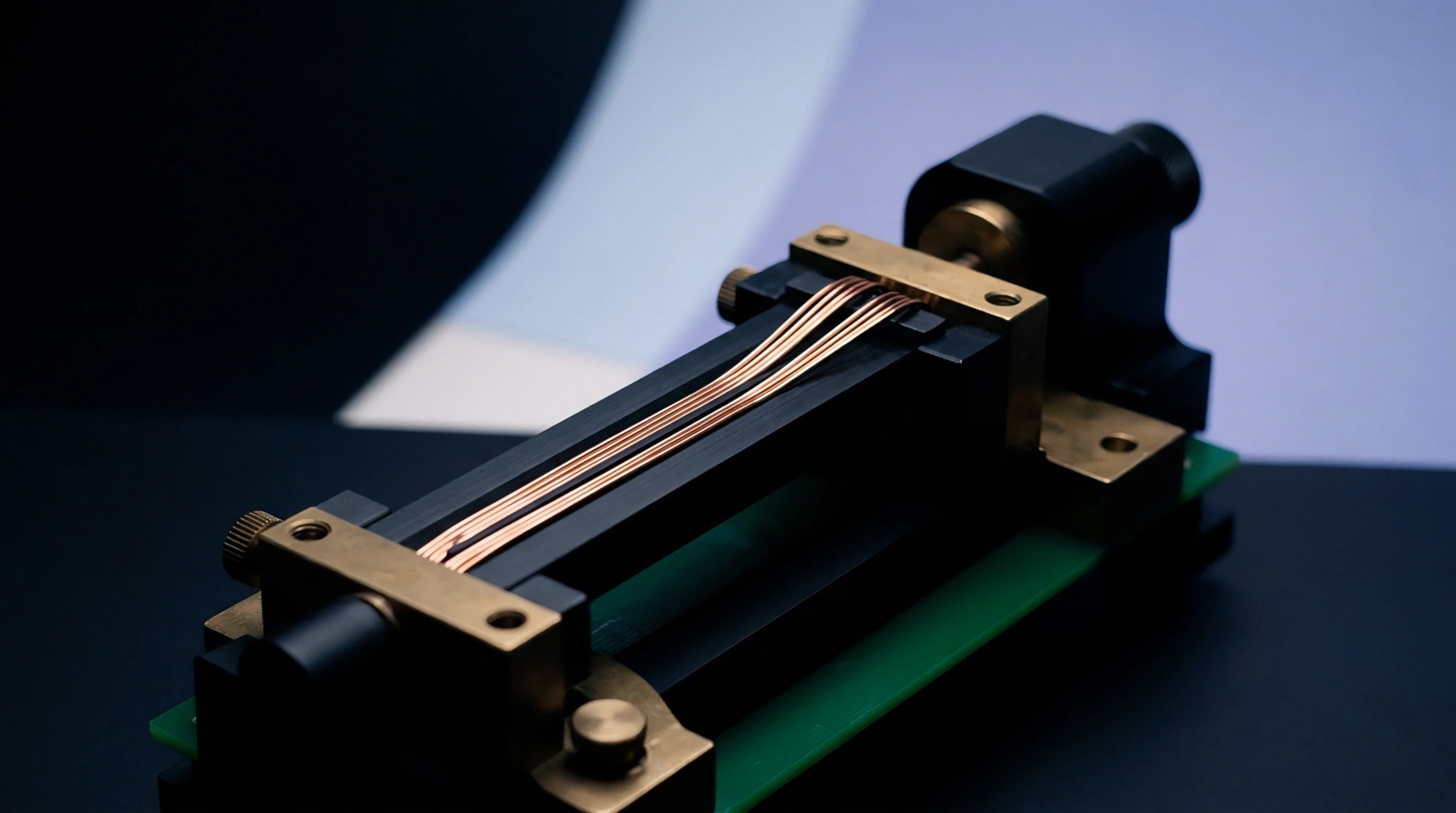
Doping concentration governs the trade-off between piezoresistive gauge factor and thermal drift while crystallographic alignment sets mechanical strain sensitivity.

Dynamic guard phase matching and synchronous clock alignment bound the noise floor and bandwidth limits of high-reactance hybrid transducer front ends.

Adapting piezoresistive and capacitive sensors requires matching source impedance, suppressing parasitics, and isolating conversion noise floors.

Extracting Allan deviation noise parameters demands fitting logarithmic asymptote slopes across discrete cluster time intervals under steady thermal conditions.
Static multi-position gravity inversion separates zero-g offset from scale factor while Allan variance bias instability defines maximum valid integration time.

Square the quotient of specified noise density over target resolution to establish the equivalent noise bandwidth required for averaging filter design.
Expertise is a utility, not a secret. sentiention™ publishes its working knowledge as open reference: intelligence layer covering the materials it sources, the markets it enters, and the reference that serves both.