Metal Oxide Semiconductor Chemisorption Mechanics and Oxygen Ionosorption Baseline Shifts
Oxygen ionosorption establishes an intergranular depletion barrier in metal oxide films, producing exponential baseline shifts from thermal and ambient moisture variations.

Lattice
Tin dioxide surfaces held at 300 degrees Celsius in dry zero air establish a steady-state depletion layer through the extraction of conduction-band electrons by chemisorbed atmospheric oxygen. This electrophysical boundary sets the baseline electrical resistance across sintered polycrystalline grains. When ambient gas profiles shift, or operating temperatures fluctuate by a single degree, the dynamic equilibrium of these surface states breaks, producing resistance baseline wander that host instruments mistake for target gas concentrations.
The electronic transport across an n-type metal oxide grain boundary follows Poisson’s equation evaluated across the space-charge region. Free electrons populate the conduction band from ionized bulk donor sites, predominantly native oxygen vacancies. Molecular oxygen adsorbs physically onto the metal oxide lattice, receives an electron from the conduction band, and pins the surface Fermi level.
This electron extraction creates a region depleted of mobile charge carriers, known as the double Schottky barrier between adjoining grains.
The barrier height relates directly to the areal density of trapped surface charge:
Vs = (e Ns^2) / (2 epsilon_r epsilon_0 Nd)
Here, e represents the elementary charge, Ns is the surface density of ionosorbed oxygen charge, epsilon_r is the relative permittivity of the metal oxide, epsilon_0 is the permittivity of free space, and Nd is the volumetric donor concentration of the semiconductor bulk. Intercrystalline resistance scales exponentially with this potential barrier:
R = R0 exp(e Vs / (k_B T))
The term k_B is Boltzmann’s constant, T is absolute temperature in Kelvin, and R0 represents the flat-band bulk resistance of the core grain. A small deviation in the surface charge density Ns translates through a squared term into the potential barrier Vs, which alters film resistance through an exponential argument. An engineer evaluating an analog frontend circuit must design for raw base resistances that vary from 10 kilo-ohms to over 50 mega-ohms across production lots.
Baseline drift in polycrystalline metal oxide films traces to exponential amplification of square-root surface ion coverage shifts across the intergranular potential barrier.
Intergranular neck diameter sets the operating regime of the sensing layer. Polycrystalline metal oxides divide into three morphological conduction models: neck-controlled, grain-boundary-controlled, and grain-controlled. When the grain radius r exceeds the depletion width Wd, electrical conduction occurs through the un-depleted core of the grain, constrained by the potential barrier at intergranular contact necks.
When grain radius approaches or falls below the depletion width, the entire crystallite becomes depleted of mobile electrons.
Under complete grain depletion, the energy bands flatten throughout the crystallite volume. The conduction channel loses its Schottky barrier characteristics and becomes purely volume-resistive. Gas sensitivity peaks in this condition, yet baseline stability degrades severely.
Any ambient fluctuation in baseline oxygen partial pressure shifts the entire cross-sectional conductivity of the film rather than modulating an interface perimeter.
Commercial thick-film sensors balance this trade-off by sintering grain sizes between 20 and 50 nanometers. Sintering at temperatures between 700 and 850 degrees Celsius locks the physical crystallite geometry. The active film remains vulnerable to chemical aging through the slow diffusion of lattice oxygen vacancies from the bulk to the grain surface.
Sintering establishes the morphology, but operational thermal stress dictates the baseline shift over thousands of running hours.

Species
Thermal activation controls the discrete chemical transitions of ionosorbed oxygen at metal oxide surfaces. Molecular oxygen physisorbs reversibly onto active metal sites below 100 degrees Celsius through weak van der Waals forces, exerting negligible influence on conduction-band carrier concentrations. Increasing the substrate heater temperature activates successive stages of electronic charge transfer, transitioning through distinct chemisorbed oxygen states.

Thermal Transition of Surface Adsorbates
Between 100 and 200 degrees Celsius, physisorbed molecular oxygen extracts a single electron from the oxide surface, establishing molecular ionosorption:
O2(gas) + e- <=> O2-(ads)
Heating the metal oxide crystallites beyond 200 degrees Celsius drives the thermal dissociation of the molecular ion. The dissociated adatoms capture additional conduction electrons, forming atomic oxygen species:
O2-(ads) + e- <=> 2 O-(ads)
The O- species exhibits high chemical reactivity toward reducing gases such as carbon monoxide, methane, and volatile organic compounds. Above 400 degrees Celsius, the singly charged atomic oxygen abstracts another electron from the lattice to produce the doubly charged ion:
O-(ads) + e- <=> O2-(lattice)
This doubly ionized state incorporates into the surface crystal lattice, interacting with oxygen vacancies rather than acting as a mobile catalytic participant. Operating a sensor at the transition boundary between 180 and 220 degrees Celsius generates chronic baseline instability. In this intermediate thermal regime, the molecular and atomic species maintain an unstable coexistence governed by local surface coverage and minute thermal fluctuations.
| Species | Temperature Range | Desorption Energy | Dominant Kinetic Reaction | Target Gas Specificity |
|---|---|---|---|---|
| O2-(physisorbed) | Below 100 °C | 0.1 to 0.2 eV | Reversible gas exchange | None (inert interface) |
| O2-(ionosorbed) | 100 °C to 200 °C | 0.4 to 0.8 eV | Molecular electron capture | Nitrogen dioxide, ozone |
| O-(atomic) | 200 °C to 400 °C | 1.0 to 1.5 eV | Dissociative catalytic reduction | Carbon monoxide, ethanol |
| O2-(lattice) | Above 400 °C | Over 2.0 eV | Lattice incorporation and vacancy filling | Methane, light alkanes |
The transition between ionosorption species dictates the selection of operating temperatures for specific analytical goals. Selecting 350 degrees Celsius optimizes atomic O- coverage for detecting reducing analytes. At this setpoint, incoming target molecules oxidize rapidly through surface reactions, returning trapped electrons to the conduction band and decreasing film resistance.
Heater supply fluctuations of 2 percent shift the local surface equilibrium between O2- and O-, inducing baseline resistance swings of 15 percent in clean air.
A temperature shift of five Kelvin across an oxide film modifies the O- to O2- equilibrium ratio sufficiently to simulate a ten parts per million hydrocarbon baseline excursion.
Chemisorption states follow the Langmuir-Hinshelwood catalytic mechanism during gas exposure. Reducing molecules react directly with pre-adsorbed atomic oxygen ions on the oxide grain. In competitive scenarios, target gases adsorb onto unoxidized metal sites before undergoing bimolecular surface reactions.
The rates of these reactions depend directly on the steady-state baseline population of ionosorbed oxygen, linking target gas responsiveness to initial baseline conditions.
Humidity
Ambient water vapor represents the primary environmental cause of baseline resistance collapse in metal oxide semiconductor sensors. Water molecules interact with metal oxide surfaces through both physisorption and dissociative chemisorption, directly interfering with oxygen ionosorption sites. This interaction reduces sensor resistance in clean air, mimicking the presence of reducing target gases and compromising detection thresholds.
Dissociative chemisorption of water occurs when a water molecule reacts with a surface tin atom and a surface oxygen atom:
H2O(gas) + Sn(lattice) + O(lattice) <=> (Sn-OH) + (O_lattice-H)+ + e-
The reaction yields two terminal hydroxyl groups. The first binds to the tin cation, while the remaining proton associates with the lattice oxygen ion to produce a second hydroxyl group. This process releases an electron into the conduction band, directly thinning the depletion layer.
The surface potential barrier decreases independently of any target gas presence, driving down the baseline resistance.
Hydroxyl groups also act as physical obstacles to atmospheric oxygen ionosorption. A surface densely populated by terminal OH groups presents fewer available Lewis acid sites for molecular oxygen capture. As relative humidity increases from 20 percent to 80 percent at 25 degrees Celsius, the available oxygen ionosorption density drops significantly, suppressing the sensor’s dynamic response to carbon monoxide and hydrocarbons.
Water dissociation on active metal oxide surfaces supplies conduction electrons that permanently lower the baseline potential barrier unless purged by extended thermal bake-out cycles.
At sensor operating temperatures below 150 degrees Celsius, molecular water physisorbs atop the initial chemisorbed hydroxyl monolayer. Hydrogen-bonded water clusters facilitate proton hopping across the surface via the Grotthuss mechanism:
H3O+ + H2O <=> H2O + H3O+
This ionic transport acts as a parallel conductive path to electronic semiconductor transport. Sensor designers operate micro-hotplates above 250 degrees Celsius specifically to eliminate this protonic conduction mode, isolating the sensing mechanism to electronic charge transfers. Operating at high hotplate temperatures fails to prevent dissociative chemical poisoning by hydroxyl groups, which persists up to 450 degrees Celsius on pure tin dioxide.
Silicone vapors compound humidity-driven baseline shifts by forming impermeable glass layers over active grains. Volatile siloxanes like hexamethyldisiloxane, common in consumer environments, crack on hot metal oxide surfaces. The resulting silicon dioxide coats the grain necks, trapping hydroxyl species within the inner porous structure and permanently altering gas transport channels.
The standard test protocol outlined in IEC 60068-2-78 mandates operational validation at 40 degrees Celsius and 93 percent relative humidity for 96 hours to reveal baseline recovery failure. Sensors exhibiting incomplete recovery under this exposure mandate software compensation or hardware mitigation. Failure to isolate humidity dependencies at the physical layer forces firmware teams to implement heuristic baseline tracking algorithms that conceal slow, continuous target gas leaks.

Heater
The electrical heater circuit within a metal oxide sensor sets the thermodynamic state of the sensing film. Early sensor designs relied on ceramic tubes wrapped with platinum wire or printed with ruthenium oxide tracks, requiring between 500 milliwatts and 1.2 watts to maintain an operating core at 350 degrees Celsius. Modern instrumentation relies on silicon micro-electro-mechanical systems micro-hotplates, reducing steady-state thermal power budgets below 15 milliwatts.
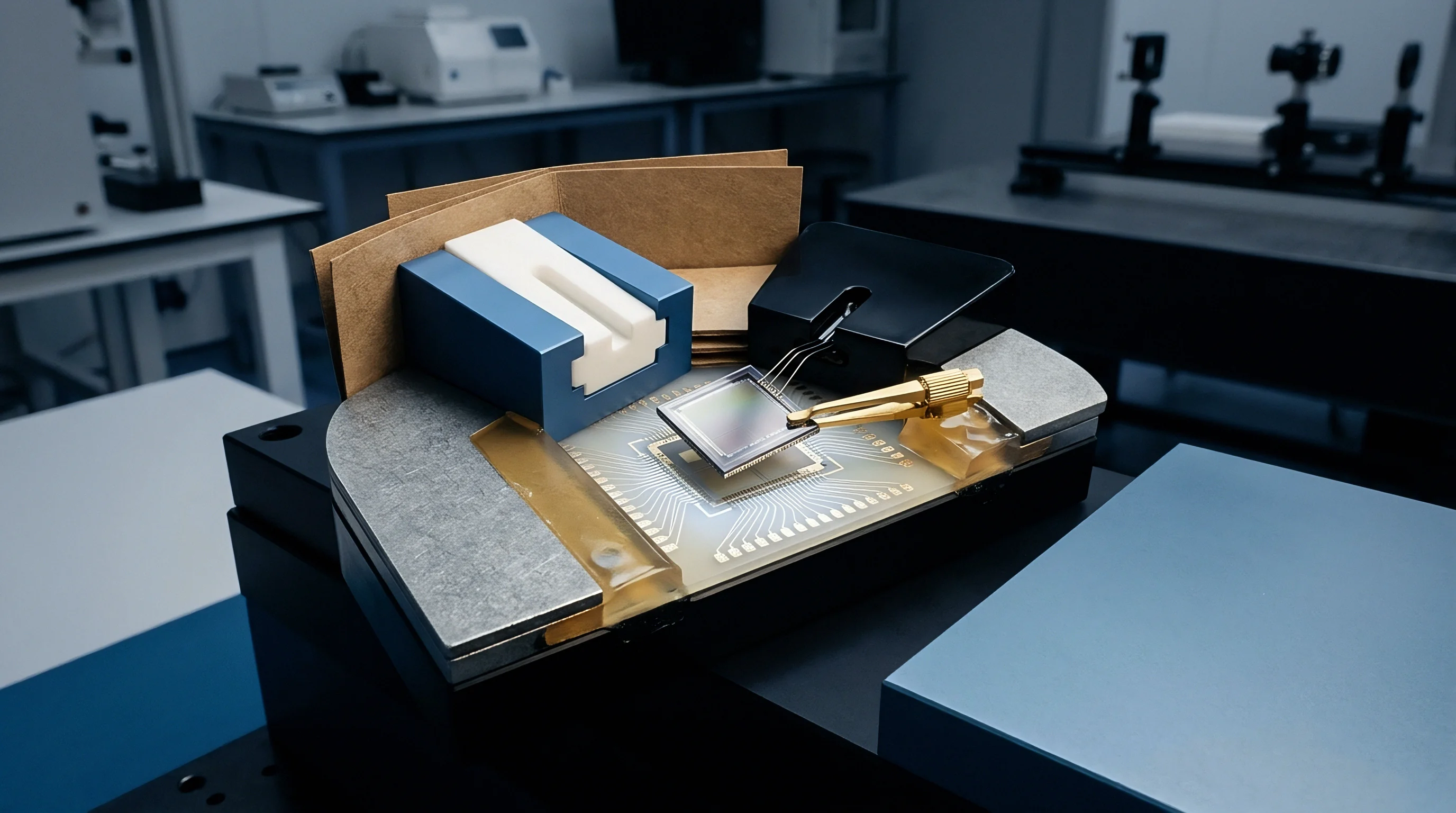
Micro-Hotplate Architecture and Thermal Uniformity
Micro-hotplates isolate the active sensing area using thin dielectric membranes fabricated from silicon nitride or silicon dioxide stacks. A suspended membrane measuring 200 micrometers square and 1.5 micrometers thick provides high thermal isolation from the supporting silicon frame. Within this membrane, a serpentine resistor fashioned from tungsten, platinum, or doped polysilicon generates the required thermal profile.
Thermal gradients across the membrane introduce local variations in oxygen chemisorption. The perimeter of the active area operates up to 60 degrees Celsius cooler than the center due to conductive heat loss through the membrane anchors. Because different oxygen species dominate at different temperatures, the sensor film simultaneously supports molecular O2- at its edges and atomic O- at its center.
This thermal distribution broadens the baseline response and introduces dual-slope response dynamics.
| Platform Type | Heater Material | Power Consumption | Thermal Time Constant | Long-Term Drift Rate |
|---|---|---|---|---|
| Ceramic Tube | Platinum wire winding | 750 to 1100 mW | 12 to 25 seconds | Under 1.5% per year |
| Alumina Substrate | Ruthenium oxide thick-film | 280 to 450 mW | 4 to 8 seconds | 2.0% to 3.5% per year |
| Silicon Micro-hotplate | Tungsten thin-film | 12 to 25 mW | 15 to 35 milliseconds | 3.0% to 6.0% per year |
| Silicon Micro-hotplate | Doped polysilicon | 8 to 18 mW | 10 to 20 milliseconds | Over 5.0% per year |
Fast thermal time constants allow micro-hotplates to utilize pulsed temperature modulation. Cycling the heater between 150 degrees Celsius and 380 degrees Celsius over a 500-millisecond cycle alters the rate of surface reactions, allowing transient response analysis to distinguish individual gases. The short thermal time constant introduces mechanical vulnerabilities.
Rapid thermal expansion cycles induce shear stresses at the interface between the metal oxide film and the dielectric passivation layer.
Over millions of heating cycles, cyclic thermal fatigue can detach the sensing film from the micro-hotplate electrodes. Doped polysilicon heaters suffer from dopant redistribution and grain coalescence under long-term thermal bias, altering heater resistance. Because host controllers apply constant voltage or constant current drive circuits, any shift in heater resistance shifts the operating temperature, driving baseline sensor wander.
High-reliability designs employ closed-loop temperature control based on the heater’s real-time resistance. Platinum and tungsten exhibit predictable positive temperature coefficients of resistance, allowing the heating element to serve as its own resistance temperature detector. Measuring heater current and voltage drop at a kilohertz sample rate allows analog feedback loops to stabilize membrane temperatures within 0.5 degrees Celsius across ambient extremes.
Constant voltage circuits fail to protect the sensing element from changing environmental convection currents. When high-velocity gas flows strike an open-cavity sensor, convective cooling drops the film surface temperature by tens of degrees. Closed-loop control circuits compensate for this heat loss by injecting additional drive current, preserving the oxygen ionosorption baseline across varying pipeline or ventilation flow velocities.

Circuitry
Signal acquisition architectures for metal oxide semiconductors must resolve resistance variations spanning six orders of magnitude while preserving signal integrity against thermal noise and leakage currents. A standard voltage divider driven by a fixed reference voltage provides an inexpensive conditioning interface, yet its nonlinear transfer function compresses dynamic resolution at baseline extremes. When sensor resistance rises above 10 mega-ohms, parasitic board leakage channels dominate the measurement.
Is Dynamic Transimpedance Necessary?
Dynamic transimpedance amplifiers address the wide dynamic range of metal oxide films by switching feedback resistance networks. An operational amplifier maintains the sensing film’s sensing electrode at a virtual ground potential, eliminating errors driven by common-mode voltage fluctuations. A low-leakage analog multiplexer swaps precision feedback resistors into the loop to track film resistance across distinct operational decades.
Designing this input stage requires careful component selection. Printed circuit board surface contamination creates stray parasitic resistance paths parallel to the sensor. A 100 mega-ohm parasitic path bypassing a 50 mega-ohm baseline film generates a 33 percent baseline measurement error.
Mitigating this issue requires guarded trace geometries surrounding all high-impedance nodes, driven at the exact guard potential as the sensing pin to eliminate board-level leakage currents.
- Operational amplifier bias currents must remain below 100 femtoamps at maximum operating temperature to avoid corrupting high-resistance baseline measurements.
- Feedback resistor temperature coefficients should not exceed 10 parts per million per degree Celsius across the industrial operating envelope.
- Analog multiplexer switch leakage demands isolation below 5 picoamps in off states to prevent parallel current paths across switched gain stages.
- Input decoupling capacitors require dielectric absorption ratings under 0.01 percent using polypropylene or C0G ceramics to minimize settling lag during gain shifts.
A worked conversion calculation clarifies the quantization demands imposed by wide baseline shifts. Consider an un-doped tin dioxide thin-film sensor targeting carbon monoxide monitoring. In dry clean air, the sensor establishes a baseline resistance of 10 mega-ohms at 300 degrees Celsius.
Exposure to 100 parts per million carbon monoxide reduces the film resistance to 100 kilo-ohms. The signal chain must measure small deviations at both operating limits.
Assume an analog-to-digital converter runs at a 3.3-volt full-scale reference. When conditioned through a static load resistor of 1 mega-ohm in a classic voltage divider, the output voltage in clean air equals:
V_out = 3.3 V (1 MOhm / (10 MOhm + 1 MOhm)) = 0.300 V
At 100 parts per million carbon monoxide, the output voltage shifts to:
V_out = 3.3 V (1 MOhm / (0.1 MOhm + 1 MOhm)) = 3.000 V
Resolving a 50 parts per billion shift around the 10 mega-ohm baseline requires resolving a delta of approximately 0.05 percent of the base resistance, shifting the baseline from 10.000 mega-ohms to 9.995 mega-ohms. The voltage divider output alters by only 130 microvolts. A 12-bit analog-to-digital converter provides a least significant bit step of 805 microvolts, missing this baseline movement entirely.
A system tracking low-level toxic exposure requires a 16-bit or 24-bit converter, or active gain staging.
Low-frequency 1/f flicker noise limits resolution in thin-film oxide coatings. Trapping and de-trapping of charge carriers at intergranular defects produce voltage fluctuations proportional to the inverse of frequency. Analog filtering stages must place high-order low-pass filters at 2 to 5 Hertz, eliminating power line interference while passing the low-frequency chemical response.
This analog filtering introduces phase delay into fast-pulsed heater profiling regimes.
The host system reads raw output codes that integrate chemical shift, aging drift, and supply voltage variation. Separating baseline drift from true target gas interaction requires the software layer to implement moving baseline estimators. When software algorithms track baselines continuously, slow-building gas leaks can be mistaken for environmental drift, causing the algorithm to adjust the baseline upward and mask life-threatening hazards.

Qualification
Procuring metal oxide semiconductor sensors requires incoming inspection protocols capable of separating manufacturing defects from native stabilization behaviors. Freshly manufactured metal oxide films exhibit erratic surface charge profiles caused by ambient organic contamination and un-annealed lattice vacancies. A rigorous burn-in protocol is necessary to stabilize baseline resistance before running qualification tests.

Burn-In Schedules and Stabilization Mechanics
Unpowered sensors stored under standard atmospheric conditions adsorb hydrocarbons, moisture, and siloxanes onto unpassivated sites. Initial power application triggers sudden catalytic oxidation of these contaminants, causing wide resistance swings. Factory qualification procedures must enforce continuous heater burn-in periods before taking baseline validation readings.
- Thermal stabilization bake runs the heater at 110 percent nominal power for 48 hours in clean synthetic air to strip physisorbed contaminants and anneal unstable surface vacancies.
- Atmospheric equilibrium soak maintains nominal operating temperature for 72 hours under 50 percent relative humidity at 25 degrees Celsius, allowing the initial hydroxyl monolayer to reach chemical equilibrium.
- Clean air baseline logging samples the sensor resistance every 10 seconds across a 24-hour window to calculate the standard deviation and drift rate of the unexposed film.
- Analytical challenge injection exposes the sensor to calibrated reference gas at mid-scale concentration for 10 minutes, validating sensitivity and response kinetics.
- Desorption recovery check tracks the return trajectory to clean air baseline, rejecting units failing to recover within 5 percent of the pre-exposure value after 30 minutes.
Batch variations in grain morphology create substantial baseline yield distributions. A commercial wafer run yields sensor chips with nominal baseline resistances spanning a standard deviation of 20 to 40 percent around the targeted mean. Procuring bare metal oxide elements without integrated factory calibration shifts the burden of multi-point calibration onto the instrument assembly line, increasing test chamber cycle times and overall production costs.
Commercial suppliers handle this distribution through lot binning based on baseline resistance in clean synthetic air. When procuring high-volume consumer air-quality sensors, purchase specifications define acceptable resistance bins to match the input stages of fixed-gain frontends. Specialized industrial gas transmitters sidestep binning by using automated baseline calibration procedures executed in certified zero air at final assembly.
Long-term drift remains an inherent property of metal oxide semiconductor physics. Over continuous operation, grain boundary diffusion causes slow agglomeration of nanoscale crystallites, increasing effective neck sizes and lowering baseline resistance. Thermal cycling accelerates this coalescence.
Incoming inspection agreements define maximum allowable baseline shift rates, typically bounded between 10 percent and 25 percent per year under clean air conditions.
Procurement teams must guard against unauthorized alterations in supplier raw material sources. Swapping a precursor salt during chemical vapor deposition alters the film’s dopant profile, modifying vacancy formation energy. The resulting sensor might meet short-term sensitivity specifications while displaying unacceptable baseline wander under elevated humidity.
Long-term supply contracts require formal change notifications covering paste formulation, substrate chemistry, and sintering profiles.

Procurement
Selecting an environmental gas sensing modality requires evaluating systemic trade-offs between physical limits, power allocations, operational lifetimes, and recurring costs. Metal oxide semiconductor elements offer compact size and unit costs below one dollar in automotive-scale quantities. Their vulnerability to baseline wander, non-specific cross-sensitivity, and continuous power consumption frequently demands complex downstream compensation.
Technology Trade-Offs across Competing Principles
Non-dispersive infrared sensing provides high optical specificity and stable optical zero baselines, eliminating the chemical cross-sensitivities common to metal oxides. NDIR platforms demand optical pathlengths of several centimeters to resolve low parts-per-million gas concentrations, driving up enclosure volumes and component costs. For measuring carbon dioxide, methane, or refrigerants, NDIR avoids baseline drift, but unit pricing remains five to ten times higher than metal oxide solutions.
Electrochemical cells measure toxic gases like carbon monoxide, hydrogen sulfide, and nitric oxide through amperometric oxidation-reduction reactions without needing micro-heaters. Operating at ambient temperatures drops total sensor power requirements into the microampere range, making them suitable for intrinsically safe handheld monitors. Electrochemical sensors suffer from electrolyte dry-out in arid climates, container leakage risks, and finite operational lifespans between two and three years.
Photoionization detectors excel at broad-spectrum volatile organic compound detection with sub-part-per-billion resolution and fast response times. They rely on high-energy ultraviolet discharge lamps that require periodic window cleaning and frequent zero-gas calibrations. A single photoionization sensor subsystem commands pricing exceeding one hundred dollars, restricting its deployment to professional industrial hygiene monitors and perimeter safety networks.
| Modality | Baseline Stability | Cross-Sensitivity Impact | Power Budget | Unit Cost (10k Units) |
|---|---|---|---|---|
| Metal Oxide (MOS) | Poor (10% to 25% drift/yr) | High (humidity, ethanol, solvents) | 10 to 40 mW (pulsed MEMS) | $0.60 to $2.50 |
| Non-Dispersive Infrared | High (under 2% drift/yr) | Negligible (narrow optical filter) | 15 to 80 mW (pulsed emitter) | $6.00 to $18.00 |
| Electrochemical Cell | Moderate (5% drift/yr) | Moderate (acid gases, hydrogen) | Under 0.1 mW | $4.00 to $12.00 |
| Photoionization (PID) | Low (requires daily zero) | High (universal ionization) | 100 to 300 mW | $80.00 to $250.00 |
Supply base concentration creates commercial vulnerabilities in sensing programs. The specialized wafer foundries capable of depositing catalytic thin films onto suspended MEMS membranes remain clustered across a limited number of suppliers in Europe, Japan, and China. Sourcing custom metal oxide formulations limits alternative vendor options.
When a sole-source wafer supplier issues an end-of-life notice or alters its fabrication line, re-qualifying a replacement component requires up to eighteen months of environmental chamber testing and firmware revisions.
A supplier will argue that internal baseline tracking firmware mitigates all physical drift across the operating lifetime. This claim assumes the sensor encounters clean air baselines during routine operation. When deployed in applications with persistent background gas concentrations, such as agricultural operations, wastewater treatment plants, or heavily sealed building envelopes, automated baseline logic mistakes continuous real exposure for baseline drift.
The algorithm re-zeros the instrument at elevated gas levels, compromising measurement accuracy.