Polymeric Potting Relaxation Dynamics in Precision Transducer Packaging
Polymeric potting stress relaxation causes time-dependent zero drift in precision transducers, requiring thermal seasoning to stabilize output baseline.


Gel
Potting compounds protect transducer packages against contamination, mechanical shock, and dielectric breakdown, but they also introduce mechanical coupling between the housing and delicate sensing elements. Thermosets, silicones, and structural epoxies behave viscoelastically under deformation, exhibiting both elastic and viscous responses. When an assembly experiences mechanical stress or thermal shifts, the potting deforms immediately, then its molecular network creeps over time.
This dual response creates a complex stress field around sensitive components such as piezoresistive silicon chips, strain gauges, and capacitive diaphragms. The force transferred from encapsulant to diaphragm depends on the polymer’s instantaneous shear modulus. Because these moduli change with both temperature and time, mechanical loads on the sensing element continue to shift long after assembly.
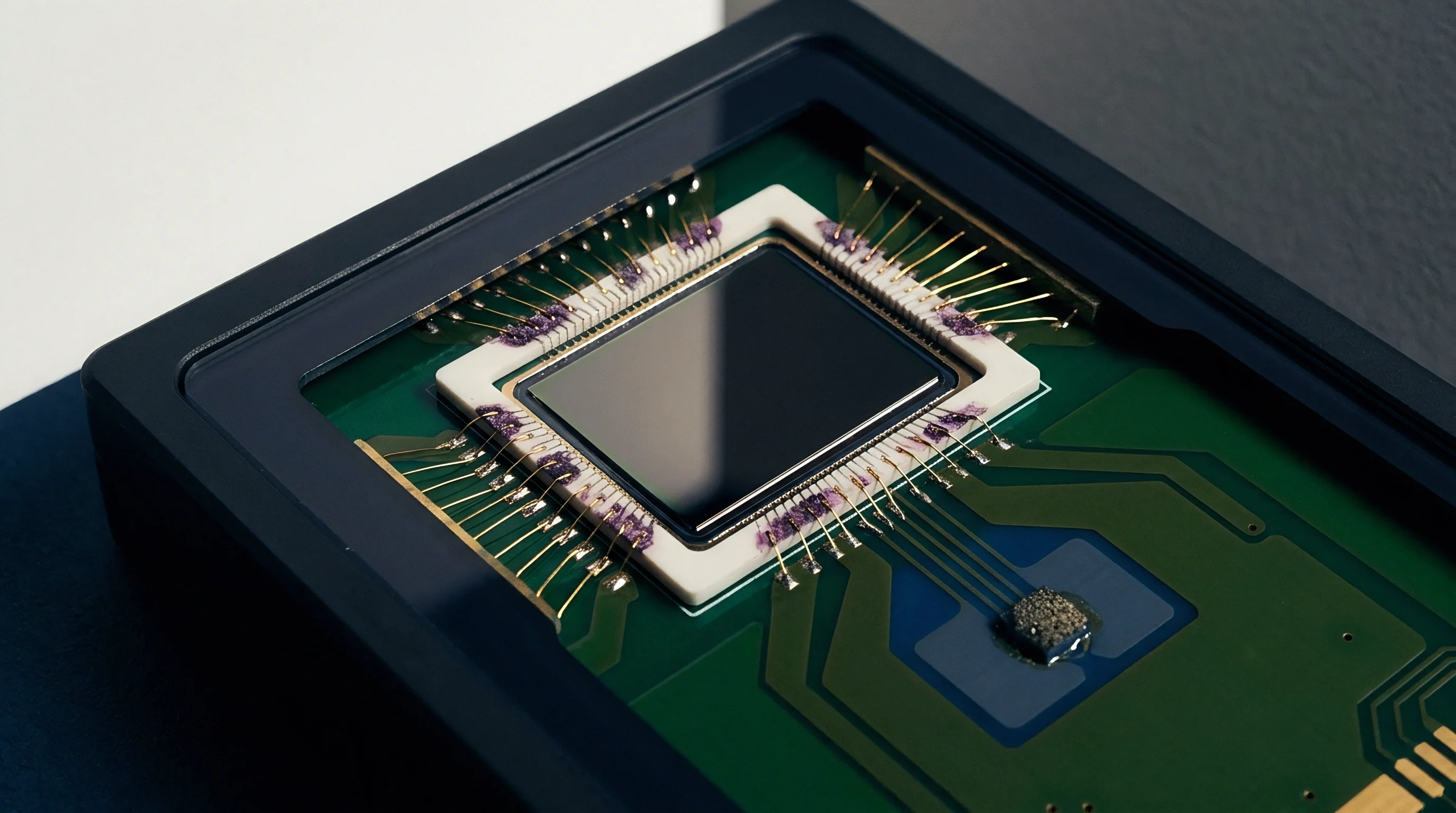
Viscoelastic Stress Transfer in Encapsulated Sensors
Polymeric matrices deform under internal stress driven by expansion mismatches. Common potting compounds have thermal expansion coefficients between 100 and 300 parts per million per Kelvin, compared to roughly 2.6 parts per million per Kelvin for silicon substrates and near 16 parts per million per Kelvin for stainless steel housings. Temperature shifts therefore generate significant differential strain across these bonded interfaces.
That strain field remains active even at constant temperature. Localized shear forces cause polymer chains to slip past one another, relaxing internal stress over hours and days. As that stress decays, the mechanical baseline on the diaphragm changes, moving the electrical zero signal.
In precision pressure transducers rated below one percent full-scale accuracy, even micro-strain shifts in the potting produce measurable zero-point drift.
Initial mechanical preloads decay as molecular chains settle into lower-energy configurations. In high-accuracy sensors, this ongoing stress redistribution shows up as baseline drift, span shifts, and unrepeatable calibration curves.
The mechanical interaction comes down to polymer chemistry and crosslink density. Addition-cure silicone gels maintain low crosslink density, resulting in low moduli that limit force transfer to sensitive diaphragms. Rigid epoxies offer moisture protection and structural strength, but transmit heavy thermal expansion stress directly to the sensor core.
| Material Formulation | Initial Shear Modulus (MPa) | Glass Transition Temperature (°C) | Coefficient of Thermal Expansion (ppm/K) | Baseline Relaxation Half-Life (Hours) |
|---|---|---|---|---|
| Addition-Cure Two-Part Silicone Gel | 0.05 | -120 | 310 | 12 |
| Flexibilized Polyurethane Elastomer | 4.50 | -45 | 180 | 140 |
| Cycloaliphatic Amine Cured Epoxy | 1850.00 | 65 | 55 | 3200 |
| Two-Component Acid Anhydride Epoxy | 3100.00 | 135 | 38 | 8500 |
Glass Transition Shift under Thermal Cycling
Operating near phase changes alters mechanical stiffness dramatically. Crossing the glass transition region converts the polymer from a rigid, glassy solid to a soft elastomer. Across this transition, storage modulus, loss modulus, and volumetric expansion coefficients change by several orders of magnitude.
Industrial sensors rated for minus forty to plus one hundred twenty-five degrees Celsius often push the encapsulant back and forth through its glass transition during routine operation. When cooling below this threshold, free volume in the matrix freezes, trapping residual stress from thermal contraction.
Silicone encapsulants with glass transition temperatures below minus fifty degrees Celsius maintain a modulus change under five percent across the primary sensor operating band.
Subsequent thermal cycles release and recreate these trapped stress fields non-linearly. Because past thermal history dictates current stress levels, sensors often fail to return to their exact zero state after thermal cycling. Lab evaluations of precision pressure transducers show a baseline drift of 0.12 percent of full scale over two thousand operating hours from unreleased thermal stress in the potting.
Low-modulus gels are frequently assumed to isolate sensing elements completely from packaging stress, yet volumetric expansion under tight confinement still exerts hydrostatic pressure directly on the diaphragm.
Decay
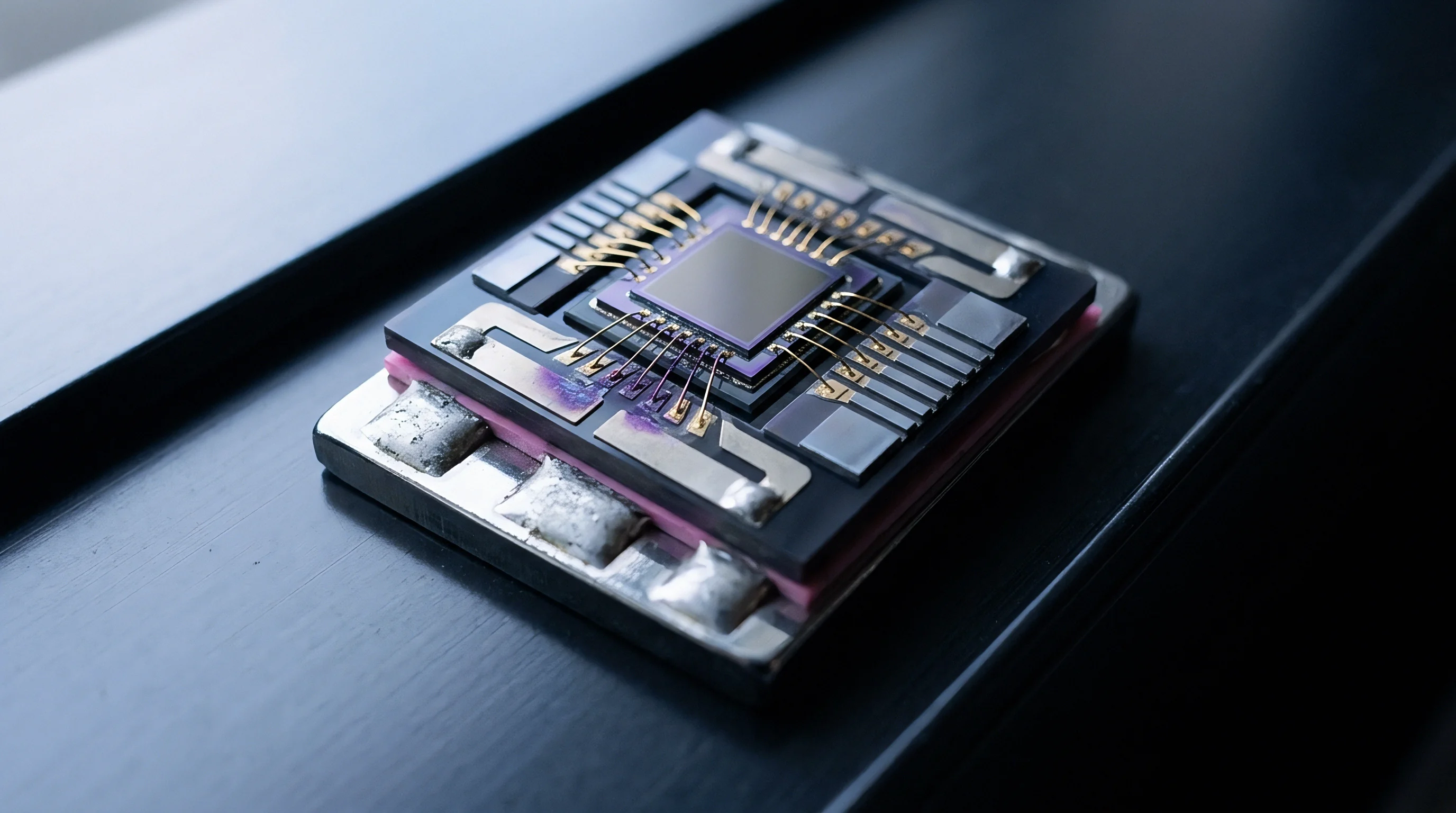
Time-dependent strain dissipation in cured elastomers creates persistent baseline instability. Stress relaxation follows a continuous spectrum curve: internal forces fall off quickly during the first hours after deformation, then settle into slow, logarithmic decay over months and years. Modeling this behavior requires non-linear viscoelastic frameworks suited to stretched exponentials.
The Kohlrausch-Williams-Watts model offers an empirical framework for long-term stress relaxation. In this formulation, stress at time t is expressed as σ(t) = σ₀ · exp , where σ₀ is initial stress, τ is characteristic relaxation time, and β is a stretching exponent between zero and one. Lower β values reflect wider distributions of molecular relaxation times within the amorphous polymer.
Micro-Strain Dissipation and Zero-Point Drift
Piezoresistive pressure sensors rely on Wheatstone bridges diffused directly onto silicon diaphragms. Micro-strain transferred across potting boundaries alters resistance values through piezoresistive coupling. As stress in the encapsulant continuously decays, the bridge offset voltage drifts, altering the calibrated zero baseline without any change in external pressure.
Early relaxation drops steeply before settling into predictable linear-logarithmic drift curves. While thermal seasoning accelerates this initial drop so parts pass factory calibration screens, long-term physical aging keeps altering polymer density and internal stress throughout the device’s service life.
Below the glass transition temperature, non-equilibrium polymer glasses slowly relax toward thermodynamic equilibrium. Free volume steadily decreases, driving up polymer density and shifting shear modulus values. This physical aging continues indefinitely at rates dictated by how close the operating temperature is to the glass transition boundary.
| Aging Protocol | Characteristic Time τ (Hours) | Stretching Exponent β | Residual Stress Ratio at 1000 Hours | Residual Stress Ratio at 8760 Hours |
|---|---|---|---|---|
| Constant 23 °C / 50% RH Storage | 1450 | 0.42 | 0.38 | 0.19 |
| Continuous 85 °C Dry Bake | 185 | 0.58 | 0.08 | 0.01 |
| Damp Heat 85 °C / 85% RH Exposure | 92 | 0.35 | 0.04 | 0.005 |
| Thermal Cycling -40 °C to +125 °C | 310 | 0.48 | 0.14 | 0.03 |

Modes of Viscoelastic Failure in Encapsulated Assemblies
Viscoelastic stress shifts trigger structural degradation mechanisms that compromise calibration stability over time. Interfacial debonding, phase separation, and localized modulus variations produce unrepeatable measurement errors over long deployments.
- Asymmetric Shear Decoupling occurs when localized bond failure releases stored potting stress along one edge of the sensing element, producing permanent zero offsets.
- Free Volume Trapping happens during rapid cooling, freezing high-modulus molecular structures in place and delaying stress relaxation until temperatures rise.
- Post-Cure Contraction Drift stems from incomplete crosslinking during primary cure, allowing ongoing reactions to shrink the matrix around delicate wire bonds.
- Modulus Inversion Spikes develop when sub-zero temperatures drop polymer formulations below glass transition thresholds, turning compliant gel buffers into rigid stress amplifiers.
Controlling these failure modes requires tracking strain relaxation kinetics over long time horizons to ensure the chosen encapsulant matches the required calibration lifespan.
What residual stress fraction remains unrelaxed inside potted packages after five years of continuous operational field service?

Moisture
Water vapor diffusing into encapsulants alters matrix density over time. Polymers absorb ambient moisture through Fickian diffusion, causing weight gain and volumetric expansion. The resulting swelling stresses combine with thermal and viscoelastic effects, complicating baseline stability predictions in precision packaging.
Absorbed moisture acts as a plasticizer inside polymeric networks. Water molecules disrupt interchain hydrogen bonds, boosting molecular mobility and dropping the glass transition temperature. This shift accelerates stress relaxation while reducing the material’s mechanical storage modulus.
Where Does Encapsulant Swelling Alter Zero Point?
Volumetric swelling from moisture uptake exerts compressive forces on encapsulated sensor elements. In side-potted housings, uneven water absorption creates bending moments across sensitive diaphragms that mimic applied pressure signals. Because these swelling forces track ambient humidity changes, they induce seasonal calibration drift.
Sorption kinetics depend on temperature and vapor pressure gradients. Absorbed moisture concentration follows Fick’s second law, ∂C/∂t = D · ∇²C, where C is moisture concentration and D is the temperature-dependent diffusion coefficient. High diffusion coefficients lead to rapid moisture equilibrium, whereas low coefficients preserve steep moisture gradients inside the potting mass for thousands of hours.
Even silicones absorb water over time, altering molecular spacing and causing volume expansion that destabilizes bridge output offsets independently of thermal expansion.
In shifting humidity, moisture gradients create non-uniform stress throughout the encapsulant. The outer layer swells quickly in humid air while the dry core resists expansion, subjecting embedded chips to complex shear and tensile forces.
Testing under IEC 60068-2-78 dictates continuous exposure to ninety-three percent relative humidity at forty degrees Celsius, where unbaked polyurethanes lose thirty percent of initial shear modulus.
Ignoring moisture diffusion kinetics during package design leads to high recalibration costs when devices deployed in humid environments drift past baseline tolerances within months.

Harness
Housing geometry can limit mechanical coupling between outer enclosures and internal elements. Effective transducer packaging isolates mechanical stress so potting relaxation doesn’t corrupt sensor accuracy. Compliance layers, floating die mounts, and dual-compound encapsulants decouple shell deformation from delicate sensing diaphragms.
Floating die architectures place soft silicone gel around the sensor chip inside a rigid outer housing filled with structural epoxy. The inner gel absorbs stress relaxation without loading the diaphragm, while the epoxy shell provides environmental protection and structural stiffness. Success requires tight control over interface geometry and fill volumes.

Decoupling Geometries for Encapsulated Sensors
Package geometry determines how relaxation forces act on sensitive sensor zones. Stress concentrates near sharp internal corners, rigid substrate edges, and potting fill lines. Adding fillet radii along internal walls distributes thermal expansion forces and lowers stress concentrations.
Leaving potting surfaces unconstrained allows polymers to expand without generating hydrostatic pressure against embedded chips. Leaving open volume above soft gel fills creates a free surface boundary, allowing low-modulus materials to expand freely at high temperatures.
- Aspect Ratio Verification checks the relationship between potting depth and housing width so expansion forces vent toward open fill boundaries.
- Interface Compliance Screening confirms elastomeric buffer layers are soft enough to isolate strain gauge grids from housing deflections under load.
- Thermal Expansion Gradient Matching aligns contraction rates across die adhesives, substrates, and potting compounds to minimize residual shear stress at interfaces.
- Degassing Pressure Control removes micro-bubbles from encapsulants during vacuum filling, preventing localized stress spots and dielectric breakdown.
Structural packaging designs must carefully balance mechanical protection against the risk of strain transmission as unbaked polymers creep over time.
Thick potting layers distribute thermal expansion strains across larger volumes, reducing localized force on sensitive bridge elements.
Maintaining uniform potting thickness throughout the package prevents asymmetrical stress distributions during long-term viscoelastic relaxation.

Audit
Evaluating potted transducers metrologically requires long-term baseline tracking under controlled environmental cycles. Standard factory calibrations done right after assembly miss the slow viscoelastic stress decay and moisture absorption that emerge over extended use. Qualifying precision packaging requires test protocols that separate polymer relaxation from intrinsic sensor drift.
ISO/IEC 17025 accredited calibration laboratories build uncertainty budgets that account for long-term stability metrics, hysteresis, and temperature coefficients. Quantifying viscoelastic relaxation requires separating strain-induced zero drift from electronic aging and reference standard uncertainty.

Traceable Metrology and Uncertainty Budgets
Traceability chains for precision pressure and strain sensors link field calibrations back to primary standards held by national metrology institutes. Evaluating potted packaging involves measuring zero-point stability across thermal dwells to map baseline shifts directly to material relaxation.
Test protocols use multi-step thermal ramps separated by long dwell periods. These extended dwells allow potting materials to approach viscoelastic equilibrium at each temperature step, separating instant thermal expansion from time-dependent relaxation creep. Metrology protocols log output stability over one-hundred-hour dwells to resolve slow relaxation modes.
- Standardize thermal conditioning by holding packaged transducers at maximum rated operating temperature for forty-eight hours prior to zero baseline calibration.
- Mount transducers in fixed zero-g orientations using low-stress torque frames calibrated to standard mechanical tolerances.
- Apply reference excitation voltages traceable to national laboratory primary standards while logging baseline output signals at ten-second sampling intervals.
- Cycle environmental test chambers across full thermal boundaries while recording differential hysteresis loops during ramp and dwell phases.
- Compute time-dependent zero drift rates using non-linear least squares fits to quantify viscoelastic relaxation parameters.
Because baseline instability directly impairs measurement reliability, calibration certificates must state long-term stability limits under realistic environmental stress.
To comply with ISO 10012 measurement management systems, organizations must set recalibration intervals based on empirical stability data so viscoelastic drift doesn’t break measurement traceability in the field.
Yield
Manufacturing costs rise when unconditioned assemblies drift during final testing. Polymeric relaxation directly impacts yield, calibration throughput, and long-term warranty liability. Manufacturers must balance the cost of thermal seasoning against the financial risk of field returns from out-of-spec drift.
High-precision transducer grades ~ such as those rated for 0.05 percent full-scale accuracy ~ tolerate almost no zero offset migration over their service life. Unseasoned potting can cause units to fail initial calibration after a twenty-four-hour room-temperature soak, leading to rework or scrap. Running pre-calibration thermal seasoning cycles stabilizes polymer networks and raises final yields.
Economic Optimization of Thermal Seasoning
Post-cure thermal seasoning speeds up initial stress relaxation by holding finished packages at elevated temperatures prior to final calibration. Although seasoning uses oven capacity and adds cycle time, it narrows zero-drift variability across production lots.
The economics depend heavily on product grade. Premium sensor lines yield high margins but carry heavy warranty liabilities if baseline drift exceeds tight spec bands. Lower-accuracy grades tolerate greater stress relaxation without failing, altering the justification for lengthy thermal seasoning.
| Seasoning Regimen | Process Cost per Unit (USD) | Initial Calibration Pass Rate (%) | Three-Year Warranty Return Rate (%) | Total Landed Cost per Certified Unit (USD) |
|---|---|---|---|---|
| No Pre-Calibration Seasoning | 0.00 | 78.50 | 6.20 | 142.50 |
| Twenty-Four Hour Bake at 85 °C | 4.20 | 91.20 | 2.10 | 118.80 |
| Ninety-Six Hour Bake at 85 °C | 12.50 | 97.80 | 0.40 | 112.30 |
| Dynamic Thermal Cycling Protocol | 22.00 | 99.10 | 0.15 | 121.50 |
Proper thermal seasoning protocols stabilize the matrix, optimizing unit margins while protecting calibration integrity.
Unseasoned potted assemblies double field failure rates within eighteen months due to baseline zero migration.
Investing in extended thermal conditioning remains the most reliable way to maintain high yields on precision transducers. Allowing viscoelastic stress to relax before final factory calibration establishes baseline stability that holds up under demanding field conditions.