
Isolated Signal Conditioning Package Selection for High Density Power Converters
Select compact isolated signal packages by matching CTI ratings to creepage rules and holding parasitic capacitance under 1 pF to survive 100 kV/µs transients.
Select compact isolated signal packages by matching CTI ratings to creepage rules and holding parasitic capacitance under 1 pF to survive 100 kV/µs transients.

Bandgap output voltage temperature coefficients balance complementary and proportional silicon junctions, shifting under package stress and thermal hysteresis.
Mitigate component obsolescence by balancing last-time-buy capital against redesign fees, resolving footprint and bus timing changes before production freezes.

Package trace parasitic inductance induces millivolt ground bounce during fast transients, degrading precision reference accuracy without low-loop layout.
Clear stuck open-drain lines using nine manual clock cycles, followed by power-rail cutoff via load switch when latchup bypasses clock release.
Thermal dissipation cycles induce package strain that skews bandgap reference outputs, necessitating symmetrical copper relief and strain-matched packaging.

Accumulated line capacitance degrades open-drain rise times, demanding active acceleration or branch buffering to maintain deterministic software enumeration.

Cascade enable logic eliminates individual chip-select routing across dense sensor arrays by propagating a single hardware token down a shared serial bus.
Dynamic address assignment eliminates external multiplexers in dense sensor arrays, trading minor firmware development time for reduced PCB routing and lower bill-of-materials costs.

Manage identical I2C devices by combining hardware pin strapping, pass-gate multiplexers, or inline address translators to isolate matching identifiers.
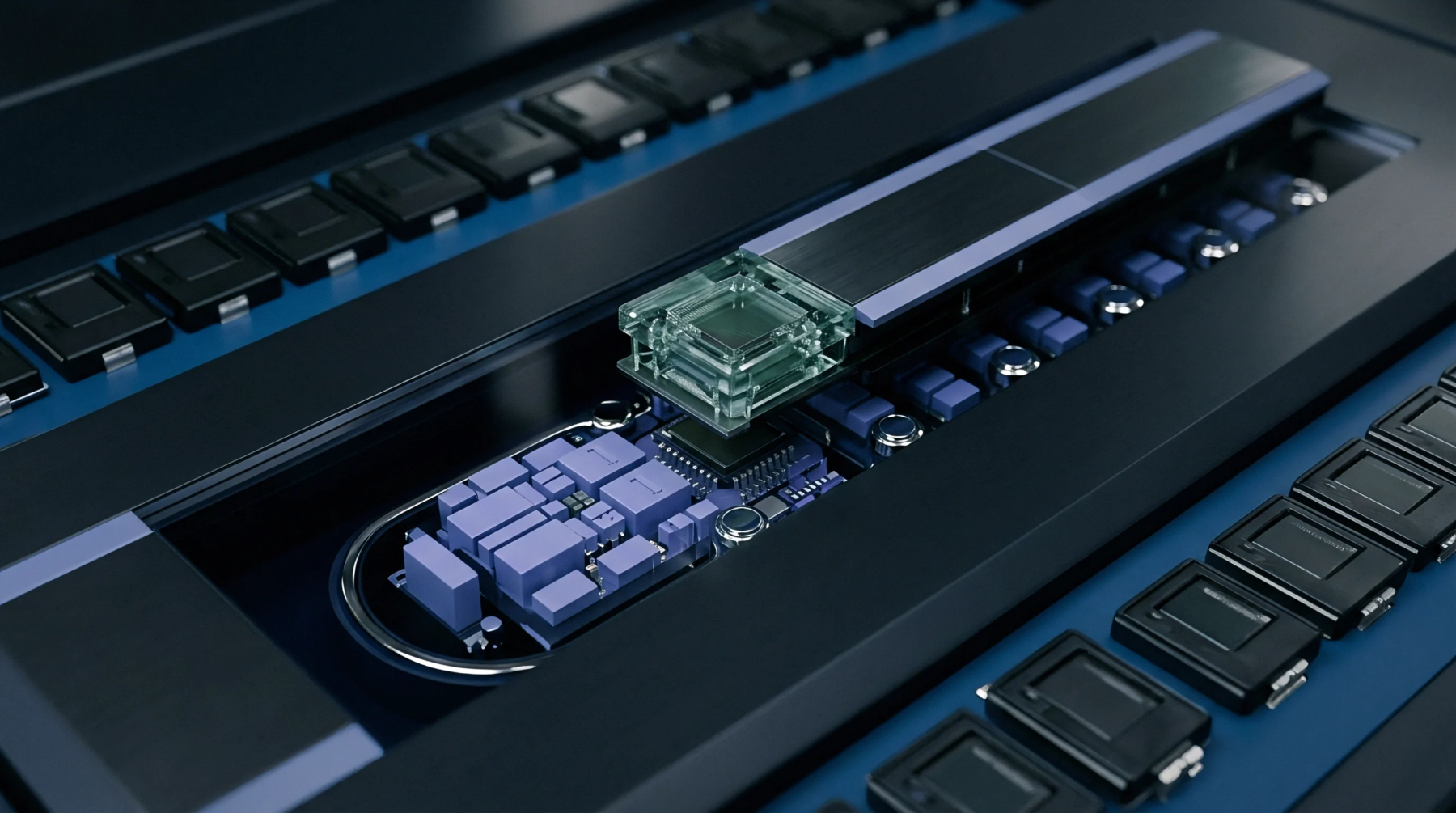
Surface mount strain gauge selection relies on matching package shear modulus, serial bus update rates, and IPC-9704 board strain limits.

Mitigate bandgap thermal stress errors using compliant leaded packages, PCB isolation slots, polyimide die buffers, and stabilized factory calibration.

Asymmetric thermal gradients across precision references induce microvolt offsets through Seebeck potentials and piezo-resistive stress imbalance.

Dynamic address assignment eliminates multiplexers in dense sensor arrays through cascade enable lines or software ARP, reducing PCB area while raising firmware bring-up requirements.

Asymmetric output load dissipation creates substrate thermal gradients across monolithic reference dies, inducing microvolt baseline offsets in precision data converters.
Expertise is a utility, not a secret. sentiention™ publishes its working knowledge as open reference: intelligence layer covering the materials it sources, the markets it enters, and the reference that serves both.