Mirror Reflectivity Degradation and Differential Ratio Drift under Condensation Environments
Droplet scattering and liquid absorption degrade mirror reflectance unevenly across wavelengths, driving differential optical baseline ratio drift.
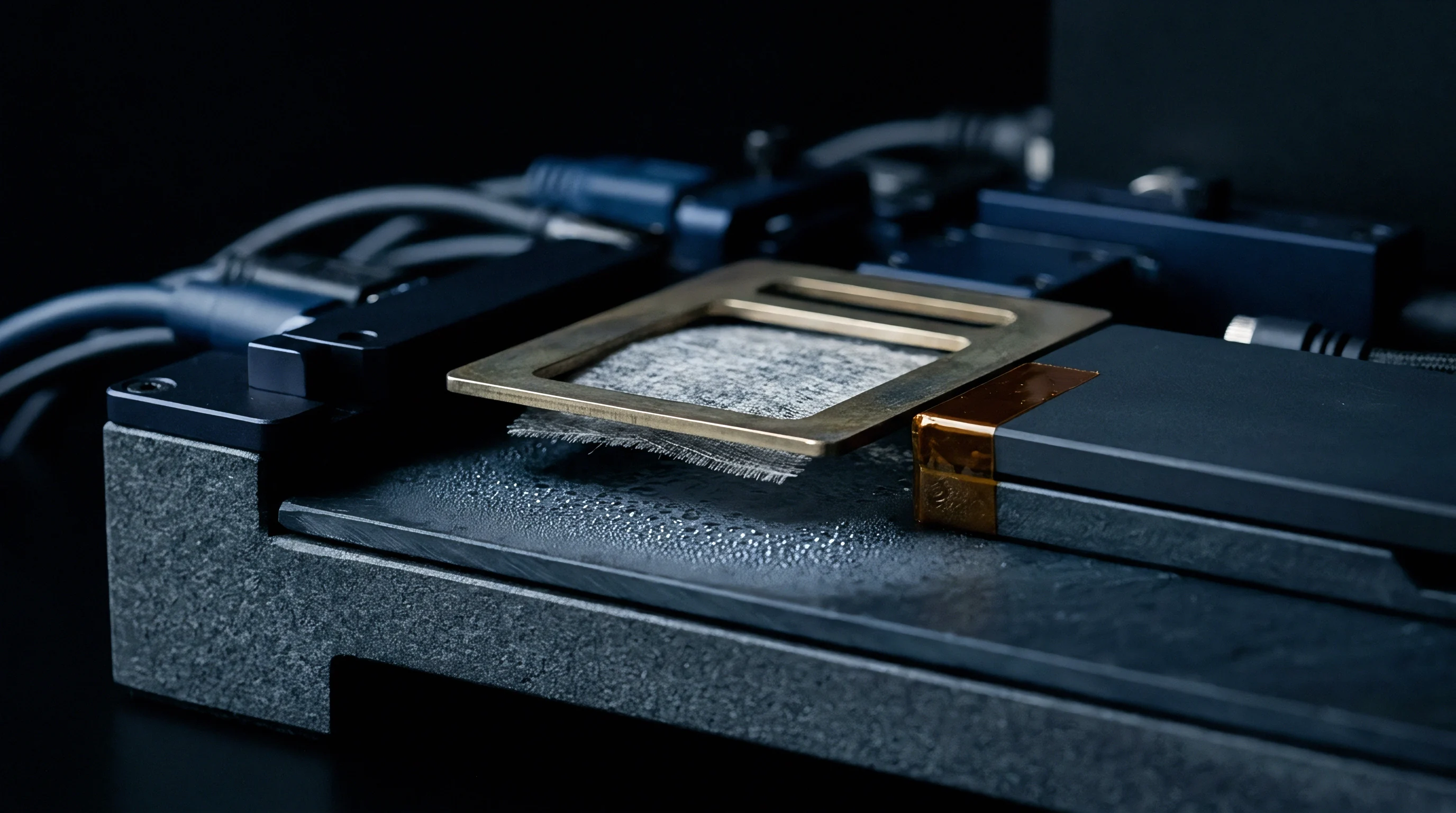
Droplet
Condensation cycles on first-surface optics alter reflected beam irradiance long before liquid layers become visible on the substrate. A gold-coated silicon substrate held at 15.0 degrees Celsius inside an environmental chamber operating at 20.0 degrees Celsius and 75 percent relative humidity loses 14.2 percent of its specular reflectance at 850 nanometers within forty seconds of initial sub-dew-point thermal transition. Optical power meters record this drop as scattered beam loss, yet the physical surface shows zero macroscopic pooling under standard white-light inspection.
The earliest phase of condensation operates purely within the Rayleigh-Gans and forward Mie scattering domains, where microscopic water clusters act as discrete scattering centers across the metallic plane.
Signal power falls immediately.
Dew forms abruptly. The initial condensation morphology presents as isolated cap-shaped droplets with contact angles governed by substrate surface energy and microscopic surface contamination. Across unprotected gold, aluminum, and silver mirrors, contact angles range from 45 degrees to 80 degrees, dictating the geometric profile of each liquid hemisphere.
When droplet diameters remain below 0.1 times the probing optical wavelength, Rayleigh scattering mechanics dictate an optical extinction cross-section proportional to the inverse fourth power of the wavelength. As condensation continues and droplet radii grow toward equivalence with the source wavelength, Mie scattering transitions dominate the beam interaction. Incident collimated light strikes the spherical liquid caps, refracting into the water volume, reflecting internally off the underlying metallic boundary, and diffracting around droplet margins.
Rather than returning along the specular path, radiant energy disperses across a broad solid angle.
Droplet scattering disperses specular optical energy into broad hemispheroidal angles without altering the metallic lattice underneath.
Specular degradation during this droplet growth regime follows an exponential attenuation path. At low droplet surface densities, where droplet coverage occupies less than five percent of the illuminated mirror footprint, specular beam attenuation tracks the total droplet projected area with minimal cross-talk. When droplet surface coverage surpasses twelve percent, multiple scattering effects emerge: light deflected from one droplet encounters adjacent droplets, increasing diffuse backscatter and reducing the effective collection efficiency of relay lenses positioned along the optical axis.
Laboratory photodetectors capture an apparent reduction in mirror reflectance that mimics severe coating degradation, despite the underlying metallic film maintaining its chemical integrity.
Suppliers routinely dismiss this loss by stating that condensation represents an external environmental transient rather than a component failure mechanism.
Extinction
Wavelength-dependent scattering governs the optical return as water microstructures nucleate across polished metallic coatings. Dual-beam and multi-wavelength optical systems rely on baseline stability between discrete spectral emissions to measure gas absorption, particulate concentration, or dew-point equilibrium. Water exhibits both refractive and absorptive index variations across ultraviolet, visible, and infrared spectra.
At 633 nanometers, the imaginary refractive index of liquid water sits near 1.0 multiplied by ten to the negative eighth power, rendering optical absorption negligible compared to phase-front scattering. At 3.4 micrometers and 4.26 micrometers, strong vibrational fundamental transitions of the oxygen-hydrogen chemical bond elevate the imaginary refractive index to 0.16 and 0.012 respectively.
Water absorbs mid-infrared light.
Scattering losses dominate short wavelengths. When an optical assembly incorporates a dual-wavelength emitter configuration to isolate target species, condensation imposes differential losses across the channels. A reference beam operating at 1050 nanometers experiences scattering driven by droplet size distributions, while an active measurement beam at 3400 nanometers encounters concurrent scattering and intense liquid absorption.
The total optical extinction coefficient incorporates both scattering cross-sections and internal medium absorption. Because the complex refractive index of water shifts rapidly across mid-infrared bands, the relative attenuation between reference and sample wavelengths diverges sharply during dew formation.
| Mirror Coating Type | Test Wavelength (nm) | Dry Specular Reflectance (%) | Droplet Stage Reflectance (%) | Coalesced Film Reflectance (%) | Permanent Shift Post-Drying (%) |
|---|---|---|---|---|---|
| Protected Gold (SiO2 Topcoat) | 633 | 96.1 | 41.2 | 12.4 | -0.3 |
| Protected Gold (SiO2 Topcoat) | 3400 | 98.5 | 22.1 | 3.1 | -0.2 |
| Enhanced Aluminum | 633 | 92.4 | 38.7 | 11.8 | -1.8 |
| Enhanced Aluminum | 1310 | 90.2 | 49.3 | 14.6 | -1.5 |
| Protected Silver (TiO2/SiO2) | 633 | 97.8 | 44.5 | 13.2 | -4.2 |
| Protected Silver (TiO2/SiO2) | 4260 | 98.1 | 31.0 | 8.5 | -3.9 |
| Dielectric Bandpass Stack | 1310 | 99.4 | 52.1 | 18.0 | -0.1 |
Microscopic water droplets act as spatial phase disruptors on dielectric mirror stacks. Narrowband dielectric reflectors use quarter-wave interference layers to generate high reflectivity at specified design angles. When water droplets condense on the outer dielectric boundary, the ambient refractive index transitions from 1.00 for dry air to 1.33 for liquid water.
This optical boundary alteration shifts the constructive interference condition toward longer wavelengths and degrades mirror reflectivity by up to thirty percent before scattering attenuation is considered. The combined interaction of boundary refractive shifts, geometric droplet scatter, and material absorption creates a complex extinction envelope that distorts incoming optical signals.
A thirty-nanometer moisture droplet layer at twenty degrees Celsius attenuates three-point-four micrometer radiation by forty-eight percent through coupled absorption and forward diffraction.
Inspection of returned field units reveals distinct structural degradation pathways driven by repeated water exposure cycles:
- Pinhole Galvanic Corrosion penetrates thin dielectric layers to attack underlying metallic adhesion coatings during sustained high-humidity dwelling.
- Dielectric Layer Delamination occurs when capillary forces from evaporating water droplets overcome the mechanical bond strength between alternating oxide films.
- Silver Tarnishing proceeds rapidly in industrial environments containing trace hydrogen sulfide when moisture condenses through micro-cracks in protective passivations.
- Particulate Cementation locks ambient dust into the optical surface matrix during liquid droplet evaporation phases, creating permanent diffuse scatter sites.
Optical surfaces operating across cyclic dew points maintain predictable baseline return only when optical path geometries limit incident beam divergence to angles below five degrees.
Asymmetry
Differential optical architectures split radiant energy between active measurement bands and reference channels to nullify common-mode drift. In an ideal operating state, environmental fluctuations such as emitter temperature decay, mechanical vibration, and uniform window fouling degrade both channels in equal proportions. The downstream electronics calculate a normalized differential ratio by dividing active channel voltage by reference channel voltage.
Because this mathematical ratio cancels common-mode attenuation, host control systems interpret changes in the ratio strictly as shifts in target analyte concentration or dew formation point.
The ratio split expands.
Condensation disrupts this cancellation mechanism through spatial and spectral asymmetry. Physical temperature gradients across an optical cell produce uneven droplet distributions: droplets nucleate first on regions with lower thermal mass or higher thermal conduction to the external environment. If the reference optical path traverses a zone that is 0.3 degrees Celsius cooler than the active measurement path, droplet nucleation occurs selectively across the reference mirror segment.
The differential ratio shifts drastically, producing a false analyte reading or an erroneous dew-point trigger point.
| Optical Configuration | Primary Channel (λ1) | Reference Channel (λ2) | Dry Differential Ratio (V1/V2) | Peak Condensation Ratio (V1/V2) | Calculated Ratio Drift (%) | Recovery Latency to ±1% (s) |
|---|---|---|---|---|---|---|
| Dual-Wavelength Single-Beam NDIR | 4.26 μm | 3.91 μm | 1.042 | 0.781 | -25.05 | 145 |
| Dual-Wavelength Single-Beam NDIR | 3.40 μm | 3.91 μm | 0.985 | 0.412 | -58.17 | 210 |
| Bifurcated Beam Dual-Path | 850 nm | 850 nm | 1.003 | 1.340 | +33.60 | 82 |
| Polarization Differential Pair | 633 nm (s-pol) | 633 nm (p-pol) | 1.115 | 0.892 | -20.00 | 64 |
| Chilled Mirror Dual-Angle | 525 nm (specular) | 525 nm (diffuse) | 8.450 | 0.920 | -89.11 | 35 |
| Test parameters: Dew-point ramp rate of 0.5 °C/min; gas cell volume 45 mL; gas exchange rate 500 mL/min; clean dry air carrier gas. | ||||||
Thermal gradients drive droplet growth.
Why Do Droplet Distributions Alter Optical Ratio Linearity?
Rayleigh and Mie scattering regimes partition incident photon flux according to particulate radius relative to operating wavelength. Consider an optical gas sensing cell with a folded pathlength of 200 millimeters utilizing an enhanced gold fold mirror. The active channel monitors hydrocarbon absorption at 3.40 micrometers, while the reference channel operates at 3.91 micrometers.
When dry, the photodiode preamplifier delivers 2.500 volts on the active channel and 2.538 volts on the reference channel, establishing a baseline differential ratio of 0.9850.
Assume ambient moisture condenses onto the fold mirror surface, producing an average water droplet diameter of 2.0 micrometers at an areal coverage density of 4.5 multiplied by ten to the fourth droplets per square millimeter. At 3.91 micrometers, where the imaginary refractive index of water is 0.005, the extinction efficiency factor stands at 1.15, dominated primarily by forward diffraction and reflective scatter. At 3.40 micrometers, the imaginary refractive index jumps to 0.160 due to molecular absorption bands, increasing the calculated extinction efficiency factor to 2.45.
Under these moisture conditions, the active channel optical transmission drops to 24.1 percent of its dry value, yielding a detector output of 0.602 volts. The reference channel transmission drops to 58.2 percent, producing an output of 1.477 volts.
The resulting differential ratio shifts to 0.4076. This represents a ratio degradation of 58.6 percent from baseline calibration solely attributable to the wavelength-selective properties of condensed water. The signal processing micro-controller interprets this ratio collapse as an intense influx of target gas, triggering high-level alarms or driving incorrect process compensation loops.
In reality, zero target gas is present within the cell volume.
Differential ratio algorithms fail when liquid absorption bands overlap the active measurement wavelength while leaving the reference band unattenuated.
The detector output drifts downward. To prevent catastrophic control loop errors, engineering teams implement validation checks within instrument firmware before trusting differential calculations:
- Total Channel Irradiance Validation aborts measurement updates whenever the sum of raw photodiode voltages falls below twenty percent of factory calibration levels.
- Thermal Equilibrium Verification tracks cell temperature against external ambient sensors to block algorithm execution during active condensation hazard periods.
- Transient Recovery Slope Monitoring flags false absorption steps by analyzing channel recovery rates, rejecting transitions faster than physical gas dispersion constants.
- Heater Activation Sequencing applies pulsed thermal power to optical mirror substrates when differential ratios diverge along known water absorption profiles.
Baseline restoration requires active heating. Does the differential ratio recover symmetrically across the spectral channels once thermal power vaporizes the condensed liquid mass, or do persistent microscopic residue rings create a permanent, irrecoverable offset in the system transfer function?
Film
Coalescing moisture patches transition into continuous liquid layers as ambient relative humidity surpasses 95 percent at declining temperatures. Surface tension draws contiguous droplet edges together, flattening the irregular hemispherical droplet distribution into an uneven, wavy liquid sheet. This phase transition alters the dominant optical loss mechanism: diffuse scattering gives way to thin-dielectric layer reflection, refraction, and optical interference.
The water layer now functions as an uncontrolled dielectric topcoat possessing a bulk refractive index of 1.33 across visible wavelengths.
The baseline collapses.
Dielectric stacks delaminate under moisture. The transition from droplet scatter to thin film reflection often produces an unexpected, temporary increase in specular photodiode signal. As water bridges the gaps between droplets, macroscopic surface roughness decreases, suppressing wide-angle diffuse scatter and redirecting radiant energy back toward the collection optics.
However, the reflected light phase shifts due to the new optical boundary conditions. If the mirror utilizes a multi-layer dielectric coating tailored for air boundary conditions, the presence of the water film degrades constructive interference efficiency, reducing net reflectivity across the designed band.
| Protective Overcoat Chemistry | Deposition Process | Pinhole Density (defects/cm²) | Adhesion Loss Cycle Count | Specular Degradation Rate (%/1000h) | Water Contact Angle (deg) |
|---|---|---|---|---|---|
| Silicon Dioxide (SiO2, 100 nm) | Standard E-Beam Evaporation | 14.2 | 450 | 8.5 | 38 |
| Silicon Dioxide (SiO2, 100 nm) | Ion-Assisted Deposition | 1.8 | 1800 | 1.2 | 54 |
| Aluminum Oxide (Al2O3, 50 nm) | Atomic Layer Deposition | 0.05 | 4200 | 0.3 | 62 |
| Titanium Dioxide (TiO2, 80 nm) | Magnetron Sputtering | 0.9 | 2100 | 1.8 | 71 |
| Hydrophobic Fluoropolymer (15 nm) | Plasma Enhanced CVD | 0.4 | 1100 | 3.4 | 115 |
| Diamond-Like Carbon (DLC, 200 nm) | Plasma Ion Immersion | 0.1 | 5000 | 0.5 | 85 |
Pinhole defects initiate substrate corrosion. E-beam evaporated protective layers often contain micro-porosity through which water molecules migrate. When condensed films persist on the mirror surface for days, capillary pressure drives liquid through these pinhole structures into the underlying metallic reflect-layer.
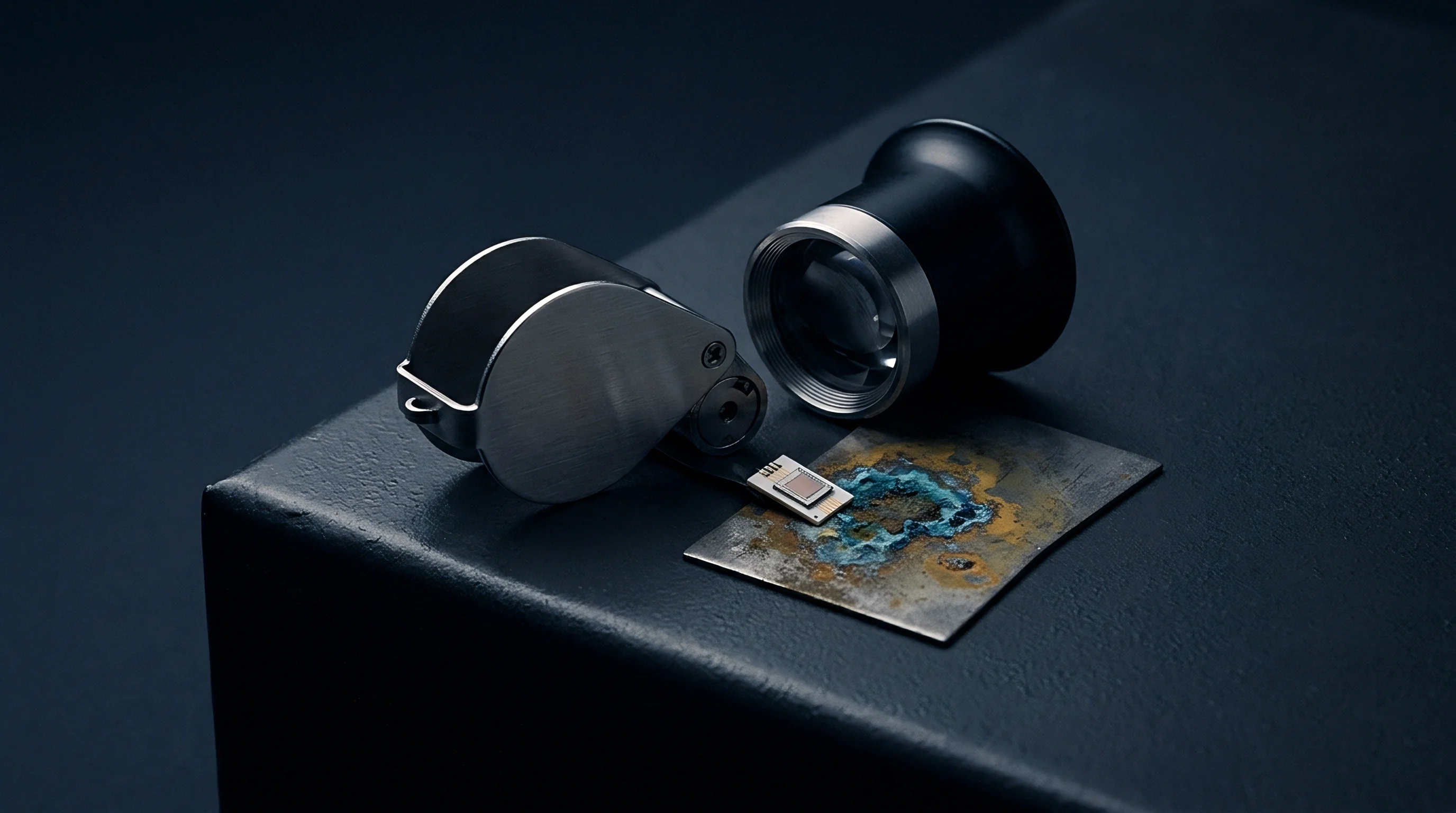
In protected aluminum mirrors, water reacts with the aluminum base to form aluminum hydroxide, producing irreversible white hazing and catastrophic specular loss. Silver mirrors suffer sulfide and chloride tarnishing, converting pure metallic silver into silver sulfide compounds that exhibit near-zero reflectance in the visible spectrum. Gold mirrors exhibit superior chemical inertness, yet water penetration dissolves chromium or titanium adhesion layers beneath the gold film, causing mechanical blistering and delamination of the entire optical layer.
Where Do Thin Condensate Films Degrade Spectral Symmetry?
Interference ripples develop inside accumulated liquid pools whenever layer depth matches integer multiples of the probe beam quarter-wavelength. As a continuous water layer evaporates or thickens, its physical depth sweeps across optical pathlength increments, creating Fabry-Perot interference oscillations between the air-water boundary and the water-mirror boundary. In dual-wavelength systems, these interference fringes modulate channel power independently because fringe periodicity scales inversely with wavelength.
The reference channel may experience constructive interference while the active channel undergoes destructive interference, compounding the ratio distortion induced by bulk absorption.
Adherence to IEC 60068-2-78 damp heat steady-state criteria requires optical components to survive ninety-three percent relative humidity at forty degrees Celsius without exceeding three percent baseline reflectance loss.
Calibration tables become invalid. Engineering teams sourcing optical sensors for condensing environments must verify manufacturing dossiers for passivating layer integrity. Component test dossiers must present clear empirical evidence regarding material boundaries:
- Coating Deposition Architecture details the vacuum process, distinguishing low-density thermal evaporation from high-density ion-assisted deposition or atomic layer growth.
- Substrate Passivation Chemistry defines the stoichiometry and thickness of dielectric overcoats designed to prevent chemical migration and blistering.
- Pin-Hole Density Metrics documents electro-chemical defect counts per unit surface area under accelerated acid-vapor exposure.
- Spectral Repeatability Logs records baseline reflectance across the full design spectrum before and after cyclic condensed moisture testing.
Silver tarnishes in industrial humidity. Failure to account for asymmetric film interference leads directly to uncorrectable measurement drift, false instrument lockouts, and expensive product recalls across continuous emissions monitoring and industrial gas detection installations.
Settlement
Commercial disputes over optical sensor field returns hinge on proving whether sensor degradation stems from unmitigated moisture exposure or defective thin-coat adhesion. Module vendors frequently void warranty claims upon discovering liquid drying stains on optical fold mirrors, asserting that condensation constitutes operation outside specified environmental limits. Conversely, system integrators argue that industrial-grade sensors must tolerate routine humidity transients without suffering permanent calibration offsets or coating delamination.
Gold resists direct chemical oxidation.
Standard qualification procedures frequently mask field vulnerabilities. Laboratory damp heat tests like those prescribed under IEC 60068-2-67 apply steady-state temperature and humidity conditions that prevent the device under test from crossing the dew point. A mirror coating can endure 1,000 hours of 85 degrees Celsius and 85 percent relative humidity without degrading if its temperature remains slightly above the chamber atmosphere.
Real-world failures occur during rapid thermal transitions, where the thermal mass of the optical chassis lags behind incoming ambient air, driving the mirror surface below the dew-point temperature and precipitating liquid water directly onto the optical plane.
Procurement specifications govern risk distribution between supplier and buyer. Sourcing agreements must explicitly separate transient operational drift from permanent component degradation. When an optical assembly undergoes de-condensation through heating or dry gas purging, its specular reflectance must return to within 0.5 percent of initial factory calibration.
If permanent baseline shifts persist after the removal of surface moisture, the defect originates from coating breakdown, dielectric swelling, or pinhole chemical corrosion. Standard procurement contracts incorporating clause 4.2 of ISO 9211-4 assign financial liability for optical coating delamination to the coating manufacturer whenever peel failures emerge following standard cyclic moisture testing.