Component Discontinuance Cost Modeling across Board Layout Redesign and Nitrogen Storage Capital Exposure
Component obsolescence decisions require balancing upfront board redesign NRE against multi-year nitrogen storage capital tie-up and solderability decay risks.

Expiry
Silicon manufacturers broadcast product termination notices when semiconductor fabrication lines transition to smaller gate geometries. When a critical active component in a high-reliability industrial board assembly receives an End-of-Life notice, hardware teams face an immediate financial decision. The choice rests between committing capital to a Last-Time Buy inventory order or funding a printed circuit board redesign.
Quantifying the initial exposure requires analyzing the complete bill of materials to identify single-sourced active components. Last-Time Buy commitments force procurement teams to estimate production volumes over five to ten-year horizons, tying up operational cash flow in stored physical silicon. Capital locked in inventory incurs holding expenses, physical insurance costs, and scrap risk from potential product end-of-life before components are consumed.
Cash flow drops during initial inventory acquisition.
Silicon Lifecycle Discontinuance Signals
Component vendors issue Product Discontinuance Notifications with specified last-time-buy dates and final shipment windows. These documents set strict timelines, often allowing six months for final purchase order placement and twelve months for final delivery. Evaluating the risk profile requires assessing whether the package form is an industry-standard Quad Flat No-Lead device, a Ball Grid Array, or a proprietary Small Outline Integrated Circuit.
Proprietary pinouts eliminate direct drop-in replacements, forcing structural board layout modifications if inventory is not secured.
| Package Type | Pin Count and Pitch | Drop-In Availability | Layout Impact Severity | Re-Qualification Scope |
|---|---|---|---|---|
| SOIC-8 | 8 pins, 1.27 mm pitch | High (Second-sourced) | Low (Trace rerouting rare) | Bench check and functional verification |
| QFN-32 | 32 pins, 0.50 mm pitch | Moderate (Pinout shifts) | Medium (Decoupling placement) | EMC pre-compliance and thermal verification |
| LGA-16 | 16 pads, 0.65 mm pitch | Low (Custom land geometries) | High (Layer stackup modification) | Full environmental stress and vibration test |
| BGA-64 | 64 balls, 0.80 mm pitch | Very Low (Die-level variance) | Critical (Escape routing update) | Full system-level re-qualification cycle |
When silicon foundries decommission older process nodes, whole families of microcontrollers and specialized analog front-ends disappear from distributor channels simultaneously. The decision to execute a Last-Time Buy prevents design disruption but exposes the business to component degradation hazards during extended storage. Physical oxidation of lead terminations and moisture ingress into epoxy mold compounds occur gradually, even in ambient warehouse conditions.

Last-Time Buy Inventory Capital Obligations
Procuring multi-year component stock demands upfront capital commitments that sit on corporate balance sheets. Purchasing ten years of silicon demand upfront converts liquid cash into static inventory subject to interest rate carrying costs. Beyond purchase cost, storage overhead mounts over time through specialized handling, environmental control, and security fees.
Component obsolescence forces an immediate capital choice between long-term inventory financing and hardware engineering re-design.
Scrap risks escalate when end-product market demand drops faster than projected forecasts. Excess silicon components purchased under a Last-Time Buy cannot easily be resold on secondary markets once a component is formally decommissioned. Tooling charges apply immediately upon submission.
Solderability losses grow over stored time. Unit prices change at lower volumes. Failing to account for surface oxidation yield losses leads directly to unrecoverable scrap costs during late-stage assembly.
Copper
Engineers updating printed circuit assemblies facing component obsolescence evaluate the extent of physical trace changes. A complete board respin involves modifying signal routing, ground planes, decoupling capacitor positions, and mechanical clearance zones. Signal degradation introduces latent system drift, while verification delays push commercial product launches.
Redesigning a printed circuit board for an alternate active component incurs Non-Recurring Engineering costs across multiple departments. Layout engineers alter Gerber files, update CAD library footprints, and modify impedance-matched traces. Hardware engineers verify signal integrity, power supply rejection ratios, and thermal dissipation through thermal land patterns.
Mechanical engineers ensure package height variations fit within existing module enclosures.

Non-Recurring Engineering Costs in Board Respins
Modifying printed circuit layouts incurs immediate expenses across design engineering, prototype fabrication, and test setup. The table below itemizes standard non-recurring engineering line items for a four-layer industrial board layout respin.
| Cost Element | Engineering Hours | Direct Financial Rate | Material Expense | Subtotal Exposure |
|---|---|---|---|---|
| CAD Layout and Routing | 40 hours | 125 USD per hour | 0 USD | 5,000 USD |
| Firmware Driver Adaptation | 60 hours | 150 USD per hour | 0 USD | 9,000 USD |
| PCB Spin and Stencil Fabrication | 0 hours | 0 USD per hour | 2,500 USD | 2,500 USD |
| Prototype SMT Assembly | 16 hours | 100 USD per hour | 1,200 USD | 2,800 USD |
| EMC and Environmental Compliance | 24 hours | 175 USD per hour | 8,500 USD | 12,700 USD |
| Total Estimated Non-Recurring Engineering Exposure | 32,000 USD | |||
Redesign activities extend beyond hardware layout changes into embedded firmware drivers. When a replacement component uses a different internal register map or modified bus interface timing, software leads spend engineering weeks refactoring device drivers. Register address collisions and interrupt line variations require software regression testing to verify system timing constraints.

Land Pattern Pinout Translation and Signal Integrity
Replacing an active integrated circuit often demands mapping existing signal lines onto modified mechanical footprint geometry. A transition from a Leadless Grid Array to a Quad Flat Package introduces parasitic inductance changes due to wire-bond length variances. Layout adjustments preserve high-speed bus trace lengths and matched differential pairs to prevent signal degradation.
- Land Pattern Dimensioning Adjusting pad sizes and pitch prevents solder bridging and ensures joint inspection compliance under IPC-A-610 standards.
- Thermal Relief Routing Connecting exposed package ground pads to internal copper planes maintains thermal dissipation pathways without creating thermal sinks that impede reflow.
- Decoupling Placement Position high-frequency bypass capacitors within two millimeters of device power pins to suppress transient voltage spikes on low-voltage rails.
A full printed circuit board layout respin for an industrial module demands an average non-recurring engineering commitment of thirty-two thousand dollars in direct labor and testing fees.
Stencil aperture geometry defines paste volume, while package pinouts alter routing density across inner layers. Meanwhile, interfacial stress can split internal package bonds over thermal cycling.
Atmosphere
Preserving sensitive surface-mount packages over extended timelines relies on environmental containment systems. Standard ambient warehouse storage exposes plastic surface-mount devices to moisture absorption, leading to popcorning defects during reflow soldering. Long-term component retention utilizes nitrogen dry storage cabinets to isolate parts from atmospheric oxygen and moisture.
Nitrogen-purged storage environments maintain internal relative humidity levels below one percent. Displacing oxygen slows down the natural oxidation of tin-lead and lead-free solder terminations. Physical cabinet installations require initial capital investments in storage hardware, gas filtration manifolds, continuously monitored humidity sensors, and high-purity nitrogen supply lines, along with recurring electrical expenses for climate management.

Nitrogen Dry Storage Capital and Operating Costs
Automated dry storage cabinets purge interior chambers with continuous high-purity inert gas streams. The capital equipment expenditure for an industrial-grade nitrogen cabinet ranges from eight thousand to twenty-five thousand dollars based on chamber volume and automated purging capabilities. Operating expenses include continuous nitrogen gas consumption, electricity for desiccant regeneration, and annual sensor calibration.
- System Procurement Selecting automated nitrogen purging cabinets capable of holding internal relative humidity below one percent continuously.
- Gas Infrastructure Integration Connecting liquid nitrogen dewars or onsite nitrogen generators to deliver 99.99 percent pure gas at regulated pressure.
- Environmental Monitoring Setup Installing calibrated digital hygrometers and data loggers to trace relative humidity and oxygen levels in real time.
- Handling Protocol Execution Establishing strict operator door-opening durations to limit ambient moisture ingress during component withdrawal cycles.
Gas supply economics dictate ongoing operating costs. Consuming bulk liquid nitrogen or operating onsite pressure-swing adsorption generators creates a fixed monthly operating expense. Facilities calculate the cost per component-year of stored inventory to assess whether physical dry preservation remains financially viable over long horizons.

Does Dry Storage Capital Risk Exceed Redesign Payback?
Financial paybacks between physical storage infrastructure and board re-engineering depend on remaining product production volumes. For low-volume, high-margin aerospace or medical equipment, dry storage capital expenses represent a fraction of complete flight or medical re-certification costs. Conversely, high-volume consumer products absorb layout redesign expenses quickly over large production runs.
While pure nitrogen delays surface oxidation, extended storage still accelerates intermetallic compound migration between copper substrate pads and solder plating layers. This growth creates brittle boundary layers that reduce mechanical solder joint reliability during subsequent surface-mount assembly.
Solderability Loss and Packaging Material Degradation
Long-term inventory storage induces microstructural alterations inside semiconductor lead finishes and organic carrier materials. Outgassing from standard plastic carrier tapes, anti-static bags, and cover tapes releases organic compounds that deposit onto component leads. Deposited films act as solder contaminants, impeding wetability during reflow soldering.
Under IPC/JEDEC J-STD-033 recommendations, surface-mount parts exposed to ambient humidity above threshold limits require low-temperature baking prior to reflow assembly.
Baking moisture out of plastic surface-mount components before assembly introduces thermal stress. Repeated bake cycles accelerate intermetallic compound growth on lead finishes, deteriorating solderability faster than dry nitrogen storage. Maintaining continuous dry conditions eliminates the need for pre-assembly baking cycles, as inert gas pressure holds moisture away from porous plastic compounds far better than standard desiccant packs.
Amortization
Financial comparison models balance immediate non-recurring engineering fees against long-term inventory holding costs. Total Cost of Ownership calculations combine component purchase prices, capital financing costs, storage hardware depreciation, gas utility bills, scrap allowances, and board redesign costs. Evaluating these metrics on a Net Present Value basis provides clear direction for component discontinuance decisions.
A comprehensive financial model includes discount rates representing corporate cost of capital. Cash tied up in Last-Time Buy stock cannot fund research, product development, or commercial expansion. Amortizing non-recurring engineering expenses across remaining unit production volumes reveals the breakeven point where board redesign becomes more economical than long-term nitrogen storage.

Net Present Value Comparative Cost Equation
Quantitative trade-off modeling applies discounted cash flow principles across total operational life cycles. The total cost of a Last-Time Buy strategy combines initial inventory procurement capital with recurring storage expenses and expected yield losses over time. The alternative board redesign strategy sums initial non-recurring engineering, qualification costs, and unit price adjustments over the remaining manufacturing lifespan.
1. Calculate initial inventory capital outlay by multiplying terminal component demand by negotiated Last-Time Buy unit price.
2. Compute annual physical storage costs including nitrogen gas consumption, cabinet depreciation, floor space allocation, and maintenance labor.
3. Apply an annual inventory holding penalty rate representing capital lockup cost and insurance liabilities.
4. Sum discounted annual cash flows over the target preservation timeline to obtain the Net Present Value of inventory preservation.
Comparing cash flows highlights cross-over points where redesign investment delivers lower cumulative expenditure. Higher annual production volumes shorten the payback period of board redesign investments.
| Cost Category | Last-Time Buy Nitrogen Storage | Board Layout Redesign | Financial Variance Impact |
|---|---|---|---|
| Upfront Capital Outlay | 120,000 USD (Component Stock) | 32,000 USD (NRE Engineering) | 88,000 USD Capital Savings on Redesign |
| Equipment Infrastructure | 15,000 USD (N2 Cabinet Purchase) | 2,500 USD (PCB Tooling / Stencil) | 12,500 USD Infrastructure Advantage |
| Annual Operating Expense | 3,500 USD per year (Gas & Power) | 0 USD per year | 35,000 USD 10-Year Cumulative OpEx |
| Component Scrap / Yield Loss | 8,000 USD (Estimated 5% Decay) | 0 USD | 8,000 USD Waste Elimination |
| Unit Cost Variance | 0 USD (Locked LTB Price) | -1.50 USD per unit (Cheaper Silicon) | 15,000 USD Savings (10k units total) |
Breakeven Lifetime Production Volume Thresholds
A critical manufacturing volume determines whether component procurement or circuit board redesign yields lower expense. Low-volume product lines under five hundred units annually rarely justify complete circuit board respins, favoring inventory preservation inside nitrogen storage environments. High-volume assemblies exceeding ten thousand units per year amortize redesign non-recurring engineering within months, making board redesign the lower-risk choice.
Contractual risk allocation clauses in manufacturing service agreements enforce financial liabilities for unconsumed component inventory directly on the original equipment manufacturer.
Evaluating trade-off thresholds allows sourcing managers to choose paths backed by verifiable financial figures. Inventory holding risks increase exponentially as storage durations extend past five years. Standard supplier agreements shift total financial liability for unsold inventory directly to the purchaser once last-time-buy orders execute.

Arbitration
Engineering managers choose strategic supply paths by balancing layout adaptability against long-term capital lockup. Mitigating component discontinuance exposure requires structured design practices that incorporate supply chain elasticity directly into printed circuit board designs. Implementing dual-sourcing land patterns allows manufacturing lines to switch active component footprints without layout modifications.
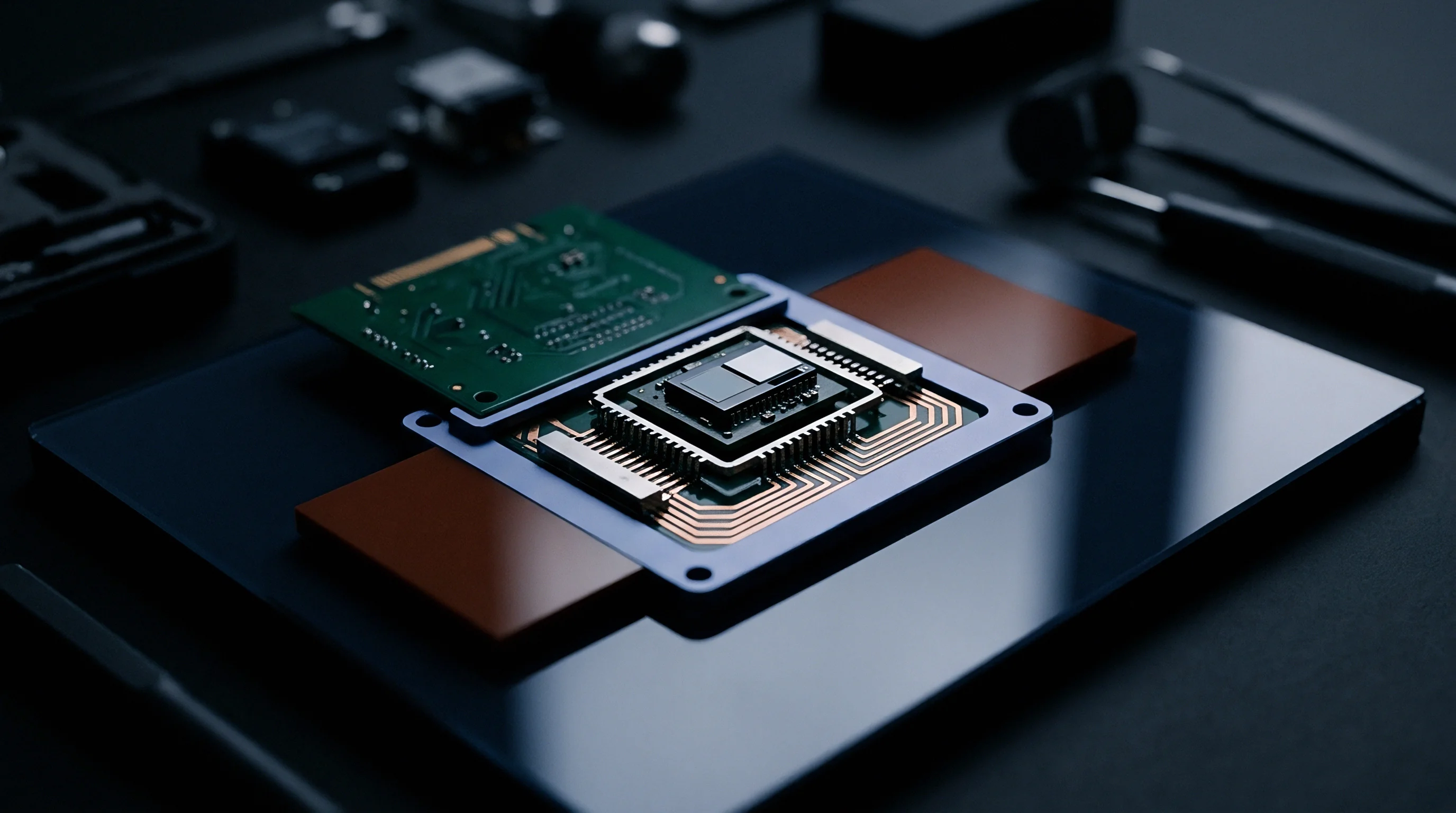
Dual-footprint designs accommodate two different package sizes on the same physical board space. Routing composite land patterns enables populating either a primary active component or an alternative second-source component during assembly. Dual-sourcing limits future exposure to component obsolescence notifications and reduces dependency on single-source suppliers.
Dual-Sourcing Footprint Strategies and Composite Pads
Designing flexible printed circuit boards with overlapping footprints accommodates alternative active package outlines. For example, a land pattern layout can overlay an SOIC-8 footprint atop a smaller WSON-8 pad arrangement. Routing shared signal nets to both pad sets allows assembly lines to place whichever component package is available in distribution channels.
- Composite Geometry Layout Overlapping trace pads for two package variants while maintaining minimum solder mask damper spacing between pins.
- Solder Mask Webbing Assurance Maintaining a minimum 0.08 millimeter solder mask bridge between adjacent pads prevents solder bridging during reflow assembly.
- Decoupling Bus Sharing Positioning shared bypass capacitors so ground loops remain minimal regardless of which package variant populates the board.
- Pick-and-Place File Governance Maintaining distinct surface-mount placement files for alternate bill-of-materials configurations inside manufacturing documentation.
Dual-footprint strategies consume additional printed circuit board surface area. High-density assemblies may lack necessary surface area for dual land patterns, forcing a choice between nitrogen inventory storage or full board redesign.

Long-Term Supply Risk Governance Criteria
Procurement practices establish structured evaluation criteria to evaluate component obsolescence notices within forty-eight hours. Cross-functional teams comprising sourcing managers, board layout engineers, and firmware developers evaluate Last-Time Buy options against redesign timelines. Standardized decision protocols prevent panic purchasing while avoiding component stockouts.
Maintaining clear component lifecycle visibility allows teams to predict end-of-life dates based on supplier node transitions. Proactive monitoring identifies high-risk components years before formal end-of-life notices issue. Integrating physical storage cost models with engineering layout metrics ensures business decisions rely on precise total cost calculations.
The open question remains whether emerging moisture-barrier polymer coatings can eventually replace active nitrogen purging cabinets for long-term component preservation.