Predicting Long Term Frequency Bias Instability from Viscoelastic Relaxation in Eutectic Wafer Bonding
Viscoelastic relaxation in eutectic wafer bonds causes exponential long-term frequency drift requiring dual-element Maxwell model parameterization.
Coupling
Micro-electromechanical frequency standards rely on mechanical eigenmodes governed by structural dimensions and elastic constants. When a silicon MEMS resonator substrate undergo wafer-level hermetic encapsulation via eutectic bonding, thermal processes lock substantial mechanical energy into the joint stack. The bonding sequence occurs at elevated temperatures where liquid phases form and consolidate, such as 363°C for gold-silicon or 280°C for gold-tin.
Cooling the assembly to room temperature induces severe residual stress states driven by differential thermal contraction between the bulk single-crystal silicon die, the glass or silicon lid, and the intermediate metallic layers. Silicon expands anisotropic under load.
Residual mounting stress alters the native resonant frequency through two distinct physical mechanisms. The first mechanism is geometric deformation, where stress fields bow the device substrate or flex internal anchor points, altering the kinetic and strain energy distribution of the vibrating mode shape. The second mechanism operates through the non-linear piezo-elastic effect, where mechanical stress directly modifies the stiffness tensor components of single-crystal silicon.
High-aspect-ratio beam structures and bulk acoustic resonators experience fractional frequency shifts proportional to the net stress tensor integrated across their anchor footprints. Thermal expansion mismatches store mechanical energy.
The total mechanical stress transferred from the bond perimeter into the active sensing cavity decays with geometric distance, yet residual stresses often exceed several tens of megapascals near anchor points. Packaging strain transfer channels govern how this stored energy impacts long-term operational performance:
- Anchor Strain Sensitivity transfers localized frame deformation directly into the flexural or extensional support beams of the resonant mass.
- Substrate Package Bow generates bending moments across the active die plane that shift structural stiffness continuously under ambient temperature fluctuations.
- Intermetallic Volume Contraction occurs during solid-state phase transformations within the bond line, inducing localized shear strains along the bonding boundary.
- Cap Deflection Coupling alters internal cavity air gap dimensions, modifying electrostatic spring constants in capacitive transduction architectures.
Gold-silicon eutectic bond lines at 200°C display an initial stress relaxation rate exceeding 0.4 MPa per hour under a 30 MPa localized assembly load.
If the bond material behaved as a purely linear elastic solid, the residual stress state would remain completely static over the multi-decade operating lifetime of the sensor, creating a fixed, calibratable frequency offset. Metallic bonding layers exhibit time-dependent inelastic behavior. Eutectic structures undergo slow stress redistribution over time, causing the mechanical strain field at the resonator anchors to drift.
This continuous stress evolution generates an uncompensated, long-term frequency bias drift that degrades system clock precision. Thermal stress accumulation without stress-isolation structures results in long-term frequency bias instability that exceeds system error budgets long before component wear-out occurs.

Seal
Intermediate metallic layers in microelectronic packages do not maintain a permanent elastic equilibrium under sustained mechanical loads. Metallic systems operating above half their absolute melting temperature experience continuous microstructural adjustment. At standard operating environments ranging from minus 40°C to 125°C, gold-based and aluminum-based eutectic alloys sit at elevated homologous temperatures.
Homologous temperature represents the ratio of ambient operating temperature to the alloy melting point in Kelvin. For gold-tin eutectic alloy with a melting point of 280°C (553 K), an operating environment of 85°C (358 K) corresponds to a homologous temperature of 0.65, placing the material inside the active thermal creep domain.
Viscoelasticity in Intermetallic Alloys
Polycrystalline metallic bond lines exhibit time-dependent strain responses under constant stress, characterized by instantaneous elastic deformation followed by slow viscoelastic relaxation and viscoplastic flow. Elastic strain energy stored during wafer cooling gradually converts into plastic deformation through mass transport within the alloy structure. Grain boundary sliding dominates low stress levels.
Coble creep drives atomic transport along internal grain boundaries, while Nabarro-Herring creep operates through bulk lattice diffusion at higher thermal states. Dislocation climb and glide become dominant when localized stress concentrations exceed the yield strength of the constituent intermetallic phases.
The complex microstructural makeup of eutectic interfaces accelerates these relaxation phenomena. Au-Si and Au-Sn bond zones do not consist of uniform single-phase metals; they contain complex networks of distinct intermetallic compounds (IMCs) alongside soft binary phases. Over time, these phases undergo continuous grain growth, phase coarsening, and interdiffusion.
Intermetallic growth alters structural stiffness. As phase boundaries shift and grain orientations coarsen, the effective mechanical compliance of the bond layer evolves dynamically. Modulus drops under steady displacement.
| Eutectic System | Composition (wt%) | Eutectic Temp (°C) | Activation Energy Q (eV) | Relaxed Modulus Reduction (%) | Viscous Flow Threshold (MPa) |
|---|---|---|---|---|---|
| Au-Si | 85.0 Au / 15.0 Si | 363 | 0.88 | 22 to 35 | 12.5 |
| Au-Sn | 80.0 Au / 20.0 Sn | 280 | 0.74 | 30 to 48 | 8.0 |
| Al-Ge | 51.0 Al / 49.0 Ge | 419 | 1.05 | 15 to 25 | 18.0 |
| Cu-Sn | 95.0 Cu / 5.0 Sn (Solid Phase) | 231 (T_melt Sn) | 0.92 | 18 to 28 | 15.0 |

Microstructural Evolution during Thermal Aging
Solid-state diffusion drives continuous phase transformation within eutectic interfaces during high-temperature storage and normal field operation. In gold-tin systems, the initial non-equilibrium distribution of Au5Sn and AuSn phases gradually shifts toward thermodynamically stable stoichiometric configurations. This solid-state atomic rearrangement causes localized volume changes up to two percent within the bond perimeter.
Volume contraction inside a rigid, fully constrained silicon frame generates internal shear stress spikes, triggering secondary creep waves inside the softer metallic phases. Gold diffuses rapidly into silicon.
Thicker intermediate metallic bond layers decrease high-frequency stress transmission while accelerating long-term viscoelastic bias drift.
Packaging foundries frequently assure clients that post-bonding thermal annealing completely eliminates residual interfacial stress prior to component delivery. Thermal annealing relieves trapped interfacial stresses. A single thermal bake merely shifts the stress state into a slower logarithmic decay regime rather than terminating the underlying physical relaxation mechanism.

Arithmetic
Quantifying long-term frequency drift requires translating time-dependent stress fields into structural strain shifts at the sensor anchor points. Viscoelastic relaxation modeling employs rheological networks combining discrete spring and dashpot elements. The classic Burgers model effectively captures both short-term transient compliance and steady-state long-term viscous flow.
A Burgers element connects a Maxwell model in series with a Kelvin-Voigt model, defining time-dependent compliance under constant stress.
Constitutive Burgers Rheological Model
The time-dependent relaxation modulus E(t) under constant strain conditions is expressed as a series of decaying exponential terms representing distinct physical relaxation mechanisms within the intermetallic matrix:
E(t) = E_infinite + E_1 exp(-t / tau_1) + E_2 exp(-t / tau_2)
In this equation, E_infinite represents the fully relaxed long-term equilibrium modulus, E_i represents the relaxation strength of the i-th relaxation mode, and tau_i defines the characteristic relaxation time constant for that specific mode. Relaxation times scale with temperature according to an Arrhenius relationship:
tau_i(T) = tau_0i exp(Q_i / (k_B T))
Where tau_0i is the pre-exponential factor, Q_i is the activation energy of the governing diffusion mechanism, k_B is Boltzmann’s constant, and T is absolute temperature in Kelvin. The stress tensor sigma(t) acting across the resonator anchors evolves as a convolution of the initial stress tensor sigma_0 with the normalized relaxation modulus:
sigma(t) = sigma_0 (1 – sum(alpha_i (1 – exp(-t / tau_i))))
Here, alpha_i represents the fractional stress drop attributed to relaxation mode i. The fractional frequency bias drift delta_f(t)/f_0 of the micro-electromechanical resonator relates directly to the anchor stress evolution through the mode-specific mechanical stress sensitivity factor K_stress, typically expressed in units of ppm per MPa:
delta_f(t) / f_0 = K_stress (sigma(t) – sigma_0) = – K_stress sigma_0 sum(alpha_i (1 – exp(-t / tau_i)))
Frequency bias drifts predictably log-time. Calculating the long-term frequency drift trajectory of a eutectic wafer-bonded MEMS resonator follows a defined mathematical procedure:
- Determine the initial residual mounting stress tensor sigma_0 at the anchor footprints using finite element thermal contraction modeling from the bonding solidification temperature down to 25°C.
- Measure the stress sensitivity coefficient K_stress of the specific resonant mode shape via calibrated uniaxial substrate bending experiments.
- Extract the activation energies Q_i and relaxation mode strengths alpha_i of the eutectic bond line using dynamic mechanical analysis across a thermal spectrum from minus 40°C to 150°C.
- Calculate temperature-shifted relaxation time constants tau_i for the targeted operational temperature profile using the Arrhenius shift formula.
- Compute the integrated stress relaxation magnitude delta_sigma(t) over operational time steps spanning from 1 hour to 175,200 hours (20 years).
- Multiply the cumulative stress relaxation delta_sigma(t) by the stress sensitivity coefficient K_stress to yield total projected frequency bias drift in parts per million.
Failure to account for non-linear stress relaxation under MIL-STD-883 Method 1008 conditions leads to unpredicted frequency drift exceeding system error budgets during extended field deployment.

Time-Temperature Superposition and Shift Factors
Viscoelastic relaxation processes accelerate at elevated temperatures, allowing long-term room-temperature behavior prediction from short-term elevated-temperature experiments. The empirical shift factor a_T transforms operational time t into an equivalent reduced time t_r:
t_r = t / a_T(T)
Applying time-temperature superposition assumes that all structural relaxation mechanisms possess identical thermal activation energies. When multiple intermetallic phases relax simultaneously through different diffusion pathways, simple single-activation Arrhenius scaling breaks down, requiring multi-mode relaxation networks.
| Operating Temp (°C) | 1 Year Drift (ppm) | 5 Year Drift (ppm) | 10 Year Drift (ppm) | 20 Year Drift (ppm) |
|---|---|---|---|---|
| 25 | 0.82 | 2.14 | 3.10 | 4.05 |
| 55 | 2.45 | 4.88 | 6.12 | 7.20 |
| 85 | 5.60 | 8.92 | 10.15 | 11.08 |
| 125 | 10.42 | 12.80 | 13.45 | 13.90 |
Worked Calculation of Frequency Bias Drift
To demonstrate the model under realistic operational parameters, evaluate a single-crystal silicon bulk acoustic wave resonator bonded with an 85/15 gold-silicon eutectic frame. Assume an initial post-bonding tensile residual stress sigma_0 of 45 MPa concentrated at the anchor pads at 25°C. Let the measured mechanical stress sensitivity coefficient K_stress be -0.32 ppm/MPa. Assume viscoelastic characterization identifies two dominant relaxation modes: Mode 1 representing rapid grain boundary sliding (alpha_1 = 0.15, Q_1 = 0.72 eV, tau_01 = 1.2 x 10^-7 hours) and Mode 2 representing slow bulk lattice rearrangement (alpha_2 = 0.30, Q_2 = 0.95 eV, tau_02 = 4.5 x 10^-9 hours).
At an operating temperature of 85°C (358.15 K), thermal energy accelerates both relaxation pathways. Calculating the relaxation time constants yields tau_1 = 1,642 hours for Mode 1 and tau_2 = 101,450 hours for Mode 2. After 1 year (8,760 hours) of continuous operation at 85°C, the fractional stress drop in Mode 1 reaches 1 – exp(-8760 / 1642) = 0.995, representing near-complete saturation of this transient phase.
Mode 2 achieves 1 – exp(-8760 / 101450) = 0.082 of its total potential relaxation strength.
Summing both active modes produces a cumulative fractional stress reduction factor of (0.15 0.995) + (0.30 0.082) = 0.14925 + 0.02460 = 0.17385. The absolute stress reduction across the anchor footprint equals 45 MPa 0.17385 = 7.823 MPa. Multiplying this stress change by the stress sensitivity coefficient yields a 1-year frequency bias drift delta_f/f_0 = (-0.32 ppm/MPa) (-7.823 MPa) = +2.503 ppm.
Extending the operational duration to 20 years (175,200 hours) at the same 85°C environment allows Mode 2 to advance to 1 – exp(-175200 / 101450) = 0.822 of its ultimate relaxation capability. The updated cumulative stress relaxation factor increases to (0.15 1.0) + (0.30 0.822) = 0.15 + 0.2466 = 0.3966. The total relaxed stress reaches 45 MPa 0.3966 = 17.847 MPa, which generates a 20-year frequency bias drift of +5.711 ppm.
Shear strain modifies resonant frequency.
Whether non-linear plastic yield events occurring during thermal cycling interact synergistically with low-stress diffusion creep remains an analytical uncertainty, as current constitutive models assume independent additive strain components without cross-mode coupling terms.
Assay
Validating multi-year frequency stability models within commercial production timelines requires accelerated thermal stress protocols. Standard high-temperature storage testing per IEC 60068-2-2 subjects bonded devices to unpowered thermal exposure at temperatures ranging from 125°C to 175°C. Real-time frequency monitoring inside precision thermal chambers tracks output deviation against reference rubidium standards, isolating bond line dynamics from chamber environmental noise.
Accelerated Aging and Frequency Tracking
Short-term accelerated aging data can mask long-term drift trajectories if testing durations fall below the transition knees of primary relaxation modes. A device tested for only 100 hours at 125°C captures rapid initial transient creep but omits slow, secondary grain boundary diffusion processes that dominate long-term field drift at 25°C. Complete parameter extraction requires minimum test durations of 1,000 hours across at least three distinct elevated temperature steps (such as 105°C, 125°C, and 150°C) to construct accurate Arrhenius slope regressions.
Laser Doppler vibrometry combined with high-temperature storage resolves sub-nanometer bond line creep deformations over a 1000-hour test interval.
How Does Thermal Cycling Accelerate Viscoelastic Stress Redistribution?
Temperature transitions induce cyclic mechanical strain swings across the eutectic frame due to thermal expansion mismatches between silicon, metal, and enclosure materials. Thermal cycling creates localized plastic deformation zones along grain boundaries, accelerating atomic diffusion rates compared to static isothermal aging. Viscoelasticity introduces long hysteresis loops.
Alternating strain fields continuously generate new dislocation densities within soft binary metallic phases, preventing stress relaxation saturation and driving continuous frequency bias drift.
Evaluating long-term frequency bias stability demands clear differentiation between bond line relaxation and confounding physical failure modes. Experimental isolation protocols distinguish distinct drift signatures:
- Outgassing Pressure Shifts alter cavity vacuum levels over time, causing frequency drift accompanied by a sharp drop in mechanical quality factor (Q-factor).
- Surface Mass Loading from residual moisture or organic contaminants causes pure downward frequency shifts without altering anchor stress distribution.
- Eutectic Viscoelastic Relaxation produces monotonic frequency drift with stable Q-factor readings and measurable changes in package surface curvature.
- Silicon Fatigue Creep occurs exclusively at extreme stress levels exceeding 500 MPa, remaining negligible in standard wafer-level encapsulation architectures.
Interferometric and Acoustic Failure Analysis
Resolving localized strain relaxation requires optical interferometry combined with scanning acoustic microscopy. White-light interferometry maps out-of-plane package topography down to sub-nanometer resolutions, enabling real-time detection of die-level bowing changes during thermal aging. Laser Doppler Vibrometry (LDV) measures localized velocity fields across vibrating resonator beams, pinpointing mode shape tilt caused by asymmetric anchor stress relief.
Hermetic sealing locks in strain.
To ensure measurement integrity during long-term stability characterization, test engineers follow a standardized verification sequence:
- Mount encapsulated MEMS devices in low-stress test sockets designed to decouple printed circuit board thermal expansion from the sensor package.
- Stabilize test samples in an isothermal chamber held within plus or minus 0.05°C accuracy for a minimum of two hours prior to taking baseline frequency measurements.
- Record initial resonant frequency, quality factor, and parasitic equivalent circuit parameters using a calibrated vector network analyzer.
- Subject test groups to isothermal storage at 125°C, removing samples at pre-determined logarithmic time intervals (24, 72, 168, 500, and 1000 hours) for room-temperature re-characterization.
- Fit recorded frequency drift data to a dual-mode exponential relaxation equation using non-linear least-squares regression to extract active relaxation time constants.
- Extrapolate time-temperature shift factors to project 20-year frequency bias stability at standard field operating temperatures.
A reliable test protocol isolates mechanical packaging drift from electrical conditioning drift by verifying sensor element impedance profiles before and after accelerated thermal aging.

Mitigation
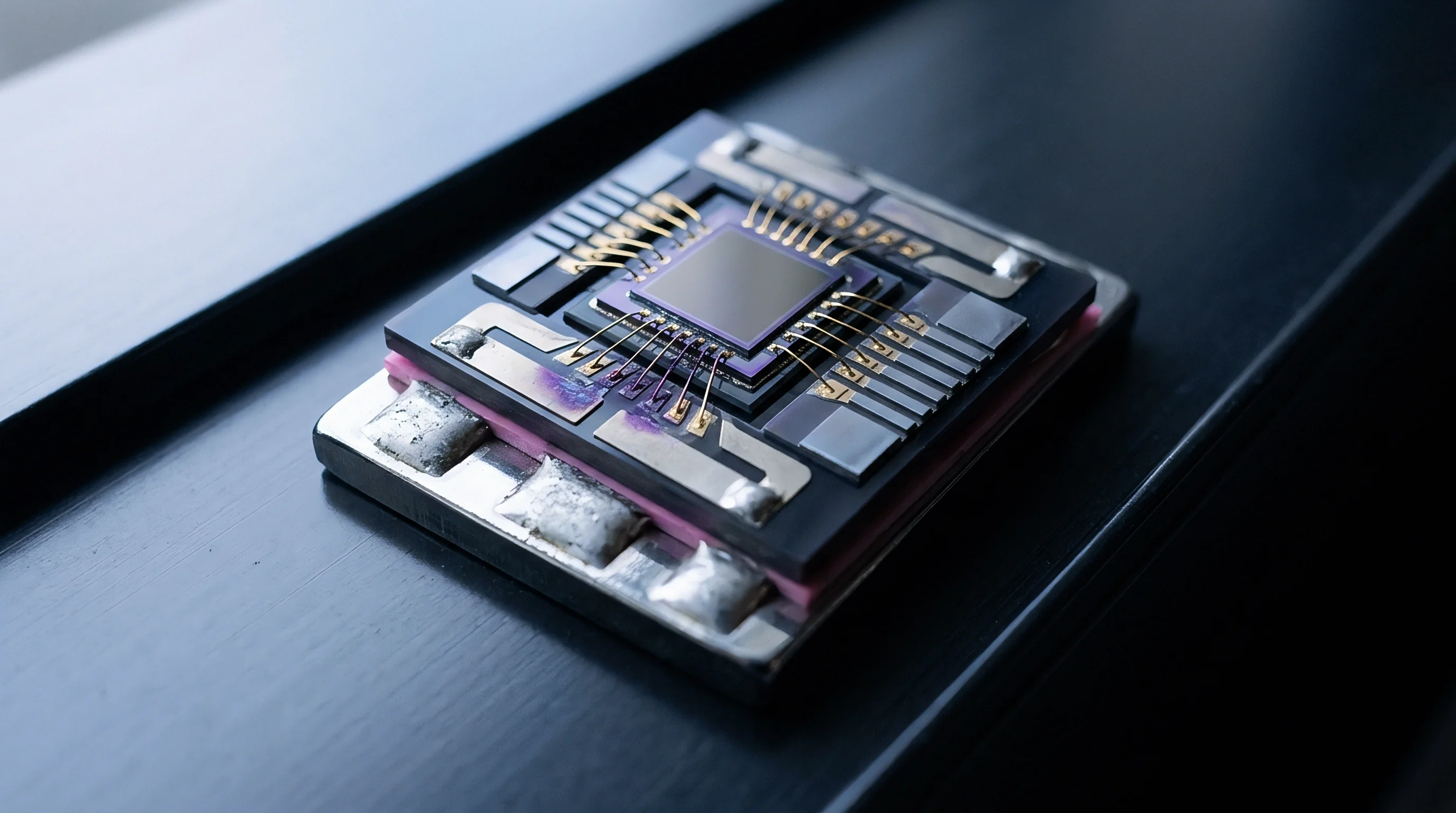
Minimizing long-term frequency bias instability requires engineering intervention at both the structural design stage and the metallurgical processing level. Structural isolation techniques focus on decoupling the active vibrating element from stress fields generated at the wafer bonding boundary. Incorporating folded-beam strain relief structures or deep reactive-ion etched stress-isolation trenches around anchor pads attenuates package-induced strain transfer by factors exceeding twenty decibels.

Bond Frame Topology and Strain Isolation
Symmetrical bond frame layouts balance mechanical strain components across the sensor substrate, converting asymmetric shear stresses into uniform in-plane hydrostatic stresses. Hydrostatic stress fields generate substantially lower piezo-elastic frequency shifts in single-crystal silicon compared to directional shear components. Anchor placement along low-stress crystallographic axes, such as the direction in (100) silicon wafers, further reduces mode frequency sensitivity to residual mounting stress variations.
Package curvature induces frequency offset.
| Design Parameter | Standard Process Window | Low-Drift Optimized Window | Impact on Bias Instability |
|---|---|---|---|
| Bond Line Thickness | 3.0 to 5.0 µm | 0.8 to 1.2 µm | Reduces total viscoelastic volume and creep amplitude |
| Post-Bond Anneal Temp | None or 200°C / 1 hr | 280°C / 12 hrs (Au-Si) | Exhausts short-term transient relaxation modes |
| Anchor Distance to Bond Frame | < 100 µm | > 400 µm with isolation trench | Attenuates strain transfer field via geometric decay |
| Alloy Stoichiometry Shift | Off-eutectic (+/- 2 wt%) | Eutectic point (+/- 0.2 wt%) | Prevents brittle phase formation and secondary volume changes |
Post-Bond Annealing and Thermal Stabilization
Metallurgical optimization focuses on controlling alloy stoichiometry, grain size, and intermetallic phase distribution within the bonding layer. Depositing precise eutectic compositions during physical vapor deposition prevents excess primary phase formation, minimizing secondary solid-state phase transformations during operating lifetimes. Refining metal grain structures through micro-alloying additives increases grain boundary pinning, suppressing Coble creep pathways at elevated operating temperatures.
Creep rate scales with temperature.
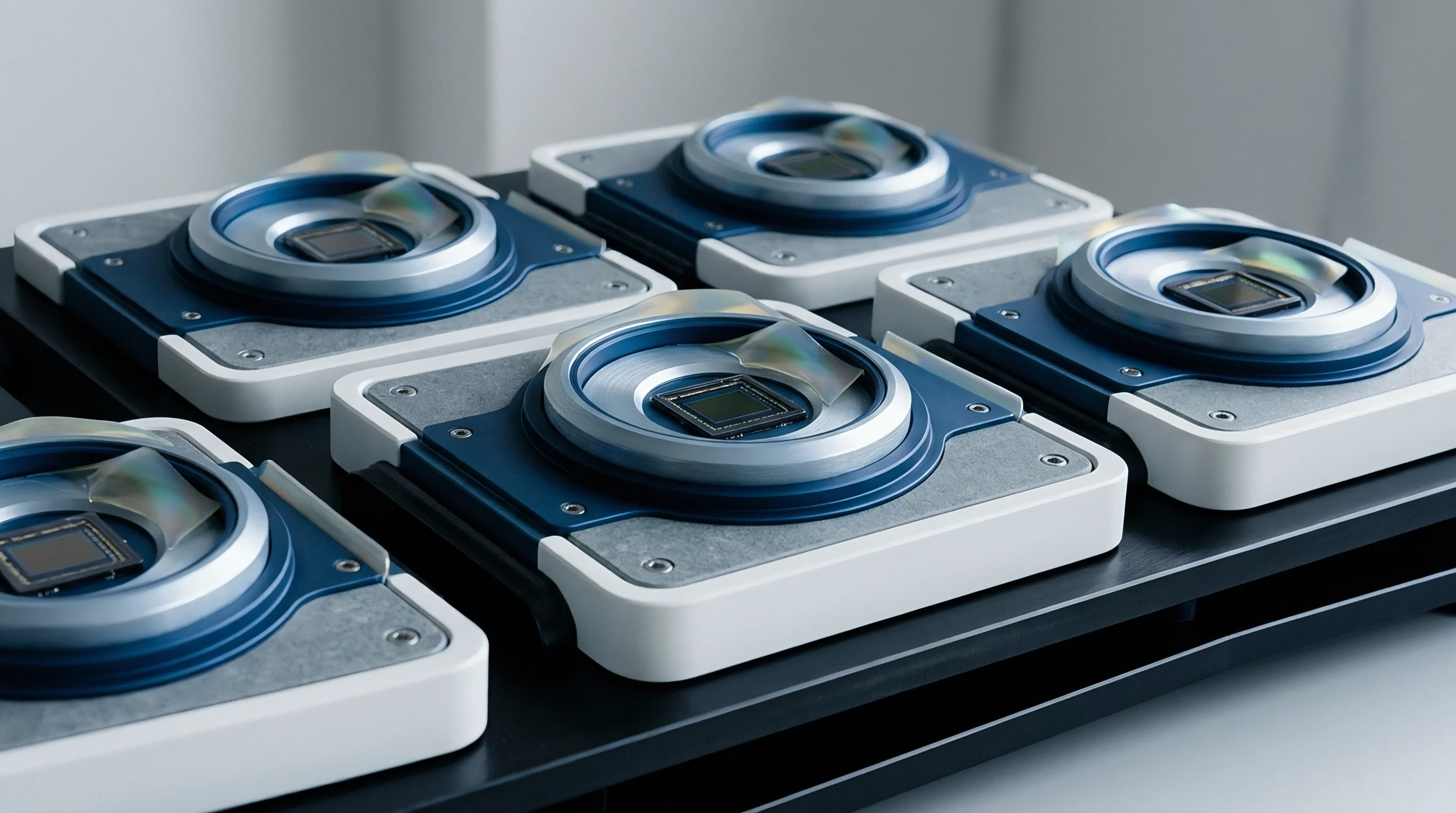
High-temperature post-bond stabilization annealing offers a powerful operational mitigation strategy. Subjecting freshly bonded wafers to prolonged thermal exposure at temperatures slightly above maximum storage limits accelerates short-term transient relaxation modes to full saturation prior to final device calibration. This process exhausts the rapid viscoelastic compliance phase, leaving only ultra-slow long-term diffusion processes active during subsequent field deployment.
Procurement agreements for high-reliability MEMS resonators specify that eutectic wafer bonding processes comply with MIL-STD-883 Method 1010 condition B thermal cycling and demonstrate post-anneal frequency bias drift below 0.5 ppm over a 1,000-hour, 125°C qualification burn-in period.