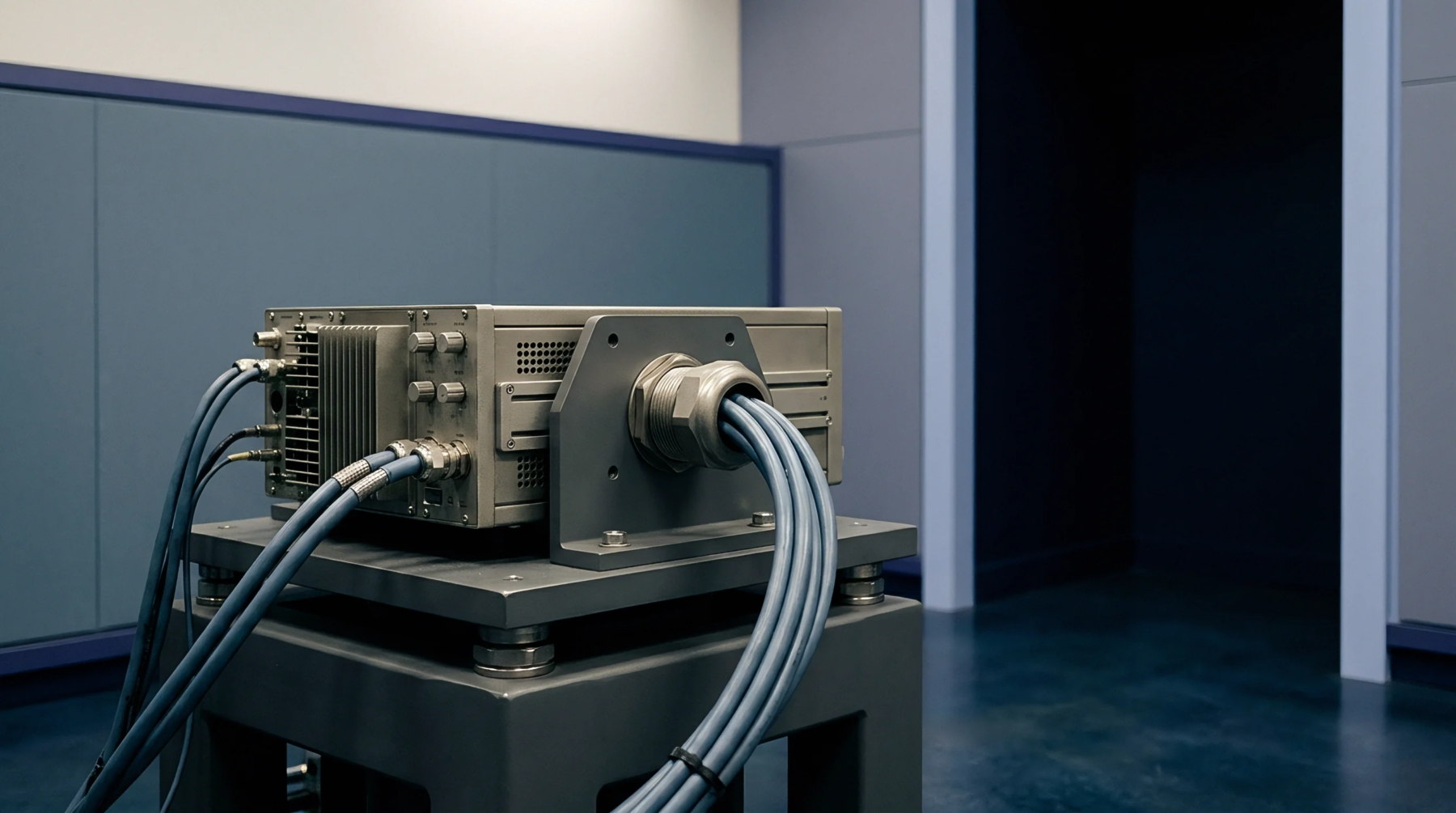
Tactical Inertial Measurement Unit Thermal Bias Modeling Fundamentals
Tactical IMU thermal bias modeling requires combining static higher-order polynomials with real-time temperature derivative terms to eliminate dynamic lag errors.
Tactical IMU thermal bias modeling requires combining static higher-order polynomials with real-time temperature derivative terms to eliminate dynamic lag errors.

Dynamic thermal gradients induce structural strain and bias errors that static calibrations miss, requiring real-time state observer algorithms.
Real-time matrix correction using on-die piezoresistive strain arrays reduces board flexure induced zero-rate drift in automotive MEMS gyroscopes below 0.02 deg/s.

Augmenting Extended Kalman Filters with dynamic temperature derivative states eliminates dynamic thermal bias drift during rapid ramp conditions.

Extracting Allan deviation noise parameters demands fitting logarithmic asymptote slopes across discrete cluster time intervals under steady thermal conditions.

Bench Allan variance parameters convert to discrete Kalman process noise matrices by integrating state transition matrices over the sampling interval.
Closed loop inertial sensor Allan variance noise parameters require isolating active rebalance filter artifacts before populating discrete Kalman filter process noise matrices.

Dynamic multi-node state-space modeling eliminates transient thermal bias lag by reconstructing internal die gradients from embedded physical sensors.

Quantify gyro noise coefficients by fitting specific logarithmic slope asymptotes to overlapped Allan deviation curves gathered in thermally stabilized static rigs.

Allan Variance bias stability metrics directly determine discrete Kalman process noise matrix entries to prevent filter divergence under non-stationary drift.

Dynamic thermal gradient compensation requires multi-node spatial sensing and state-space filtering to eliminate phase-lagged bias shifts during rapid thermal slewing.
Expertise is a utility, not a secret. sentiention™ publishes its working knowledge as open reference: intelligence layer covering the materials it sources, the markets it enters, and the reference that serves both.