Non Fickian Moisture Sorption Kinetics in Electronic Encapsulants
Non-Fickian moisture sorption causes delayed polymer relaxation, elevating trapped internal water mass and triggering catastrophic reflow delamination.

Matrix
A 12 mm by 12 mm quad flat no-lead package absorbs 0.28 percent water by weight during 168 hours of exposure to 85 degrees Celsius and 85 percent relative humidity. Classical Fickian diffusion models predict that mass gain scales strictly with the square root of exposure time until internal moisture reaches an equilibrium plateau. Measurements collected across modern highly filled epoxy molding compounds show that mass gain departs from this linear relationship.
Water molecules interact chemically with the polymer network, alter the free volume, and initiate secondary absorption phases that continue long after Fickian mathematics predict saturation. Moisture moves past the perimeter.
Silicon dies encapsulated in transfer-molded epoxy compounds rely on the surrounding composite to isolate sensitive bond wires and metallization from ambient humidity. The material consists of an epoxy resin backbone, phenolic or amine hardeners, flame retardants, and spherical silica filler particles loaded between 75 percent and 90 percent by weight. Fickian equations treat this heterogeneous system as an isotropic, non-reactive continuum governed by a constant diffusion coefficient.
In practice, the resin backbone undergoes physical aging, structural relaxation, and hydrogen bonding with permeating moisture. These thermodynamic interactions render classical Fickian predictions inaccurate for predicting long-term moisture accumulation, internal vapor pressure, and interfacial shear stress.
Epoxy Molding Compound Formulation Variables
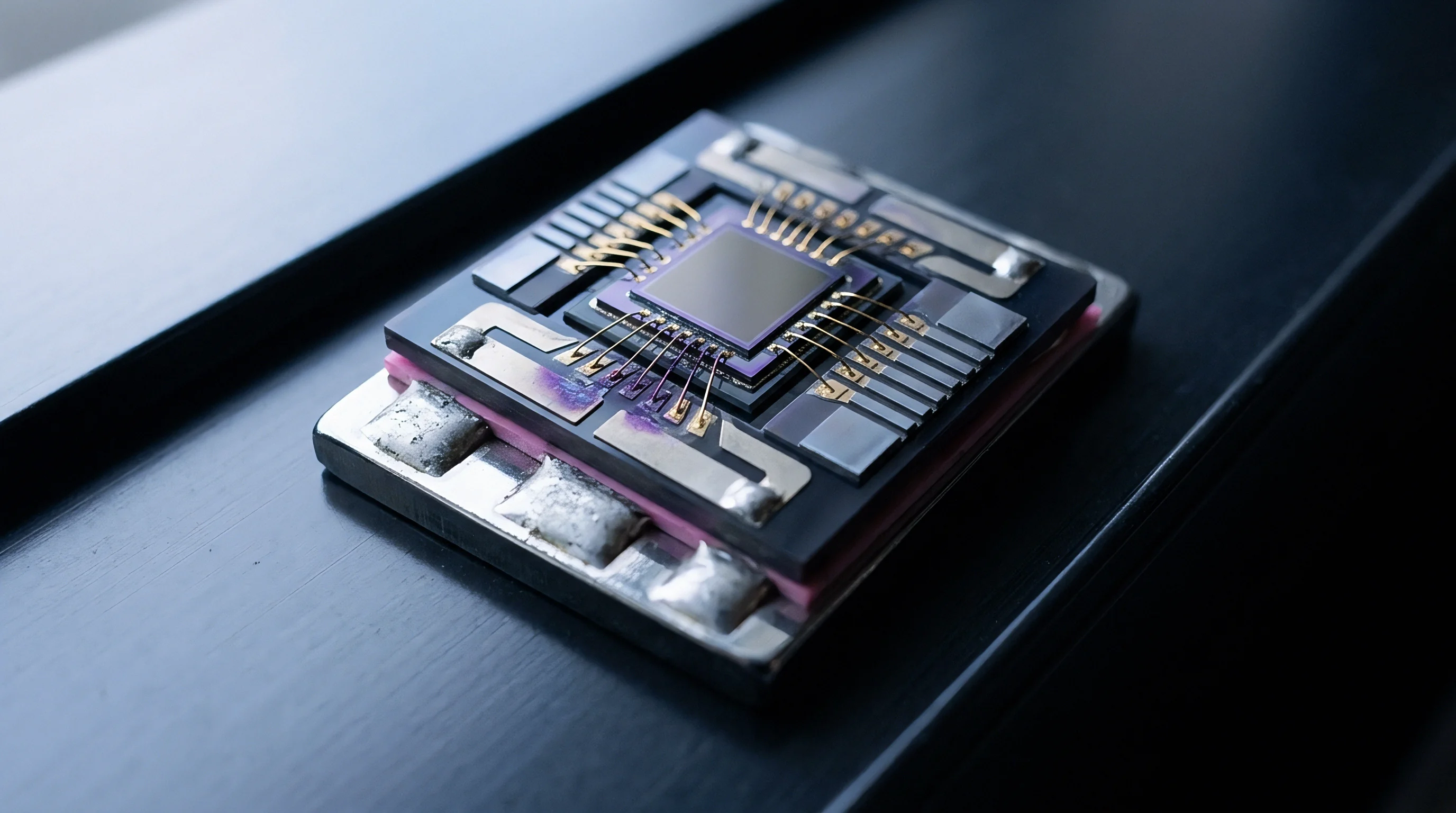
Silica particles reduce the overall coefficient of thermal expansion from 50 parts per million per degree Celsius down to 8 to 12 parts per million per degree Celsius, matching the copper leadframe. These inorganic particles do not absorb water directly, forcing moisture to navigate tortuous pathways through the resin matrix. Coupling agents like epoxysilane coat each filler particle to bond the organic resin to the inorganic silica.
Hydrolysis breaks these silane bonds under sustained heat and humidity, opening capillary channels at the filler-polymer boundary. The effective diffusion rate changes dynamically as water progresses into the package bulk.
Resin crosslink density determines the initial volume of nano-scale cavities present in the unexposed component. Ortho-cresol novolac epoxies present a tightly crosslinked network with low initial free volume, whereas biphenyl and multi-functional epoxy resins exhibit lower crosslink densities that permit higher moisture capacity. Brominated flame retardants create localized steric hindrances that disrupt uniform packing, creating micro-voids where water collects.
Hydrophobic resin backbones delay water entry during standard factory storage, yet they still experience anomalous secondary absorption when environmental temperatures approach the glass transition point.
Biphenyl molding compounds tested at 85 degrees Celsius and 85 percent relative humidity exhibit an equilibrium moisture content of 0.42 weight percent, diverging from Fickian saturation by 22 percent after 500 hours.
Biphenyl compounds offer superior resistance to solder reflow temperatures, yet their moisture absorption curves show pronounced non-Fickian signatures. The initial phase of uptake follows apparent Fickian behavior up to approximately 60 percent of saturation. The absorption rate then decelerates prematurely before resuming a slow, continuous upward climb.
Engineers modeling this behavior with simple one-dimensional Fickian formulas underestimate the total moisture mass inside the package by 20 to 35 percent at reflow assembly. Free volume controls initial entry.
Moisture Concentration at Saturation Boundaries
Internal distribution profiles show steep local gradients near metallic interfaces. Fickian models calculate a smooth error-function curve extending from the exterior package surfaces to the die paddle. Nuclear reaction analysis and tritium radiolabeling reveal localized concentration spikes at the interface between the molding compound and the copper leadframe.
Water molecules gather at polar copper oxide sites, generating interfacial moisture concentrations up to three times higher than the bulk polymer saturation level.
This localized concentration skews standard gravimetric data. Gravimetric measurements record only the net change in specimen mass, masking localized saturation zones. While the bulk package appears dry or partially saturated during accelerated environmental testing, critical internal interfaces reach full water saturation within 48 hours.
Solder reflow magnifies this error.
| Resin Chemistry | Filler Loading (wt%) | Glass Transition (C) | Diffusion Coefficient (mm2/s) | Sorption Deviation Type |
|---|---|---|---|---|
| Ortho-Cresol Novolac | 78.5 +/- 0.5 | 165 +/- 3 | 2.10e-6 +/- 0.15e-6 | Pseudo-Fickian Plateau |
| Biphenyl Epoxy | 86.0 +/- 0.4 | 125 +/- 4 | 3.45e-6 +/- 0.20e-6 | Dual-Stage Langmuir |
| Multi-Functional Novolac | 82.0 +/- 0.5 | 185 +/- 5 | 1.85e-6 +/- 0.12e-6 | Two-Phase Relaxation |
| Dicyclopentadiene | 88.5 +/- 0.3 | 140 +/- 3 | 2.70e-6 +/- 0.18e-6 | Case II Anomalous |
Dual Stage Uptake Deviations
Secondary mass accumulation stems from structural relaxation of the crosslinked macromolecular chains. The initial rapid influx of water populates pre-existing interstitial spaces within the crosslinked network. As polar water molecules establish hydrogen bonds with hydrophilic hydroxyl and amine groups, the cohesive energy of the polymer network diminishes.
The glass transition temperature drops.
Plasticization increases polymer chain mobility, allowing the network to expand and generate new void spaces over extended periods. This relaxation-driven void creation generates the secondary uptake slope observed in long-term gravimetric logs. Standard J-STD-020 soaking protocols end moisture exposure at 168 hours, terminating test procedures before the relaxation-induced uptake phase displays its full magnitude.
Diffusion coefficients shift during test runs.
Component qualification schedules that truncate soak times treat the 168-hour data point as an absolute asymptotic limit. When finished assemblies operate in humid tropical environments or enclosed automotive engine compartments for thousands of hours, the encapsulant continues to gain mass until the relaxed polymer network reaches physical equilibrium. Component designers who rely strictly on short-term soak measurements remain unaware of this reservoir of latent moisture.
Relaxation
Polymer chains undergo mechanical reorientation when exposed to water molecules at elevated temperatures. In pure Fickian diffusion, the rate of solvent diffusion is several orders of magnitude slower than the relaxation rate of the polymer network. The polymer adjusts instantaneously to the presence of penetrant molecules, establishing a constant boundary condition.
In electronic encapsulants operating between 60 degrees Celsius and 125 degrees Celsius, the molecular relaxation rate aligns directly with the moisture diffusion rate. This parity invalidates simple diffusion differential equations and introduces Deborah number dependencies into mass transport calculations.
The Deborah number represents the ratio of the characteristic polymer relaxation time to the characteristic solvent diffusion time. When this value approximates unity, anomalous sorption occurs. The diffusing water molecules act as plasticizers that actively alter the mechanical modulus and diffusion resistance of the encapsulant during the sorption process.
The material does not behave as an inert porous medium. The material deforms viscoelastically under osmotic pressure exerted by water migrating through the network.

Viscoelastic Chain Rearrangement under Humidity
Water absorption induces swelling strains that counteract post-cure thermal shrinkage. During transfer molding, molding compounds experience volumetric shrinkage between 0.3 percent and 0.8 percent as crosslinking completes, followed by additional contraction during cool-down due to thermal coefficient differentials. Moisture absorption induces hygroscopic swelling that expands the resin matrix by 0.15 percent to 0.40 percent per weight percent of absorbed moisture.
Polymer chains slowly reorganize.
This hygroscopic swelling does not develop instantaneously. The coefficient of chemical hygroscopic swelling exhibits distinct time-dependent viscoelastic relaxation. Stress relaxation tests show that hygroscopic expansion relaxes internal compressive stresses over hundreds of hours at 85 degrees Celsius.
When compressive clamping stresses at the silicon die interface relax, the interface becomes susceptible to delamination during sudden thermal transients.
- Pseudo-Fickian Sorption manifests as an apparent linear mass gain against the square root of time, followed by an early plateau that masks ongoing sub-surface chain rearrangement.
- Dual-Stage Absorption exhibits an initial rapid Fickian uptake followed by a continuous, non-linear mass increase driven by polymer matrix dilation and hydrogen-bond network restructuring.
- Langmuir-Type Diffusion incorporates reversible chemical binding where water molecules toggle between a mobile state diffusing through free volume and a bound state locked to polar sites.
- Case II Transport features a sharp, advancing moisture front traveling at a constant velocity, driven entirely by macromolecular relaxation rather than concentration gradients.

Where Do Dual Stage Diffusion Models Break Down?
Engineers employ dual-stage sorption models to capture the secondary mass rise missed by classical Fickian approaches. These formulations sum a rapid Fickian diffusion term with a time-dependent relaxation term governed by an exponential relaxation time constant. The mathematical fit matches gravimetric data during uninterrupted isothermal exposure in environmental chambers.
Mass measurements show persistent drift.
The formulation collapses when the component experiences cycling environmental conditions. If relative humidity drops from 85 percent to 30 percent, desorption does not retrace the absorption path. Desorption proceeds via rapid Fickian out-gassing of mobile water, while bound water molecules remain trapped within the relaxed network.
Dual-stage equations that treat the relaxation time constant as a reversible scalar fail to predict the permanent volumetric dilation remaining in the package. Package swell persists after cooling.
Industrial qualification data gathered in 2021 across 24 test coupons of biphenyl molding compound indicated a dual-stage Langmuir saturation limit of 0.42 weight percent at 85 degrees Celsius and 85 percent relative humidity. This figure shifts upward by 15 percent if the surface silanization of the silica filler degrades during melt compounding. A design team calculating moisture accumulation without verifying the silanization quality of the incoming compound batch will miscalculate the moisture content by tens of milligrams.

Langmuir Affinity and Mobile Water Fractions
The Langmuir diffusion model divides internal moisture into mobile molecules and bound molecules. Mobile molecules diffuse freely through the polymer network with a diffusion coefficient D, while bound molecules undergo reversible bonding with polar sites at a probability rate alpha and unbinding at a rate beta. When the unbinding rate beta is small, water molecules become immobilized for long durations.
Water molecules aggregate into clusters.
Nuclear magnetic resonance spectroscopy demonstrates that at low moisture concentrations, bound water dominates. As exposure continues and polar bonding sites saturate, the mobile water fraction increases rapidly. This mobile fraction exerts internal hydrostatic pressure and vaporizes instantly during solder reflow.
The unbinding parameter beta increases exponentially with temperature according to an Arrhenius relationship, releasing bound water into mobile states during thermal reflow ramps.
Polymer relaxation rates equal solvent diffusion rates when electronic encapsulants operate near their wet glass transition temperatures, preventing Fickian models from establishing fixed boundary states.
Does the irreversible chemical restructuring of the resin matrix during high-temperature moisture exposure permanently alter the baseline diffusion capacity of the encapsulant for all subsequent operating cycles?
Void
Capillary spaces form at the phase boundary between spherical silica particles and the organic resin. Even in pristine components fresh from post-mold cure, transmission electron microscopy identifies micro-separations ranging from 5 to 50 nanometers along filler surfaces. These nanometer-scale separations originate from thermal contraction mismatches between the silica filler, with an expansion coefficient of 0.5 parts per million per degree Celsius, and the surrounding resin, which expands at 60 parts per million per degree Celsius.
Moisture fills these micro-separations rapidly.
Moisture entering these sub-micron separations condenses into liquid water through capillary condensation. The Kelvin equation indicates that within nanometer pores, water vapor condenses into liquid at relative humidity levels far below 100 percent. Once liquid water collects in these internal cavities, it dissolves residual ionic impurities such as chloride, sodium, and sulfate ions left behind by epichlorohydrin synthesis.
The resulting electrolytic solution accelerates interfacial corrosion of internal aluminum bond pads and copper leads. Internal copper leads peel cleanly.

Micro Cavity Nucleation Mechanisms
Cyclic mechanical loading and thermal cycling accelerate the generation of micro-cavities within the encapsulant. When an electronic control unit powers up and down, local temperature changes cause cyclic expansion and contraction. The rigid silica particles act as internal stress concentrators, generating triaxial tensile stresses in the thin resin ligaments separating adjacent particles.
When these local stresses exceed the yield strength of the crosslinked polymer, micro-voids nucleate.
These nucleated voids do not require chemical degradation to form. Mechanical cavitation occurs during standard temperature cycling between minus 40 degrees Celsius and 125 degrees Celsius. Once nucleated, the voids provide storage reservoirs for moisture that bypasses the polymer network entirely.
The moisture storage capacity of the component increases systematically with the number of operating thermal cycles. Inspection gates catch this deviation.
- Condensation occurs in sub-micron filler separations as capillary forces liquefy ambient water vapor below nominal saturation thresholds.
- Osmotic pressure drives additional water into these localized pockets to dilute concentrated ionic contaminants extracted from the polymer.
- Hydrostatic stress expands the cavity boundaries plastically, micro-cracking the surrounding resin ligaments under sustained hydrothermal exposure.
- Vaporization during solder reflow generates internal steam pressure spikes exceeding the ultimate tensile strength of the adjacent interfaces.
Cluster Formation during Environmental Stress
Water molecules form hydrogen-bonded clusters within electronic grade polymers. Fourier-transform infrared spectroscopy shows that at relative humidity levels below 50 percent, water exists primarily as isolated monomers bound to hydroxyl groups on the epoxy backbone. Above 60 percent relative humidity, the water-water hydrogen bonding affinity surpasses the water-polymer affinity, forming multi-molecular clusters containing between four and eight molecules.
These clusters effectively function as microscopic liquid droplets suspended inside the solid dielectric matrix.
Dielectric loss measurements capture the exact moment cluster formation begins. As clusters form, the dielectric dissipation factor of the molding compound increases sharply, causing signal attenuation on high-frequency gigahertz trace lines routed beneath the package. The activation energy for bound-water dissociation in amine-cured novolac systems remains contested in published literature, with values spanning from 0.32 eV to 0.58 eV.
Because experimental techniques cannot isolate chemical dissociation from physical desorptive transport, procurement engineers must bracket both limits in their finite element thermal-mechanical decks to verify worst-case interfacial peel stresses.
Civil engineers encounter an analogous phenomenon in deep concrete dam structures, where hydraulic pressure forces water into micro-pore networks that take decades to reach thermodynamic equilibrium. In semiconductor packaging, that same physical reality unfolds across tenths of a millimeter in mere hours. Vapor pressure builds inside crevices.
Is Desorption Reversibility Guaranteed after Reflow?
Assembly specifications assume that moisture absorption is a fully reversible physical process. Factory personnel bake moisture-sensitive devices at 125 degrees Celsius for 24 hours prior to surface-mount assembly, operating under the assumption that all absorbed moisture leaves the package without altering its physical characteristics. Gravimetric measurements demonstrate that while the mass of the package returns to its initial dry baseline, the internal physical structure does not.
High-temperature baking drives out mobile water but leaves behind permanent micro-structural alterations. The micro-cavities formed by capillary condensation and osmotic swelling remain open. When baked components return to ambient factory air, their re-absorption kinetics proceed three to five times faster than observed during the initial factory exposure.
The material exhibits severe sorption hysteresis.
A package baked dry and then exposed to factory floor conditions for 24 hours can accumulate moisture equivalent to 72 hours of baseline exposure. Treating dried encapsulants as chemically and structurally identical to pristine material misjudges the rapid rate at which previously baked devices re-absorb humidity. Dry weight defines the baseline.
Moisture sorption hysteresis creates permanent internal voids that accelerate subsequent moisture entry regardless of bake duration.
Delamination
Internal steam explosions cause mechanical ruptures during surface-mount soldering. When a moisture-laden package travels through a convection reflow furnace, the temperature rises from ambient to 260 degrees Celsius within three to four minutes. Water trapped within the polymer matrix, along leadframe boundaries, and inside micro-voids vaporizes rapidly.
Saturated steam pressure at 260 degrees Celsius reaches 4.69 megapascals, creating extreme internal pneumatic forces that push outward against the adhesion interfaces. Standard bakes leave trapped water.
The molding compound loses mechanical strength at reflow temperatures. As the temperature exceeds the glass transition point, the elastic modulus of the encapsulant drops from 25 gigapascals at room temperature down to between 1.0 and 2.5 gigapascals. The ultimate tensile strength falls from 120 megapascals to less than 15 megapascals.
The encapsulant experiences its maximum internal vapor loading precisely when its physical resistance to deformation and fracture is at its absolute lowest level.
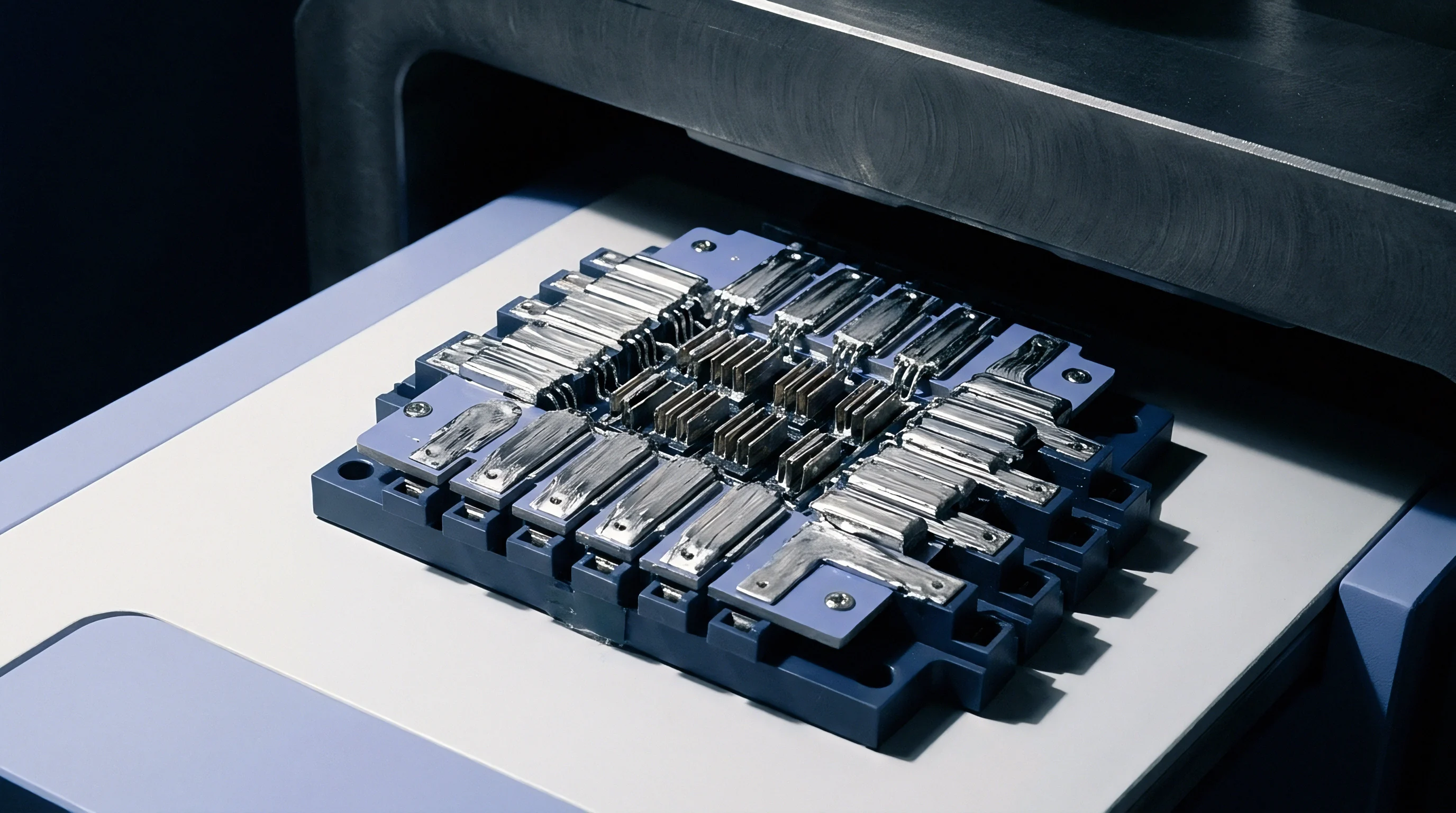
Interfacial Vapor Pressure Stack at Reflow
Adhesion along the silicon die face and the copper leadframe depends on hydrogen bonding, mechanical interlocking, and covalent bonding from adhesion promoters. Non-Fickian moisture accumulation degrades these bonding mechanisms prior to the start of the soldering cycle. Moisture displacement displaces the epoxy resin from the copper oxide surface through competitive adsorption, reducing baseline fracture toughness by 60 to 80 percent before heat is applied.
When vapor pressure develops within the weakened boundary layer, a crack initiates at stress concentrations such as sharp silicon die edges or leadframe corners. Once initiated, the crack propagates across the die paddle or the active silicon surface, causing the defect known as popcorning. The package emits an audible acoustic pop as the bottom of the plastic case bulges and fractures.
| Package Type | Moisture Load (wt%) | Vapor Pressure (MPa) | Interface Adhesion (J/m2) | Interfacial Shear Stress (MPa) | Failure Mode |
|---|---|---|---|---|---|
| QFN-48 (7×7 mm) | 0.31 +/- 0.02 | 4.69 | 12.5 +/- 1.5 | 28.4 +/- 2.1 | Die Paddle Delamination |
| LQFP-144 (20×20 mm) | 0.24 +/- 0.02 | 4.20 | 18.5 +/- 2.0 | 19.8 +/- 1.5 | Corner Leadframe Crack |
| BGA-256 (17×17 mm) | 0.38 +/- 0.03 | 4.69 | 8.2 +/- 1.1 | 34.2 +/- 2.8 | Substrate Core Blistering |
| WLCSP-36 (3×3 mm) | 0.12 +/- 0.01 | 2.10 | 24.0 +/- 2.5 | 14.5 +/- 1.2 | Polyimide Passivation Shear |
Hygro Mechanical Stress Discrepancies
Stress models that incorporate only thermal expansion miss the destructive contribution of hygroscopic swelling. Total package strain equals the sum of thermal strain, elastic strain, and hygroscopic strain. The hygroscopic stress component develops because the silicon die exhibits a hygroscopic expansion coefficient of zero, while the encapsulant expands significantly as it absorbs water.
This differential expansion creates steady-state shear stresses along the die edges during environmental conditioning.
At 260 degrees Celsius, thermal expansion and hygroscopic swelling act concurrently. The critical interfacial fracture toughness along copper leadframe interfaces at 260 degrees Celsius is 18.5 Joules per square meter, based on tests conducted in 2019 across 40 diced quad-flat package specimens. This toughness figure collapses to 5.8 Joules per square meter if the pre-assembly moisture content exceeds 0.18 weight percent.
When interfacial toughness drops below the combined thermal and vapor energy release rate, spontaneous crack propagation occurs.
Interfacial shear stresses driven by hygroscopic swelling accumulate along silicon die boundaries during storage, lowering the fracture energy threshold before reflow heating begins.
Total strain energy release rates scale with package surface area. Small discrete components withstand higher relative moisture contents because their short diffusion paths allow rapid vapor escape through the package edges. Large-body components such as high-density ball grid arrays and quad flat packages trap vapor over wide internal areas, building destructive total forces that shear internal interconnects.
Worked Hygroelastic Mismatch Estimation
A representative 14 mm by 14 mm exposed-pad thin quad flat package carries a 6 mm by 6 mm silicon die mounted on a copper die paddle with an epoxy die-attach adhesive. The molding compound layer above the die measures 0.80 mm in thickness. Assume the package absorbs moisture up to 0.32 percent total weight gain after environmental storage.
The coefficient of hygroscopic swelling for the molding compound is 0.28 mm per mm per weight percent of water. This yields an unconstrained hygroscopic swelling strain of 0.000896 mm per mm.
The copper die paddle has a thermal expansion coefficient of 17 parts per million per degree Celsius, while the encapsulant exhibits an expansion coefficient of 12 parts per million per degree Celsius below its glass transition of 140 degrees Celsius, and 48 parts per million per degree Celsius above it. Over a thermal excursion from 25 degrees Celsius to 260 degrees Celsius reflow, the integrated thermal strain differential between the copper paddle and the encapsulant reaches 0.00342 mm per mm. The combined hygro-thermal mismatch strain totals 0.004316 mm per mm.
With an effective high-temperature rubbery modulus of 1.4 gigapascals, this mismatch strain generates an in-plane shear stress of 6.04 megapascals along the outer periphery of the die paddle.
When this mechanical shear stress combines with an internal steam pressure of 4.69 megapascals acting perpendicularly across the 36 square millimeter die paddle area, the resulting tensile force exceeds 168 Newtons. This force exceeds the interfacial adhesion limit of the copper-epoxy bond at 260 degrees Celsius. The joint separates instantaneously, transferring all mechanical load to the internal gold bond wires, which shear at their neck points.
Yield drops to zero.
When production facilities miscalculate non-Fickian moisture retention prior to furnace entry, entire surface-mount production lots experience internal interfacial shearing that goes undetected by automated optical inspection, escaping into final product inventory as catastrophic latent field failures.


Qualification
Component moisture sensitivity ratings rely on IPC/JEDEC J-STD-020 standards to assign factory floor life. This standard establishes eight moisture sensitivity levels ranging from Level 1, which permits unlimited factory floor life at 30 degrees Celsius and 85 percent relative humidity, down to Level 6, which demands mandatory baking before every assembly run. The standard assigns these ratings by subjecting test lots to fixed soaking intervals followed by three passes through a standard reflow profile, verifying structural soundness via acoustic microscopy.
The underlying assumptions of J-STD-020 depend on classic Fickian absorption kinetics. The standard specifies accelerated soak intervals designed to simulate worst-case factory floor life by establishing equivalent moisture uptake. Level 3 qualification mandates 168 hours of storage at 30 degrees Celsius and 60 percent relative humidity, or an accelerated equivalent soak of 40 hours at 60 degrees Celsius and 60 percent relative humidity.
Non-Fickian materials invalidate this mathematical equivalence. Diffusion paths shorten unevenly.
Deficiencies in Standardized Moisture Sensitivity Ratings
Accelerating environmental conditions by elevating temperature changes the physical sorption mode within the material. At 30 degrees Celsius, moisture absorption in an advanced multi-functional epoxy compound proceeds via slow, relaxation-dominated diffusion. When the soak temperature rises to 60 degrees Celsius or 85 degrees Celsius to accelerate test cadence, the thermal energy activates dormant Langmuir binding sites and accelerates chain mobilization.
The package absorbs water through entirely different molecular mechanisms than it encounters during factory floor storage.
Accelerated test conditioning often indicates that a component passes a specific moisture sensitivity level when it actually fails during real-world storage. Conversely, accelerated testing can induce severe non-Fickian degradation that never occurs at standard ambient factory temperatures, disqualifying viable component packaging from commercial use. Qualification testing conducted without verification of non-Fickian kinetics produces unreliable reliability classifications.
Desorption Bake Schedules and True Dry Weights
J-STD-033 outlines standard factory baking schedules designed to reset the floor life clock for exposed components. The standard prescribes bakes at 90 degrees Celsius or 125 degrees Celsius for durations ranging from a few hours up to several days, depending on package thickness and assigned moisture sensitivity level. These bake tables assume that desorption follows inverted Fickian kinetics, with drying rates mirroring absorption rates.
Desorption rates in highly filled encapsulants lag far behind initial absorption rates. Strong hydrogen bonding between water molecules and hydrophilic resin sites creates a high activation energy barrier for desorption. While a 24-hour bake at 125 degrees Celsius drives out loose mobile water, bound water remains trapped in micro-voids and along internal leadframe interfaces.
The component leaves the bake oven with a hidden residual moisture load, shortening its true floor life to a fraction of the standardized allowance.

Commercial Procurement Clauses for Encapsulant Integrity
Procurement teams sourcing plastic-encapsulated microelectronics for high-reliability industrial and automotive systems must supplement baseline J-STD-020 ratings with specific kinetic verification requirements. Purchase specifications must demand that semiconductor manufacturers provide empirical sorption-desorption isotherms measured across multiple relative humidity levels. Component datasheets that list only a single Fickian diffusion coefficient and a generic moisture sensitivity level provide insufficient technical data for accurate reflow windowing.
Receiving inspection operations must implement precise gravimetric monitoring using calibrated microbalances capable of 0.01-milligram resolution. Incoming component reels should undergo baseline verification testing to establish true dry weight using vacuum desorption ovens rather than standard convection bake stations. Vacuum desiccation lowers the activation energy for bound-water extraction, allowing accurate measurement of baseline dry mass without subjecting the component package to thermal aging.
Suppliers frequently defend premature package popcorning by asserting that their devices fully complied with published J-STD-020 Level 3 ratings and that assembly reflow profiles stayed within nominal JEDEC peak temperature limits. This defense ignores the reality that non-Fickian kinetics allow moisture to accumulate beyond theoretical limits when factory floor humidity remains elevated over extended periods. Production contracts that enforce specific moisture sorption compliance protect buyers from bearing the commercial cost of these systematic material failures.
Standard purchase agreements must stipulate compliance with IPC/JEDEC J-STD-020 Section 6, explicitly incorporating acoustic micro-imaging rejection thresholds for any internal interfacial delamination exceeding 10 percent of the total die paddle surface area following real-time, non-accelerated humidity exposure.