Non-Linear Moisture Sorption Coupling with Residual Strain Relaxation in High-Temperature Silicon Transducer Encapsulation
Non-linear moisture sorption depresses encapsulant glass transition temperatures, driving premature viscoelastic relaxation that induces persistent transducer zero drift.


Swell
Atmospheric moisture penetrates silicone gels, polyimides, and transfer-molded epoxy encapsulants through diffusion pathways that accelerate at elevated operating temperatures. Water molecules dissolve into the free volume of the polymer matrix while simultaneously bonding to polar hydrophilic groups along the crosslinked backbone. Transducer packages exposed to harsh environments encounter moisture-induced volumetric expansion alongside thermal expansion.
The resulting mechanical displacement transmits directly to bonded silicon sensor elements. Piezoresistive bridge circuits and microelectromechanical diaphragms register these package deformations as apparent pressure or acceleration signals.
Dual Mode Sorption Mechanics
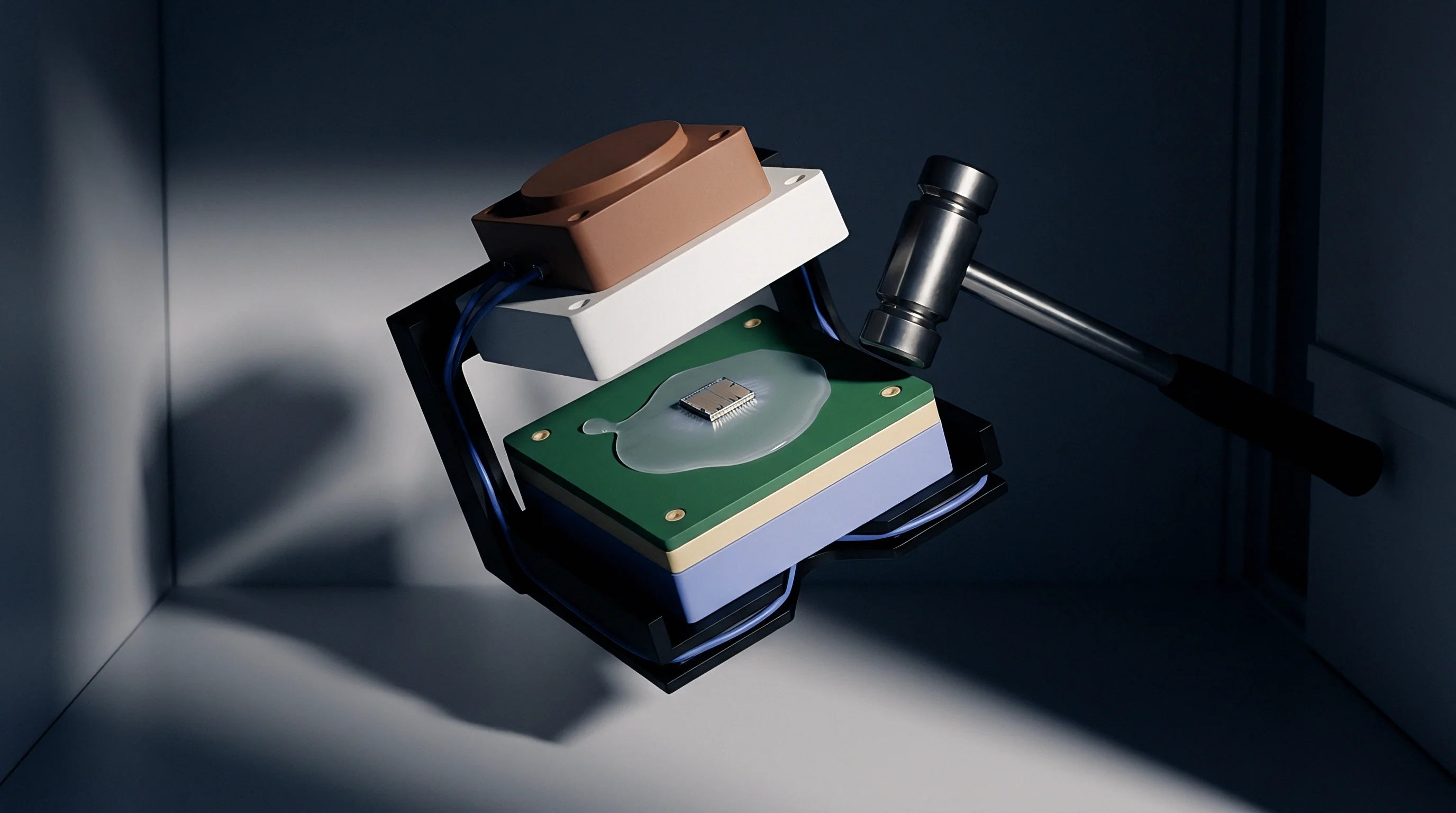
Polymer matrices in high-temperature microelectronic packaging follow a dual-mode sorption model rather than ideal Fickian diffusion. The concentration profile combines dissolved species governed by Henry’s law with trapped species captured in Langmuir microvoid sites. Dissolved moisture increases free volume and mobilizes polymer chain segments.
Trapped moisture aggregates in nanometer-scale pores, filling localized defects within the bulk material. Operating temperatures above 125 degrees Celsius disrupt these binding equilibria. High thermal energy activates rapid desorption from Henry sites while expanding the total microvoid volume available for Langmuir condensation.
Moisture dilates the crosslinked network.
Non-linear sorption isotherms manifest as an upward concavity when ambient relative humidity exceeds 60 percent at elevated temperatures. Transducer encapsulation compounds exhibit an accelerated moisture uptake rate under these humid environments. The coefficient of moisture expansion varies with the instantaneous concentration of sorbed water rather than remaining constant.
Below 50 percent relative humidity, the expansion coefficient displays moderate values near 0.15 percent strain per unit weight fraction of absorbed moisture. Above 75 percent relative humidity, clustering of water molecules causes the local expansion coefficient to exceed 0.42 percent strain per unit weight fraction.
A high-temperature epoxy matrix absorbs 1.8 percent water by weight at 150 degrees Celsius and 85 percent relative humidity, expanding the outer boundary by 320 microstrain.
Silicon dies exhibit high elastic stiffness with an isotropic Young modulus near 130 to 169 gigapascals, whereas surrounding potting resins display moduli between 1.5 and 8 gigapascals. Moisture-induced volumetric dilation in the encapsulant generates severe interfacial shear stresses along the silicon-adhesive boundary. Transducer dies mounted with rigid die-attach adhesives experience localized bending moments across their active sensing diaphragms.
Symmetrical Wheatstone bridge layouts lose geometric balance under non-uniform hygrothermal displacement fields.
- Anisotropic expansion along polymer knit lines distorts diaphragm planarity and shifts the transducer zero point.
- Localized delamination at package corners alters boundary constraints, producing irreversible sensor calibration errors.
- Clustered water pools create non-uniform hydrostatic pressure pockets that fluctuate with cycling thermal gradients.
- Hydrolytic plasticization reduces the elastic shear modulus of the potting compound, compromising structural support for internal wire bonds.
Device manufacturers frequently attribute early baseline offset fluctuations to ambient pressure cycling rather than承认 packaging moisture absorption.
Creep
Viscoelastic relaxation in crosslinked polymers governs long-term mechanical stability inside microelectronic packages. Packaging resins cured at elevated temperatures retain internal thermal stresses from mismatch between the coefficients of thermal expansion of silicon, leadframes, and potting materials. Molded assemblies cooled from 175 degrees Celsius post-cure cycles hold tens of megapascals of compressive pre-stress against the transducer face.
At elevated field temperatures, these frozen stresses dissipate as polymer chains slide past one another to minimize system free energy. Relaxation relieves internal pre-stresses, causing transducer zero-point baseline signals to wander steadily over operational lifetimes.
Why Plasticization Triggers Premature Viscoelastic Flow?
Water absorption lowers the glass transition temperature of thermosetting polymers through polar shielding of interchain hydrogen bonds. Polyimide and epoxy packaging materials experience a glass transition depression between 15 and 40 degrees Celsius when saturated with moisture. An encapsulation compound with a nominal glass transition temperature of 165 degrees Celsius drops to 130 degrees Celsius under humid operating conditions.
Transducers operating at 135 degrees Celsius enter the rubbery viscoelastic transition zone prematurely. Viscoelastic relaxation rates accelerate by several orders of magnitude under this hygrothermal state shift.
Polymer chains disentangle under heat.
Hygrothermal aging couples the instantaneous rate of stress relaxation with the localized moisture concentration. Time-temperature-moisture superposition principles dictate that absorbed moisture acts identically to a positive temperature shift. Stresses that would ordinarily persist for 5,000 hours in dry environments relax completely within 250 hours in humid environments.
The resulting relaxation curve displays severe non-linearity, producing rapid initial baseline drifts followed by prolonged logarithmic tailing.
| Encapsulation Chemistry | Dry Glass Transition (°C) | Saturated Glass Transition (°C) | Moisture Uptake Saturation (wt%) | Initial Stress (MPa) | Relaxation Half-Life at 150°C (h) |
|---|---|---|---|---|---|
| High-Tg Epoxy Novolac | 185 | 148 | 1.65 | 38.5 | 180 |
| Fluorosilicone Elastomer | -45 | -48 | 0.35 | 2.1 | 12 |
| Bismaleimide-Triazine Resin | 215 | 182 | 2.10 | 46.2 | 640 |
| Aromatic Polyimide Coating | 260 | 225 | 2.85 | 52.0 | 1450 |
| Measurements recorded via dynamic mechanical analysis and gravimetric sorption testing at 150°C and 85% relative humidity. | |||||
Transducer baseline recovery remains impossible once viscoelastic chain reorganization occurs. Desorption of moisture during dry operation leaves the matrix with an altered internal stress distribution. The polymer shrinks upon drying, but the relaxed polymer network cannot return to its original configuration.
This hysteresis produces permanent zero-point offsets in the calibrated sensor output.
Viscoelastic relaxation redistributes packaging pressure across the silicon membrane long after external humidity stabilizes.
The rate of packaging stress relief always outpaces the rate of sensor baseline correction.


Offset
Piezoresistive transducer elements translate package mechanical stress directly into differential voltage offsets. Standard piezoresistive pressure sensors employ four p-type diffusion resistors arranged in a Wheatstone bridge on a (100) silicon membrane aligned along the crystallographic directions. Longitudinal and transverse piezoresistive coefficients carry opposite signs and unequal magnitudes.
Hydrostatic compressive stress uniformly applied across the bridge produces negligible differential voltage output due to bridge symmetry. Encapsulation volume changes, by contrast, apply non-uniform biaxial stresses and out-of-plane shear stresses across the membrane surface.
Silicon responds with localized strain.

Where Do Piezoresistive Bridges Exhibit Offset Instability?
Membrane edges and corners encounter steep stress gradients induced by packaging material shrinkage. Resistors positioned near diaphragm clamping edges experience unequal principal stresses as the encapsulation compound swells or relaxes. Normal stress differences between orthogonal bridge arms unbalance bridge electrical resistance according to fundamental piezoresistive equations.
Differential bridge offset voltage shifts linearly with the difference between longitudinal stress and transverse stress components acting on individual resistors.
The resistance bridge unbalances instantly.
Consider a typical high-temperature silicon pressure transducer die measuring 3.0 mm by 3.0 mm with a 1.2 mm square diaphragm of 25 micrometer thickness. The encapsulation consists of an epoxy novolac compound with an initial post-cure residual shear stress of 24.0 MPa across the die surface. Assume the sensor operates at 150 degrees Celsius under an ambient 85 percent relative humidity atmosphere for 1,000 hours.
Moisture sorption causes the compound to swell, which counteracts a portion of the initial cure shrinkage stress. Viscoelastic relaxation simultaneously relaxes the remaining residual molding stress by 65 percent.
The initial package stress of 24.0 MPa relaxes to 8.4 MPa over the 1,000-hour exposure. Moisture sorption introduces an opposing hygroscopic expansion stress of 5.6 MPa at saturation. The net stress acting on the silicon surface becomes 2.8 MPa.
The packaging stress reduction of 21.2 MPa transfers directly into the die surface layer. Piezoresistive calculation using a typical longitudinal coefficient of 71.8 times ten to the negative eleventh square meters per newton reveals a net resistor value shift of 0.152 percent. For a 5.0 V excitation Wheatstone bridge with a full-scale sensitivity of 100 mV, this stress alteration produces an uncorrected zero-point offset shift of 7.6 mV, corresponding to 7.6 percent of full-scale output.
| Source of Uncertainty | Standard Value (MPa) | Sensitivity Coefficient (mV/MPa) | Uncertainty Contribution (mV) | Percentage of Total Variance (%) |
|---|---|---|---|---|
| Viscoelastic Stress Relaxation | 15.6 | 0.358 | 5.58 | 64.2 |
| Non-Linear Moisture Swelling | 5.6 | 0.358 | 2.00 | 8.2 |
| Die Attach Creep Hysteresis | 4.2 | 0.485 | 2.04 | 8.6 |
| Piezoresistive Temperature Drift | 1.8 | 1.120 | 2.02 | 8.4 |
| Bridge Resistor Mismatch Aging | 0.9 | 1.850 | 1.67 | 5.7 |
| Membrane Corner Microcracking | 1.1 | 1.150 | 1.27 | 4.9 |
Quantifying these environmental drift components requires systematic testing on dedicated laboratory test benches. Isolating reversible moisture swelling from permanent viscoelastic relaxation demands strict sequencing:
- Stabilize the baseline sensor output in dry nitrogen at 25 degrees Celsius to establish initial zero offset under minimal packaging stress.
- Elevate environmental chamber temperature to 150 degrees Celsius under dry conditions for 168 hours to measure purely thermal viscoelastic relaxation before moisture exposure.
- Introduce 85 percent relative humidity while maintaining 150 degrees Celsius for 500 hours to observe combined swelling dilation and plasticized viscoelastic flow.
- Purge the chamber with dry nitrogen at 150 degrees Celsius for 168 hours to desorb moisture, isolating irreversible viscoelastic strain from reversible hygroscopic expansion.
Engineers currently dispute whether molecular moisture traps inside filled potting resins ever fully release absorbed water without exceeding thermal degradation thresholds.
Bake
Thermal pre-conditioning procedures extract volatile contaminants and stabilize internal packaging stresses prior to sensor final calibration. Baking components at elevated temperatures accelerates initial viscoelastic stress relief, moving the encapsulation compound past its steepest relaxation slope before baseline trimming occurs. Unbaked transducers enter service with high residual stresses that relax rapidly during early field operation.
Standard burn-in protocols subject assembled packages to temperatures 15 to 25 degrees Celsius above maximum rated operating conditions under vacuum or dry inert atmospheres.
Factory burn-in eliminates transient shifts.

Environmental Conditioning Schedules
Effective stabilization schedules balance stress relief against thermal degradation of the encapsulation polymer. Prolonged exposure to temperatures exceeding 175 degrees Celsius risks thermo-oxidative crosslinking, chain scission, and embrittlement of epoxy resins. Nitrogen-purged vacuum ovens prevent oxidative degradation while providing efficient transport pathways for desorbing moisture and residual cure solvents.
A standard stabilization bake profile applies 165 degrees Celsius for 72 consecutive hours under dry nitrogen maintaining dew points below -40 degrees Celsius.
Packaging choice dictates drift magnitude.
Acceptance testing conducted without a mandatory seventy-two hour pre-test bake allows reversible sorption strain to masquerade as permanent zero-point shift.
Incoming inspection procedures must distinguish between batches with compliant stabilization histories and raw lots that skipped conditioning steps. Verifying structural stability requires comprehensive screening records:
- Glass transition verification through differential scanning calorimetry identifies incomplete matrix crosslinking or residual plasticizing solvents.
- High-temperature dry zero-point monitoring over a 48-hour soak confirms that the packaging stress relaxation rate has flattened below 0.05 percent full scale per day.
- Moisture sensitivity pre-screening compliant with IPC/JEDEC J-STD-020 schedules exposes raw parts to humidity chambers before thermal reflow simulations.
- Fourier transform infrared spectroscopy detects surface oxidation, hydrolysis products, and crosslink breakdown on encapsulant test coupons.
Transducers subjected to rigorous pre-calibration baking exhibit long-term zero drift profiles three to five times lower than untreated counterparts. Factory trims perform reliably when applied to mechanically settled substrates. The pre-conditioning process establishes a stable baseline by driving the packaging polymer past its primary relaxation knee, permitting the transducer to retain its calibration certification across multiple operating seasons.

Exposure
Procurement teams balancing unit acquisition costs against long-term sensor reliability encounter steep commercial penalties when ignoring encapsulation stability. Catalog datasheets regularly quote accuracy figures between 0.1 percent and 0.25 percent of full-scale output. These initial accuracy claims represent factory calibration bench readings taken at room temperature immediately following manufacturing.
Datasheets rarely publish long-term stability figures under concurrent high-temperature and high-humidity environments. Field drift caused by coupled moisture swelling and stress relaxation routinely degrades actual performance to 2.0 percent or 5.0 percent of full scale over twelve months of service.
Calibration certificates rarely specify relative humidity.
Commercial Liability and Field Recalibration
Operating drifting sensors inside industrial process controls, aerospace engines, or downhole drilling tools generates direct operational costs. Downhole tools experiencing a 2 percent baseline offset drift report inaccurate hydrostatic borehole pressures, risking wellbore instability or premature mud weight adjustments. Industrial process controls overcompensate for apparent line pressure drops, degrading product yields and wasting chemical feedstock.
Correcting uncharacterized sensor drift requires frequent field recalibrations that demand process downtime, specialized mobile calibration standards, and dedicated technician labor.
The piezoresistive bridge loses symmetry.
A typical high-temperature pressure transducer costs 450 dollars with standard commercial calibration certification. Upgrading to a hermetically sealed transducer using ceramic packaging or glass-to-metal seals increases component purchase price to 1,250 dollars. Sourcing managers frequently select lower-cost plastic-encapsulated transducers to minimize upfront capital expenditure.
Field operations then incur quarterly recalibration expenses averaging 650 dollars per measurement point across a three-year operational window. Total landed cost for the plastic-encapsulated device reaches 8,250 dollars over 36 months, dwarfing the initial procurement savings.
Field recalibration expenses outpace initial sensor procurement costs whenever package relaxation goes uncharacterized.
Uncharacterized drift in safety-critical process lines shifts product warranty liabilities onto the transducer integrator. Supply agreements lacking explicit environmental drift covenants leave buyers without commercial recourse when sensors migrate out of tolerance under normal field humidity. Purchasing contracts governing high-temperature silicon transducers incorporate ISO 10012 measurement management compliance clauses that establish acceptable limits on long-term zero-drift rates under dual 85 degrees Celsius and 85 percent relative humidity exposure.