Silicon Flexure Anchor Moisture Sorption Dynamics in Micro-G Sensors
Moisture sorption at silicon flexure anchors alters mechanical stress and mass, driving bias drift in micro-g sensors that mandates vacuum hermetic packaging.


Joint
Precision micro-g sensors rely on single-crystal silicon flexures to establish ultra-low mechanical stiffness while maintaining structural stability against parasitic cross-axis inputs. At acceleration levels below one micro-g, structural deformation down to sub-nanometer scales alters the baseline differential capacitance or resonant frequency of the sensor. The physical point where the suspended silicon structure anchors to the supporting substrate or package cavity forms a complex mechanical and material transition.
While monocrystalline silicon itself is chemically inert to ambient moisture at room temperature, the boundary interfaces, glass frit layers, anodic bonding oxides, and organic die-attach adhesives located at the base of the structural suspension act as active sites for water molecule physisorption and chemisorption.

Anchor Interfacial Mechanics and Mass Loading
Boundary regions located at the base of suspension beams bear concentrated mechanical reaction forces during proof mass movement. Water molecules penetrating the package cavity condense onto exposed hydrophilic hydroxyl sites present on native thermal silicon dioxide surfaces. This surface adsorption creates a hydrated layer several monolayers thick, increasing the localized mass density of the flexure root.
Mass addition at the flexure suspension points shifts the overall center of mass of the suspension system, creating an asymmetrical gravitational torque under micro-g static tilts.
Volumetric swelling introduces compressive strain across the flexure root as water molecules diffuse into amorphous interfacial layers. The differential strain between the non-swallowing crystalline silicon flexure and the expanding interfacial layer generates a localized bending moment at the anchor boundary. This mechanical stress alters the effective spring constant of the suspension arm through the stress-stiffening effect.
The altered spring constant changes the mechanical sensitivity of the micro-g sensor, resulting in continuous output drift as atmospheric moisture levels shift within unsealed or micro-leaking packages.
| Material Interface | Sorption Mechanism | Volumetric Strain (ppm / %RH) | Diffusion Coefficient (cm²/s) | Impact on Micro-g Stability |
|---|---|---|---|---|
| Native Silicon Oxide | Surface Physisorption | 0.02 to 0.05 | 1.0e-11 to 3.0e-11 | Localized strain shifting zero-g offset |
| Borosilicate Glass Frit | Capillary Condensation | 0.12 to 0.35 | 4.0e-10 to 1.2e-09 | Substrate warping and hysteresis |
| Silver-Filled Epoxy | Bulk Matrix Sorption | 4.50 to 12.80 | 2.5e-08 to 8.0e-08 | Severe bias drift and structural tilt |
| Au-Si Eutectic Bond | Interfacial Monolayer | 0.00 | 0.00 | Thermomechanical mismatch only |
Polymeric Adhesives and Oxide Phase Sorption
Organic adhesives applied during die attachment provide compliance to cushion thermal expansion mismatches between the silicon sensor die and the ceramic package substrate. Polymer matrices exhibit high water vapor absorption capacities, absorbing up to three percent water by weight under standard relative humidity conditions. As water penetrates the polymer network, hydrogen bonding disrupts the existing polymer-polymer crosslinks, lowering the glass transition temperature and reducing the bulk storage modulus of the adhesive layer.
Lowered adhesive stiffness shifts the fundamental resonance frequency of the suspended micro-g structure downward, altering the dynamic scale factor of the transducer.
Moisture sorption inside the anchor region proceeds through distinct physical mechanisms that compromise long-term sensor stability:
- Interfacial Delamination occurs when condensed water clusters along the adhesive-silicon interface, reducing thermodynamic work of adhesion and initiating micro-fractures under high vibration.
- Volumetric Expansion creates asymmetric mechanical pressure against the silicon anchor walls, inducing rotational tilt across the proof mass suspension axis.
- Mass Asymmetry develops as moisture diffuses unequally across opposing anchor mounts, producing zero-acceleration output errors indistinguishable from low-frequency gravity signals.
- Dielectric Drift arises when absorbed water alters the relative permittivity of adjacent insulating oxides, shifting parasitic capacitance pathways within high-impedance readout nodes.
A moisture change of five percent relative humidity inside an unsealed sensor cavity generates up to twelve micro-g of uncompensated zero-acceleration bias drift.
Capillarity drives water condensation inside nanometer-scale pores present at glass-to-silicon anodic bonding boundaries. Condensed liquid water exerts capillary attraction forces against the flexible suspension arms, pulling fine flexure structures toward adjacent substrate surfaces. In high-aspect-ratio silicon flexures, capillary forces overcome structural restoring forces, causing stiction or permanent zero-offset jumps.
Dry nitrogen purging removes unbonded water molecules but fails to quickly dislodge chemisorbed hydroxyl groups bound tightly to silica networks within the anchor core. Failing to account for interfacial water uptake at the mechanical root leaves low-frequency gravimetric payloads vulnerable to unrecoverable zero-point calibration shifts.

Diffusion
Mass transport of water vapor toward internal structural anchors follows multi-phase kinetics dictated by concentration gradients, thermal excitation, and package cavity volume. Water molecules entering an enclosure undergo transient adsorption onto inner cavity walls before establishing dynamic equilibrium with the gas phase. The rate of moisture accumulation at the flexure anchor depends on the permeability of package seals and the exposed surface area of hydrophilic interfacial materials.
In sub-micro-g accelerometers, mass transport processes occurring over months or years produce persistent ultra-low-frequency noise floors that obscure real physical acceleration inputs.

How Moisture Migrates through Hermetic Package Cavities?
Water vapor ingress through microscopic package leaks or organic seals establishes a rising partial pressure of water vapor inside the internal cavity. Ambient humidity fluctuations drive water molecules through fine cracks, glass frit pore networks, or polymer seal rings via Knudsen diffusion and molecular flow. Once inside the cavity, water molecules collide with exposed silicon flexure structures and migrate toward regions of high surface energy, such as etched corner fillets and flexure anchor roots.
Silicon flexure roots act as local sinks for water sorption, drawing moisture along surface energy gradients toward the mechanical junction.
Knudsen diffusion dominates inside narrow internal cavities where molecular mean free paths exceed physical gap dimensions. In capacitive micro-g accelerometers featuring gap spacings below two micrometers, water vapor molecules interact frequently with comb finger surfaces and flexure anchors. Adsorbed moisture creates a transient surface layer that diffuses laterally across the monocrystalline silicon root toward high-stress regions.
The lateral surface diffusion rate governs the initial phase of zero-g offset drift following rapid external humidity changes.

Concentration Gradients and Transient Stress Relaxation
Transport of water molecules within the anchor oxide or adhesive material follows Fickian kinetics during initial absorption phases. The concentration profile of absorbed moisture evolves as a function of depth into the anchor material and exposure time, described by the standard diffusion equation. As moisture penetrates deeper into the anchor structure, localized swelling strain spreads non-uniformly across the flexure foundation, causing time-dependent stress redistribution.
The mechanical relaxation time of the anchor material lags behind the environmental humidity step, introducing phase delay between relative humidity changes and observed sensor bias shifts.
Flexure roots carry high stress. Structural strain distributions across the anchor modify the local chemical potential of the oxide matrix, altering the localized equilibrium concentration of sorbed water. High tensile stress zones at the upper fillets of a deflected flexure anchor exhibit enhanced water solubility compared to compressive zones.
This stress-assisted sorption phenomenon creates a feedback loop: mechanical loading from proof mass deflection accelerates moisture uptake in high-stress zones, which further distorts the anchor shape and increases local strain. Non-Fickian moisture transport occurs when polymer relaxation rates match diffusion rates, leading to anomalous long-term drift characteristics that resist simple exponential mathematical correction.
Thicker native oxide interfaces at the flexure root increase moisture storage capacity while extending diffusion relaxation times.
Temperature shifts accelerate moisture transport by increasing diffusivity according to an Arrhenius relationship. Elevated operational temperatures speed up outgassing from internal cavity walls while simultaneously increasing the rate of moisture absorption into organic anchor materials. When thermal and humidity gradients occur concurrently, thermo-molecular transport drives moisture condensation specifically into cool anchor regions.
Packaging vendors often explain ambient-driven drift as temporary environmental stabilization that disappears after sustained thermal baking.


Bias
Signal processing chains in micro-g instrumentation translate sub-attofarad capacitance shifts or micro-hertz frequency changes into calibrated acceleration outputs. When moisture sorption alters the mechanical boundary conditions at the flexure anchor, the front-end transducer generates electronic offset shifts indistinguishable from genuine physical accelerations. Distinguishing between gravitational signals and moisture-induced mechanical artifacts requires analyzing the spectral characteristics and time constants of the drift signal.
Anchor sorption dynamics primarily manifest as low-frequency bias instability and scale factor variation, deteriorating the long-term performance metrics defined by Allan variance analyses.

Zero-G Offset Shift and Capacitive Readout Perturbation
Capacitive micro-g accelerometers detect proof mass displacement by sensing differential capacitance between fixed stator fingers and moving rotor fingers attached to the central flexure beam. Physical displacement of the proof mass by one picometer corresponds to a typical capacitance change on the order of attofarads. Moisture-induced strain at the flexure anchor rotates the proof mass suspension beam by micro-radians, shifting the baseline rest position of the moving comb fingers relative to the fixed stators.
This mechanical displacement directly alters the differential capacitance balance at zero acceleration, creating a persistent zero-g offset shift.
Package leaks destroy bias stability. Moisture adsorption onto native silicon dioxide layers covering capacitive sensing fingers modifies the local surface potential and dielectric constant. Water possesses a relative static permittivity of approximately eighty at room temperature, whereas vacuum or dry nitrogen exhibits a dielectric constant of unity.
Condensation of a thin water film across the parasitic capacitance paths near the anchor increases stray baseline capacitance. High parasitic capacitance attenuates the signal-to-noise ratio of front-end charge amplifiers, elevating the equivalent acceleration noise floor of the sensor system.
| Transduction Principle | Primary Moisture Sensitivity | Dominant Anchor Mechanism | Typical Offset Drift Magnitude | Primary Mitigating Design Choice |
|---|---|---|---|---|
| Capacitive Comb-Drive | Asymmetric flexure root rotation | Interfacial oxide swelling strain | 5.0 to 25.0 µg / %RH | Differential anchor strain cancellation |
| Resonant Silicon Beam | Stiffness shift via stress coupling | Mass loading and modulus reduction | 0.8 to 4.2 µg / %RH | Symmetrical SOI anchor anchoring |
| Optical Waveguide MEMS | Refractive index and beam tilt | Substrate warping at anchor pad | 12.0 to 45.0 µg / %RH | Athermalized glass-silicon stack |
| Piezo-Resonator Flexure | Charge leakage and strain offset | Dielectric absorption at root contact | 15.0 to 60.0 µg / %RH | Hermetic metal-can vacuum sealing |

Resonant Frequency Sensitivity and Q-Factor Degradation
Resonant micro-g sensors measure acceleration by detecting frequency shifts in vibrating silicon flexures caused by inertial tensioning forces. The natural resonant frequency of a double-ended tuning fork or single-flexure resonator depends directly on beam stiffness and total suspended mass. Moisture sorption at the flexure root alters both variables simultaneously.
Moisture increases mass density. Mass loading from sorbed water layers lowers the baseline resonant frequency, introducing an artificial negative acceleration shift in the sensor calibration output.
Energy dissipation through viscoelastic anchor losses increases when moisture softens organic die-attach materials or creates a lossy aqueous layer at boundary junctions. The mechanical quality factor (Q-factor) of the resonant flexure quantifies energy stored relative to energy lost per vibration cycle. Absorbed water introduces thermoelastic dissipation and viscous damping along the anchor interfaces, reducing the system Q-factor.
Lower Q-factors broaden the resonant peak width, increasing phase noise within the oscillator feedback loop and degrading the short-term frequency stability of the micro-g sensor.
Evaluating the quantitative impact of moisture sorption requires analyzing a worked structural calculation for a representative capacitive micro-g flexure anchor assembly.
Assume a single-crystal silicon flexure beam suspended over a silicon-on-insulator anchor base. The flexure length is 1500 micrometers, width is 12 micrometers, and thickness is 40 micrometers, providing an effective bending spring constant of 0.85 Newtons per meter for a proof mass of 2.5 milligrams. The nominal mechanical sensitivity equals 2.94 millimeters per g of acceleration.
The readout circuit resolves a minimum proof mass displacement of 0.29 picometers, corresponding to an acceleration resolution of 0.1 micro-g.
Assume a native thermal oxide layer of 15 nanometers thickness present at the flexure anchor root, subject to a relative humidity step of 40 percent inside an unsealed sensor housing. Sorption experiments demonstrate that thermal silicon dioxide absorbs 0.015 weight percent water per 10 percent increase in relative humidity at 25 degrees Celsius, producing an isotropic volumetric expansion coefficient of 1.2e-6 per percent change in relative humidity. For a 40 percent humidity rise, the induced linear swelling strain within the anchor oxide layer equals 4.8e-5.
Because the oxide layer is constrained by the rigid silicon substrate below, the swelling strain translates into an asymmetric bending stress concentrated across the 40-micrometer thickness of the flexure root. Using beam deflection geometry, the localized compressive stress of 3.4 Megapascals at the upper root boundary generates an angular tilt of 0.14 microradians at the base of the main suspension beam. Propagating this angular tilt along the 1500-micrometer beam length displacement yields an unwanted lateral deflection of the proof mass equal to 0.21 nanometers.
Dividing the moisture-induced displacement of 0.21 nanometers by the mechanical sensitivity of 2.94 millimeters per g results in an equivalent zero-g acceleration bias offset of 71.4 micro-g. This uncompensated bias shift exceeds the 0.1 micro-g sensor resolution floor by more than seven hundred times, demonstrating that micro-g measurement stability requires rigorous control over anchor moisture sorption. Flexure suspensions designed with symmetrical anchor footprints cancel out first-order expansion forces while doubling the high-frequency mechanical noise floor.
Metrology
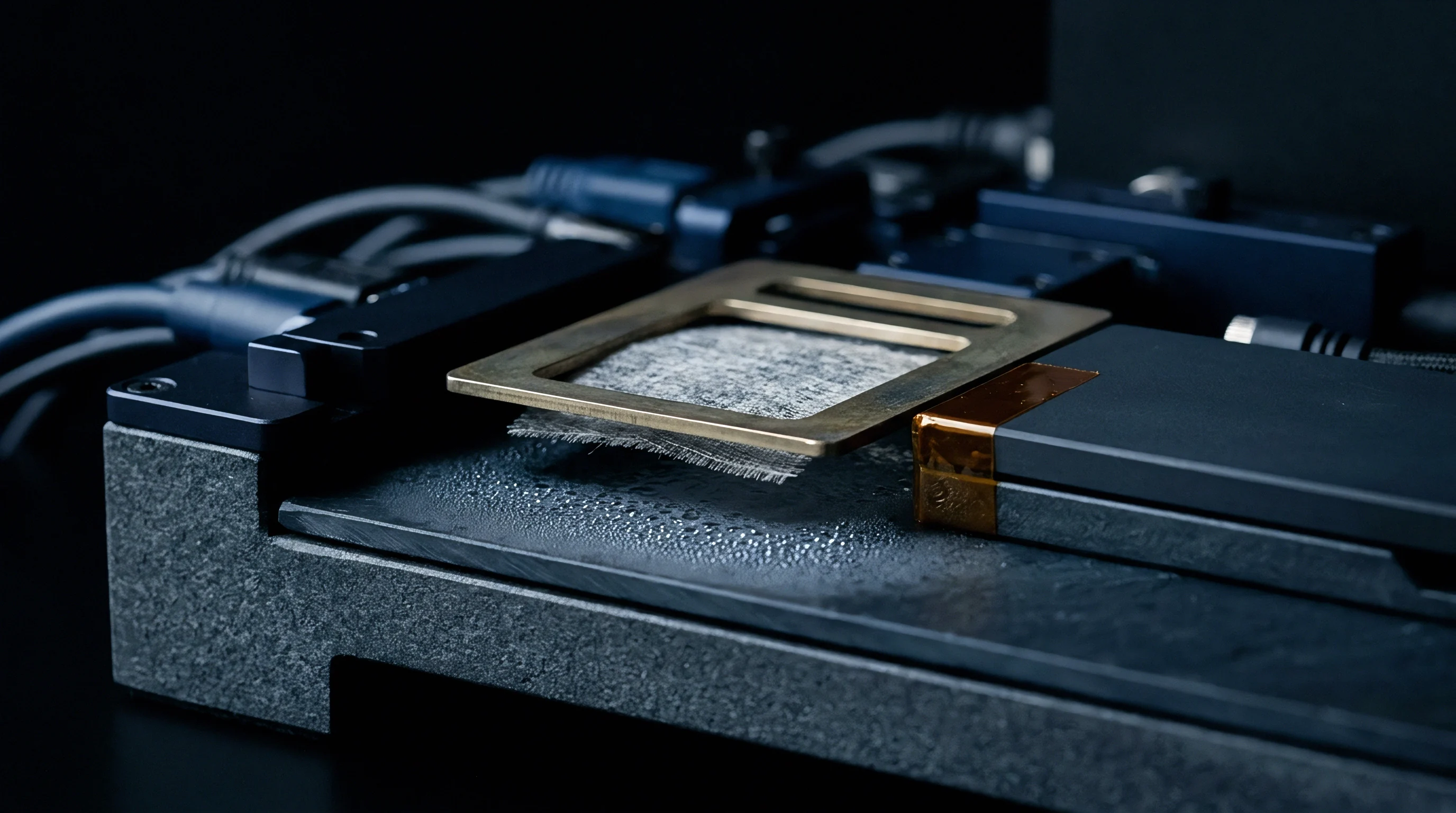
Quantifying moisture sorption dynamics in micro-g flexure anchors requires specialized bench setups capable of separating environmental humidity effects from thermal, mechanical, and electronic drift sources. Standard commercial environmental test chambers frequently introduce airflow vibrations and rapid temperature oscillations that obscure micro-g measurement outputs. High-precision sensor evaluation demands custom thermal-vacuum test chambers equipped with precise humidity injection systems, magnetic shielding, and ultra-low-noise vibration isolation platforms.

Environmental Chamber Protocols and RH Step Testing
Bench verification of anchor sorption dynamics relies on stepped relative humidity profiles conducted under strict isothermal conditions. Temperature stability must be maintained within five millikelvin across the test duration to prevent thermal expansion strain from masking moisture-induced strain shifts. High-purity carrier gases, such as dry nitrogen or argon, pass through dual-stage bubbler systems to generate precise relative humidity steps ranging from zero to ninety percent.
Output signals from the micro-g sensor are logged continuously alongside reference optical dew-point hygrometers and precision barometric sensors.
Stresses alter suspension stiffness. Characterizing sorption response times involves exposing the sensor assembly to a step change in ambient relative humidity while capturing the transient acceleration output. The resulting bias drift curve typically exhibits dual-time-constant behavior.
A fast time constant, spanning seconds to minutes, reflects surface physisorption across exposed silicon structures. A slow time constant, spanning tens to hundreds of hours, corresponds to Fickian diffusion into bulk anchor oxides, glass frit boundaries, or polymeric die-attach matrices.
Standardized characterization procedures require a repeatable sequence of environmental steps to isolate structural moisture sorption from external interference:
- Place the micro-g sensor assembly inside an unpowered baseline thermal chamber at twenty-five degrees Celsius for twenty-four hours.
- Increase cavity humidity from ten percent to eighty percent relative humidity over a controlled ten-minute step.
- Record zero-g output voltage continuously across a forty-eight-hour stabilization window at one-second sampling intervals.
- Extract the transient decay time constant and permanent offset shift using non-linear least squares fitting algorithms.
Allan Deviation Extraction under Humidity Cycling
Allan deviation plots serve as the primary metrological tool for identifying noise processes and long-term bias instability in micro-g accelerometers. In a constant humidity environment, the Allan deviation curve decreases with integration time following a minus-one-half slope, indicating dominant velocity random walk noise. Under fluctuating ambient humidity conditions, moisture sorption dynamics introduce a prominent bump in the Allan deviation plot at integration times corresponding to the diffusion time constants of the anchor material.
Silicon anchors absorb ambient water. Quantifying the bias instability floor requires running extended Allan deviation measurements over hundreds of thousands of seconds inside controlled environmental chambers. As moisture diffuses through flexure anchor interfaces, the low-frequency noise transition shifts from pure random walk behavior toward exponential random drift.
Isolating anchor sorption contributions from sensor electronic pink noise requires repeating Allan deviation runs under varying baseline humidity levels while keeping ambient thermal and electromagnetic parameters constant.
Under IEC 60068-2-78 test compliance, any unsealed package exhibiting moisture-induced bias drift exceeding fifty micro-g over one thousand hours triggers immediate lot rejection.
Quartz crystal microbalance (QCM) gravimetry provides complementary material-level validation by measuring exact mass accumulation on thin films representing the anchor interface. Co-locating a QCM crystal coated with the anchor material inside the environmental test chamber allows direct correlation between mass uptake in nanograms and acceleration offset drift in micro-g. Combining QCM mass readings with finite element mechanical models verifies whether observed sensor drift stems from mass loading or anchor strain redistribution.
Standard testing under IEC 60068-2-78 mandates continuous monitoring of zero-acceleration output throughout ninety-six hours of humidity exposure, disqualifying sensors that exhibit drift exceeding five micro-g.

Hermeticity
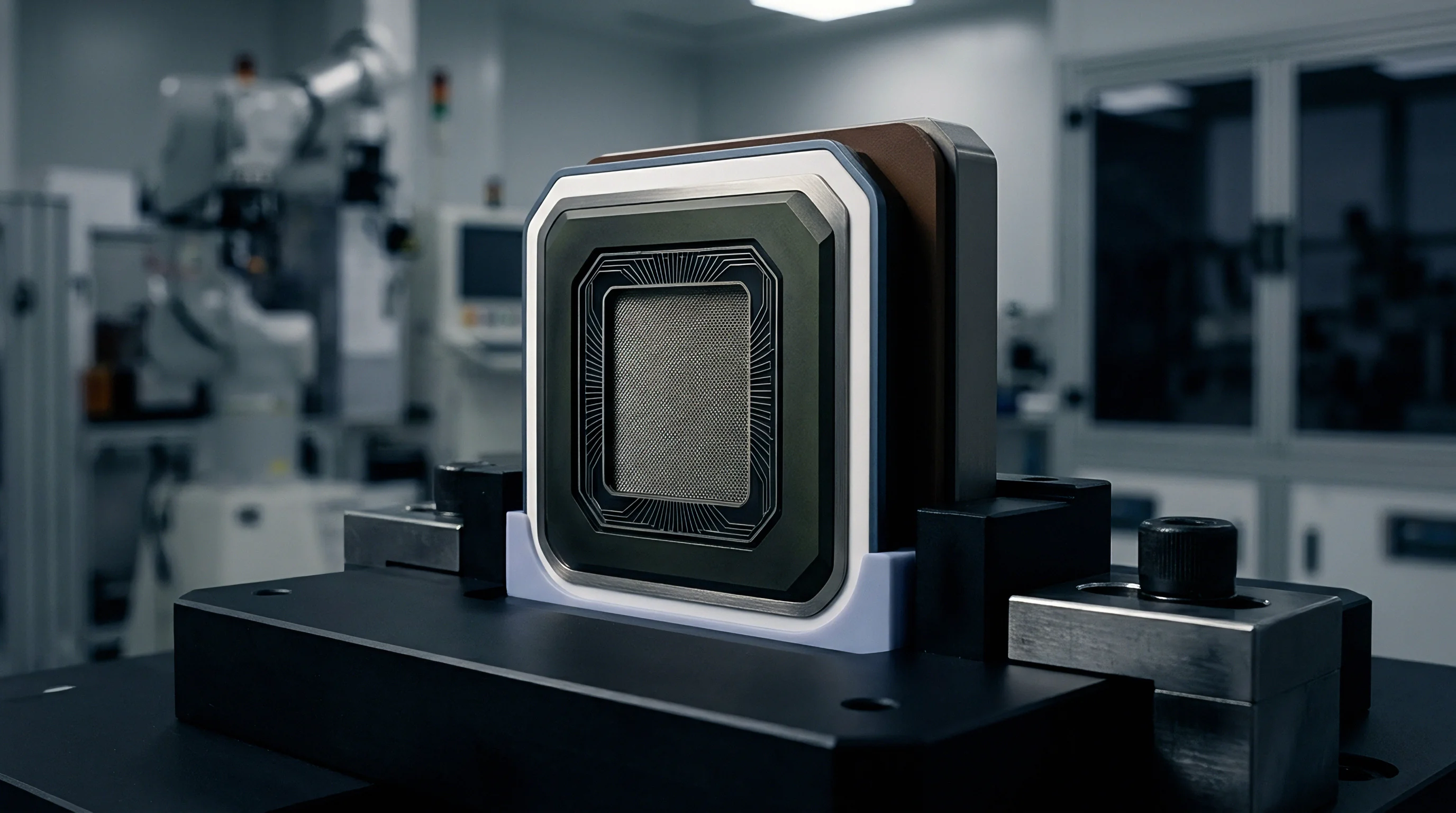
Eliminating moisture sorption dynamics in micro-g flexure anchors requires implementing robust wafer-level packaging and hermetic sealing strategies during sensor manufacturing. Preventing water vapor access to the internal flexure cavity eliminates interfacial sorption, preserving the sub-micro-g bias stability of the sensor over multi-year operational lifespans. Selecting appropriate packaging methodologies requires balancing hermetic sealing performance against manufacturing yield, thermal budget limits, landed unit cost, and long-term outgassing characteristics of internal cavity components.

Wafer Level Bonding and Eutectic Sealing Technologies
Wafer-level encapsulation encloses the delicate micro-g silicon structures within a hermetically sealed micro-cavity before dicing the wafer into individual sensor chips. Metallic eutectic bonding, such as gold-tin or aluminum-germanium bonding, provides superior hermetic performance compared to glass frit or organic adhesive sealing routes. Eutectic seal rings form dense, inorganic metallic bonds around the cavity perimeter, exhibiting helium leak rates below 1.0e-12 standard cubic centimeters per second.
Metallic seals eliminate organic moisture diffusion pathways, insulating the internal flexure anchors from ambient humidity variations.
| Packaging Technology | Leak Rate (atm cc/s He) | Internal Cavity Moisture Level | Process Thermal Budget | Supplier Base Depth |
|---|---|---|---|---|
| Au-Sn Eutectic Wafer Bond | < 1.0e-12 | < 100 ppm H2O | 280 to 320 °C | Moderate (Specialized MEMS Foundries) |
| Glass Frit Sealing | 1.0e-08 to 5.0e-09 | 500 to 2000 ppm H2O | 420 to 450 °C | Broad (Standard Commercial Foundries) |
| Anodic Silicon-Glass Bond | < 1.0e-11 | < 300 ppm H2O | 350 to 400 °C | Broad (Standard MEMS Foundries) |
| Epoxy Cavity Gasket | 1.0e-05 to 5.0e-06 | Ambient Saturated | 120 to 150 °C | Extensive (Standard Packaging Houses) |
Dry nitrogen restores baseline readings. Anodic bonding joins silicon sensor wafers to borosilicate glass cap wafers under high electric fields and elevated temperatures, forming a hermetic chemical bond across sodium oxide interfaces. While anodic bonds achieve low gas leak rates, residual water vapor trapped inside the glass matrix can outgas into the sealed cavity during high-temperature storage.
Non-evaporable getters (NEG), deposited as thin zirconium-vanadium-iron alloy films inside the cap cavity, actively consume outgassed water vapor, hydrogen, and carbon oxides, maintaining cavity moisture concentrations below fifty parts per million over product operational lifespans.

Surface Passivation and Thin Film Sorption Barriers
Atomic layer deposition (ALD) offers a precise chemical route for passivating hydrophilic sites on silicon flexures and anchor roots prior to package sealing. Conformally applying sub-fifty-nanometer oxide or nitride films coats native hydroxyl groups with hydrophobic atomic layers. Titanium oxide and aluminum oxide ALD films block water molecule access to underlying silica networks, suppressing moisture physisorption even if minor trace moisture enters the package cavity during final assembly.
Evaluating packaging options requires comparing technical metrics and supply chain risks across commercial integration pathways:
- Gold-Tin Eutectic Seal provides ultra-low hermetic leak rates and zero polymeric sorption pathways, but demands high capital equipment investment and strict wafer topography controls.
- Anodic Glass Bond delivers established process maturity and high mechanical strength, but exposes sensor dies to high electrostatic voltages during bonding execution.
- Non-Evaporable Getter maintains sub-ppm cavity moisture levels over decade lifespans, but increases unit fabrication cost and requires precise thermal activation steps.
- Atomic Layer Barrier passivates surface hydroxyl sites at low processing temperatures, but introduces minor mechanical damping if film thickness uniformity deviates across flexure roots.
Eutectic gold-tin wafer bonding eliminates the polymeric moisture sorption pathway inherent to organic die-attach adhesives.
Selecting bare die supply vs fully encapsulated wafer-level package (WLP) components dictates the final assembly burden for system integrators. Buying unencapsulated MEMS dies forces the buyer to manage complex hermetic cavity sealing, getter activation, and low-outgassing die-attach procurement within their own production line. Purchasing fully qualified WLP micro-g sensors shifts hermeticity compliance and moisture control verification onto the sensor foundry, reducing downstream yield risks while locking the BOM to a single specialized manufacturing source.
Whether atomic layer deposition of titanium oxide across ultra-thin flexure roots can completely eliminate nanometer-scale moisture condensation without introducing mechanical damping remains an open area of investigation.