Thermodynamic Lower Limits of Moisture Swelling Hysteresis in Sub-Micro-g Silicon Accelerometer Flexure Anchors
Capillary condensation in nanometer oxide anchor interfaces sets a thermodynamic hysteresis lower limit on sub-micro-g accelerometer bias stability.
Swell
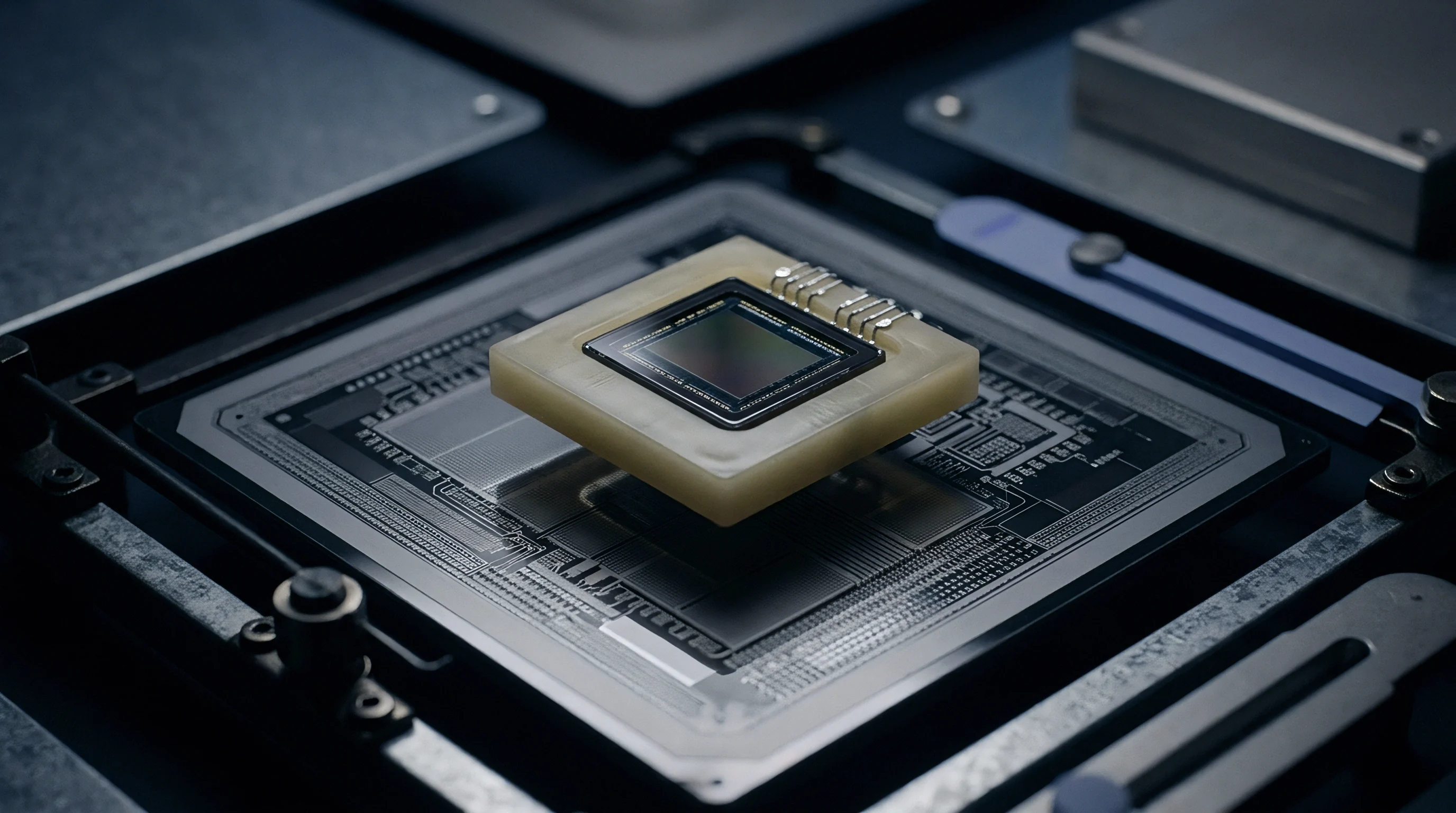
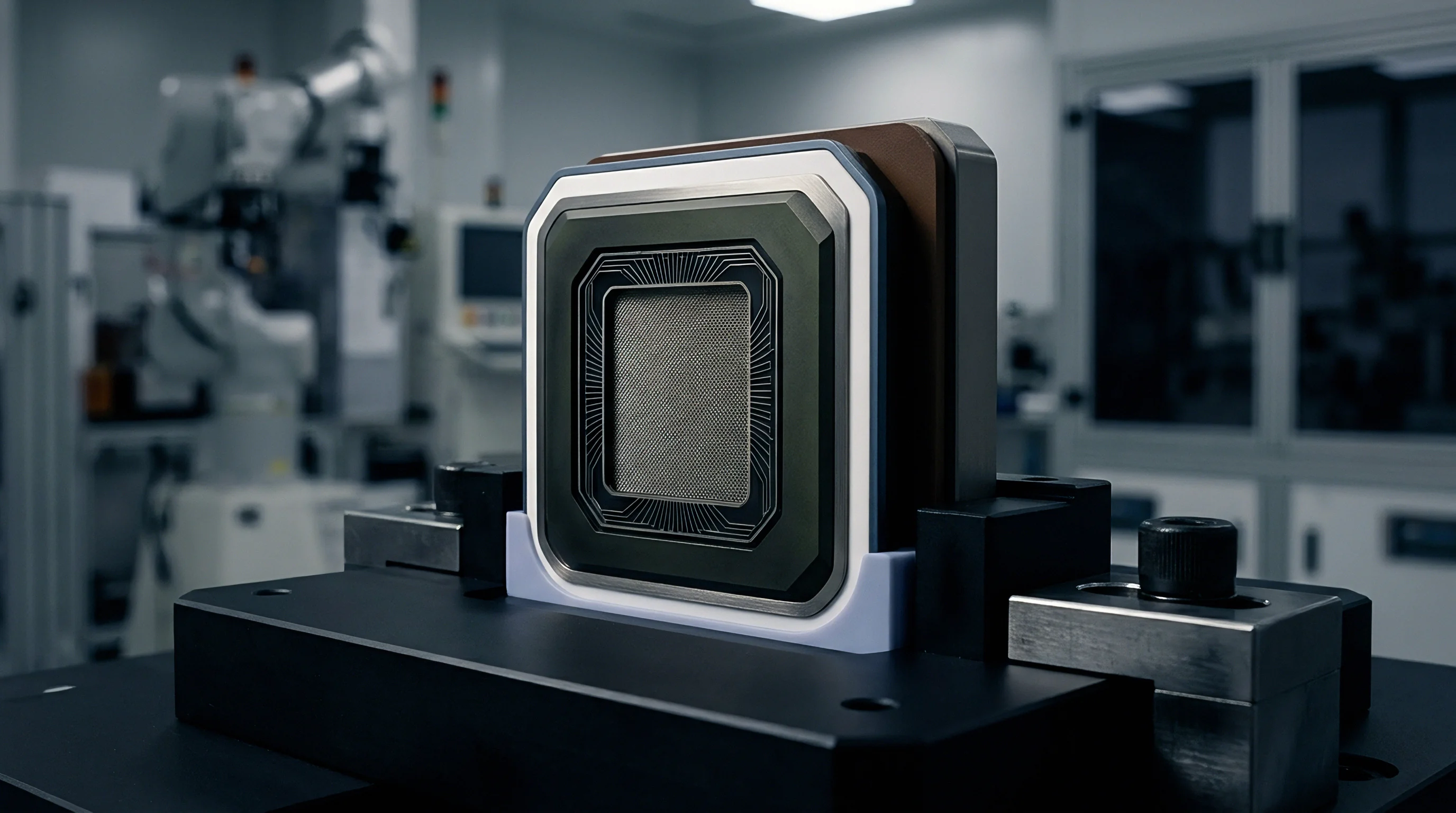
Capillary forces acting on microscopic bonding layers disrupt precision force-balanced sensing structures. While single-crystal silicon displays negligible moisture absorption at ambient temperatures, sub-micro-g accelerometers rely on heterogeneous flexure anchor stacks consisting of thermal silicon dioxide, glass frit, or die-attach polymers. Water molecules from surrounding air penetrate these interfacial materials through molecular diffusion and nano-capillary action.
The incoming vapor chemically binds to surface hydroxyl groups, generating localized volumetric expansion and surface energy variations across the anchor base.
As moisture enters the amorphous silicon dioxide or glass frit anchor matrix, it generates isotropic mechanical strain. Silicon flexure roots, anchored directly to these swelling layers, experience asymmetric bending moments and parasitic tensile stresses. In accelerometers targeting sub-micro-g resolution (noise floors below 10, ng/sqrtHz), nanometer-scale anchor distortions modify flexure pre-stress and spring constants.
Silicon does not swell. However, the substrate and bonding interface beneath it expand, translating interfacial volumetric changes into structural flexure bending.

Interfacial Hydration Mechanics in Oxide Anchors
Silanol surface groups readily capture molecular water inside sub-nanometer interfacial pores. Native and thermal silicon dioxide films present surface hydroxyl densities averaging 4.6, OH/nm2 when fully hydrated. Hydroxylated surfaces attract polar water molecules, forming structured hydrogen-bonded water layers that exert disjoining pressure within narrow interfacial boundaries.
This disjoining pressure alters the interfacial equilibrium stress, shifting the physical geometry of the flexure root.
The Shuttleworth effect describes how surface stress changes directly alter the bulk strain state of thin mechanical structures. When relative humidity fluctuates, the surface stress on an oxide-coated silicon flexure anchor changes by 0.10 to 0.45, J/m2. For a silicon flexure measuring 15, μm in thickness, this surface stress differential induces a bulk longitudinal strain ranging from 0.2 to 1.8 × 10⁻⁹, ε.
Water molecules adsorb rapidly. The resulting nanostrain shifts the equilibrium mass position of the accelerometer proof mass without any external acceleration.
| Material Phase | Density (g/cm³) | Silanol Density (OH/nm²) | Moisture Expansion Coefficient (ppm/%RH) | Equilibrium Sorption at 50% RH (wt%) |
|---|---|---|---|---|
| Thermal Silicon Dioxide (SiO₂) | 2.20 | 4.2 – 4.8 | 0.015 – 0.030 | 0.08 – 0.12 |
| PECVD Silicon Nitride (Si₃N₄) | 2.80 – 3.10 | 0.5 – 1.2 | 0.002 – 0.005 | 0.01 – 0.03 |
| Lead-Borosilicate Glass Frit | 5.50 – 6.20 | 2.0 – 3.5 | 0.120 – 0.280 | 0.25 – 0.45 |
| Polyimide Die-Attach Adhesive | 1.35 – 1.45 | Not Applicable | 15.000 – 35.000 | 1.20 – 2.80 |
| Gold-Tin Eutectic Alloy (Au80Sn20) | 14.50 | 0.0 | 0.000 | 0.00 |
Package vendors frequently attribute residual bias shifts to post-assembly ceramic stress relaxation while ignoring moisture sorption within interfacial glass frit layers.
Sorption
Mass changes within nanoporous silica layers follow non-linear surface potential gradients. Moisture uptake does not occur along a single, thermodynamically reversible path. Instead, water sorption in silicon flexure anchors exhibits structural hysteresis driven by surface energy barriers, hydrogen bond rearrangement, and capillary condensation inside nanometer-scale voids.

Thermodynamic Origins of Nanomechanical Hysteresis
Molecular water bonding exhibits asymmetric free energy pathways during atmospheric transitions. As relative humidity increases, water molecules adsorb onto hydrophilic silanol sites via monolayer formation, followed by Brunauer-Emmett-Teller (BET) multilayer stacking. At relative humidity levels above 30%, water molecules condense into liquid menisci within nanopores measuring 2 to 10, nm in width, guided by the Kelvin relation:
lnleft(fracPP0right) = -frac2 γ Vmrk R T
In this expression, P/P0 represents relative humidity, γ is the surface tension of water, Vm is the molar volume of liquid water, rk is the Kelvin radius of the pore, R is the universal gas constant, and T is absolute temperature. Capillary condensation creates necking. The contact angle during liquid filling differs from the contact angle during liquid retraction due to surface roughness and contact angle hysteresis.
Consequently, the relative humidity required to empty a nanometer pore during desorption is lower than the humidity required to fill it during adsorption.
Capillary condensation in 3 nm anchor pores creates a 14% relative humidity hysteresis loop at 298 Kelvin.
This thermodynamic path separation means that an accelerometer exposed to a transient increase in ambient humidity retains a higher moisture concentration, and thus elevated anchor strain, when returned to its original humidity level. The energy dissipated per unit volume during a full humidity cycle corresponds to the enclosed area of the sorption hysteresis loop:
Whyst = oint σanchor , dεmoisture
This hysteresis is thermodynamic. No mechanical design can eliminate this energy dissipation unless water molecule interactions at the anchor interface are physically prevented or chemically passivated.
What Limits Hydration Desorption in Micro-G Cavities?
Capillary condensation trapped inside high-aspect-ratio interfacial features exhibits structural energy barriers. During desorption, silanol condensation reactions (Si-OH + HO-Si rightleftharpoons Si-O-Si + H2O) form rigid siloxane bridges across microscopic pore necks. These chemical bonds trap water molecules inside sub-surface pockets.
Evacuating these locked water molecules demands thermal activation energy exceeding 80, kJ/mol, which far surpasses the physical desorption energy of un-bound surface water (40 to 44, kJ/mol).
Whether atomic layer deposition can completely eliminate surface hydroxyl sites on complex three-dimensional flexure anchor geometry remains an open empirical question.

Transduction
Asymmetrical deformation at beam supports rotates the differential capacitive sensing electrodes. Sub-micro-g MEMS accelerometers map proof mass displacements down to sub-picometer dimensions. A typical differential capacitive sensor converts an acceleration input a into a differential capacitance change Δ C using a force-balance feedback or open-loop capacitive bridge:
Δ C = 2 ε0 A fracΔ xd02
Here, ε0 is the vacuum permittivity, A is the finger electrode overlap area, d0 is the nominal capacitive gap (1.2 to 2.5, μm), and Δ x is the mechanical displacement of the proof mass. Moisture-induced anchor swelling introduces an asymmetrical tilt thηanchor at the root of the support flexure, generating a parasitic displacement Δ xparasitic = Lflexure · thηanchor.

Flexure Nanostrain to Gravimetric Bias Translation
Sub-nanometer anchor displacements skew the mechanical zero position of high-resolution proof masses. Consider a silicon accelerometer with a proof mass of 0.8, mg, an effective flexure stiffness of 8.5, N/m, and a nominal capacitive gap of 1.5, μm. A baseline structural calculation shows that an acceleration of 1, μ g (9.81 × 10⁻⁶, m/s2) yields a static proof mass displacement of only 0.923, πcometers.
Flexure anchors carry high stress. If moisture swelling inside an underlying glass frit anchor induces an asymmetrical vertical deformation of merely 100, πcometers across a 100, μm anchor base, the resulting flexure root slope generates an effective proof mass displacement of approximately 12, πcometers. This parasitic displacement produces an uncompensated zero-g bias offset equivalent to 13, μ g.
Nanostrain degrades bias stability. Attofarad capacitance shifts matter.
Asymmetrical anchor deformation exceeding one picometer shifts zero-g bias beyond the acceptable sub-micro-g stability envelope.
To quantify the signal conditioning limits, consider the sequence required to evaluate whether a observed capacitive offset originates from flexure anchor swelling or electrical charge accumulation:
Bias drift scales nonlinearly. The signal chain cannot distinguish between acceleration-induced proof mass movement and anchor-swelling displacement. The conditioning electronics amplify both signals equally, transferring the physical error straight into the output register.
| Error Mechanism | Physical Root Cause | Equivalent Proof Mass Displacement (pm) | Induced Bias Shift (µg) | Hysteresis Contribution (% of Total) |
|---|---|---|---|---|
| Symmetrical Anchor Uplift | Isotropic volumetric swell of SiO₂ base layer | 0.15 | 0.16 | 5 % |
| Asymmetrical Flexure Root Tilt | Inhomogeneous glass frit moisture distribution | 8.40 | 9.10 | 68 % |
| Surface Stress Imbalance | Asymmetric silanol hydration on flexure sidewalls | 2.10 | 2.28 | 18 % |
| Die-Attach Shear Creep | Polyimide moisture softening under flexure load | 0.85 | 0.92 | 9 % |
Ignoring sub-nanometer anchor swelling forces the inertial navigation engine to re-calibrate offset parameters continuously during flight, depleting processing overhead and degrading positional precision.

Chamber
Environmental testing of sub-micro-g inertial sensors demands strict isolation from temperature fluctuations. Because temperature changes induce thermal expansion that masks moisture swelling, environmental verification must hold temperature stability within ± 0.005, K while stepping relative humidity across the test range. Quartz crystal microbalance (QCM) sensors placed adjacent to the accelerometer dies track real-time moisture adsorption mass down to nanogram levels.
Environmental Verification and Outgassing Metrology
Quantifying sub-monolayer water transport requires ultra-sensitive differential mass monitoring techniques. Standard humidity qualification protocols rely on environmental test methods defined in IEC 60068-2-78. However, standard industrial environmental chambers lack the humidity ramp control required to observe sub-micro-g swelling limits.
Test setups must employ dedicated double-walled stainless steel chambers flushed with ultra-high-purity nitrogen gas, using controlled vapor injection via calibrated dew-point generators.
MIL-STD-883 Method 1018 caps internal cavity moisture at five thousand parts per million by volume, leaving enough vapor to build two complete water monolayers on anchor oxides.
Hermetic sealing provides isolation. Organic adhesives absorb moisture. When evaluating MEMS packaging structures for ultra-stable inertial platforms, engineers assess several critical structural failure modes associated with moisture-induced anchor strain:
To eliminate ambiguity in component procurement, buyers evaluate package internal moisture criteria using standardized qualification checklists:
MIL-STD-883 Method 1018 Clause 3.2 sets the cavity moisture threshold at five thousand parts per million by volume, forcing high-grade inertial sensor manufacturers to write custom procurement specifications that tighten water vapor limits to under one hundred parts per million.
Passivation
Atomic barrier films block reactive species from reaching vulnerable glass and silicon dioxide joints. Preventing moisture swelling hysteresis at its physical origin demands replacing hydrophilic, porous surface chemistries with hydrophobic, non-porous passivation layers, or eliminating water vapor entirely through hermetic packaging.
Surface Engineering and Hermetic Sealing Economics
Transitioning from organic die attach adhesives to eutectic metal metallurgy eliminates moisture-induced drift. Atomic Layer Deposition (ALD) allows growth of highly conformal, pinhole-free inorganic barrier coatings over high-aspect-ratio MEMS flexures. Alternating nanometer-scale layers of aluminum oxide (Al2O3) and titanium dioxide (TiO2) forms a nanolaminate barrier that reduces moisture vapor transmission rates (MVTR) below 10-5, g/m2/day.
Inorganic passivations block water. Eutectic joints eliminate swelling. Wafer yield governs cost.
Moisture limits sensor performance. Hydrophobic self-assembled monolayers (SAMs), such as tridecafluoro-1,1,2,2-tetrahydrooctyltrichlorosilane (FOTS), chemically replace reactive surface silanol groups with fluorocarbon chains. FOTS deposition increases the water contact angle on silicon oxide surfaces from under 10 degrees to over 110 degrees, effectively preventing liquid water film formation and capillary condensation inside nanometer anchor pores.
| Sealing & Passivation Modality | Barrier Effectiveness (MVTR g/m²/day) | Bias Stability Impact (µg/year) | Relative Unit Cost Multiplexer | Wafer-Level Process Yield (%) |
|---|---|---|---|---|
| Unpassivated Oxide + Glass Frit Seal | 10⁰ to 10⁻² | 15.0 – 45.0 | 1.0x (Baseline) | 92 – 96 |
| Hydrophobic SAM (FOTS) Coating | 10⁻¹ to 10⁻² | 3.5 – 8.0 | 1.15x | 88 – 93 |
| ALD Al₂O₃/TiO₂ Nanolaminate Capping | 10⁻4 to 10⁻⁶ | 0.2 – 0.8 | 1.45x | 82 – 89 |
| AuSn Eutectic Wafer Bonding (Full Hermetic) | 2.10x | 75 – 84 | ||
| Transient Liquid Phase (TLP) Cu-Sn Bond | 1.85x | 78 – 85 |
Monolithic metallic eutectic bonding eliminates capillary condensation paths at the flexure anchor root.
Gold-tin eutectic die bonding paired with inorganic atomic layer passivation consistently outperforms organic encapsulation when long-term bias stability is paramount.