Selecting Polymer Die Attach Materials for Low Drift MEMS Accelerometers
Select low-modulus silicones or cyanate esters with uniform bondlines to decouple package stress and eliminate viscoelastic offset drift in MEMS accelerometers.

Bond
Mechanical stress originating at the package interface couples directly into the silicon suspension of a surface-micromachined proof mass, shifting the zero-g bias and degrading scale factor stability over operational lifetimes. When package warpage or differential thermal expansion deforms the package base, that displacement propagates through the adhesive layer into the anchor points of the micromachined flexures. In low-noise capacitive accelerometers targeting sub-milligram bias stability, a baseline package strain of fifty microstrain transmits sufficient anchor displacement to pull differential sensing fingers out of balance, generating tens of milli-g in false acceleration signal.
The core design trade-off centers on adhesive modulus and mechanical retention. High-modulus structural adhesives anchor the die firmly against mechanical shocks exceeding 2000 g, yet they transfer thermal strain from the alumina or organic substrate into the silicon with minimal attenuation. Soft elastomeric formulations absorb thermal mismatches across wide temperature swings, yet they introduce mechanical compliance that permits the die to tilt under steady gravitational fields, distorting axis alignment.
Selecting an attachment medium requires reconciling this antagonism across storage temperatures, reflow excursions, and decades of operational life.
A six-milligram offset shift occurs when ten kilopascals of shear stress transfer across the package boundary into the anchor suspension of an open-loop capacitive comb.
Differential thermal expansion dominates this mechanical coupling. Silicon possesses a linear coefficient of thermal expansion near 2.6 parts per million per Kelvin at room temperature. Alumina ceramic packages exhibit values around 6.5 parts per million per Kelvin, while conventional FR-4 or bismaleimide-triazine organic substrates range from 13 to 17 parts per million per Kelvin.
As an assembled device cools from a typical curing temperature of 150 degrees Celsius to room temperature, the substrate contracts substantially more than the silicon chip. The resulting shear strain concentrates along the die perimeter and transmits directly through the adhesive layer.

Package Strain Coupling Mechanics
Package-induced shear stress transmits from the interface toward the active sense element through finite boundary zones. The shear stress peaks sharply at the chip edges and decays exponentially toward the center, following classical shear-lag formulations. Positioning sensing anchors near the geometrical center of the silicon die isolates them from these edge peaks, though it does not eliminate strain completely.
When the adhesive possesses a high shear modulus, the boundary shear stresses remain elevated over a larger fraction of the die area. This creates an elliptical warpage across the die plane that bends the proof mass suspension springs. In capacitive devices with capacitive gaps between one and two micrometers, out-of-plane deflections of merely ten nanometers produce asymmetric capacitance variations.
The readout application-specific integrated circuit interprets these structural imbalances as an apparent acceleration input. Sourcing teams frequently encounter components whose bias drift tracks environmental temperature with unacceptable hysteresis loops, a direct outcome of inelastic strain transmission across the package interface.
Thermal hysteresis emerges because the stress state at forty degrees Celsius during an upward temperature sweep fails to match the stress state at the same temperature during a cooling sweep. Polymer relaxation dynamics, volumetric phase changes, and interface sliding contribute to this non-reversing behavior. If the adhesive layer transfers thermal contraction forces rigidly during thermal cycling, the internal spring anchors suffer permanent micromechanical misalignments, rendering post-assembly calibration lookup tables ineffective over extended operational deployment.
Chemistry
Polymer die attach formulations for precision microelectromechanical sensors divide into silicones, epoxies, polyimides, and hybrid cyanate ester systems, each dictating a unique set of viscoelastic and thermomechanical properties. The backbone structure and cross-link density govern the storage modulus, glass transition temperature, and volatile outgassing characteristics across the sensor operating window.
Which Die Attach Chemistry Limits Creep?
Viscoelastic drift arises directly from molecular rearrangement under sustained mechanical strain, pointing toward cross-linked cyanate esters and high-purity addition-cured silicones as the most stable formulations for DC-stable tilt applications. Standard epoxies exhibit tertiary amine or anhydride cured aromatic networks with high cross-link densities, yielding storage moduli between one and eight gigapascals at room temperature. These rigid networks resist gravitational settling and dynamic vibration, but their elevated modulus converts minute substrate contractions into massive die stresses.
Modifying epoxies with aliphatic flexibilizers or elastomer adducts lowers the room-temperature modulus to the range of fifty to three hundred megapascals, easing mechanical strain on the chip while introducing secondary beta-relaxations that drive long-term baseline drift.
Silicones present polydimethylsiloxane backbones characterized by low glass transition temperatures, typically below minus one hundred degrees Celsius. Across the industrial operating span from minus forty to positive one hundred and twenty-five degrees Celsius, silicones operate in their rubbery plateau region. Their storage modulus remains stable, often between one and five megapascals, providing near-ideal stress decoupling for sensitive silicon anchors.
Silicones minimize thermal hysteresis because their polymer chains undergo rapid, unhindered conformational changes without locking into non-equilibrium conformations. However, this compliance reduces mechanical resonance control, leaves the die vulnerable to high-g impact damage, and permits the entire die to tilt slightly when subjected to changing orientation within a gravity field.
Polyimides provide high thermal stability and survive continuous exposures above three hundred degrees Celsius, yet their cure cycle demands temperatures approaching three hundred and fifty degrees Celsius. This severe thermal budget creates severe residual stresses upon cooling to room temperature. Cyanate ester resins bridge this gap by curing via cyclotrimerization into stable sym-triazine rings, achieving moderate moduli between one and two gigapascals with low moisture uptake.
Thermoplastic pastes allow strain release via yielding, though their sensitivity to solvent retention and thermal creep limits their deployment in low-drift instrumentation grades.
| Polymer Class | Storage Modulus (MPa) | Glass Transition Temperature (°C) | CTE Below Tg (ppm/K) | Moisture Absorption (%) | Typical Cure Schedule |
|---|---|---|---|---|---|
| Standard Aromatic Epoxy | 3500 to 7500 | 120 to 180 | 35 to 55 | 0.8 to 2.2 | 30 min at 150°C |
| Flexibilized Low-Modulus Epoxy | 40 to 250 | minus 10 to 45 | 80 to 140 | 1.1 to 2.8 | 60 min at 120°C |
| Addition-Cure Silicone | 1.2 to 8.0 | minus 120 to minus 80 | 220 to 350 | 0.1 to 0.4 | 60 min at 150°C |
| Cyanate Ester Paste | 1100 to 2200 | 160 to 240 | 45 to 65 | 0.3 to 0.7 | 120 min at 165°C |
| Elastomer-Modified BMI | 800 to 1800 | 140 to 200 | 50 to 75 | 0.6 to 1.2 | 60 min at 175°C |
Filler selection modifies these properties significantly. Silver flake additions provide thermal and electrical dissipation for ground returns, but they raise the storage modulus and exacerbate mechanical rigidity. Silica fillers lower the bulk thermal expansion coefficient to balance the silicon substrate boundary, yet excessive particle loading increases paste viscosity, complicates capillary wetting, and promotes micro-voiding beneath the die edge.
In ungrounded sensor architectures, unfilled non-conductive pastes provide lower moduli and smoother strain gradients across the adhesive footprint.
Outgassing represents a silent risk for hermetic cavity packages. Condensation of fugitive volatile fractions onto the micromachined fingers alters local dielectric properties and dampens proof mass resonance. Silicones with high concentrations of low-molecular-weight cyclosiloxanes release volatile species that redeposit on polysilicon surfaces, occasionally creating viscous surface drag.
Formulations must undergo thermal vacuum bakeout and demonstrate total mass loss below one-tenth of one percent under standard screening protocols. Resin formulators commonly counter that slight baseline drift over thermal cycling represents an unavoidable property of flexible polymer backbones rather than a deficiency in cross-link control.


Creep
Polymer chains undergo progressive conformational rearrangement when subjected to permanent mechanical preloads, generating time-dependent stress relaxation within the attachment boundary. When an accelerometer package solders onto a printed circuit board, the package experiences localized mechanical flexion and thermal shock. The die attach adhesive initially stores this energy elastically, but it progressively converts that strain energy into plastic deformation over thousands of operating hours.
This structural relaxation manifests at the sensor output as a continuous, uncorrectable offset drift.

Where Does Moisture Shift Offset Drift?
Atmospheric moisture penetrates permeable package boundaries and diffuses directly into the polymer network, swelling the matrix and driving zero-bias instability through hygroscopic expansion. The ingress kinetics follow classical Fickian diffusion equations, where the diffusion coefficient depends exponentially on ambient temperature. As water molecules form hydrogen bonds with polar groups in epoxies and polyimides, they push the polymer chains apart, causing volumetric swelling that exerts compressive forces across the bottom surface of the silicon die.
Consider an unpassivated flexibilized epoxy layer exposed to a shift from twenty percent to eighty percent relative humidity at thirty-five degrees Celsius. The adhesive layer absorbs up to two percent moisture by weight over three hundred hours. The coefficient of hygroscopic swelling for modified epoxies ranges from two to five hundred parts per million per weight percent of absorbed moisture.
Consequently, the adhesive expands by six hundred to one thousand microstrain. Because the rigid ceramic or silicon substrate resists in-plane expansion, the swelling converts entirely into out-of-plane bending moments, deflecting the die surface and producing bias shifts exceeding fifteen milli-g in precision dual-axis tiltmeters.
Desorption reverses this process unevenly. As ambient humidity drops, water molecules leave the surface layers rapidly while remaining trapped within the central bulk of the adhesive pad. This gradient establishes an asymmetric internal stress state that distorts the proof mass plane, producing pronounced offset hysteresis during seasonal humidity cycles.
Silicones resist this specific failure mechanism effectively, displaying low equilibrium moisture absorption despite their high gas permeability.
Hygroscopic swelling in polar adhesive matrices generates out-of-plane bending moments capable of exceeding fifteen milli-g in bias deviation during seasonal weather shifts.
Viscoelastic stress relaxation behaves according to time-temperature superposition principles. The mechanical relaxation modulus follows a decaying power-law or Kohlrausch-Williams-Watts stretched exponential function. Below the glass transition temperature, relaxation proceeds slowly, spreading drift over years of service.
If the sensor operates within thirty degrees Celsius of the glass transition temperature, relaxation rates accelerate dramatically, destroying the calibration accuracy established at the factory.
Field data from structural health monitoring nodes frequently reveals gradual baseline drift that correlates with elapsed operating time rather than thermal cycles. This long-term migration reflects the gradual relaxation of residual assembly stresses. When the mounting bond relaxes, the mechanical pre-stress on the silicon anchor diminishes, causing the resting position of the comb finger array to drift by several fractions of an angstrom each week.
The central design challenge remains whether polymer relaxation can ever be stabilized completely in non-hermetic, low-cost plastic packaging without relying on complex multi-point mechanical isolation submounts.

Deposition
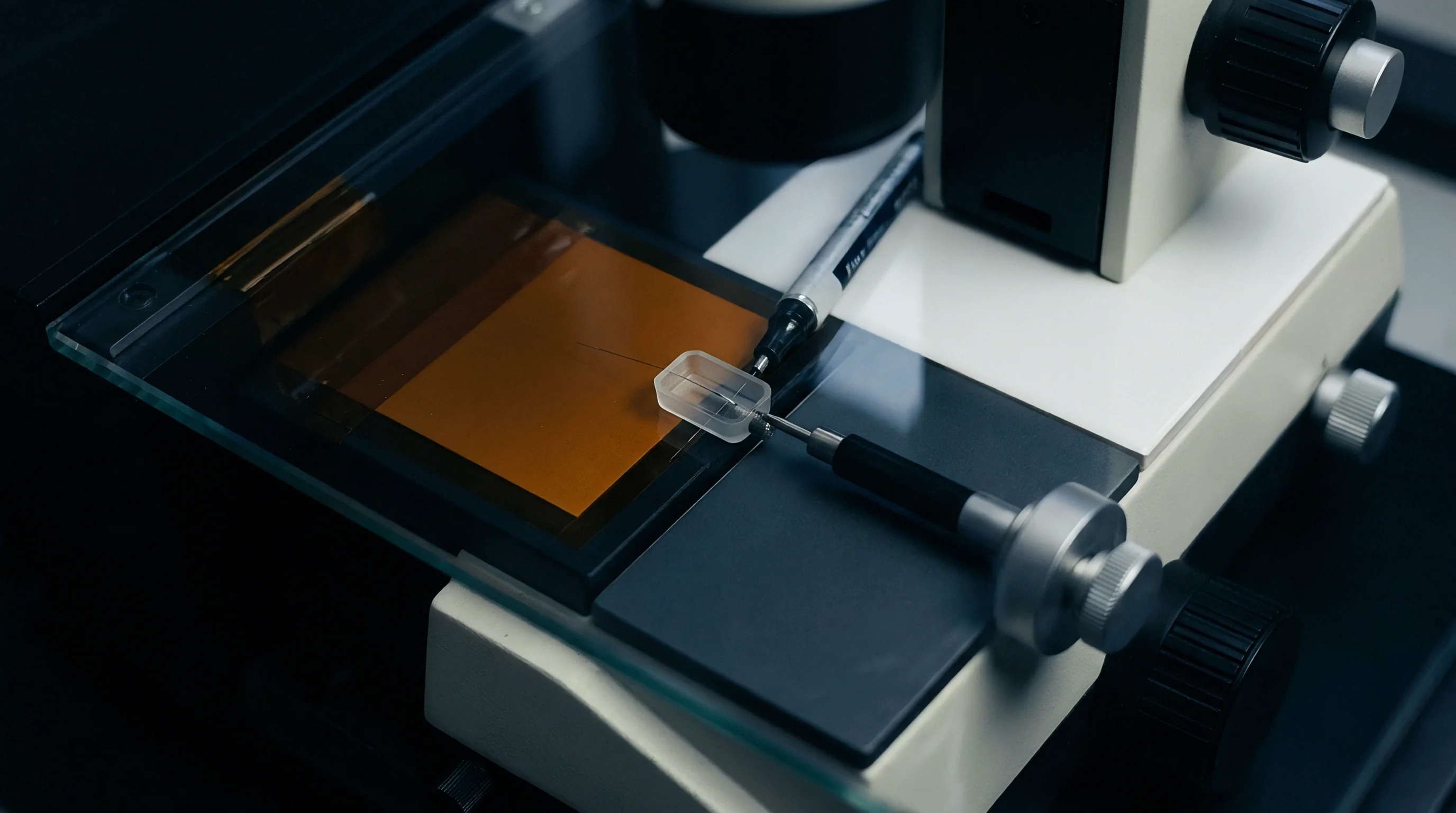
Dispensing geometries and thermal cure profiles govern the physical uniformity of the cured joint, directly dictating whether the theoretical properties of the polymer materialize on the production floor. Variations in bondline thickness across a single die create tilt angles and non-uniform stress fields that ruin accelerometer cross-axis rejection ratios. In low-drift sensors, bondline thickness must remain uniform within five micrometers across a three-millimeter square die footprint.

Bondline Control and Spacer Implementation
Calibrated solid glass or polymer spacer spheres blended into the adhesive paste at controlled weight percentages prevent the die from tilting or squeezing the adhesive out during automated placement. Without spacer spheres, placement tool force variations, dispense volume tolerances, and paste rheology fluctuations yield unpredictable bondlines ranging from ten to sixty micrometers across a single production lot.
Thicker bondline configurations isolate package stress more effectively than thin joints. The total mechanical compliance of the attachment layer scales proportionally with its physical thickness. A joint measuring fifty micrometers reduces thermal shear stress transfer into the silicon die by more than sixty percent compared to a twelve-micrometer joint using the identical polymer.
However, thick joints increase positional instability and amplify curing shrinkage forces if the material undergoes substantial volumetric contraction during polymerization. Maintaining a uniform thickness of forty to fifty micrometers with tightly sized glass spheres limits die tilt to less than one-tenth of a degree.
Dispense patterns establish the baseline for void formation. Dispensing a single central dot forces air outward along radial flow fronts as the die descends, minimizing trapped bubbles beneath the die center. Cross, star, or multi-dot dispense patterns frequently trap air pockets where advancing fluid fronts converge.
Voids beneath the silicon die disrupt stress symmetry, creating localized strain concentrations that bend the silicon unevenly during temperature excursions.
| Dispense Pattern | Void Area Fraction (%) | Bondline Tilt (mrad) | Stress Concentration Factor | Symmetry of Residual Stress |
|---|---|---|---|---|
| Single Central Dot | 0.5 to 2.0 | 0.8 to 1.5 | 1.1 to 1.3 | High Radial Symmetry |
| Five-Dot Matrix | 4.0 to 12.0 | 1.2 to 2.8 | 2.0 to 3.5 | Severe Local Asymmetry |
| Cross Pattern | 1.5 to 5.0 | 0.6 to 1.4 | 1.4 to 1.8 | Moderate Quadrant Symmetry |
| Full Perimeter Dam-and-Fill | 6.0 to 18.0 | 0.4 to 1.1 | 2.5 to 4.2 | Poor Inverted Symmetry |
Curing thermal profiles require precise optimization to balance conversion degree against polymerization shrinkage. Rapid thermal ramps induce violent solvent evaporation and initiate gelation before the polymer chains achieve relaxed equilibrium configurations, freezing severe internal stresses into the matrix. Stepped curing regimes mitigate these risks.
A typical high-reliability curing regime incorporates an initial thermal dwell below the solvent boiling point or reaction onset temperature, allowing uniform thermalization and volatile release without bubbling. The temperature then ramps at one to two degrees Celsius per minute toward the primary cure plateau, ensuring uniform cross-linking across the bondline. Fast curing ovens that heat parts to peak temperature in two minutes maximize assembly throughput, but they generate high residual stresses that systematically elevate accelerometer bias drift over time.
A slow ramp rate through the gel point yields lower residual interfacial stress than post-cure thermal annealing cycles performed after cross-linking completes.
Inspectors monitor voiding fractions using scanning acoustic microscopy. In military and aerospace inertial grades, total void area must stay below five percent of the die footprint, with zero voids located directly beneath active suspension anchors. Even a thirty-micrometer void situated beneath a central spring anchor creates asymmetric thermal expansion, tilting the proof mass along a sensitive axis and inducing milligram-level offset drift during operational thermal swings.
Solder-attach processes such as gold-tin eutectic bonding eliminate polymer creep entirely, offering absolute DC stability. However, their extreme stiffness (shear modulus exceeding thirty gigapascals) demands matched submount materials such as silicon or silicon carbide to prevent die cracking during reflow cooling. Polymer adhesives remain the dominant choice for cost-effective packaging, provided the manufacturing process controls dispense patterns, bondline thickness, and cure kinetics rigorously.
Thorough process control demands evaluating dispense geometry before fine-tuning placement speed.
Ledger
Sourcing low-drift die attach formulations requires verifying rigorous lot-to-lot chemical tolerances that standard industrial adhesive data sheets rarely disclose. Procurement contracts often specify materials based on headline room-temperature modulus and thermal conductivity, omitting glass transition spreads, outgassing spectrums, and moisture absorption constants. When material lots shift in monomer ratio or filler size distribution, assembly facilities face unexplained yield dropouts during multi-axis thermal screening of finished sensors.

Procurement Dossier Specifications
Procurement teams must demand specific incoming inspection parameters to ensure that production lots deliver consistent thermomechanical performance. Standard qualification documents must capture properties that govern mechanical stability:
- Dynamic mechanical analysis curves mapping storage modulus, loss modulus, and loss tangent from minus sixty degrees Celsius to positive one hundred and fifty degrees Celsius at one Hertz oscillation frequency to verify that the glass transition temperature remains strictly outside the sensor operating band.
- Thermogravimetric outgassing spectra documenting total mass loss below zero-point-one percent and collected volatile condensable material below zero-point-zero-one percent under ASTM E595 vacuum test parameters to protect cavity-packaged micromechanical fingers from chemical contamination.
- Differential scanning calorimetry thermograms establishing the total heat of reaction and peak reaction temperature to verify consistent monomer purity and shelf-life stability prior to automated dispensing.
- Laser diffraction filler sizing metrics proving that maximum filler particle diameters remain three times smaller than the specified target bondline thickness, preventing filler bridging from tilting the die.
Cold-chain logistics add financial exposure to the procurement equation. Premixed and frozen syringes of elastomeric epoxies and cyanate esters require continuous storage at minus forty degrees Celsius. Temperature excursion logging throughout transit prevents premature room-temperature exposure, which advances the polymer cross-linking reaction, raises paste viscosity, and degrades wet-out performance during dispensing.
Syringes exposed to dry-ice depletion during international air freight must be scrapped immediately, as partially advanced resin generates uneven bondlines and elevated voiding fractions.
Second-Source Equivalency Verification
Qualifying secondary material suppliers involves extensive mechanical and thermal characterization. Drop-in substitutions rarely succeed in low-drift MEMS designs because proprietary catalyst packages, coupling agents, and flexibilizers alter the adhesive relaxation modulus, even when bulk modulus specifications match on commercial datasheets. A secondary source qualification process must include rigorous verification steps:
- Dispense profile optimization to map capillary flow, wet-out fillet geometry, and voiding thresholds using production pick-and-place automation.
- X-ray and scanning acoustic microscopy inspection of bonded silicon test vehicles to confirm that void fractions remain below two percent of total die surface area.
- Thermal shock screening across five hundred cycles from minus forty to positive one hundred and twenty-five degrees Celsius to verify bondline integrity and adhesion retention.
- Continuous zero-g bias monitoring across one thousand hours of environmental chamber testing at eighty-five degrees Celsius and eighty-five percent relative humidity to quantify long-term hygroscopic drift and viscoelastic stress relaxation.
Cost structures reflect these tight performance envelopes. High-reliability, medical-grade, and aerospace-certified adhesives command prices reaching five hundred to two thousand dollars per thirty-cubic-centimeter syringe, compared to fifty dollars for commercial electronics adhesives. For a typical three-millimeter square die using zero-point-zero-two cubic centimeters of adhesive per unit, the direct material cost remains modest at a few cents per package.
However, the true cost driver sits in line-yield fallout, cryogenic shipping compliance, and the months of chamber qualification required to validate that a new formulation will not induce long-term bias drift in mission-critical applications.
Standard purchase agreements incorporating AEC-Q100 Grade 0 or MIL-STD-883 Method 5011 bind adhesive formulators to notify buyers of any chemical reformulation, including sub-tier catalyst modifications or filler supplier changes, ensuring that undocumented recipe variations do not destabilize the sensor manufacturing line.