
Spatial Thermal Gradient Mapping Micro-Machined Accelerometer Arrays
Spatial thermal gradient mapping in micro-machined accelerometer arrays decouples linear motion from external board heat using differential thermopile matrices.
Spatial thermal gradient mapping in micro-machined accelerometer arrays decouples linear motion from external board heat using differential thermopile matrices.

Precision capacitive MEMS accelerometer thermo-mechanical bias stability requires stress-isolated ceramic packaging and gradient-aware temperature calibration.

Non-linear thermoelastic coupling dictates mechanical dissipation ceilings in sub-microbar vacuum packages when spatial temperature gradients exceed two kelvins per millimeter.

Vacuum cavity outgassing drives long term zero offset instability in MEMS absolute pressure sensors by increasing internal cavity pressure over time.

Wafer-level packaging stress relaxation induces anisoelastic stiffness drift and quadrature leakage, requiring stabilization annealing to hold tactical bias limits.

Non-linear squeeze film compression transforms high-frequency cross-axis vibration into static acceleration bias through phase-aligned mechanical gap modulation.

Thermomechanical stress relaxation in MEMS suspensions causes long-term zero-g bias drift that requires Prony series modeling and state estimation to mitigate.

Silicon substrate thermal expansion alters MEMS structural spacing and compliance, requiring isolated single-point anchors and 3rd-order ASIC polynomial correction.

Sub-Torr MEMS resonators experience in-phase bias instability when spatial thermal gradients skew anisotropic flexure stiffness, requiring multi-point sensing compensation.
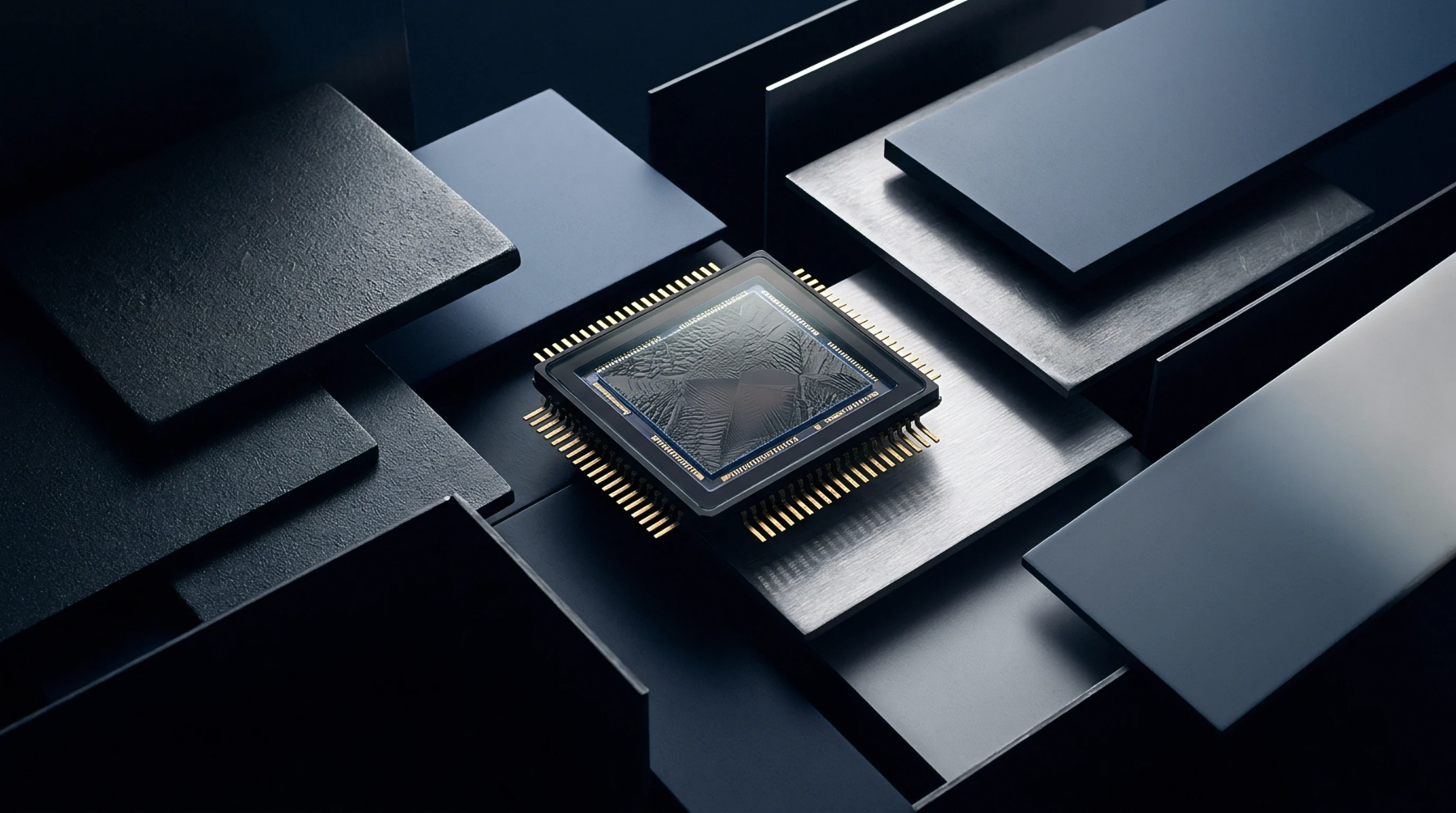
Separating package stress from silicon creep during calibration relies on modeling the exponential viscoelastic time constants of polymers against intrinsic lattice stability.

Spatial thermal gradients shift MEMS zero rate drift by inducing asymmetric anchor stress, flexure mode coupling, and local frequency splitting.
Expertise is a utility, not a secret. sentiention™ publishes its working knowledge as open reference: intelligence layer covering the materials it sources, the markets it enters, and the reference that serves both.