Viscoelastic Die Attach Creep in Harsh Thermal Environments
Viscoelastic die attach creep relaxes assembly stresses under heat, causing zero-point offset drift in micro-sensors that requires rigid high-Tg formulations.
Modulus
Polymeric adhesives utilized for semiconductor die attachment exhibit complex mechanical responses that combine elastic energy storage with viscous dissipation under thermal stress. In microelectronic packaging, the mechanical state of an adhesive layer depends directly on ambient temperature and time under load. At low operational temperatures below the glass transition point, the polymer matrix maintains a high elastic storage modulus, preserving rigid mechanical coupling between the silicon substrate and the supporting carrier package.
As operating temperatures approach and exceed the glass transition point, molecular chains gain rotational freedom, causing the material to transition from a glassy state to a rubbery state. This state change triggers a dramatic reduction in storage modulus, often dropping by two to three orders of magnitude within a narrow temperature window.
Dynamic mechanical analysis characterizes this viscoelastic transition by applying sinusoidal shear strain to cured adhesive samples across defined temperature sweeps. Measurements separate the real component of complex modulus, representing stored elastic energy, from the imaginary component, representing dissipated viscous energy. The ratio of loss modulus to storage modulus defines the damping factor, which reaches its maximum value at the glass transition temperature.
High-temperature sensor packages operating near this region experience accelerated stress relaxation, where internal mechanical stress built up during assembly thermal processes decays non-linearly over operational time.
| Polymer Matrix Base | Fill Volume Ratio (%) | Glass Transition Temperature (°C) | Storage Modulus at 25°C (GPa) | Storage Modulus at 150°C (GPa) | Loss Tangent Peak Value |
|---|---|---|---|---|---|
| Standard Bisphenol-A Epoxy | 70 | 115 | 8.5 | 0.4 | 0.38 |
| High-Tg Cycloaliphatic Epoxy | 75 | 175 | 11.2 | 2.1 | 0.22 |
| Polyimide High-Temp Adhesive | 65 | 240 | 6.8 | 4.5 | 0.14 |
| Fluorosilicone Elastomer Paste | 60 | -45 | 0.08 | 0.03 | 0.08 |
Crosslink density governs elevated temperature compliance.
When operating environments exceed the glass transition threshold, time-temperature superposition principles describe how long exposure times at moderate temperatures produce mechanical deformation equivalent to short exposure times at elevated temperatures. Shift factors derived from the Williams-Landel-Ferry relationship allow reliability engineers to project long-term mechanical creep from short-term laboratory measurements. In precise sensing applications, this time-dependent modulus degradation alters the mechanical boundary conditions of the encapsulated die, shifting structural resonance frequencies and modifying internal strain fields.
Storage modulus drops eighty percent when epoxy temperature exceeds the glass transition point by twenty degrees Celsius.
Suppliers frequently present room-temperature shear strength figures as proof of structural reliability, neglecting to report the severe modulus decay that occurs past the glass transition temperature during sustained thermal exposure.

Bond
Differential thermal contraction between a silicon die and its ceramic or leadframe carrier generates sustained shear forces across the die attach layer. Silicon exhibits a low coefficient of thermal expansion near two point six parts per million per Kelvin, whereas copper leadframes and alumina substrates possess thermal expansion coefficients of seventeen and six point five parts per million per Kelvin respectively. As cooling occurs following high-temperature adhesive cure, this expansion mismatch induces baseline compressive and shear stresses within the silicon crystal lattice.
High thermal environments reverse or amplify these stresses depending on operational temperature excursions.
Sustained thermal exposure combined with residual strain triggers microstructural shear creep inside the polymer matrix. Over operational time, polymer chains slide past one another under the influence of internal shear fields, converting elastic strain energy into permanent viscous displacement. This stress relaxation process proceeds rapidly initially before slowing into a steady creep rate governed by polymer chain disentanglement.
The resulting redistribution of mechanical strain alters the physical geometry of the die attach interface, introducing localized warpage variations across the active die surface.
Interfacial shear stress redistribution alters sensor geometry through distinct physical mechanisms:
- Polymer Chain Disentanglement drives permanent viscous flow under sustained internal shear forces, reducing mechanical preload across package interfaces.
- Fill Particle Migration shifts localized stress points as filler grains realign within the softening polymer matrix under cyclic thermal loading.
- Micro-void Consolidation merges microscopic manufacturing voids into larger interfacial defects under long-term thermal dwell conditions.
- Moisture-Induced Plasticization depresses the effective glass transition temperature, accelerating creep rates during humid high-temperature operation.
Thermal expansion mismatches drive interfacial shear.
Interfacial strain relaxation alters the structural boundary conditions supporting the integrated circuit. For micromachined sensors, including MEMS accelerometers and piezoresistive pressure diaphragms, altered boundary conditions modify the mechanical zero point of the transducer element. As stress relaxes within the adhesive layer, the silicon substrate unwinds from its post-cure warped state, generating a continuous, uncommanded drift in sensor output signal that standard temperature compensation algorithms fail to track.
Uncorrected viscoelastic stress relaxation across die attach layers causes baseline signal wander, compromising long-term measurement stability and invalidating multi-year sensor accuracy guarantees.
Hysteresis
Silicon strain gauge bridges and piezoresistive sensor elements convert physical deformation into electrical signals with extreme sensitivity. When bonded to a supporting carrier using polymer die attach materials, these sensing structures respond not only to external physical inputs but also to internal strain transferred from the packaging matrix. Viscoelastic creep within the adhesive causes the strain state of the die to lag behind external thermal cycles, creating pronounced signal output hysteresis during thermal excursions.
During heating phases, the softening die attach permits partial relaxation of compressive stresses, allowing the silicon die to expand toward its unconstrained dimensions. Upon cooling, the polymer matrix re-stiffens before full elastic recovery occurs, locking in a modified strain configuration. This asymmetric mechanical path produces a shifted sensor zero-point voltage at the conclusion of every thermal cycle.
Repeated thermal cycling drives cumulative zero-point wander until the polymer matrix reaches a stabilized physical aging state.
Which Glass Transition Shift Induces Permanent Offset Wander?
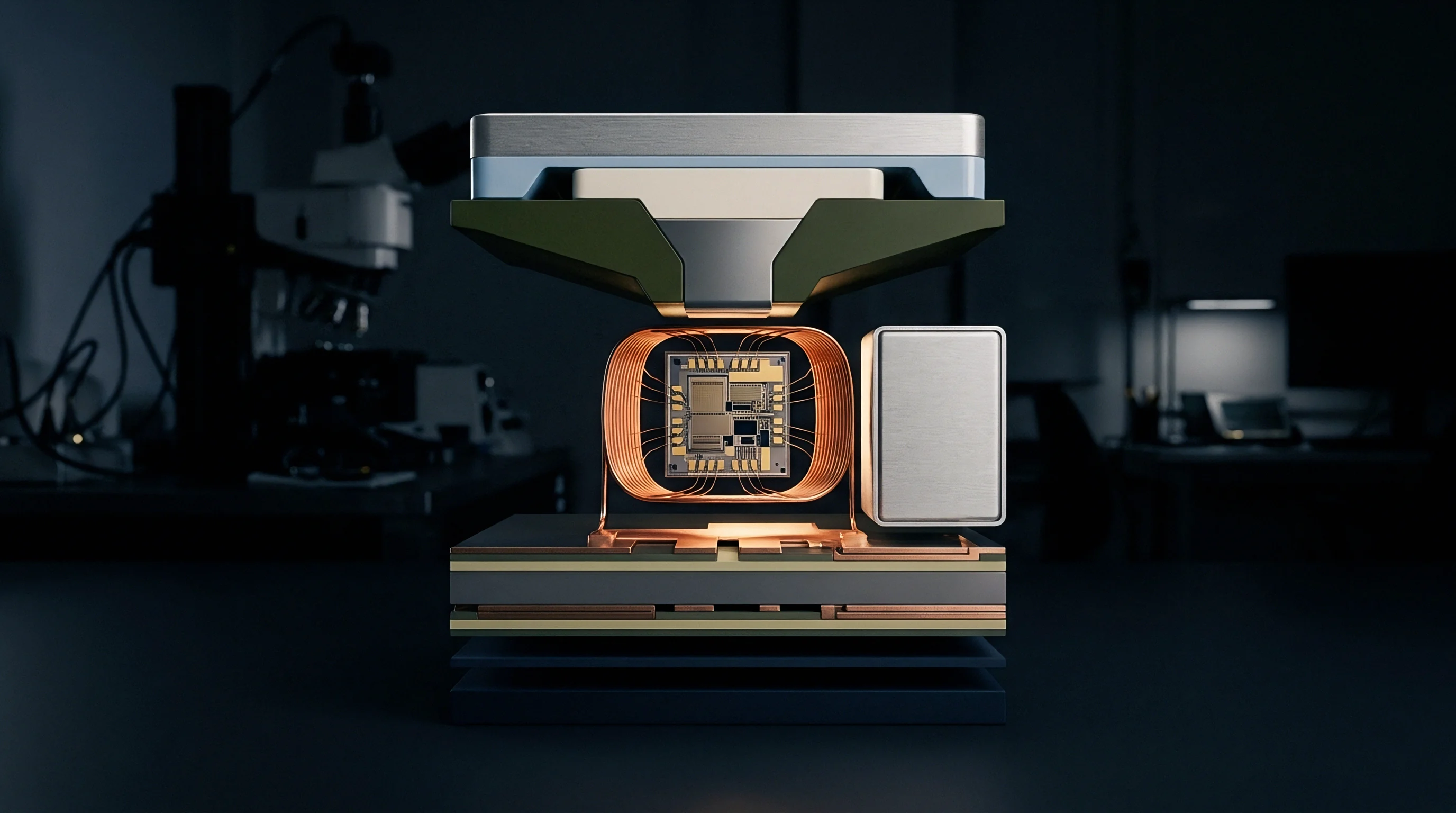
A downward shift in glass transition temperature, caused by moisture absorption or incomplete resin crosslinking, brings the viscoelastic relaxation window directly into the operational temperature range of harsh environment electronics. When operational temperatures cross this reduced glass transition threshold during routine thermal cycling, the adhesive transitions repeatedly between glassy and rubbery states. Each transition cycle reorganizes the internal polymer structure, introducing non-recoverable mechanical strain into the silicon sensor element and causing continuous zero-point offset drift.
| Die Attach Formulation | Thermal Cycling Range (°C) | Initial Zero Offset (mV/V) | Offset Drift at 1000h (mV/V) | Recoverable Hysteresis (%) | Permanent Strain Offset (% FS) |
|---|---|---|---|---|---|
| Conductive Epoxy Grade A | -40 to +125 | 0.12 | 0.85 | 0.15 | 0.42 |
| High-Purity Silicone Paste | -40 to +150 | 0.05 | 0.18 | 0.04 | 0.09 |
| Bimodal Silver Epoxy | -50 to +175 | 0.22 | 1.45 | 0.28 | 0.68 |
| Sintered Nano-Silver Paste | -50 to +200 | 0.31 | 0.02 | 0.01 | 0.01 |
Stress relaxation shifts zero offset voltage.
Quantifying this hysteresis demands systematic verification protocols across multiple thermal cycles:
- Stabilize the sensor package at twenty-five degrees Celsius for two hours to establish baseline zero-point output voltage.
- Ramp ambient temperature to the maximum rated operating limit at a controlled rate of five degrees Celsius per minute.
- Hold maximum temperature for four hours to permit complete viscoelastic stress relaxation within the die attach matrix.
- Cool package to minimum rated operating temperature at five degrees Celsius per minute and maintain dwell for four hours.
- Return temperature to twenty-five degrees Celsius and record final zero-point output voltage after two hours stabilization.
Thermal cycling per MIL STD 883 Method 1010 Condition C induces irreversible piezoresistive zero drift when viscoelastic shear strain exceeds zero point two percent.
Whether non-linear physical aging within crosslinked epoxy networks under long-term thermal dwell can be modeled deterministically without continuously tracking operational thermal histories remains an open question in sensor packaging metrology.

Calibration
Pre-conditioning packages through elevated temperature thermal dwell stabilizes the polymeric matrix before taking baseline metrology measurements. Extended thermal treatment past the adhesive curing cycle accelerates initial physical aging and removes volatile outgassing species. This stabilization burn-in forces the die attach material past its rapid initial stress relaxation phase, placing the package into a secondary creep regime characterized by significantly lower strain accumulation rates during subsequent operational service.
Calibration procedures for sensors deployed in harsh thermal environments require traceable reference standards capable of operating across broad temperature ranges with low uncertainty. Test equipment must separate sensor diaphragm compliance changes from package-induced strain drift. Calibration systems utilize automated pressure controllers and precision oil baths or thermal chambers, recording output codes across multiple thermal equilibrium points to generate individual matrix compensation coefficients.
The total calibration uncertainty budget combines baseline reference standard uncertainty, thermal chamber gradients, and residual viscoelastic drift during measurement intervals. Standard evaluation methods combine independent variance contributions into an expanded uncertainty expression:
utotal = ( uref2 + uchamber2 + ucreep2 + uhysteresis2 )1/2
Mechanical drift corrupts three year accuracy claims.
Uncertainty components arising from viscoelastic relaxation scale directly with dwell times at test temperatures. If calibration cycle times are short relative to adhesive stress relaxation time constants, the recorded thermal coefficients capture temporary transient mechanical states rather than equilibrium operating conditions. Compensation coefficients calculated from non-equilibrium data introduce systematic measurement errors once the package achieves full thermal and mechanical relaxation in the field.
Contracts specifying ISO/IEC 17025 accredited calibration protocols under IEC 60068 environmental testing standards mandate that suppliers state explicit coverage factors alongside long-term zero drift projections, forcing verification of creep-induced measurement uncertainty over stated service lifespans.
Fatigue
Accumulated inelastic displacement within die attach polymers degrades structural integrity under cyclic thermal exposure. Viscoelastic creep under sustained shear forces creates micro-voiding and localized micro-cracks along the filler-polymer interface. Over repeated thermal cycles, micro-cracks coalesce into macro-scale delamination regions, altering both stress distribution across the die and thermal resistance between silicon and package carrier.
Calculating time-dependent creep strain requires evaluating the creep compliance function over operational timescales. Consider a silver-filled epoxy die attach subjected to sustained thermal exposure at one hundred fifty degrees Celsius under an internal thermal expansion shear stress of ten megapascals. The initial elastic strain equals shear stress divided by initial shear modulus:
γelastic = τ / G′ = 10 MPa / 2.0 GPa = 0.005 (0.5%)
Using Williams-Landel-Ferry constants C1 = 17.44 and C2 = 51.6 K for standard epoxy systems, the shift factor aT for operation twenty degrees Celsius above a glass transition temperature of one hundred thirty degrees Celsius evaluates to:
log10 aT = ( -17.44 × 20 ) / ( 51.6 + 20 ) = -348.8 / 71.6 = -4.87
This shift factor demonstrates that one hour of viscoelastic relaxation at one hundred fifty degrees Celsius corresponds to approximately seventy-four thousand hours of physical aging at room temperature. The creep compliance J(t) expands over time according to a power-law relationship:
J(t) = J0 + J1 × ( t / τr )β
Assuming empirical constants J0 = 0.5 GPa-1, J1 = 2.5 GPa-1, relaxation time τr = 100 hours, and power exponent β = 0.3, the total shear strain after one thousand hours of sustained thermal dwell reaches:
γ(1000h) = 10 MPa × GPa-1 = 10 × × 10-3 = 0.0548 (5.48%)
This tenfold increase over initial elastic strain demonstrates severe creep deformation, relaxing sixty-five percent of internal package stress and driving a calculated zero-point drift of one point four millivolts per volt in an underlying piezoresistive bridge.
Unverified adhesives open severe warranty exposures.
Engineers auditing prospective die attach materials rely on systematic material qualification criteria to screen out creep-susceptible formulations:
- Glass Transition Margin confirms that material glass transition temperatures exceed maximum package operational limits by at least thirty degrees Celsius.
- High-Temperature Storage Modulus verifies that storage modulus remains above one gigapascal at peak operational testing temperatures.
- Weight Loss Profiling verifies that thermal gravimetric analysis shows less than zero point one percent volatile loss up to two hundred degrees Celsius.
- Creep Compliance Thresholds limits total shear creep strain to less than one percent under ten megapascals load after one thousand hours dwell.
Adhesives operating above their glass transition temperature relax internal stresses through steady strain accumulation rather than elastic retention.
Adhesives maintained strictly below their glass transition temperature across all operating profiles retain structural elasticity and resist rapid creep-induced stress relaxation.
Audit
Sourcing engineers evaluating high-temperature sensor assemblies evaluate material qualification expenses against long term post-deployment failure costs. Low-cost silver-filled epoxies offer low initial procurement costs but carry high long-term drift risks in environments exceeding one hundred twenty-five degrees Celsius. Advanced attach technologies, such as transient liquid phase bonding or sintered nano-silver pastes, demand higher material costs and specialized processing equipment but eliminate polymeric viscoelastic creep mechanisms entirely.
| Die Attach Technology | Relative Material Cost Ratio | Lot Thermal Qualification Cost ($) | 3-Year Zero Offset Drift (% FS) | Projected Field Return Rate (%) |
|---|---|---|---|---|
| Standard Conductive Epoxy | 1.0 | 2,500 | 1.20 | 4.50 |
| High-Tg Polyimide Adhesive | 2.8 | 4,200 | 0.45 | 1.10 |
| Transient Liquid Phase Bond | 6.5 | 8,500 | 0.08 | 0.15 |
| Sintered Nano-Silver Paste | 8.2 | 12,000 | 0.02 | 0.02 |
Sintered silver eliminates polymeric creep mechanisms.
Specification decisions depend on balancing initial unit costs against five-year total cost of ownership, including calibration maintenance, warranty claims, and field failure liabilities. Selecting a standard epoxy for a harsh automotive under-hood application reduces piece-part costs by several dollars per unit. Uncontrolled viscoelastic creep in service leads to elevated warranty return rates, easily overwhelming initial material savings through field recall expenditures and legal exposure.
Silver filled epoxies subjected to one thousand hours at one hundred seventy five degrees Celsius exhibit a three fold increase in shear compliance.
Procurement specifications incorporating explicit dynamic mechanical property limits, creep compliance caps, and mandatory pre-conditioning burn-in cycles protect manufacturing programs from unverified die attach substitutions. Establishing traceable verification procedures ensures that sensor accuracy claims hold true over multi-year operational lifespans in severe thermal environments.