Submicron Acoustic Phase Inversion Mapping for High Temperature Hydrolytic Interfacial Delamination in Assemblies
Acoustic phase inversion maps submicron hydrolytic delamination by detecting the 180-degree polarity flip of ultrasonic echoes at debonded package boundaries.

Pulse
Scanning acoustic microscopy relies on high-frequency sound reflections at material interfaces. As an acoustic wave propagates through a coupling medium into an electronic package, it hits boundaries between epoxy mold compounds, metallic leadframes, and silicon dies. The amplitude and polarity of the returning signal depend on the impedance mismatch across these layers ~ defined as material density multiplied by acoustic velocity.
Moving from lower to higher impedance, a reflected signal keeps its initial phase. Moving into a material with lower acoustic impedance, the reflected waveform undergoes a 180-degree phase shift.
Silicon exhibits high acoustic impedance, and copper leadframes present comparable density and sound speed, whereas epoxy mold compounds sit much lower than either semiconductor substrates or metals. In a sound package under normal manufacturing conditions, an acoustic wave passing from mold compound into a silicon die reflects with positive phase, its radio-frequency echo mirroring the polarity of the transmitted excitation wave. Defect sites alter this relationship entirely.
Delamination creates a physical gap across the bonded boundary. When high-temperature moisture exposure breaks interfacial adhesion, the mold compound separates from the underlying die or leadframe. Even submicron gaps present an extreme acoustic discontinuity because air or vacuum inside the void carries near-zero acoustic impedance.
The signal reflects inverted, shifting the reflection coefficient from a positive value to negative unity.
A 230 megahertz transducer focused through five hundred microns of mold compound resolves acoustic impedance changes across delamination gaps as narrow as thirty nanometers.
This phase shift acts as a binary indicator of mechanical separation. Submicron phase inversion mapping isolates the return echo off the target interface with a precise temporal gate; as the digitizer tracks echo arrival, processing hardware extracts the polarity of the first half-cycle. Where standard amplitude mapping records only total reflected energy ~ introducing ambiguity whenever attenuating materials dampen the signal ~ phase inversion mapping cleanly separates acoustic attenuation from physical detachment.
Acoustic Energy at Dissimilar Material Junctions
Mechanical waves encounter sudden changes in density and sonic velocity across bonded layers, with the reflection coefficient setting how much acoustic pressure returns to the transducer. Because transmission through multi-layer assemblies attenuates high-frequency waves rapidly, operating frequency must be balanced carefully against interfacial depth.
| Material Layer | Density (g/cm³) | Longitudinal Velocity (m/s) | Acoustic Impedance (MRayl) | Reflection Coefficient from Epoxy |
|---|---|---|---|---|
| Epoxy Mold Compound | 1.95 | 2950 | 5.75 | 0.00 |
| Silicon Die | 2.33 | 8430 | 19.64 | +0.547 |
| Copper Leadframe | 8.96 | 4700 | 42.11 | +0.760 |
| Deionized Water Ingress | 1.00 | 1490 | 1.49 | -0.588 |
| Gaseous Delamination Void | 0.0012 | 343 | 0.0004 | -0.999 |
Acoustic impedance sets the reflection amplitude: positive coefficients point to an intact mechanical junction between epoxy and solid substrates, while negative values signal delamination. Even when liquid water displaces air inside a hydrothermal fissure as the radio frequency pulse enters, the impedance stays lower than that of the encapsulant, preserving the negative polarity signature.

Radio Frequency Phase Inversion Principles
A negative reflection coefficient flips the polarity of the ultrasonic wave packet. High-speed analog-to-digital converters sample the radio-frequency waveform at rates above two gigasamples per second, allowing the system to capture the initial half-cycle peak. Unbonded regions yield negative peak values above preset noise floors, and because phase detection targets waveform orientation, it avoids the calibration drift that attenuation causes in thick packages.
High-frequency transducers generate acoustic pulses centered between 100 megahertz and 300 megahertz. Pulse duration sets the axial resolution: shorter pulses keep front-surface reflections from overlapping reflections from deeper buried interfaces, while internal damping elements absorb trailing acoustic energy to maintain a clean monocycle waveform.
Hydrolysis
Moisture ingress degrades molded packages under elevated thermal regimes, as water vapor works into epoxy networks through free-volume diffusion and capillary action along filler-polymer boundaries. Higher temperatures accelerate diffusion while softening polymer chains, initiating chemical breakdown the moment moisture reaches the interface between encapsulant and metallic leadframe.
Hydrolysis cleaves covalent bond networks directly. Silane coupling agents provide the adhesion between organic epoxy resins and oxidized copper or silicon surfaces; under ambient storage, these siloxane linkages resist mechanical shear. Exposure to elevated heat and humidity drives hydrolytic cleavage across the silicon-oxygen-metal bonds, where water molecules attack polarized linkages and reduce strong covalent structures to hydroxyl-terminated fragments until interfacial mechanical strength falls below thermal stress thresholds.
Silane coupling agents degrade when steam penetrates to the metallic boundary.
Interfacial shear stress stems from mismatched coefficients of thermal expansion ~ silicon expands near 2.6 parts per million per Kelvin, copper at 16.5 parts per million per Kelvin, and mold compounds between 10 and 15 parts per million per Kelvin below their glass transition temperature. Once hydrolysis strips the chemical anchoring, differential thermal expansion and contraction shear the interface during temperature cycling, opening microscopic gaps along the boundary.
- Leadframe copper oxidation accelerates when dissolved oxygen reaches heated metal, forming friable cuprous oxide scales that detach under mechanical strain.
- Polymer matrix swelling generates localized volumetric expansions that induce tensile peeling forces across rigid silicon corners.
- Coupling agent chain scission replaces structural organosilane bridges with unbonded silanol groups, eliminating adhesive resistance across the assembly boundary.
- Extractable ionic migration leaches trace chlorides and bromides into interfacial moisture films, dissolving passive surface oxides and pitting adjacent metal.
As thermal stress opens microcracks, moisture accumulates inside the newborn fissures. In unpressurized testing, this water remains vaporous or condenses into liquid films depending on temperature and relative humidity; under autoclave testing, saturated steam under pressure forces liquid water directly into submicron delamination seams.
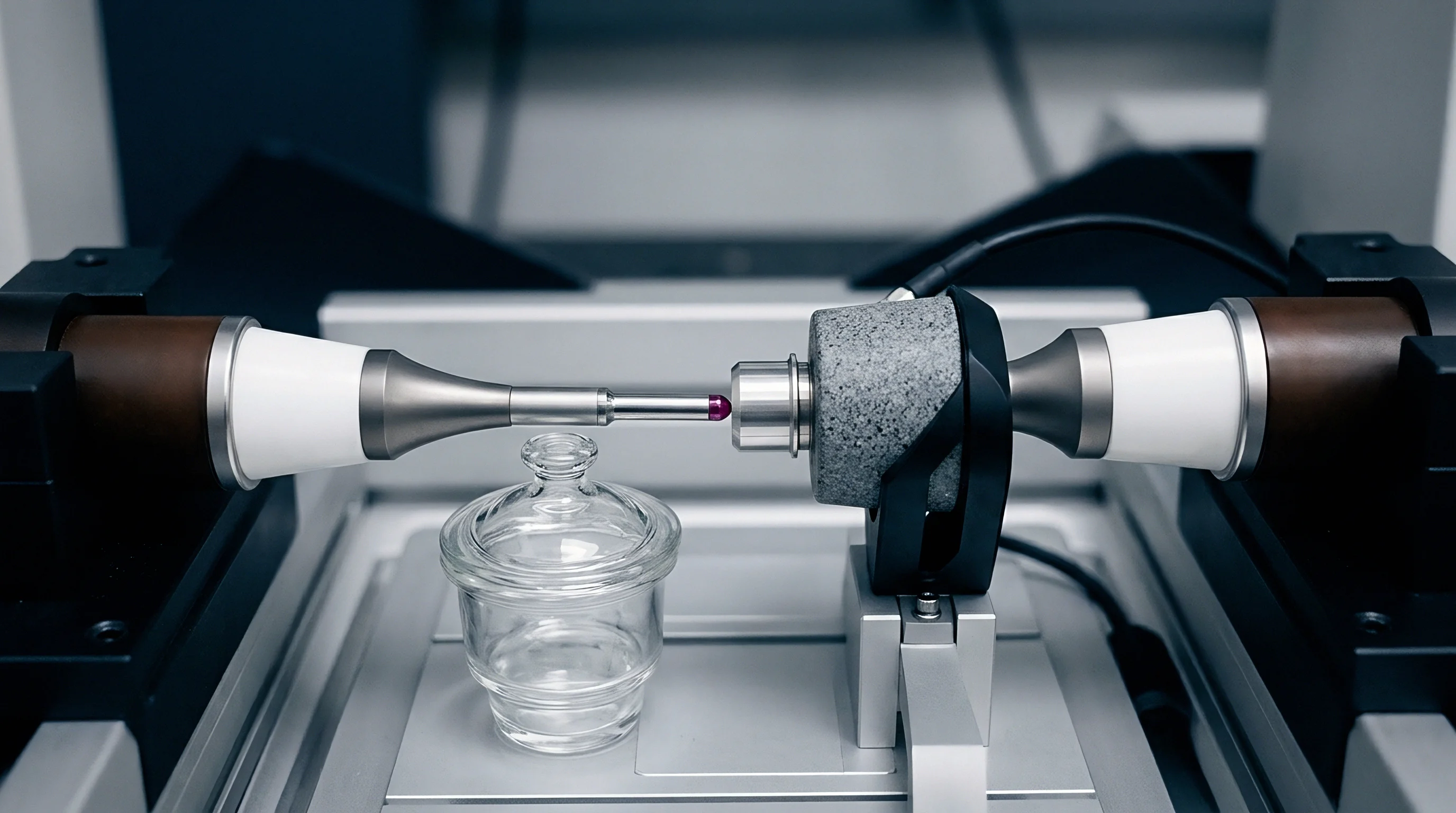
Silane Bond Scission along Copper Interfaces
Organofunctional silanes bond mold compounds to copper leadframes through condensation reactions, where epoxy groups react with the resin matrix while alkoxy groups hydrolyze and condense onto copper oxide layers. Water degrades interfacial shear strength over time, and elevated thermal cycling in humid environments reverses the condensation reaction, regenerating hydrolyzed silanols and loose copper hydroxides.
Hydrolytic debonding spreads unevenly across leadframes because plating variations, residual stamping stresses, and localized organic contamination form paths for accelerated moisture buildup. Delamination typically initiates at outer leadframe fingers ~ where shear strain peaks during cooling ~ and advances inward toward the die pads. Acoustic inspection maps these advancing fronts with submicron positional resolution.
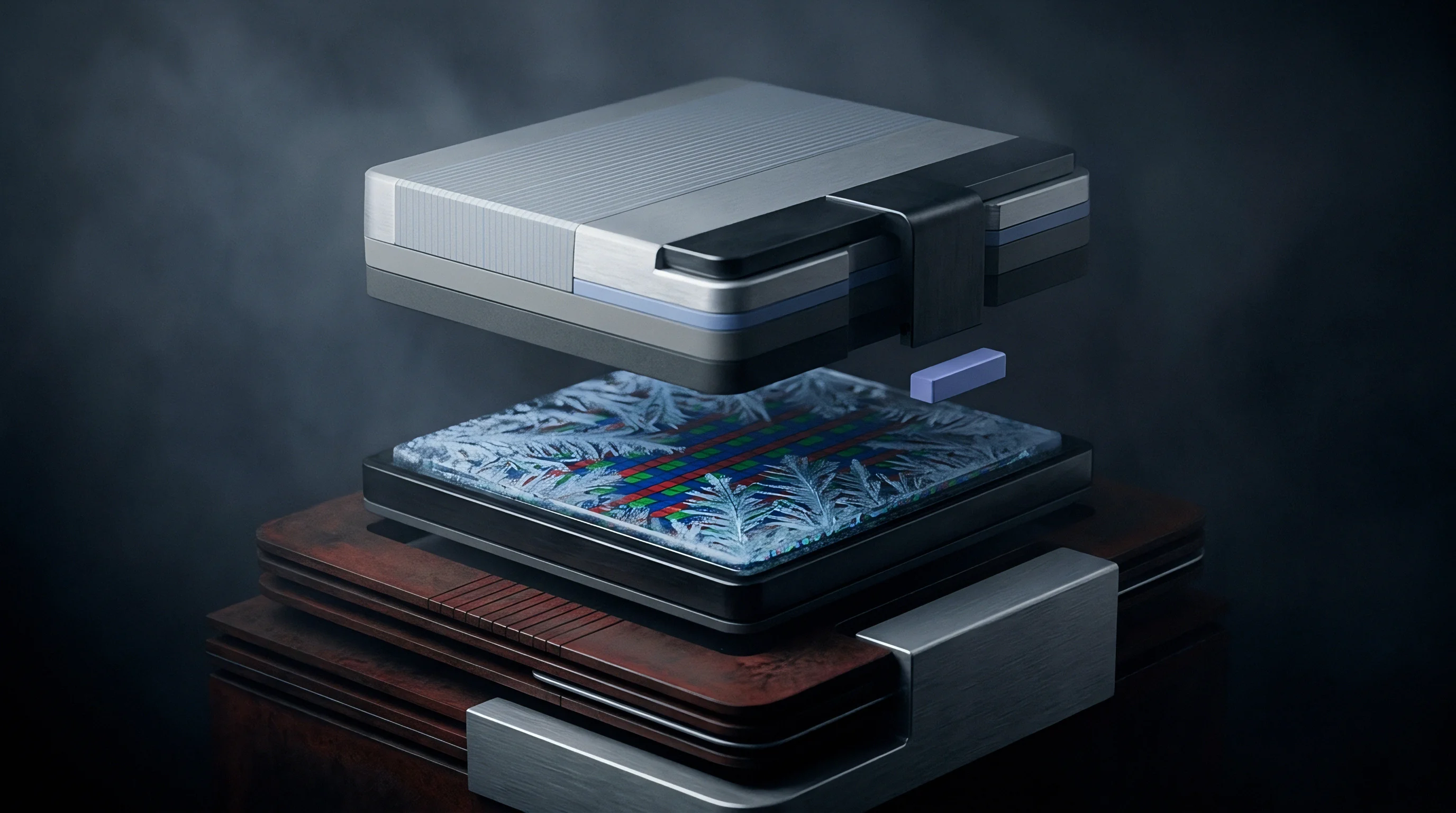
Autoclave Stress Conditions and Vapor Pressure
Standardized highly accelerated temperature and humidity testing subjects components to two atmospheres of steam. Saturated vapor at 121 degrees Celsius and 100 percent relative humidity fully saturates packaging resins within 96 hours, allowing unbiased autoclave tests to evaluate structural integrity under severe moisture loading without electrical bias.
Steam pressure forces condensation into debonded seams, so that when post-autoclave acoustic inspection is performed, liquid fills voids down to twenty nanometers thick. Acoustic phase inversion mapping still detects these water-filled seams because water carries an acoustic impedance of 1.49 MRayl ~ well below the 5.75 MRayl of typical mold compound ~ causing the reflected pulse to invert polarity despite the absence of air.
Delamination signals in stressed components can stem from temporary moisture condensation as well as irreversible adhesive failure.
Transducer
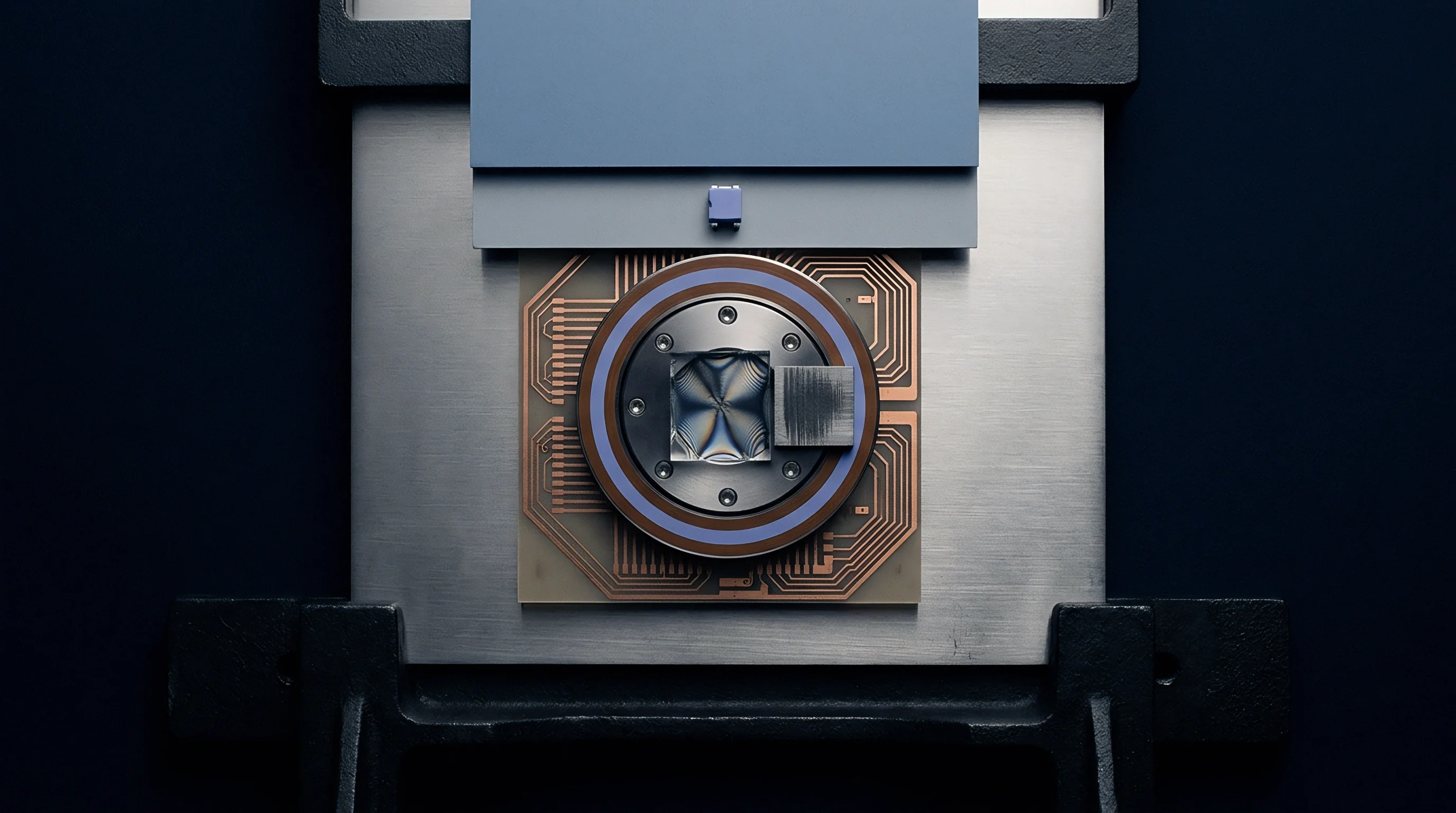
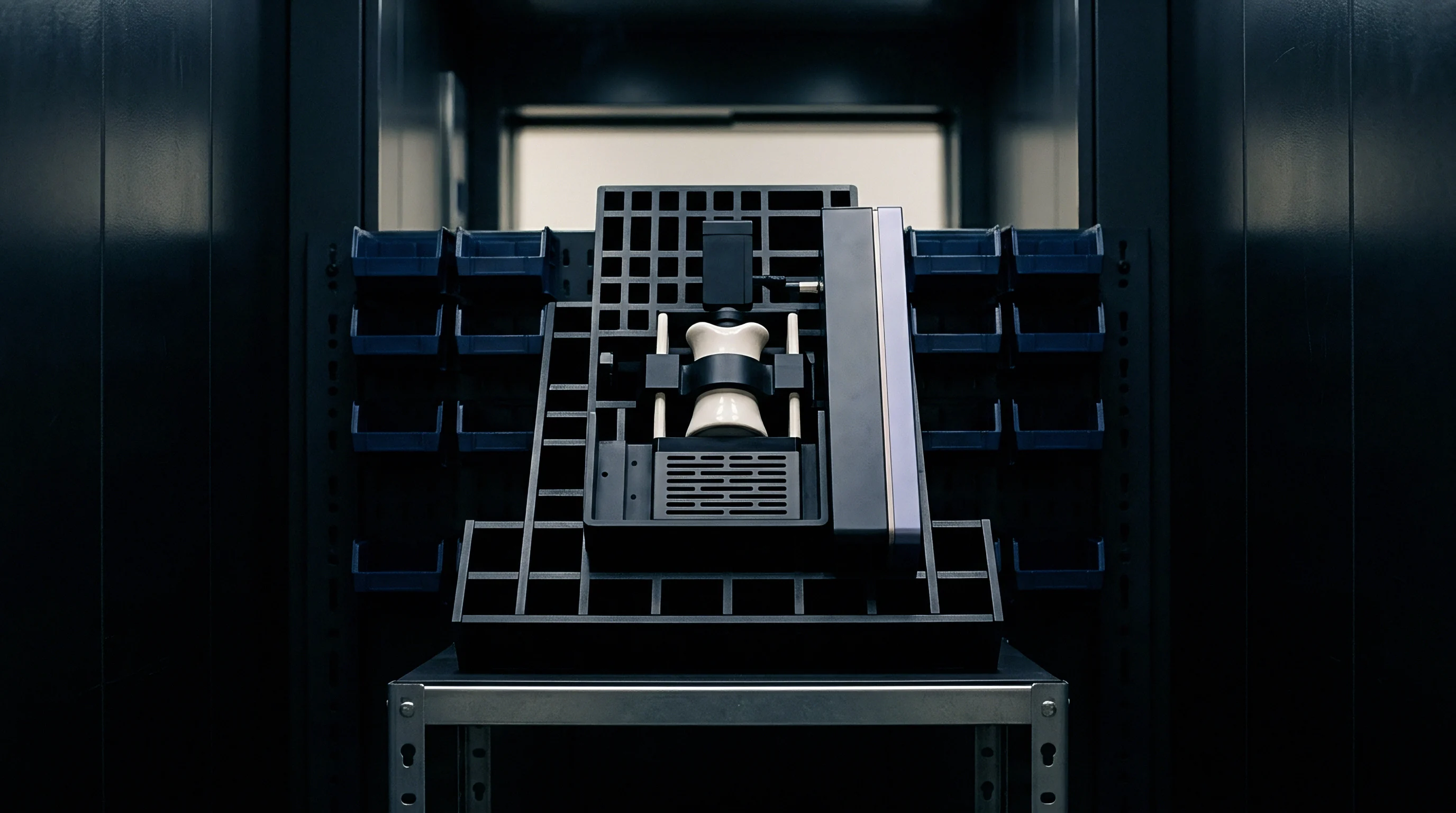
Piezoelectric elements generate high-frequency mechanical vibrations through crystalline excitation, using zinc oxide thin films or lithium niobate crystals as acoustic sources for ultra-high-frequency scanning microscopy. A short electrical impulse excites the crystal, sending an acoustic transient through an acoustic lens.
Spherical ground sapphire cavities focus the sound, collimating the acoustic beam toward a diffraction-limited focal point. High-frequency inspection requires short focal lengths to minimize attenuation inside the coupling fluid, as focal spot diameter sets lateral spatial resolution ~ operating at 230 megahertz yields a focal spot diameter near 12 microns in water. Higher numerical apertures improve this lateral resolution, though at the expense of depth of field.
Transducer central frequencies shift downward as acoustic lenses undergo thermal expansion in heated immersion tanks.
Fluorinert attenuates acoustic energy rapidly, leaving deionized water as the primary coupling fluid for high-frequency acoustic microscopy. Water offers a sound speed of 1490 meters per second at 25 degrees Celsius alongside low attenuation compared to fluorinated hydrocarbons; heating the fluid alters acoustic velocity, which shifts the lens focal position and changes echo arrival times.
| Frequency (MHz) | Wavelength in Water (µm) | Focal Spot Diameter (µm) | Penetration Depth in Mold Compound (mm) | Attenuation in Coupling Fluid (dB/mm) |
|---|---|---|---|---|
| 50 | 29.8 | 45.0 | 3.50 | 0.55 |
| 100 | 14.9 | 23.0 | 1.80 | 2.20 |
| 175 | 8.5 | 15.0 | 0.95 | 6.75 |
| 230 | 6.5 | 11.5 | 0.55 | 11.60 |
| 300 | 5.0 | 8.0 | 0.30 | 19.80 |
Phase gating requires nanosecond stability, with digital hardware capturing only echoes returning from the specific depth of the target boundary. Achieving this temporal accuracy demands precise mechanical positioning along the z-axis, where mechanical scanners maintain scan-plane flatness within two microns across a 300-millimeter field of travel.
- Position the reference target inside the degassed deionized water tank at twenty-three degrees Celsius.
- Adjust the pulser excitation voltage to minimize crystal ringdown time below eight nanoseconds.
- Lower the scanner vertical stage until the front surface reflection aligns with the temporal reference zero.
- Advance the electronic gate delay to bracket the package leadframe interface echo window.
- Set the digitizer sampling clock to five gigasamples per second to capture the initial half-cycle polarity.
- Scan a known polished silicon-copper standard to confirm positive phase echo detection across intact bonds.
Transducer damping narrows pulse width. Broadband transducers feature low mechanical quality factors, preventing resonant oscillations that would otherwise obscure closely spaced interface echoes. When encapsulation thickness exceeds one millimeter, heavy acoustic attenuation forces a shift to lower inspection frequencies, trading lateral resolution to preserve phase sensitivity.
Piezoelectric Crystal Damping and Focal Length
Tungsten-loaded epoxy backings dampen piezoelectric crystals to prevent spurious ringing, keeping pulse durations short enough to separate reflections from closely spaced package features. If pulse duration exceeds the round-trip travel time through a thin layer, internal reflections overlap and create interference that distorts phase information.
Sapphire lenses carry a high longitudinal sound velocity near 11,100 meters per second. This sharp contrast with water minimizes spherical aberration across the lens cavity interface. Focal spot dimensions conform to Rayleigh criterion calculations, setting the physical boundary for lateral defect discrimination.
Coupling Fluid Attenuation across Temperature Gradients
Heated deionized liquid baths experience shifting sound velocities and transmission losses. Water velocity changes by roughly 2.5 meters per second per degree Celsius near room temperature, so temperature fluctuations in an unjacketed scanning tank cause the acoustic focal plane to drift vertically during long inspection runs.
Acoustic attenuation in water scales quadratically with frequency, reaching a transmission loss of 11.6 decibels per millimeter at 230 megahertz. Maintaining water temperature within plus or minus 0.5 degrees Celsius stabilizes acoustic velocity, preserving gate timing and focus consistency over multi-hour inspection runs.
Under purchase contracts invoking MIL-STD-883 Method 2030, ultrasonic inspection records must include continuous calibration logs demonstrating gate alignment verification against certified acoustic impedance reference blocks before and after every inspection shift.

Threshold
Defect identification hinges on automated echo classification algorithms that convert radio-frequency waveforms into spatial matrices of phase and amplitude. Setting the phase detection threshold dictates whether a pixel registers as bonded or delaminated; if that threshold sits too close to the zero-crossing baseline, noise spikes, filler particle scattering, and minor focus drift will trigger phase calculation errors.
Epoxy mold compounds contain silica filler particles ranging from 5 to 50 microns in diameter. Because these particles scatter acoustic energy and create high-frequency background clutter ~ with amplitudes reaching up to fifteen percent of the primary interface return ~ placing phase detection thresholds below clutter levels causes false-positive delamination calls on intact packages.
JEDEC standard JESD22-A118 classifies any phase-inverted acoustic reflection exceeding twenty percent of the incident pulse amplitude at the die attach boundary as an operational lot rejection.
High-density leadframes with micro-etched surfaces disperse acoustic reflections, lowering returned signal amplitude without compromising underlying bond integrity. When acoustic signal levels drop toward the noise floor, phase calculation algorithms yield indeterminate outputs; advanced analysis systems flag these low-amplitude pixels as unclassified rather than defaulting them to bonded status.
| Interfacial Condition | Acoustic Reflection Polarity | Peak Amplitude Ratio (%) | Calculated Phase Shift (deg) | Classification Outcome |
|---|---|---|---|---|
| Intact Chemical Bond | Positive | 65 to 80 | 0 | Pass: Bonded Interface |
| Submicron Air Gap Void | Negative | 90 to 98 | 180 | Fail: Dry Delamination |
| Hydrolytic Water Seam | Negative | 50 to 65 | 180 | Fail: Wet Delamination |
| Micro-Roughened Copper Intact | Positive | 25 to 40 | 0 | Pass: Low-Amplitude Bond |
| Silica Filler Scattering Noise | Random | 5 to 15 | Indeterminate | Invalid: Clutter Filtered |
Phase inversion marks the defect: water-filled seams return lower negative amplitudes than air-filled delaminations because water presents higher acoustic impedance than air. With the reflection coefficient between epoxy and water near -0.588 compared to -0.999 for an air gap, polarity inversion remains the definitive marker separating liquid-filled fissures from intact solid bonds.
- Positive peak thresholding verifies that initial waveform deflections exceed positive noise margins before designating an interface bonded.
- Negative phase detection flags any gated signal whose negative initial half-cycle amplitude exceeds twenty percent of incident reference levels.
- Temporal window gating restricts echo analysis to the specific arrival window corresponding to the target leadframe depth, rejecting mold surface reflections.
- Transit time shift monitoring detects vertical displacement of interfaces caused by severe package swelling or extensive gross mechanical lifting.
Multi-gate acoustic acquisition systems capture front-surface, die-attach, and leadframe reflections simultaneously during a single raster scan. Synchronizing gate positions prevents package warpage from shifting target interfaces outside analysis windows.

Polarity Switching Detection in RF Echoes
Peak detection circuits record signal amplitude and sign at specified temporal gates, while real-time digital signal processors compare raw sampled points against calibrated zero lines. Cross-correlating against a stored reference waveform from a known bonded sample reveals phase inversions even when signal-to-noise ratios degrade.
Cross-correlation calculates the mathematical similarity between a measured echo and an ideal positive reflection template. A correlation coefficient near positive unity points to an intact bond, whereas a coefficient near negative unity confirms phase inversion, proving interfacial separation regardless of signal attenuation.

Separation between Water Ingress and Gaseous Voids
Liquid-filled gaps exhibit distinct acoustic impedances compared to dry delaminations. When packages cool after autoclave exposure, condensed steam inside delamination seams can evaporate if ambient humidity drops; scanning immediately post-autoclave captures water-filled seams, whereas dried components display gaseous void signatures.
Acoustic velocity in liquid water reaches 1490 meters per second compared to 343 meters per second in air. Because acoustic waves penetrate thin water films, they produce secondary reflections from the underlying metal surface, creating interference patterns that vary with seam thickness. Setting fixed amplitude thresholds without phase verification risks misinterpreting interference minima as total signal absorption.
Misinterpreting low-amplitude scattered signals as delamination leads to unnecessary rejection of conforming production lots, while misclassifying wet delamination as intact bonding risks releasing latent field failures into automotive and industrial supply chains.

Seam
Package perimeters present vulnerable points for mechanical separation during temperature cycling. Because mold compound interfaces terminate abruptly at package edges, mechanical and thermal loading generate high stress concentrations there, allowing moisture to creep along external leadframe seams toward active die areas.
Acoustic phase inversion mapping isolates delamination growth along these perimeters. High-resolution raster scans generate planar maps tracking delamination front propagation over environmental exposure hours, while measuring continuous unbonded length along external leads provides quantitative input for reliability models.
Autoclave testing stresses perimeter seams aggressively. As moisture absorption causes mold compound to swell, tensile peeling stresses concentrate at outer corners; acoustic mapping then reveals whether delamination halts at internal tie bars or advances onto critical die paddle bonds. Furthermore, exposure to moisture accelerates copper oxidation, creating corrosion deposits within the seam that prevent rebonding even after full bake-out cycles.
Interfacial Adhesion Criteria for Package Reliability
Lot release determinations rely on strict non-destructive inspection rules, with joint industry standards defining clear defect limits for package qualification. Specifically, J-STD-020 sets acoustic rejection criteria based on delamination location and total affected surface area.
Under automotive qualification standards, delamination exceeding ten percent of the die paddle bonding area triggers lot rejection. Any continuous phase-inverted seam extending from an external lead to an internal bond wire foot rejects the assembly immediately; phase inversion mapping provides unambiguous boundary detection, eliminating disputes tied to amplitude threshold variations.

Commercial Allocation of Inspection Overhead
High-frequency acoustic scanning requires substantial cycle time per wafer or strip. Moving a mechanical scanner across a 100-millimeter leadframe strip at ten-micron step intervals takes fifteen minutes per sample, and stepping up transducer frequencies to 230 megahertz demands finer spatial steps, escalating scan duration accordingly.
Testing labs constantly balance inspection time against defect resolution limits. Because screening entire production lots at 230 megahertz is economically unfeasible for consumer components, manufacturers rely on statistical sampling, reserving full phase inversion mapping for qualification runs, lot disposition audits, and root-cause failure analysis.
Whether submicron phase inversion mapping can maintain repeatable polarity discrimination in next-generation packages with ultra-thin mold compounds below one hundred microns remains uncertain, as internal reverberations converge temporally on interface echoes.