Quantifying Silicone Encapsulant Hygro Mechanical Swelling Stress in Silicon Pressure Transducers
Silicone swelling under humidity shifts induces interfacial stress on silicon pressure dies, creating reversible zero drift up to 0.4 percent of full scale.

Moisture

Zero Shift under Relative Humidity Steps
Silicone potting gels and room-temperature-vulcanizing elastomers isolate silicon piezoresistive pressure transducer dies from conductive media, ionic contamination, and mechanical shock. These polymers absorb atmospheric water vapor up to their equilibrium saturation point. Sorption produces volumetric expansion in the polymer matrix, which transmits mechanical stress across the gel-die interface directly into the active micromachined silicon diaphragm.
For a typical piezoresistive absolute pressure cell, this mechanical load registers as an irreversible or hysteretic shift in zero-measurand output.
Water uptake in polydimethylsiloxane networks follows a balance between gas-phase moisture activity and internal free volume. When relative humidity escalates from twenty percent to eighty-five percent at a steady ambient temperature of twenty-five degrees Celsius, standard electronic-grade silicone gels absorb between 0.10 and 0.25 weight percent water. The resulting volumetric expansion coefficient sits between 120 and 240 parts per million per percent moisture concentration.
This swelling generates normal and shear stresses along the bonded boundary layer of the silicon membrane.
Relative humidity steps from dry air to eighty-five percent drive zero-point baseline shifts up to 0.42 percent of full-scale span on gel-encapsulated ten-bar silicon dies.
The silicon sensing element relies on the piezoresistive effect within boron-doped resistors oriented along the (110) crystallographic directions of a (100) silicon wafer. Changes in stress alter the mobility of charge carriers, producing fractional resistance changes. A symmetric pressure input deflects the diaphragm, inducing tensile stress along its edges and compressive stress toward the center.
Hygro-mechanical gel swelling applies an unconstrained, perimeter-clamped traction field across the diaphragm top surface. This traction mimics an uneven pressure bias, causing the Wheatstone bridge circuit to yield an offset voltage without any external line pressure applied.

Piezoresistive Coupling across the Gel Boundary
Stress transmission from an expanding encapsulant depends on boundary conditions governed by the sensor housing. In an open-cavity packaging architecture, the gel expands upward into free headspace, reducing the transverse mechanical load transmitted to the sensor die. In compact or sealed transducer assemblies, rigid steel walls constrain lateral gel movement.
Lateral constraints redirect the volumetric expansion downwards, loading the micromachined silicon diaphragm in compression.
Transducer sensitivity to swelling stress scales inversely with nominal range. A low-range sensor operating across one hundred millibars employs a thin silicon diaphragm, often measuring ten to fifteen micrometers in thickness. A high-range transducer rated for one hundred bar uses a rigid membrane exceeding one hundred micrometers.
A swelling shear load of two kilopascals introduces a significant zero shift on a ten-micrometer membrane, whereas that identical load remains unnoticeable on a thick high-range plate.
Baseline shifts accumulate gradually because moisture diffusion through silicone is time-dependent. Fickian diffusion governs water transport through the bulk potting thickness, with diffusion coefficients ranging from 1.5e-5 to 3.0e-5 square centimeters per second at room temperature. A gel layer measuring three millimeters requires tens of hours to reach eighty percent of moisture saturation.
Transducers exposed to shifting ambient humidity experience delayed zero wander that operators frequently misidentify as long-term bridge drift.
Silicon piezoresistive dies exhibit an inherent cross-axis response when encapsulant traction contains non-uniformities. Dispensing bubbles, particulate contamination, or meniscus pinning against housing side walls creates asymmetric shear fields across the diaphragm surface. These asymmetries degrade common-mode bridge rejection.
The bridge output departs from factory zero-point trims without any physical pressure change applied to the port.
Uncalibrated swelling effects generate false alarms in critical process monitoring networks.
Strain

Formulating the Hygro Mechanical Tensor
Mechanical strain generated by moisture uptake mirrors the formal mathematical treatment of classical thermal strain. The volumetric expansion of an elastic encapsulant links to chemical moisture concentration through the coefficient of moisture expansion. The resulting swelling strain tensor couples directly into standard Hookean constitutive equations.
For an isotropic silicone encapsulant, moisture expansion behaves hydrostatically within free volume, but packaging geometries force complex non-isotropic stress fields onto the silicon die.
The total mechanical strain tensor decomposes into elastic compliance and moisture-induced swelling strain components. Defining the concentration of absorbed water vapor as C, the swelling strain component equals the product of the coefficient of moisture expansion, beta, and the change in moisture concentration relative to a dry reference state. The total strain tensor inside the silicone takes the following form:
epsilon_ij = (1 + nu) / E sigma_ij – (nu / E) sigma_kk delta_ij + beta Delta_C delta_ij
In this constitutive relation, E represents the silicone Young modulus, nu is the Poisson ratio of the cured gel, sigma denotes internal mechanical stress, and delta_ij represents the Kronecker delta. Because silicone gels display near-incompressibility, the Poisson ratio approaches 0.499. Hydrostatic volumetric expansion under geometric confinement produces high hydrostatic pressure states inside the gel.
The encapsulant pushes hard against rigid boundaries, translating minor volumetric variations into noticeable mechanical forces.
Stress Partitioning across Silicon Diaphragm Axes
Silicon behaves as an anisotropic crystal possessing cubic symmetry. The piezoresistive coefficients depends entirely on the orientation of the resistor paths relative to the silicon crystal lattice. For p-type resistors implanted along the direction of a (100) silicon substrate, the longitudinal piezoresistive coefficient pi_l and the transverse coefficient pi_t govern the electrical signal output.
The fractional change in resistor value Delta_R / R links to the in-plane normal stresses sigma_xx and sigma_yy:
Delta_R / R = 0.5 (pi_11 + pi_12 + pi_44) sigma_xx + 0.5 (pi_11 + pi_12 – pi_44) sigma_yy
Silicon packages translate encapsulant swelling into distinct surface stresses. The following table contrasts mechanical parameters across common media-isolated encapsulant formulations that govern stress transfer into the micromachined silicon structure.
| Encapsulant Chemistry | Young Modulus (kPa) | Moisture Expansion (ppm/%RH) | Equilibrium Sorption (wt%) | Diaphragm Stress (kPa) |
|---|---|---|---|---|
| Soft Dimethyl Silicone Gel | 1.2 | 85 | 0.12 | 0.35 |
| Firm Fluoro-Silicone Gel | 8.5 | 140 | 0.28 | 2.10 |
| Tough Silicone Elastomer | 450.0 | 210 | 0.22 | 48.50 |
| Two-Part Thixotropic RTV | 1200.0 | 310 | 0.35 | 185.00 |
Soft dimethyl silicone gels possess extremely low elastic moduli, maintaining interfacial stresses under one kilopascal during broad moisture excursions. Fluorosilicones show higher chemical resistance against fuels, but their higher modulus and elevated moisture absorption yield six times greater diaphragm mechanical stress. Stiffer RTV potting compounds generate massive interfacial stresses that overwhelm piezoresistive balance, causing substantial zero drift.
The piezoresistive coefficient pi_44 for p-type silicon reaches approximately 138e-11 per Pascal at room temperature. An uncompensated differential stress of fifty kilopascals across orthogonal axes yields a fractional resistance imbalance around 0.0035 percent. In a balanced Wheatstone bridge excitation of five volts, that imbalance translates to an offset error exceeding 0.17 millivolts.
For a sensor with a fifty-millivolt span, this hygro-mechanical strain absorbs nearly 0.35 percent of the measurement budget.
The boundary conditions at the edge of the silicone package alter the sign of the induced diaphragm stress. When lateral gel swelling encounters a stiff metallic header, the encapsulant exerts a downward reaction force onto the center of the silicon diaphragm. This compressive force directly subtracts from positive line pressures.
In contrast, an open top meniscus pulls upward along the silicon perimeter via surface adhesion, altering baseline bridge zero-balance in the opposite direction.
Tightly specified zero-point errors require rigorous mathematical modeling of gel swelling tensors prior to housing freeze.
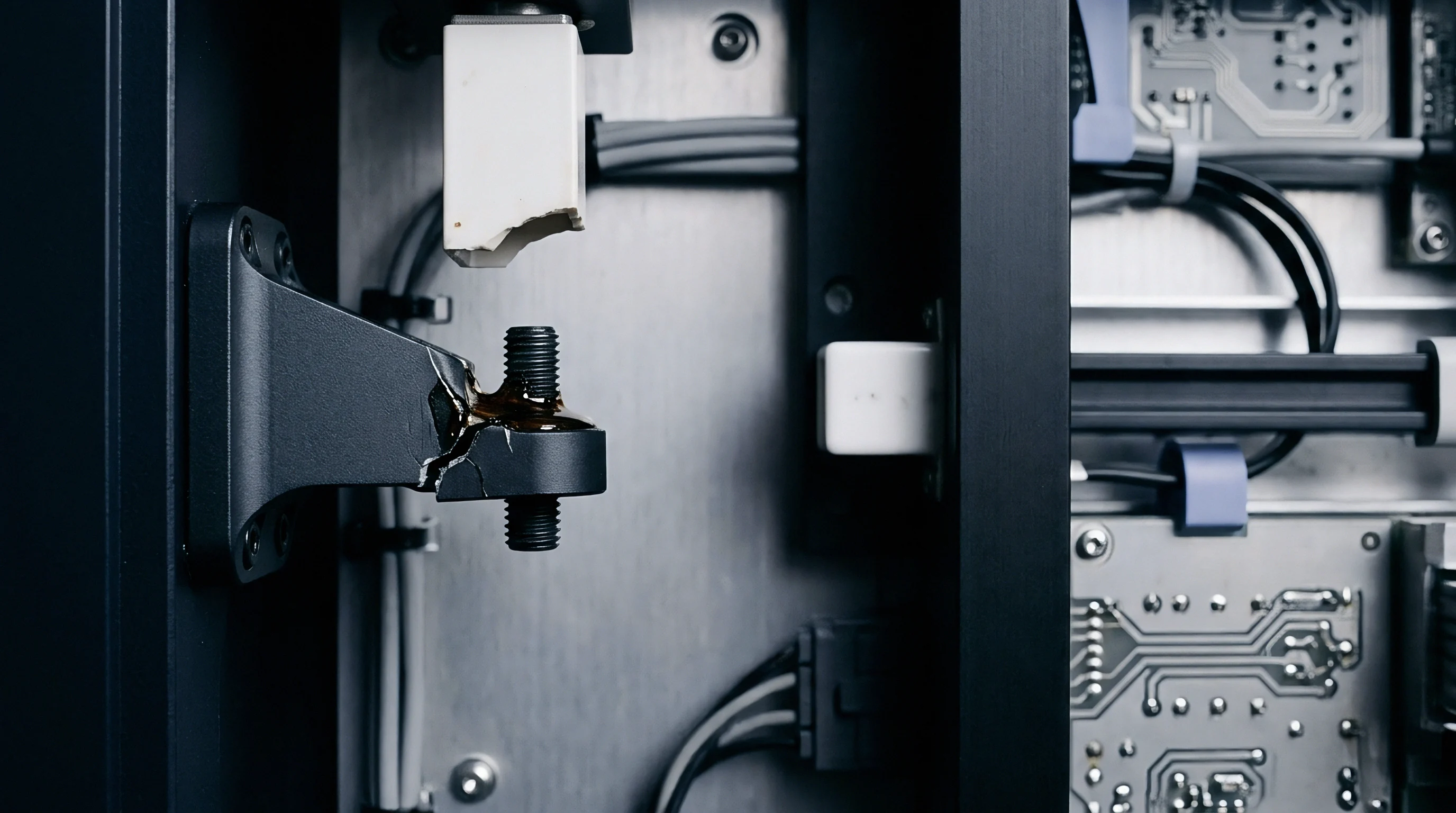

Kinetics
Fickian Diffusion Profiles across Cavity Depth
Moisture ingress into silicone gels does not take place instantaneously. The transport process requires hours or days to penetrate the bulk of a transducer cavity. One-dimensional Fickian diffusion governs moisture migration when water enters through an exposed port geometry.
The spatial concentration profile C(z, t) through the encapsulant depth z over time t follows Fick’s second law:
dC / dt = D (d2C / dz2)
The diffusion coefficient D dictates the rate of moisture advancement. For typical crosslinked polydimethylsiloxane gels, D ranges from 1.8e-5 to 2.4e-5 square centimeters per second at twenty-three degrees Celsius. Assuming a constant moisture concentration at the outer gel boundary and zero initial water content throughout the potted volume, the analytical solution employs an infinite series of complementary error functions.
The time required for moisture to reach the buried silicon die scales quadratically with the gel depth. A transducer design containing a one-millimeter gel buffer reaches ninety percent of moisture saturation at the die interface in approximately three hours. Increasing the encapsulant fill height to four millimeters pushes that saturation milestone past forty-eight hours.
This delayed kinetic penetration prevents instant zero shifts during short-term humidity excursions, but prolongs measurement recovery once ambient conditions dry out.
A four-millimeter silicone encapsulant buffer delays peak hygro-mechanical bridge offset by fifty-four hours following a step increase in relative humidity.
Sorption isotherms describe the equilibrium concentration of absorbed moisture as a function of vapor activity. Silicones exhibit linear Henry-type sorption isotherms across broad humidity ranges, meaning moisture uptake scales proportionally with relative humidity. Unlike amine-cured epoxies, silicones do not suffer from severe water clustering or structural plasticization at elevated moisture levels.
The linear relationship simplifies analytical drift models, linking ambient relative humidity directly to equilibrium swelling stress.
Thermal Acceleration of Moisture Transport
Temperature accelerates moisture kinetics by increasing the diffusion coefficient according to an Arrhenius relationship:
D(T) = D_0 exp(-E_a / (R_g T))
In this kinetic formulation, D_0 represents the pre-exponential factor, E_a denotes the activation energy for diffusion, R_g is the universal gas constant, and T is absolute temperature. For polydimethylsiloxane, the activation energy for water vapor permeation sits near thirteen to fifteen kilojoules per mole. Increasing the operating environment from twenty degrees Celsius to eighty-five degrees Celsius triples the diffusion coefficient, drastically shortening the time window required to saturate the sensor cavity.
Simultaneous thermal and moisture steps introduce convoluted response transients into the transducer output signal. When hot, humid air enters the pressure chamber, thermal diffusion through the silicone occurs orders of magnitude faster than moisture diffusion. Thermal conductivity dictates that the sensor die equilibrates thermally within several seconds.
Hygro-mechanical swelling stress requires many hours to manifest. Factory temperature-compensation circuits track rapid thermal shifts, yet remain incapable of correcting delayed zero drift driven by slow moisture kinetics.
Equilibrium swelling states depend strictly on ambient relative humidity rather than absolute moisture mass per unit volume. A transducer operating at eighty-five degrees Celsius and eighty-five percent relative humidity sustains identical equilibrium swelling stress to one operating at twenty-five degrees Celsius and eighty-five percent relative humidity. However, the high-temperature assembly reaches that equilibrium point in a fraction of the time.
Calibration technicians frequently mistake this rapid drift for thermal zero-shift error, calibrating out the wrong physical parameter.
Failure to isolate moisture sorption kinetics leads to flawed factory compensation algorithms.

Drift
Zero-Point Stability during Environmental Exposure
Environmental qualification protocols subject pressure transducers to prolonged damp heat conditions, such as eighty-five degrees Celsius at eighty-five percent relative humidity, for intervals spanning one thousand hours. For a piezoresistive pressure cell isolated by silicone gel, this test environment generates distinct degradation regimes. The first phase involves reversible moisture absorption that peaks within forty-eight hours.
The subsequent phase involves chemical aging of the silicone polymer and its adhesion promoters.
Prolonged exposure to heat and moisture induces hydrolytic scission of siloxane bonds, especially in formulations containing residual condensation-cure catalysts. Hydrolysis lowers the crosslink density of the gel, permanently softening the material and reducing its shear modulus. Concurrently, unreacted cyclosiloxanes and low-molecular-weight siloxane chains leach out or migrate toward the metallized die surface.
These chemical alterations shift baseline mechanical tension across the silicon membrane, producing irreversible zero drift that persists after complete desiccation.
Standard qualification procedures demand rigorous tracking of transducer zero returns across humidity cycles. The following structural checklist identifies mandatory environmental verification gates for assessing encapsulant reliability in precision silicon transducers:
- Baseline Stabilization verifies zero-measurand output in a dry nitrogen environment at twenty-five degrees Celsius after a minimum bakeout period of twenty-four hours.
- Sorption Step Evaluation records bridge offset every fifteen minutes during a controlled transition to eighty-five percent relative humidity across forty-eight hours.
- Desorption Hysteresis Verification measures permanent bridge offset shifts after returning the test chamber to dry gas conditions for seventy-two hours.
- Hydrolytic Aging Exposure tracks unrecoverable zero drift throughout one thousand hours of continuous damp heat at eighty-five degrees Celsius and eighty-five percent relative humidity.

Interface Adhesion and Delamination Dynamics
Moisture weakens the physical adhesion between silicone encapsulants and the passivation layer of the silicon die, which typically consists of silicon nitride or silicon dioxide. Water molecules migrate along the interface, clustering at polar sites and displacing silane coupling bonds. Interfacial delamination alters the local stress distribution across the piezoresistive sensing bridge.
When delamination initiates near the edge of the micromachined diaphragm, radial swelling constraint vanishes locally. The loss of constraint unbalances the mechanical stress distribution acting on opposing arms of the Wheatstone bridge. Delamination manifests as sudden step-changes or erratic micro-drifts in sensor output, destroying sensor repeatability.
Delamination damage is mechanically permanent, preventing recovery even if the assembly undergoes prolonged dry-out bakes.
Wire bonds encapsulated in silicone experience axial fatigue under cyclical hygro-mechanical swelling. Aluminum and gold wire bonds extending from the silicon die pads to the housing leadframe experience tension as the gel expands vertically. Repeated humidity cycles apply cyclical plastic fatigue to the heel of the wire bond, causing elevation of contact resistance before ultimate fatigue separation.
Transducers exhibiting intermittent zero wandering during humidity cycling often suffer from micro-cracking at the bond heel rather than pure piezoresistive drift.
A supplier often states that silicone gel imparts zero stress to the silicon die due to its low modulus, dismissing moisture-induced zero drift as impossible.

Compensation
Can Relative Humidity Sensors Null Transducer Drift?
Integrating an auxiliary capacitive relative humidity sensor adjacent to the potted pressure cavity provides an electronic pathway to cancel swelling-induced zero wander. The auxiliary humidity sensor monitors ambient water vapor activity in real time. The transducer microprocessor executes a digital compensation algorithm that calculates instantaneous gel swelling strain, applying a correction factor to the raw piezoresistive bridge voltage.
This architecture counteracts predictable, reversible moisture-induced zero shifts.
Digital cancellation requires embedding an accurate mathematical model of moisture diffusion into the firmware. Because swelling stress exhibits time-lagged behavior relative to ambient humidity steps, static lookup tables fail to track transient states. The compensation engine must evaluate a discrete Fickian diffusion convolution integral, estimating the moisture concentration profile at the gel-silicon interface based on historical humidity data.
This processing requires calibrated parameters for encapsulant thickness, the diffusion coefficient, and the temperature-dependent Arrhenius activation energy.
Mechanical design strategies reduce swelling stress at the source without relying on electronic compensation. Cavity geometry optimization represents the most effective passive defense. The following structural breakdown contrasts primary hardware mitigation strategies against their manufacturing complexity and drift-suppression performance:
- Open Headspace Packaging incorporates free expansion volume above the gel meniscus, cutting transferred lateral shear stress by sixty percent.
- Parylene Passivation Barriers apply a pinhole-free vapor-deposited polymer film across the bare silicon die, slowing moisture contact with the primary passivation.
- Reduced Fill Topography lowers gel height above the diaphragm to under five hundred micrometers, shortening kinetic stabilization time and lowering absolute swelling volume.
- Low-Sorption Phenyl Silicones utilize phenyl-substituted siloxane backbones to depress equilibrium moisture solubility, halving swelling strain relative to standard dimethyl silicones.

Dual Diaphragm Cancellation Geometries
Symmetric dual-element microelectromechanical layouts offer a mechanical method for cancelling hygro-mechanical swelling stress. A dual-element die integrates an active pressure-sensing diaphragm alongside an identical, mechanically isolated reference diaphragm on the same silicon substrate. The reference diaphragm sits shielded from line pressure, yet remains exposed to identical silicone encapsulant chemistry and cavity geometry.
Swelling-induced mechanical traction loads both diaphragms identically, generating common-mode resistance shifts across both internal bridge networks. Differential instrumentation amplifiers subtract the reference bridge signal from the active bridge output. The subtraction rejects common-mode swelling stress while preserving pressure-induced differential deflection signals.
This mechanical rejection operates independently of ambient humidity kinetics, eliminating the need for dynamic Fickian firmware modeling.
The following table presents a quantitative comparison of typical drift mitigation architectures, documenting their effectiveness in suppressing zero-measurand wander under humid environments.
| Mitigation Architecture | Initial Zero Error (%FS) | Moisture Drift (%FS) | Recovery Time (Hours) | Added Unit Cost (USD) |
|---|---|---|---|---|
| Standard High-Fill Dimethyl Gel | 0.08 | 0.45 | 72 | 0.00 |
| Low-Volume Meniscus Controlled | 0.05 | 0.15 | 12 | 0.45 |
| Dual-Diaphragm Differential Die | 0.04 | 0.03 | 0 | 3.80 |
| Digital Dynamic RH Compensation | 0.06 | 0.05 | 2 | 2.10 |
Standard high-fill dimethyl gel implementations incur significant drift over extended humidity exposures, drifting by nearly half a percent of full-scale span. Implementing low-volume meniscus profiling reduces that error to 0.15 percent at negligible added production cost. Dual-diaphragm configurations provide superior rejection, holding drift to 0.03 percent of span, though silicon real estate costs increase significantly.
Digital compensation achieves comparable accuracy improvements, but requires secondary sensors and extensive calibration cycling.
DIN EN 60770-1 clause 5.4 mandates that baseline stability testing record zero drift under cyclic climatic stress before specifying instrument accuracy classes.
Sourcing precision silicon pressure transducers requires verification that environmental stability ratings account for encapsulant swelling phenomena. When procurement specifications state zero-point accuracy exclusively under dry laboratory conditions, users absorb substantial field drift expenses once sensors encounter humid operational media. Verification contracts must require multi-point humidity dwell testing during lot acceptance, establishing verified stability bounds under operating moisture environments.
How the buyer proves that residual zero drift originates from moisture swelling rather than piezoresistive metallurgical instability remains an open debate between suppliers and testing laboratories.
Audit

Traceable Calibration Verification Workflows
Validating whether an operational pressure transducer complies with its stated accuracy limits during humidity exposure requires an accredited, traceable calibration routine. Standard pneumatic deadweight testers and automated pressure controllers generate reference pressures, but verifying environmental stability requires containing those references inside a controlled climatic chamber. Testing must reference ISO/IEC 17025 accredited standards, with traceability chains extending to primary piston gauges.
The verification sequence begins by mounting the sensor assembly into an environmental test manifold connected to dry calibration gas. Nitrogen gas with a certified dew point below minus forty degrees Celsius prevents stray moisture contamination during the baseline cycle. After the chamber reaches thermal equilibrium at twenty-five degrees Celsius, the technician records a five-point calibration sweep from zero to full-scale span.
This sweep establishes the baseline linearity, hysteresis, and zero-measurand offset of the dry sensor.
Once baseline zero output stabilizes, the climatic chamber steps to eighty-five percent relative humidity while holding the chamber temperature constant. Pressure ports remain isolated from wet chamber air via clean, dry gas lines, ensuring that humidity interacts solely with the electrical port and encapsulant cavity. The technician logs zero-point voltage continuously across a forty-eight-hour stabilization dwell to measure the kinetic progression of hygro-mechanical swelling stress.
The sensor undergoes an identical five-point calibration sweep at the conclusion of the forty-eight-hour dwell. Comparing the initial dry calibration sweep to the humid sweep isolates the exact influence of encapsulant swelling on sensor span and zero offset. In quality silicone potting implementations, full-scale span sensitivity remains unaffected because the silicon modulus does not change.
The error concentrates almost exclusively in zero-point translation driven by interfacial stress fields.

Uncertainty Budgets in Climatic Calibration
Building an uncertainty budget for pressure calibration under controlled humidity requires accounting for climatic chamber fluctuations. Temperature gradients across the sensor body generate thermoelectric voltages and uncompensated piezoresistive errors that obscure moisture swelling stress. Chambers must hold spatial temperature gradients within 0.1 degrees Celsius across the sensor mounting plate to prevent thermal errors from corrupting the measurement budget.
Reference pressure generation introduces its own baseline uncertainty. A high-end automated piston gauge provides an expanded calibration uncertainty of thirty-five parts per million of reading under standard conditions. Connecting reference lines into an environmental chamber introduces potential thermal transpiration and head-height pressure differentials.
Calibration engineers calculate pneumatic head corrections for the test lines, ensuring that line pressure measurements maintain a coverage factor of k = 2 with an expanded uncertainty below 0.01 percent of full scale.
Ambient barometric variations distort gauge-sensor zero monitoring throughout long humidity dwells. When testing unsealed gauge transducers, variations in atmospheric pressure directly shift sensor bridge output. Technicians must log barometric pressure continuously using an accredited resonant silicon barometer operating with an expanded uncertainty of five Pascals.
Subtracting barometric drift from raw sensor output isolates encapsulant swelling stresses from atmospheric pressure variations.
Neglecting barometric compensation during long dwell cycles corrupts zero-shift data, rendering the test invalid for identifying packaging defects.