Nonlinear Viscoelastic Shear Relaxation Dynamics Governing Long Term Zero Offset Recovery in Polymer Encapsulated Sensor Packages
Polymer viscoelastic shear relaxation dictates long term zero offset recovery rates through multi-modal stress decay and glass transition dynamics.


Pack

Strain Distribution across Encapsulated Dies
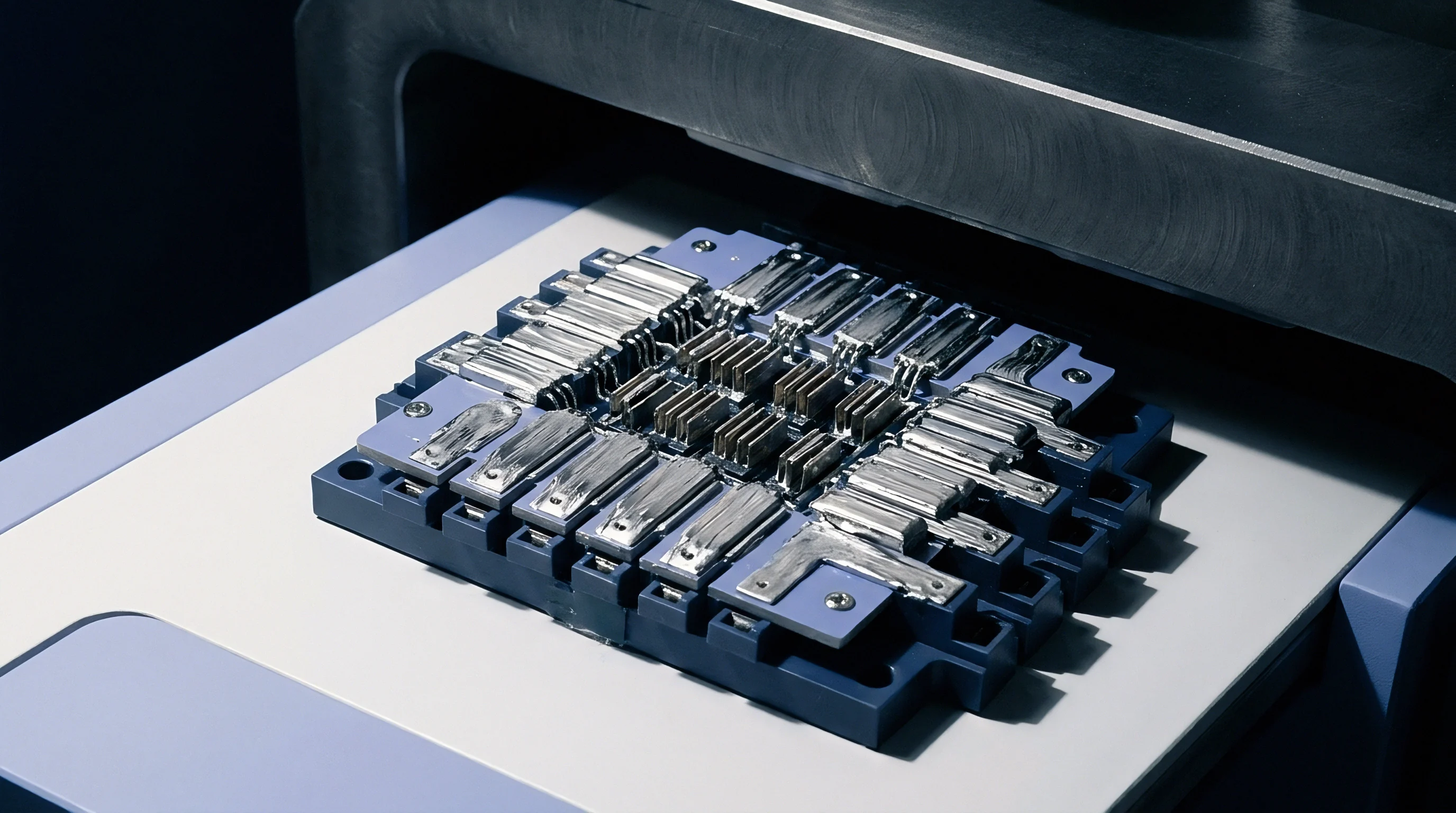
Polymer encapsulation protects sensitive piezoresistive, capacitive, and optical sensor elements from mechanical damage and atmospheric contamination. Silicon sensor dies mounted within transfer-molded epoxy or liquid-injected silicone gel packages experience permanent triaxial stress states following thermal curing. Cooling from elevated processing temperatures down to ambient operation induces differential thermal contraction between the semiconductor die, the metal leadframe, and the encapsulant.
Thermal expansion coefficients range from 2.6 parts per million per Kelvin for single-crystal silicon to 15-60 parts per million per Kelvin for epoxy compounds and up to 300 parts per million per Kelvin for silicone gels. Polymer shrinkage during cross-linking adds a chemical volume contraction component between 0.5 percent and 2.0 percent by volume.
Residual shear stress concentrates along die edges and package corners. The encapsulant transfers shear forces across the interfacial boundary into the active sensing structure, shifting the baseline signal prior to external physical excitation. Encapsulated piezoresistive bridge sensors display zero-point strain shifts exceeding 500 micro-strain directly following post-mold curing.
Silicon piezoresistors convert this localized shear profile into voltage offsets via the longitudinal and transverse piezoresistive coefficients. Initial calibration steps zero out this static stress signal during factory testing. The baseline calibration assumes that the internal stress state remains invariant throughout the service life of the package.
Micro-Mechanical Origins of Baseline Instability
Polymeric encapsulants display time-dependent strain behaviors under constant structural deformation. Polymer chains held in non-equilibrium configurations rearrange over extended periods, relaxing internal shear stresses through micro-Brownian motion. Structural relaxation alters the physical force exerted by the encapsulant onto the sensor surface without an external temperature or load change.
Baseline zero offset wanders as the internal shear profile decays. High-precision measurement applications requiring zero-point stability within 0.05 percent of full-scale output across ten years face operational challenges when encapsulated in standard mold compounds.
Micro-mechanical relaxation occurs through several distinct spatial and temporal mechanisms within the polymer matrix:
- Chain backbone translation drives long-term macroscopic shear stress decay through conformational changes across polymer entanglements over extended temporal horizons.
- Side-group rotation accounts for localized secondary relaxations operating at shorter time constants during ambient storage.
- Physical aging reduces free volume in glassy polymers, densifying the matrix and altering the effective shear modulus over thousands of operating hours.
- Interfacial delamination micro-slips release localized shear strain discontinuously, producing discrete step changes in zero offset output.
The rate of internal shear relaxation depends heavily on the initial cross-link density and the thermodynamic state of the polymer relative to its glass transition temperature. Operating near the glass transition accelerates structural relaxation by orders of magnitude compared to vitreous storage. Sub-glass transition processes persist over multi-year intervals, driving logarithmic baseline drift that resists simple linear compensation algorithms.
Package geometry, thickness variations, and filler loading ratios dictate the initial strain state, establishing the total elastic energy stored within the encapsulated assembly.
Whether physical aging in highly filled epoxy molding compounds can ever reach thermodynamic equilibrium within practical industrial operating lifespans remains an open question.
Swell
Hygro-Mechanical Free Volume Alteration
Atmospheric moisture ingress introduces a second drive mechanism for zero-point drift in encapsulated package designs. Polymers absorb ambient water molecules, which diffuse into inter-chain free volume pockets and hydrogen-bonding sites along the backbone. Moisture absorption causes isotropic swelling of the polymer network, generating volumetric expansion up to 0.4 percent by weight at saturation.
When the encapsulant is mechanically constrained by the rigid silicon die and metallic substrate, moisture swelling converts into severe interfacial shear stresses. The direction of this shear strain opposes the original thermal contraction strain, driving zero offset back toward its pre-encapsulated baseline.
Diffusion kinetics follow Fickian transport models under steady environmental conditions, but deviate during transient humidity excursions. Moisture concentration profiles across the encapsulant thickness build up non-uniform shear profiles across the sensing element. A sensor exposed to a step change in relative humidity experiences an immediate surface expansion, producing a transient offset spike before moisture reaches concentration equilibrium throughout the bulk volume.
Baseline recovery lags behind humidity changes due to the prolonged desorption time required to evacuate absorbed water molecules from deep package cavities.
| Polymer Chemistry | Glass Transition (°C) | Saturated Moisture Absorption (%) | Hygroscopic Swelling Coefficient (ppm/%RH) | Initial Shear Modulus (GPa) | Long-Term Relaxed Modulus Ratio |
|---|---|---|---|---|---|
| Epoxy Novolac (High Filler) | 165 – 185 | 0.15 – 0.25 | 12 – 18 | 18.5 | 0.82 |
| Biphenyl Epoxy Compound | 130 – 150 | 0.10 – 0.18 | 8 – 14 | 22.0 | 0.88 |
| Anhydride-Cured Epoxy Gel | -40 – -10 | 0.45 – 0.85 | 45 – 75 | 0.005 | 0.35 |
| Silicone Elastomer (Die Attach) | -120 – -50 | 0.05 – 0.12 | 2 – 5 | 0.002 | 0.15 |
| Polyimide Encapsulating Coating | 280 – 320 | 1.20 – 2.10 | 35 – 55 | 3.8 | 0.91 |
Synergistic Moisture-Temperature Coupling
Moisture absorption lowers the glass transition temperature of polymer encapsulants via plasticization. Water molecules weaken inter-molecular hydrogen bonds, increasing chain mobility and shifting the glass transition downward by 5 to 20 degrees Celsius per weight-percent of absorbed water. A polymer operating safely below its dry glass transition can cross into its transition zone under humid conditions without a change in ambient temperature.
This plasticization accelerates viscoelastic shear relaxation, increasing the drift rate of the zero offset baseline by factors of three to ten.
A 100-hour exposure to 85 degrees Celsius and 85 percent relative humidity shifts the baseline shear strain in epoxy novolac encapsulation by 420 micro-strain.
Selecting materials for high-stability package designs requires evaluating both dry viscoelastic moduli and moisture-degraded relaxation spectra. Materials showing minimal thermal creep can exhibit severe baseline instability when subjected to cyclic humidity exposure. Balancing mechanical stiffness against hygroscopic expansion coefficients ensures stable baseline operation across variable environmental profiles.
Encapsulant Material Selection Criteria
Preventing long-term baseline drift demands clear specification thresholds during material sourcing and package design. Purchasing specifications must target specific physical parameters to minimize shear transfer onto active silicon die surfaces:
- High glass transition margin guarantees that the operating temperature envelope remains at least 50 degrees Celsius below the wet glass transition threshold.
- Low moisture expansion coefficient restricts swelling-induced shear strain to under 50 micro-strain at full saturation conditions.
- High inorganic filler loading reduces absolute polymer content, cutting moisture absorption capacity and reducing overall viscoelastic creep volume.
- Low initial shear modulus minimizes the absolute mechanical force exerted on the sensing elements under all structural strain conditions.
Softer encapsulants store less elastic strain energy than rigid mold compounds.

Decay

Nonlinear Viscoelastic Modeling Mechanics
Modelling long-term zero offset recovery requires going beyond linear viscoelasticity assumptions. Linear viscoelastic models assume that the relaxation modulus depends only on time, rendering stress proportional to strain under all loading conditions. Encapsulated sensor packages experience localized shear strains exceeding 1.5 percent near die corners and bond pads.
At strain levels above 0.5 percent, polymer encapsulants exhibit non-linear viscoelastic behavior where the shear relaxation modulus degrades with increasing strain magnitude. Stress relaxation speeds up under high initial strains, causing rapid early zero offset recovery followed by extremely slow multi-year asymptotic drift.
The time-dependent shear stress relaxation modulus is represented mathematically through a Generalized Maxwell Model expanded into a Prony series with a non-linear strain dependence factor:
G(t, gamma) = G_infinity + h(gamma) SUM
Here, G_infinity represents the equilibrium shear modulus at infinite time, gamma is the localized shear strain magnitude, h(gamma) is the non-linear strain damping function, G_i represents the relaxation strength of the i-th relaxation mode, and tau_i is the characteristic relaxation time constant for that mode. For linear viscoelastic behavior, the strain damping function h(gamma) equals 1.0. Under non-linear shear strains in packaging polymers, the strain damping function is expressed via the Wagner formulation:
h(gamma) = exp( -c gamma )
where c is the non-linear damping coefficient, typically ranging between 0.15 and 0.85 for microelectronic encapsulation polymers. Higher strain magnitudes accelerate short-term relaxation by suppressing the effective relaxation time constants, altering the baseline recovery trajectory.
Stretched Exponential Dynamics
Extended time-domain stress relaxation across broad glass-transition profiles frequently deviates from discrete multi-mode Prony series expansions. Non-exponential relaxation kinetics are governed by the Kohlrausch-Williams-Watts stretched exponential function:
phi(t) = exp( – (t / tau_KWW) ^ beta )
The stretching exponent beta ranges between 0.35 and 0.75 for dense polymer encapsulants. Values of beta significantly below 1.0 indicate a wide distribution of molecular relaxation times. A lower stretching exponent produces a fast initial stress drop followed by a long, heavy-tailed relaxation process that persists across years of continuous operation.
Zero offset recovery follows this exact mathematical profile: rapid recovery during the first 100 hours post-molding, transitioning into continuous, fractional-logarithmic drift across 10,000 hours of service.
Adherence to IEC 60068-2-78 test schedules forces packaging suppliers to certify baseline drift stability under combined thermal and moisture stress.
Time-temperature superposition principles apply to baseline recovery tracking via the Williams-Landel-Ferry equation above the glass transition temperature, and the Arrhenius relation below it. The shift factor a_T modifies the relaxation time scale according to:
ln( a_T ) = – ( C_1 ( T – T_ref ) ) / ( C_2 + ( T – T_ref ) )
where T_ref is the reference temperature, and C_1 and C_2 are empirical material constants. Below the glass transition temperature, the activation energy for sub-glass relaxation ranges between 45 and 90 kilojoules per mole. Accelerating long-term zero offset drift testing requires elevating soak temperatures, but exceeding the glass transition invalidates the shift factor by altering the fundamental relaxation mechanism.
Worked Offset Drift Calculation
Consider a piezoresistive pressure sensor element encapsulated in a non-linear epoxy novolac compound. The active Wheatstone bridge has a zero-offset sensitivity factor of 12.5 micro-volts per volt per micro-strain. Post-mold processing leaves a residual edge shear strain of 0.012 (1.2 percent) at an operating temperature of 25 degrees Celsius.
The non-linear damping coefficient c equals 0.45. The unrelaxed shear modulus G_0 is 15.0 GPa, relaxing toward an equilibrium modulus G_infinity of 12.0 GPa across two distinct spectrum modes: G_1 = 2.0 GPa with tau_1 = 50 hours, and G_2 = 1.0 GPa with tau_2 = 2500 hours. The stretching exponent beta is 0.55.
Calculating the initial effective modulus under non-linear strain:
h(0.012) = exp( -0.45 0.012 ) = exp( -0.0054 ) = 0.9946
Initial shear stress state directly after molding:
sigma_0 = gamma
sigma_0 = 0.012 = 0.012 = 0.1798 GPa = 179.8 MPa
After 1,000 operating hours at ambient temperature, the relaxation components decay:
Component 1 decay: exp( – ( 1000 / 50 ) ^ 0.55 ) = exp( – ( 20 ) ^ 0.55 ) = exp( -5.20 ) = 0.0055
Component 2 decay: exp( – ( 1000 / 2500 ) ^ 0.55 ) = exp( – ( 0.4 ) ^ 0.55 ) = exp( -0.603 ) = 0.5472
Calculating the remaining shear stress at 1,000 hours:
sigma(1000) = 0.012
sigma(1000) = 0.012 = 0.012 = 0.1506 GPa = 150.6 MPa
The total shear stress drop across 1,000 hours is:
Delta_sigma = 179.8 MPa – 150.6 MPa = 29.2 MPa
This stress reduction corresponds to a micro-strain relief of:
Delta_gamma = 0.012 ( 1 – 150.6 / 179.8 ) = 0.00195 strain = 1950 micro-strain
Multiplying by the Wheatstone bridge sensitivity factor of 12.5 micro-volts per volt per micro-strain at a 5.0 Volt excitation yields a total zero offset output drift of:
V_drift = 1950 12.5 5.0 = 121,875 micro-volts = 121.88 milli-volts
If the full-scale output of the sensor is 5.0 Volts, this viscoelastic shear relaxation produces a zero offset baseline drift of 2.437 percent of full-scale output over the first 1,000 hours. Omitting non-linear strain acceleration factors leads to underestimating initial drift rates by up to 35 percent, exposing high-precision sensor systems to field calibration failures.
Underestimating non-linear relaxation coefficients causes baseline compensation algorithms to fail within the first six months of continuous service deployment.


Offset

Zero-Point Stabilization Pathways
Zero-point recovery in sensor packages proceeds along non-linear curves dictated by environmental history. A freshly molded sensor exhibits rapid initial recovery, which slows down asymptotically. Operating temperatures modulate this recovery rate by altering structural relaxation dynamics.
High storage temperatures accelerate stress relief, driving the offset toward a stable baseline faster than ambient storage. Exposure to elevated temperatures can shift the baseline past its optimal target if post-cure processes are improperly managed.
The interaction between thermal relaxation and moisture-induced swelling creates complex recovery dynamics. While thermal relaxation continuously reduces residual stress, ambient humidity fluctuations introduce reversible strain shifts. These combined effects produce baseline trajectories that reverse direction when environmental conditions shift.
Isolating permanent viscoelastic relaxation from temporary environmental variations is essential for developing reliable drift prediction models.
Polymers subjected to glass transition temperature cycles relax residual shear stresses faster than those stored under static cryogenic conditions.
Testing programs must track zero offset stability across diverse thermal and moisture exposure sequences. Evaluating recovery under static storage conditions fails to capture the baseline behavior observed in real-world operating environments.
| Conditioning Profile | Duration (Hours) | Mean Offset Shift (%FSO) | Peak Strain Variance (µε) | Recovery Time Constant (Hours) | Residual Drift Rate (%FSO/1k hrs) |
|---|---|---|---|---|---|
| Static Ambient (23°C / 50% RH) | 2,000 | 0.85 | ± 140 | 450 | 0.12 |
| Thermal Bake (125°C Dry) | 168 | 2.45 | ± 45 | 18 | 0.01 |
| Humid Bake (85°C / 85% RH) | 500 | 3.10 | ± 320 | 65 | 0.28 |
| Thermal Cycling (-40°C to 125°C) | 500 Cycles | 1.95 | ± 210 | 110 | 0.08 |
| Step Humidity Shift (20% to 80% RH) | 720 | 1.15 | ± 180 | 140 | 0.15 |
Why Does Long Term Zero Offset Recovery Decouple from Short Term Stress Relaxation?
Short-term stress relaxation tests run over 24 to 100 hours evaluate fast localized chain motions and side-group rotations. These short-term tests capture initial modulus drops but fail to capture structural physical aging processes that occur over thousands of hours below the glass transition temperature. Long-term zero offset recovery depends on broad molecular weight distributions and physical aging mechanisms that continuously densify the polymer matrix over extended periods.
Short-term testing captures high-strain non-linear relaxation while missing long-term linear aging trends, preventing simple linear extrapolation from short-term data.
High inorganic filler loading restricts long-range polymer chain mobility, creating multi-modal relaxation spectrum profiles. Short-term stress tests activate low-activation-energy relaxation modes, whereas multi-year baseline drift relies on cooperative molecular rearrangements requiring higher thermal activation energies. Extrapolating a 100-hour laboratory stress relaxation test to predict a ten-year sensor operational lifespan understates long-term zero offset drift by factors between four and twelve.
Suppliers frequently assert that baseline drift settles completely within 72 hours of post-mold curing, ignoring long-term physical aging effects that persist for years in glassy encapsulants.

Screening
Protocol for Burn-In and Thermal Conditioning
Stabilizing baseline zero offset before delivering packages to customers requires structured thermal conditioning protocols. Unconditioned encapsulants release residual processing stresses during field operation, causing uncompensated zero offset drift that triggers early field returns. Thermal stabilization accelerates early high-rate viscoelastic relaxation modes, driving the encapsulant past its rapid recovery phase prior to final factory calibration.
The standard burn-in and thermal conditioning protocol follows a six-stage sequence:
- Pre-bake package lots at 150 degrees Celsius for 24 hours under a dry nitrogen atmosphere to complete residual monomer cross-linking and establish uniform polymer stoichiometry.
- Ramp temperature down to 25 degrees Celsius at a controlled rate not exceeding 1.5 degrees Celsius per minute to avoid setting up new thermal gradient strains.
- Expose package assemblies to five continuous thermal cycles between -40 degrees Celsius and 125 degrees Celsius with 30-minute dwell times to mechanically exercise the package interface.
- Perform a high-temperature stabilization soak at 85 degrees Celsius for 168 hours to accelerate sub-glass transition stress relaxation down to asymptotic drift rates.
- De-gas package lots in a vacuum oven at 60 degrees Celsius and 10 millibar for 12 hours to purge absorbed ambient moisture before initial calibration testing.
- Execute final two-point baseline zero calibration within two hours of stabilization cooling to store baseline offsets in non-volatile memory.

Statistical Validation of Lot Recovery Distributions
Qualifying polymer encapsulated sensor lots requires verifying drift metrics across large sample populations. Testing three to five engineering samples fails to detect lot-to-lot variance caused by minor shifts in mold compound chemistry, filler distribution, or curing cycles. Statistical lot acceptance requires measuring baseline stability across minimum sample sizes of 45 units per molding batch under accelerated thermal soak profiles.
Unconditioned silicone gels preserve baseline offset errors five times longer than rigid epoxy molding compounds.
Calculating the upper tolerance limit for baseline drift requires establishing a 95 percent confidence interval with a 99 percent coverage probability across the sample lot. The lot passes qualification when the calculated upper tolerance limit for long-term offset drift remains below the system drift allowance. Lots showing non-Gaussian drift distributions indicate localized delamination or non-uniform filler loading, requiring whole-batch rejection regardless of mean drift values.
Standard procurement documentation incorporating ISO 2859-1 acceptance sampling plans mandates batch rejection if more than 1.0 percent of test samples display baseline drift exceeding 0.1 percent of full-scale output after thermal soak testing.

Settlement
Commercial Impact of Offset Instability
Specifying sensor zero offset tolerances without accounting for viscoelastic relaxation dynamics creates financial exposure across sensor supply chains. Datasheets often present zero offset specifications measured immediately after factory trim. When sensors are stored in warehouses or integrated into end devices, ongoing shear relaxation alters baseline offsets before systems reach the end customer.
If the zero offset drifts past incoming inspection limits, system integrators reject entire delivery lots, forcing sensor manufacturers to absorb scrap, recalibration, and logistics costs.
Long-term field drift increases warranty liabilities over system operational lifespans. In automotive, aerospace, and medical monitoring applications, uncompensated zero offset wander causes false system alarms, incorrect measurement outputs, and premature module replacements. Recalibrating fielded sensors requires dedicated service personnel or automated background compensation algorithms, both of which add ongoing cost to the system architecture.
Tighter initial calibration tolerances yield diminishing returns if underlying encapsulant viscoelastic drift mechanisms remain unmanaged.
| Tolerance Class | Zero Offset Tolerance (%FSO) | Required Encapsulant Conditioning | Relative Unit Packaging Cost | Factory Calibration Yield (%) | Projected 5-Year Field Return Rate (%) |
|---|---|---|---|---|---|
| Industrial Standard | ± 1.00 | Standard Post-Cure (4 hrs @ 150°C) | 1.00x | 99.2 | 1.85 |
| High Stability | ± 0.25 | Extended Soak (48 hrs @ 125°C) | 1.45x | 96.5 | 0.42 |
| Precision Grade | ± 0.05 | Full Burn-In Protocol (168 hrs + Humidity) | 2.85x | 88.0 | 0.08 |
| Ultra-Precision | ± 0.01 | Hermetic Option / Low-Stress Gel Fill | 6.20x | 74.5 | 0.01 |

Yield and Calibration Cost Balance
Tightening zero offset tolerances requires longer thermal pre-conditioning cycles and tighter process controls. Moving from an industrial standard tolerance of 1.0 percent down to a precision tolerance of 0.05 percent increases package conditioning costs by 185 percent, while factory calibration yields drop from 99.2 percent to 88.0 percent due to tight baseline window rejections. Manufacturers must balance the upfront expense of extended pre-conditioning against the downstream costs of field returns and warranty claims.
Spending more on proper encapsulant pre-conditioning during component manufacturing significantly reduces long-term field recalibration expenses.
System designers must select encapsulant formulations and stabilization protocols aligned with their specific operational lifespan requirements. Pushing standard epoxy mold compounds into ultra-precision measurement applications without accounting for non-linear viscoelastic shear relaxation leads to field drift failures, budget overruns, and ongoing engineering redesign cycles.