Polymer Degradation Dynamics in Semiconductor Assembly Interfaces
Polymer interface degradation stems from moisture hydrolysis and thermomechanical stress, requiring targeted acoustic screening and activation energy mapping.

Hydrolysis
Polymer interfaces inside microelectronic packages suffer bond breakdown when exposed to ambient moisture over extended operating life. Water molecules diffuse through the bulk mold compound via micro-cavities and free volume, accumulating at internal material boundaries where silicon, metal leads, and organic adhesives meet. Die attach materials absorb water at rates governed by ambient relative humidity and structural resin composition.
Moisture concentration at the boundary lowers adhesion energy by interrupting hydrogen bonds and cleaving chemical structures across the junction.
Die Attach Interfacial Degradation
Polar groups within cured epoxy matrices draw polar water molecules through the package substrate during environmental exposure. Epoxy molding compounds absorb between 0.2 percent and 0.8 percent water by weight during high-humidity exposure. Water molecules collect at the die attach junction, forming localized liquid clusters that exert swelling pressure.
Moisture breaks bonds. Bond cleavage reduces adhesion, accelerating delamination under mechanical stress.
Adhesive shear strength drops dramatically when water saturated resins undergo temperature cycling. Silicon-to-leadframe adhesion relies on chemical bonds between epoxy functional groups and metal oxide surfaces. Water replaces primary polymer-metal bonds with weaker hydrogen bonds, reducing die shear strength.
Saturated die attach materials lose up to half their room-temperature adhesion strength when exposed to high relative humidity environments.
Standard moisture sensitivity stress at 85 degrees Celsius and 85 percent relative humidity reduces die attach interfacial shear strength by 42 percent within 168 hours of continuous exposure.
Silane Coupling Agent Breakdown
Organofunctional silanes bond organic encapsulation resins to inorganic silicon die surfaces and glass fillers. Gamma-glycidoxypropyltrimethoxysilane provides an oxirane ring to react with epoxy networks while silanol groups condense onto silicon dioxide surfaces. Moisture ingress hydrolyzes the oxane bonds linking the silane layer to the inorganic oxide substrate.
Silanes hydrolyze first. Hydrolytic cleavage reverses the condensation reaction, forming free silanol groups and leaving the interface unprotected against mechanical separation.
Interfacial shear resistance decays following first-order hydrolytic reaction kinetics. The cleavage rate depends on localized pH, active ion concentration, and mechanical strain across the interface. Sodium and chlorine ions present as trace contaminants accelerate silane bond cleavage.
High moisture levels combined with ionic impurities lower the cohesive failure threshold, shifting the fracture path directly along the inorganic substrate boundary.
- Hydrolytic Silane Cleavage breaks covalent silicon-oxygen-silicon bridges through water insertion, converting load-bearing structural linkages into non-bonding hydroxyl groups under environmental humidity exposure.
- Plasticizer Moisture Accumulation expands free volume within the resin network, lowering local density while decreasing mechanical stiffness across the bonded assembly area.
- Ionic Contaminant Mobilization transports trace chlorine and sodium ions directly to the substrate boundary, creating localized electrolytic cells that accelerate chemical bond dissociation.
- Hygromechanically Induced Swelling Stress develops due to differential expansion between the water-saturated polymer matrix and the rigid silicon die, applying continuous peeling force to the junction.
Failure to account for moisture ingress rate and silane bond stability leads to unexpected delamination in field-deployed components, causing complete mechanical separation of the silicon die from its substrate during thermal transients.


Kinetics
Thermal degradation across polymer package boundaries follows reaction paths dictated by activation energy, temperature exposure, and local reactant concentrations. Polymeric encapsulation materials undergo thermal degradation through simultaneous crosslink scission and oxidation. Elevated operating temperatures provide necessary activation energy to generate free radicals within the epoxy backbone.
Free radicals react with trapped oxygen, producing hydroperoxides that decompose into volatile compounds, leaving behind a brittle structural network.
Arrhenius Thermal Acceleration
Reaction rates for polymer degradation scale with temperature according to classic exponential relationships. Activation energies for epoxy molding compound degradation range between 0.8 electron-volts and 1.2 electron-volts, depending on resin chemistry and catalyst selection. Small increases in continuous operating temperature trigger large acceleration factors in structural bond breakdown.
Thermal exposure over long durations reduces crosslink density, raising localized stress concentrations at corner die boundaries.
Arrhenius models predict property loss over time by mapping elevated temperature stress back to nominal operating conditions. Extrapolating high-temperature storage data down to lower temperature service profiles requires continuous monitoring of weight loss, glass transition temperature shifts, and shear strength reduction. Inaccurate activation energy values distort lifetime projections, hiding rapid degradation mechanisms that occur at normal operational limits.
| Resin System Class | Activation Energy (eV) | Test Condition Temp (°C) | Mass Loss Rate (%/1000h) | Shear Retention (% at 1000h) |
|---|---|---|---|---|
| Standard Biphenyl Epoxy | 0.92 | 175 | 0.45 | 78.2 |
| Multi-Functional Epoxy | 1.08 | 175 | 0.22 | 86.5 |
| High-Temperature Anhydride | 1.15 | 200 | 0.18 | 91.0 |
| Low-Stress Silicone-Modified | 0.84 | 150 | 0.68 | 64.3 |
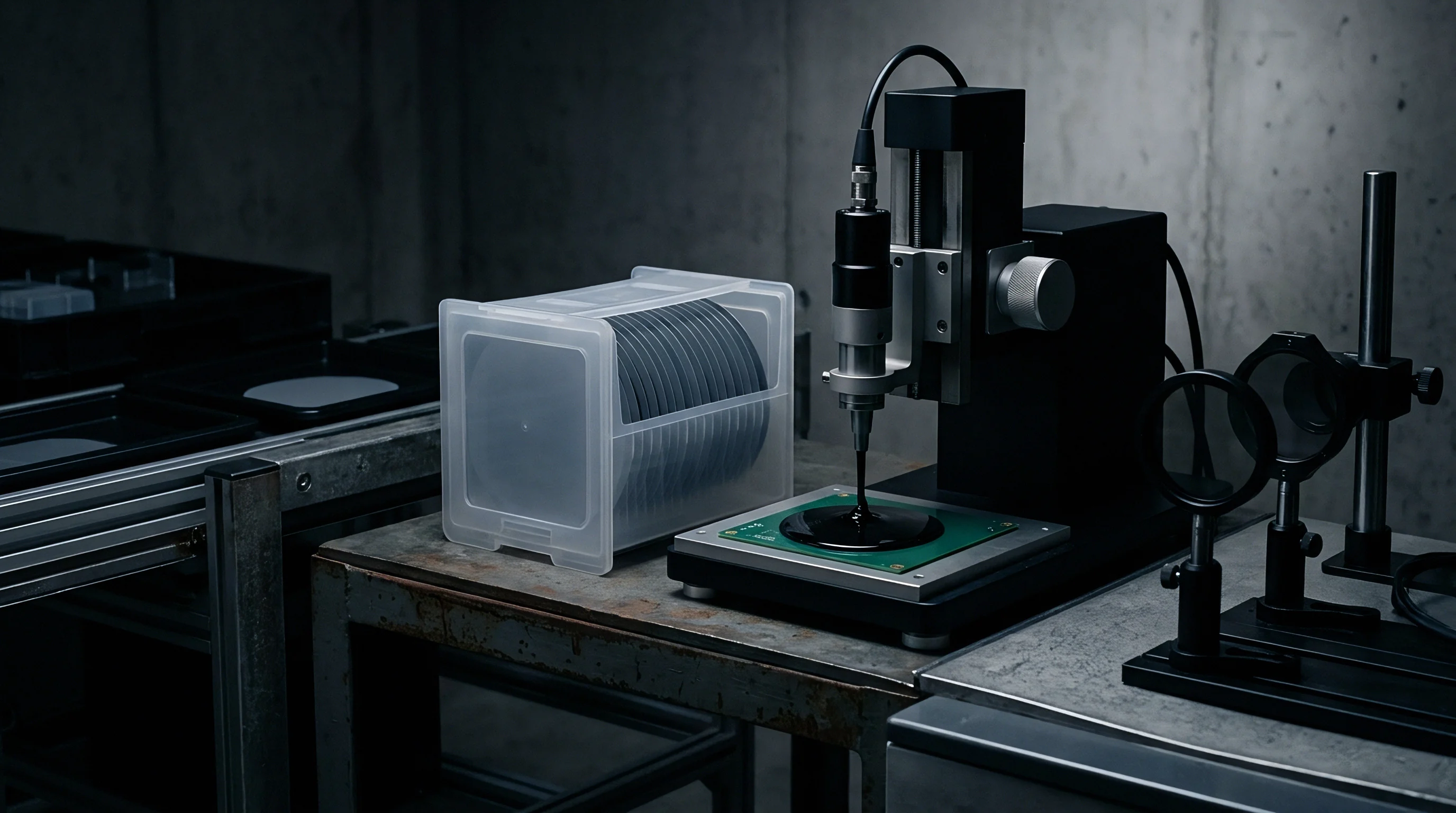
Thermo-Oxidative Volatiles Outgassing
Encapsulant matrices release unreacted monomers, plasticizers, and flame retardants under prolonged thermal stress. Free radical oxidation breaks resin backbones into low-molecular-weight volatile fragments. Outgassing corrupts bondwires.
Volatile compounds travel along internal micro-cracks and collect at wire bond interfaces, forming non-conductive residue layers. Accumulation of gaseous species within sealed package cavities raises internal hydrostatic pressure, promoting interfacial separation.
Outgassing rates peak during early thermal exposure before settling into slow, diffusion-controlled evaporation. Mass loss measurements via thermogravimetric analysis track polymer degradation progress under high temperatures. Excessive mass loss creates microscopic voids inside the mold compound, compromising structural integrity and reducing effective thermal conductivity across the assembly interface.
Paraphrased supplier reliability claims frequently mask localized resin degradation by quoting whole-mold thermogravimetric mass loss figures.
Suppliers routinely state that low mass loss during high-temperature exposure guarantees bond integrity, omitting the reality that trace outgassing concentrated specifically at wire bond land areas causes electrical open circuits long before whole-mold weight changes become detectable.


Void
Interfacial gaps and delamination sites form when hygro-mechanical stress exceeds local interfacial adhesive strength during temperature transitions. Voids grow under heat. Thermal reflow processes generate sudden vapor pressure within water-saturated polymers, driving explosive delamination across weak adhesion regions.
Microscopic voids act as stress concentrators, promoting crack propagation along the substrate junction under cyclic mechanical loading.
Acoustic Pulse Echo Inspection Metrology
Ultrasonic inspection provides non-destructive detection of internal gaps by measuring acoustic impedance mismatches across material boundaries. Acoustic impedance equals density multiplied by sound velocity. Sound travels efficiently through continuous polymer-silicon structures.
Acoustic impedance drops instantly. When an acoustic pulse encounters an air-filled gap, the signal undergoes complete reflection with a 180-degree phase inversion due to the low acoustic impedance of air compared to solid resin.
High-frequency transducers operating between 100 megahertz and 230 megahertz detect microscopic gaps down to sub-micron thicknesses. Higher frequencies improve spatial resolution while increasing signal attenuation through dense mold compounds. Precise gate windowing isolates reflections originating specifically at the die attach layer, allowing accurate mapping of delaminated areas across the package area.
- Position the package in a deionized water bath at a maintained temperature of 22 degrees Celsius to guarantee stable ultrasonic wave velocity.
- Adjust transducer focus depth to align the focal plane precisely with the die attach interface using time-domain amplitude signal monitoring.
- Set time-of-flight gating windows to capture the primary echo reflection while excluding top-surface mold compound reflections.
- Calibrate reflection phase polarity against a known air-to-silicon reference interface to verify positive detection of physical delamination.

Can Micro-Voiding below Two Micrometers Be Reliably Quantified by Acoustic Microscopy?
Detecting sub-micron gaps pushes high-frequency acoustic microscopy to its physical wave diffraction limits. Acoustic reflection amplitude depends on gap thickness relative to the acoustic wavelength in the medium. Gaps thinner than one-tenth of the acoustic wavelength produce constructive interference between top and bottom gap surfaces, attenuating echo amplitude below standard detection thresholds.
Acoustic imaging quantifies area coverage accurately, but measuring absolute vertical void thickness below two micrometers requires cross-sectional scanning electron microscopy or high-resolution X-ray computed tomography.
In high-density packaging, multiple stacked interfaces generate complex reflection spectra that overlap in the time domain. Wave interference masks signal phase changes, complicating clear distinction between full delamination and partial adhesive wetting loss. High attenuation through thick mold compounds reduces signal-to-noise ratios, obscuring fine microscopic defects across deep substrate boundaries.
| Interface Boundary | Material 1 Z (MRayl) | Material 2 Z (MRayl) | Reflection Coeff. (R) | Phase Shift (Deg) |
|---|---|---|---|---|
| Silicon / Epoxy Die Attach | 19.7 | 3.2 | -0.720 | 180 |
| Epoxy Die Attach / Copper | 3.2 | 44.3 | 0.865 | 0 |
| Mold Compound / Silicon | 3.5 | 19.7 | 0.698 | 0 |
| Mold Compound / Air Gap | 3.5 | 0.0004 | -0.999 | 180 |
| Methods Note: Reflection coefficients calculated using primary longitudinal wave velocities measured at 20 degrees Celsius. Negative values indicate phase inversion. | ||||
Quantifying whether sub-micron acoustic reflection changes stem from genuine vacuum gap formation or localized changes in resin elastic modulus remains an open metrological challenge for non-destructive packaging analysis.
Rheology
Viscoelastic properties of cured resins govern how thermal and mechanical stresses transfer across internal package boundaries. Polymers exhibit temperature-dependent mechanical responses, transitioning from a glassy state with high elastic modulus to a rubbery state with low elastic modulus. Glass transition temperature marks the region where polymer chains gain translational mobility.
Operation above this threshold drastically increases thermal expansion rates while reducing mechanical load transmission capabilities.
Glass Transition Phase Shifts
Moisture ingress depresses the glass transition temperature of epoxy resins by acting as a small-molecule plasticizer. Absorbed water molecules insert themselves between polymer chains, increasing free volume and reducing inter-chain hydrogen bonding. Stress shifts glass transition.
Moisture absorption drops glass transition temperatures by 15 to 30 degrees Celsius, pushing a stable room-temperature resin into its soft rubbery regime under normal operating temperatures.
Plasticization alters coefficient of thermal expansion values. Below glass transition, thermal expansion remains low, matching adjacent metallic and semiconductor materials closely. Above glass transition, thermal expansion increases by a factor of three to four.
Modulus decays exponentially. Large thermal expansion differences create massive shear stress along die edges during operational power cycling, promoting rapid interfacial crack propagation.
Polymer interfaces operating above glass transition temperature experience an exponential decline in adhesive shear modulus that doubles interfacial strain accumulation.
Viscoelastic Strain Relaxation Behavior
Polymeric adhesives undergo time-dependent stress relaxation when subjected to sustained strain. Viscoelastic relaxation reduces localized peak stresses over time, but continuous stress cycling causes mechanical hysteresis and energy dissipation within the adhesive layer. Energy dissipation accelerates fatigue damage, forming micro-cracks along filled resin matrix lines.
Dynamic Mechanical Analysis measures storage modulus and loss modulus to quantify energy storage and dissipation efficiency across temperature ranges.
Loss factor peaks indicate structural transitions and chain mobility relaxation points. Higher filler loading increases storage modulus while reducing total thermal expansion. Excess filler content raises resin viscosity during dispensing, causing incomplete wetting and trapping air bubbles along die edges.
Clean surfaces delay fracture. Balancing filler concentration against flow capability guarantees maximum mechanical coupling without introducing interfacial voids.
- Storage Modulus Degradation reduces load transfer capacity, allowing thermal mismatch strains to concentrate directly on wire bonds and micro-bumps.
- Loss Factor Broadening signals multi-phase plasticization within the polymer matrix, indicating non-uniform moisture absorption and localized material softening.
- Thermal Expansion Discontinuity across the glass transition point induces out-of-plane bending moments, driving die tilt and uneven bondline thickness.
- Stress Relaxation Rate Hysteresis increases permanent deformation after each thermal cycle, leading to cumulative dimensional distortion across the assembly.
A soft polymer interface buffers stress while a stiff polymer interface transfers load.

Screening
Reliability verification mandates exposing semiconductor assemblies to standardized environmental stress profiles to accelerate latent defect growth. Accelerated environmental testing identifies structural weaknesses in packaging interfaces prior to volume commercial deployment. Test conditions combine elevated temperature, humidity, and electrical bias to force moisture diffusion and chemical degradation within compressed timeframes.
Passing screening protocols requires holding precise environmental parameters across multi-week test durations.

Accelerated Reliability Qualification Methods
Standardized qualification profiles simulate years of environmental exposure within hundreds of hours. High-Temperature Storage Life testing measures thermo-oxidative endurance under dry heat up to 175 degrees Celsius. Biased Highly Accelerated Stress Test environments subject packages to 130 degrees Celsius and 85 percent relative humidity under high vapor pressure, forcing rapid water diffusion through mold compounds.
Unbiased HAST evaluates moisture ingress kinetics without electrical corrosion effects.
Preconditioning sequences simulate assembly reflow stress prior to environmental exposure. Packages undergo moisture soak periods followed by multiple thermal reflow passes at 260 degrees Celsius. Sudden heating converts absorbed liquid water into high-pressure vapor, testing interfacial adhesion against popcorning delamination mechanisms.
Passing preconditioning tests establishes a package’s Moisture Sensitivity Level rating according to standardized thermal parameters.
IPC JEDEC J STD 020 specifies reflow stress exposure parameters that mandate preconditioning moisture soak protocols prior to thermal shock evaluation.
Transducer Gate Window Alignment
Accurate verification of internal package integrity demands strict acoustic scanning calibration procedures. Inspection protocols require spatial alignment of ultrasonic gates to isolate die attach layers from surrounding leadframe and silicon signals. Echo reflections arriving within the selected gate window convert to grayscale or color pixel intensities, producing spatial maps of delamination coverage.
Setting gates too wide allows surface reflections to obscure internal voiding signals, returning false passing results.
Destructive physical analysis validates non-destructive acoustic measurements. Mechanical cross-sectioning combined with die shear testing measures remaining interfacial adhesion strength following environmental exposure. Die shear testing applies parallel force until mechanical separation occurs, revealing whether fracture paths run cohesively through the polymer bulk or adhesively along the substrate boundary.
- Acoustic Gate Alignment Verification confirms spatial resolution bounds, guaranteeing full signal coverage across die attach interfaces without background interference.
- Moisture Sensitivity Preconditioning Profile defines exact humidity soak durations and peak reflow temperatures required to qualify packaging grades.
- Biased HAST Stress Duration establishes exposure windows under 130 degrees Celsius and 85 percent relative humidity to test electrolytic corrosion limits.
- Die Shear Pass Threshold Metrics specify minimum breaking force parameters per unit area required after environmental stress completion.
According to IPC JEDEC J STD 020 Clause 5.2, any package showing acoustic delamination exceeding 11 percent of the total die attach area after reflow preconditioning stands classified as an environmental screening failure.


Yield
Commercial viability in high-density packaging relies on balancing material qualification costs against long-term field return exposure. Selecting low-cost encapsulants with high moisture absorption rates reduces initial bill-of-materials expenditure while raising risk of early field failures. High-reliability applications demand ultra-low-outgassing, low-moisture-absorption epoxies that require extended curing schedules and tight thermal storage controls.
Uncontrolled interface degradation drives up warranty repair costs and damages market standing.
Commercial Qualification Cost Mechanics
Specifying tight tolerances for polymer degradation performance increases unit production cost across multiple manufacturing stages. Specialized raw resins cost significantly more than standard commercial-grade molding compounds. Extended cure profiles reduce production line throughput, increasing facility operational expenditure per manufactured unit.
Cleanroom environmental controls and incoming batch verification testing add direct overhead to packaging operations.
Skipping rigorous interface qualification creates hidden commercial liabilities. A component fleet that passes initial functional testing but suffers hydrolytic delamination after 18 months of service opens catastrophic warranty claims. Re-qualifying replacement resin formulations during active commercial production costs orders of magnitude more than thorough upfront environmental screening protocols.
| Resin Grade Designation | Relative Resin Cost | Qualification Cycle (Hrs) | Yield Impact (% Reflow) | Warranty Risk Index |
|---|---|---|---|---|
| Standard Commercial EMC | 1.0x | 168 | -2.1 | High |
| Low-Stress Industrial EMC | 1.8x | 500 | -0.5 | Medium |
| Ultra-Low Moisture Automotive | 3.2x | 1000 | -0.1 | Very Low |
| High-Thermal Hermetic Organic | 5.5x | 1500 | -0.05 | Negligible |

Warranty Seam Exposure Analysis
Calculating financial exposure from interface degradation requires modeling failure probability distributions across expected product lifespans. Weibull slope parameters derived from HAST and thermal cycling data allow engineers to project field failure arrival rates. Early life failures stem from manufacturing contamination and incomplete curing, whereas wear-out failures originate from hydrolytic cleavage and thermo-oxidative fatigue.
Tightening incoming material acceptance criteria shifts the Weibull failure distribution beyond the commercial warranty window, protecting assembly margins.
Procurement agreements must include precise physical test definitions for lot acceptance. Material certification documentation must detail glass transition temperature, filler size distribution, outgassing mass loss, and hydrolytic stability metrics verified by accredited third-party laboratories. Relying on generic supplier datasheets without independent batch verification exposes buyers to silent resin formulation shifts that compromise product reliability.
Contract terms specify that incoming resin lots failing moisture absorption or die shear thresholds trigger lot rejection and supplier cost absorption. Quality leads enforce batch-level acoustic inspection protocols to intercept sub-micron delamination before parts enter volume assembly lines.