Constitutive Modeling of Temperature Dependent Viscoelastic Aging in Thermosetting Die Attach Adhesive Layers
Constitutive modeling of viscoelastic aging in thermoset die attach layers enables precise finite element prediction of lifetime stress and sensor drift.
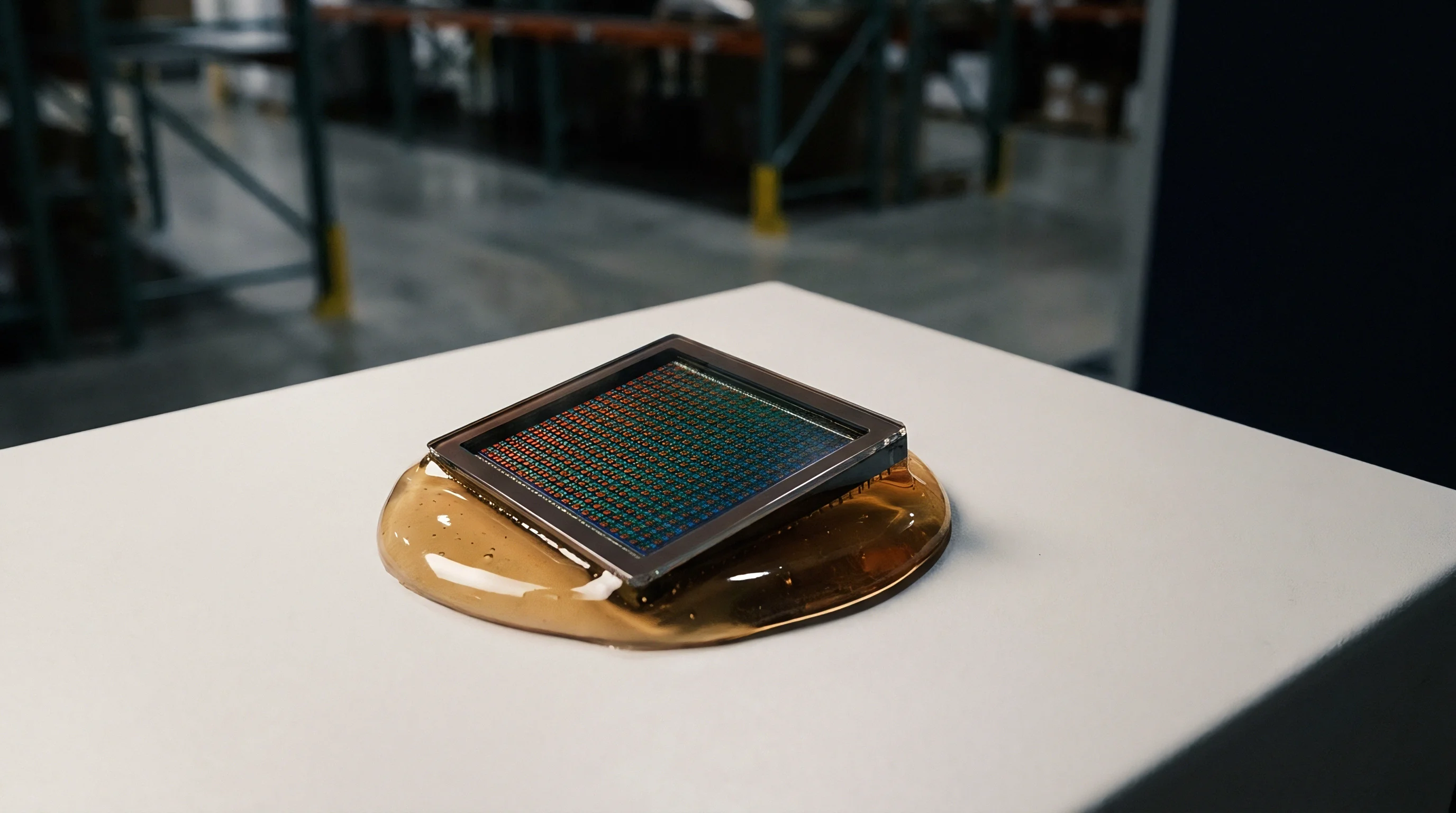

Cure
Thermosetting polymer networks formed during die attach thermal processing set the initial boundary conditions for all subsequent thermomechanical drift in microelectronic assemblies. As liquid resin formulations containing reactive epoxies, bismaleimides, or polyimide pre-polymers crosslink at elevated temperatures, three-dimensional covalent networks turn the low-viscosity fluid into a glassy solid. The final degree of conversion dictates both the initial glass transition temperature and how many unreacted functional groups remain in the adhesive layer.
Incomplete reaction kinetics leave mobile monomer or oligomeric species trapped inside the crosslinked matrix, acting as internal plasticizers that degrade long-term structural stability.
Thermal profiles in high-throughput inline assembly frequently favor fast cycle times over complete chemical stoichiometry. A typical fast-curing conductive epoxy processed at 175 degrees Celsius for 60 seconds might reach a nominal conversion of 0.88 to 0.92, leaving 8 to 12 percent of reactive sites unlinked. While the packaged semiconductor operates in the field at ambient or elevated temperatures, post-curing continues slowly alongside physical aging.
This secondary reaction increases crosslink density over time, pushing the instant glass transition temperature above its post-assembly baseline and altering the elastic modulus of the material.
A newly crosslinked thermoset exists in an inherently non-equilibrium thermodynamic state. As the material cools rapidly from its peak processing temperature through the glass transition region, structural relaxation kinetics lag behind the cooling rate. Trapped excess free volume creates an unstable, high-energy glass with elevated molecular mobility.
Die attach layers frozen in this state show non-linear viscoelastic responses even at low mechanical strain amplitudes. Building an accurate constitutive model requires separating the initial chemical state from physical structural relaxation, establishing a verified baseline modulus before environmental exposure.

Crosslink Density and Glass Transition Evolution
Network formation during step-growth or chain-growth polymerization yields uneven chain lengths between crosslink nodes. According to classic rubber elasticity theory, the average molecular weight between crosslinks directly sets the rubbery plateau modulus. In thermosetting adhesives, higher conversion compresses the molecular weight between crosslinks, raising the glass transition temperature as described by the DiBenedetto equation.
This mathematical expression links conversion to glass transition temperature through a dimensionless structure parameter that reflects the ratio of lattice energy states between the fully cured matrix and the starting monomer mixture.
High-density interconnect packaging designs introduce stress concentration points at die edges and corner fillets. In an under-cured adhesive layer, localized stress accelerates crosslink rearrangement and chain scission, altering the equilibrium shear modulus. When thermal cycles pass through the evolving glass transition zone, the relaxation spectrum shifts rapidly.
Characterizing this evolution requires combining continuous differential scanning calorimetry with dynamic mechanical thermal analysis to map conversion state against instantaneous storage and loss moduli across the material’s thermal history.
Standard thermal profiling that lacks full conversion data invalidates initial viscoelastic strain calculations across operational temperature limits.
The interplay between chemical conversion and physical property development becomes critical when choosing die attach adhesives for precision MEMS sensors. Piezoresistive pressure sensors, optical micro-mirrors, and high-frequency crystal oscillators rely on mechanical isolation from the die attach layer. If the adhesive matrix continues crosslinking during high-temperature operational life testing, the higher storage modulus transfers external package stresses straight to the active sensor membrane.
This coupling induces unrecoverable zero-point calibration shifts that standard two-point room-temperature factory calibration algorithms cannot correct.
Substrate surface chemistry also affects localized network formation near the adhesive boundary. Metallic leadframes plated with pure tin, silver, or gold exert varying catalytic or inhibitory effects on epoxy amine additions. In thin die attach layers where bondline thickness falls below 15 micrometers, interfacial interdiffusion creates a crosslink density gradient from the substrate boundary into the bulk material.
Constitutive models that treat the adhesive as a homogeneous isotropic continuum miscalculate localized strain distributions because they ignore these boundary layer gradients. Capturing localized cure kinetics requires multi-layer finite element formulations with spatially dependent relaxation spectra calibrated against micro-indentation profiles.
Ignoring localized conversion gradients and post-assembly crosslinking leads directly to structural debonding under thermal shock testing, as unpredicted strain accumulation at die corners exceeds the low-temperature fracture toughness of the partially aged interface.


Kinetics
Modeling time-dependent deformation in thermosetting die attach layers relies on viscoelastic constitutive frameworks that incorporate physical aging and thermal activation functions. Linear viscoelasticity assumes the stress response at any moment depends on the entire strain history through a convolution integral of the relaxation modulus. When temperature fluctuates during long-term storage, the material behavior turns non-linear, requiring time-temperature-aging-time superposition principles to shift the relaxation spectrum along the logarithmic time axis.
In thermoset glasses, physical aging describes the slow structural relaxation toward thermodynamic equilibrium below the glass transition temperature. Excess free volume gradually collapses, reducing molecular mobility while increasing bulk density, storage modulus, and yield stress over time. Incorporating aging into constitutive models requires an effective time parameter that compresses physical time based on the matrix’s instantaneous structural state.
The time-temperature superposition principle uses shift factors to unify viscoelastic response curves measured at discrete temperatures into a single master curve. Above the glass transition temperature, the shift factor typically follows the empirical Williams-Landel-Ferry relationship, driven by thermal expansion of free volume. Below glass transition, molecular motion is restricted to localized sub-molecular segmental movements, so the shift factor transitions to an Arrhenius relationship governed by activation energy specific to the network’s secondary relaxation modes.

When Does Physical Aging Exceed Thermal Stress?
Physical aging dominates thermomechanical stress generation when packaged microelectronics undergo prolonged storage or operation slightly below their glass transition point. In this thermal window, molecular mobility is high enough to drive structural relaxation, yet the matrix remains rigid enough to store substantial strain energy. During extended storage, the aging shift factor accelerates the decay of stress relaxation capacity, keeping residual stresses from solder reflow locked inside the die attach layer rather than dissipating over time.
Modeling this coupled phenomenon requires modifying the classic Generalized Maxwell formulation. A Prony series expansion represents the relaxation modulus as a sum of discrete Maxwell elements, each defined by a characteristic relaxation time and stiffness weight. To account for physical aging under Struik theory, each relaxation time is scaled by an aging shift factor linked to aging time through a power-law relationship.
The aging shift rate exponent typically sits between 0.7 and 1.0 for rigid epoxies, reflecting how quickly molecular relaxation times lengthen as excess free volume shrinks.
Silver-filled epoxies evaluated at elevated temperatures show a 14 percent shift in relaxation modulus after 500 hours at 125 degrees Celsius. This shift alters the internal stress profile of die attach layers, pushing peak strain locations toward fragile die corners. Omitting aging parameters from finite element constitutive equations causes numerical simulations to systematically underestimate localized die stress after long-term thermal exposure.
Structural evolution of the adhesive matrix leads to distinct failure modes under sustained mechanical loading:
- Free Volume Contraction Shear Strain drives progressive warpage shifts in thin die packages by compacting internal matrix dimensions independently of thermal contraction coefficients.
- Secondary Relaxation Modulus Stiffening increases localized stress concentrations at die corner interfaces, lowering critical strain energy release rates under dynamic shock loads.
- Relaxation Spectrum Compression shifts mechanical damping capability to higher frequencies, leaving aged packaging assemblies vulnerable to high-frequency vibrational stress.
- Interfacial Micro-Yielding Drift accumulates irreversible micro-plastic strain along the bondline boundary during sustained high-temperature loading cycles.
Structural enthalpy relaxation modeling complements free volume theory through the Tool-Narayanaswamy-Moynihan framework. This approach uses a fictive temperature to track the non-equilibrium thermodynamic state of the glassy matrix across complex thermal paths. Fictive temperature evolves as a function of both actual temperature and structural relaxation time, allowing the model to capture non-linear thermal memory effects like enthalpy overshoot during thermal ramping.
Integrating fictive temperature into finite element solvers enables precise predictions of stress evolution during thermal cycling after extended shelf storage.
Thermoset formulations containing flexible elastomer modifiers or silicone units display dual-relaxation kinetics. Soft rubbery domains undergo physical aging at noticeably different rates than the rigid epoxy matrix, producing a bi-modal relaxation spectrum shift. Standard single-exponent aging models fail to capture this dual-rate process, leading to severe miscalculations of long-term creep compliance.
Modeling these modified systems requires coupled multi-spectrum shift functions that update individual Prony terms independently based on localized domain composition.
Physical aging is often assumed to reach saturation after several hundred hours of thermal exposure, rendering long-term structural relaxation negligible in field applications. This simplified assumption ignores the ongoing coupling between ambient moisture ingress, secondary chemical post-curing, and sub-glass physical aging under actual operational thermal cycling.

Hysteresis
Verifying constitutive parameters that govern temperature-dependent viscoelastic aging requires precise dynamic mechanical thermal analysis combined with long-term stress relaxation bench testing. Isolating viscoelastic creep from physical aging demands strict control over specimen thermal history prior to testing. Without standardized pre-conditioning to erase prior thermal memory, dynamic storage and loss modulus measurements scatter widely, obscuring the true material constants needed for non-linear constitutive equations.
Measuring structural compaction from reduced free volume requires sub-ambient and elevated temperature dynamic mechanical spectroscopy across a wide frequency domain, typically from 0.01 Hertz to 100 Hertz. Isothermal frequency sweeps run at discrete temperature steps generate raw data for master curve construction using time-temperature superposition. When testing glassy thermosets prone to physical aging during the test window itself, dynamic measurements must be performed rapidly at small strain amplitudes within the linear viscoelastic regime to prevent mechanically induced structural rejuvenation.
Stress relaxation experiments provide direct verification of Prony series coefficients. Applying a constant step strain to a thin adhesive strip or bonded joint specimen allows the decaying axial or shear stress to be recorded over logarithmic time intervals from milliseconds to hundreds of hours. Fitting a 5 to 10 term Prony series to experimental relaxation curves requires non-linear least-squares optimization constrained by thermodynamic stability rules, ensuring all relaxation times and modulus weights remain positive definite.
Dynamic mechanical thermal analysis conducted at a single heating rate of two degrees Kelvin per minute yields shifting glass transition peaks that misrepresent isothermal aging rates by up to forty percent.
Differential scanning calorimetry provides an essential complementary method for calibrating structural relaxation models based on enthalpy kinetics. By measuring excess enthalpy recovery during heating scans through the glass transition temperature following isothermal aging steps, calorimetry determines the structural parameter and activation energy components of the Tool-Narayanaswamy-Moynihan model. The area under the endothermic enthalpy overshoot peak correlates directly with the physical aging and structural volume contraction experienced by the adhesive matrix during thermal dwells.
Dynamic mechanical analyzer test results often diverge from shear modulus values measured on miniature lap-shear bondline specimens ~ a discrepancy rooted in incomplete structural equilibrium. In thin die attach layers, constraints from rigid silicon and copper substrates alter localized stresses and restrict chain mobility relative to unconstrained bulk films. Calibrating constitutive models on bulk material properties alone leads to systematic errors when predicting stress profiles in bondlines thinner than 25 micrometers.
| Adhesive Chemistry Grade | Initial Tg (deg C) | Equilibrium Shear Modulus (GPa) | WLF C1 Parameter | WLF C2 Parameter (K) | Aging Exponent (mu) | Activation Energy (kJ/mol) |
|---|---|---|---|---|---|---|
| High-Thermal Conductive Silver Epoxy | 145 | 4.85 | 17.4 | 52.1 | 0.88 | 185 |
| Low-Modulus MEMS Fluorosilicone Hybrid | -35 | 0.08 | 8.2 | 105.4 | 0.32 | 72 |
| High-Reliability Bismaleimide (BMI) | 230 | 6.10 | 19.1 | 68.3 | 0.94 | 240 |
| Optoelectronics Low-Outgassing Acrylic | 85 | 2.15 | 14.8 | 44.8 | 0.76 | 135 |
Long-term creep compliance verification requires sustained mechanical loading under tightly regulated ambient conditions. Creep tests measure progressive strain accumulation under constant shear or tensile stress over extended periods up to 3,000 hours. Converting creep compliance data to stress relaxation moduli involves solving a Volterra integral equation of the first kind.
Numerical inversion using Laplace transform techniques or direct numerical regularization avoids mathematical instability, producing smooth relaxation spectra suitable for direct insertion into commercial finite element packages.
Environmental humidity introduces complex plasticization kinetics that compete directly with physical aging. Moisture absorbed into the thermoset matrix expands free volume, lowering the instantaneous glass transition temperature and counteracting structural aging compaction. High-humidity storage testing at 85 degrees Celsius and 85 percent relative humidity causes rapid transient plasticization, followed by slow hydrolysis of vulnerable ester or ether linkages in the crosslinked network.
Constitutive models must incorporate moisture concentration-dependent shift factors alongside thermal aging functions to accurately predict drift in automotive and outdoor sensor deployments.
Laboratory verification protocols executed exclusively at room temperature undercount low-temperature relaxation, missing secondary beta-relaxations that drive sub-zero embrittlement and stress amplification in high-altitude electronic hardware. How can calibration protocols separate reversible moisture-induced free volume expansion from irreversible structural aging in thin bondline geometries?
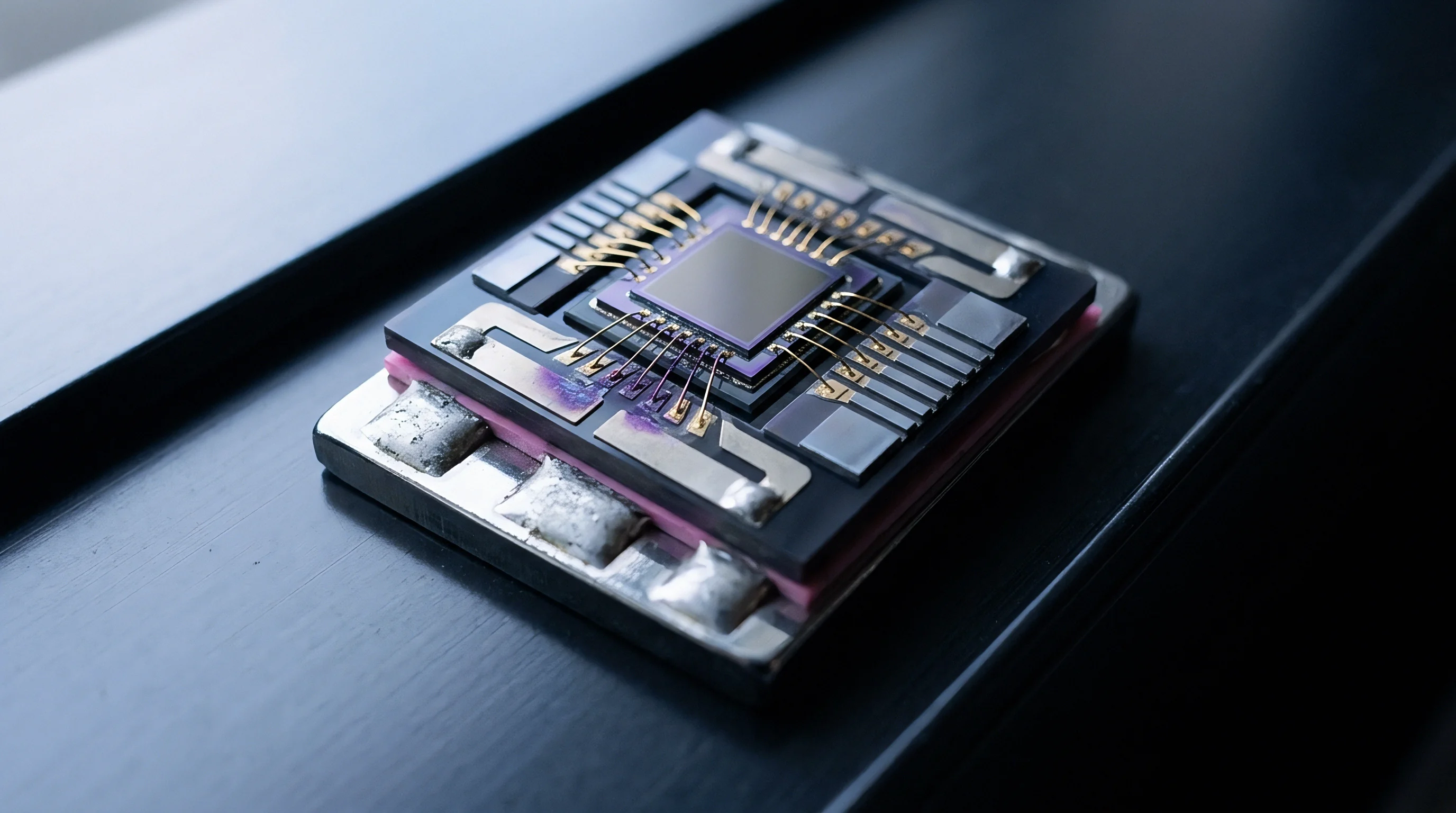
Distortion
Mechanical stress accumulation inside packaged semiconductor assemblies stems from thermal expansion coefficient mismatches between the silicon die, the die attach adhesive layer, and the supporting metallic or organic substrate. Cooling from curing temperatures to room temperature or cycling during operation generates shear stresses in the adhesive layer and bending moments across the die thickness. As the die attach adhesive undergoes continuous physical aging and viscoelastic stress relaxation, these internal stress distributions evolve dynamically over operational lifespans.
Incorporating viscoelastic aging into non-linear finite element continuum mechanics formulations requires user-defined material subroutines to capture temperature-driven spectrum changes. The total mechanical strain tensor decomposes into elastic, thermal, viscoelastic, and aging-induced volumetric components. At each incremental time step, the numerical solver calculates instantaneous stress by evaluating incremental hereditary convolution integrals using updated Prony relaxation parameters, corrected for local temperature, structural aging state, and absorbed moisture content.
To prevent tensile loads from driving micro-yielding, numerical implementation uses recursive integration algorithms to avoid storing the full historical strain tensor at every integration point, which would consume prohibitive memory during long-term simulations. Incremental algorithmic formulations store internal state variables representing the strain history of each Maxwell element in the Prony series. These internal state variables update sequentially at each step based on localized time increments divided by shifted relaxation times, delivering computationally efficient solutions for complex multi-chip module assemblies.
Consider a worked case involving a precision piezoresistive pressure sensor die mounted to a copper leadframe using a 25-micrometer silver-filled epoxy die attach layer. The silicon die measures 3.0 millimeters by 3.0 millimeters with a thickness of 300 micrometers. The assembly undergoes post-mold thermal curing at 150 degrees Celsius, cooling to 25 degrees Celsius, storage at 85 degrees Celsius for 1,000 hours, and thermal cycling between -40 degrees Celsius and 125 degrees Celsius.
Modeling mechanical stress fields and resulting zero-point sensor drift compares two constitutive approaches: a standard elastic model and an aging viscoelastic model.
Under the standard elastic model, the room-temperature cooling step produces a uniform shear stress reaching 38.5 Megapascals along the outer edges of the die attach layer. Calculated center-to-edge die warpage remains fixed at 1.42 micrometers throughout storage. Because elastic formulations ignore time-dependent relaxation, the internal stress state stays invariant during extended storage at 85 degrees Celsius, predicting zero drift in sensor output prior to thermal cycling.
Applying the viscoelastic physical aging constitutive model reveals substantial dynamic structural evolution. During initial cooling, high-temperature stress relaxation reduces peak edge shear stress at room temperature to 22.1 Megapascals, while die warpage measures 0.98 micrometers. During 1,000 hours of storage at 85 degrees Celsius, physical aging accelerates structural relaxation while increasing the glassy storage modulus from 4.2 Gigapascals to 5.1 Gigapascals.
Upon cooling back to room temperature, the aged adhesive layer exhibits an elevated edge shear stress of 31.4 Megapascals, while total die warpage increases to 1.68 micrometers from volumetric free volume contraction within the adhesive matrix.
Piezoresistive bridges react directly to this shifting stress. The calculated longitudinal stress difference across the active piezoresistive sensing bridge on the silicon surface increases by 14.8 Megapascals purely from the 1,000-hour physical aging period. Converting this stress shift into electrical output using typical piezoresistive coefficients for p-type silicon results in a zero-point offset drift of 1.82 Millivolts per Volt of bridge excitation.
In a 0.5 to 4.5 Volt sensor output range, this aging-induced drift represents a full-scale error shift of 0.45 percent, exceeding typical high-accuracy industrial tolerances before the sensor enters operational service.
- Parameter Extraction: Calibrate baseline Prony series coefficients from dry, unaged master curves using high-frequency dynamic mechanical analyzer sweeps across the operational temperature spectrum.
- Aging Exponent Determination: Measure structural enthalpy recovery peaks via differential scanning calorimetry following isothermal heat treatments to extract the Tool-Narayanaswamy-Moynihan structural parameter and aging rate exponent.
- Subroutine Integration: Write localized stress updating algorithms using hereditary integral recursion, incorporating dual WLF-Arrhenius temperature shift functions and Struik aging time shift multipliers.
- Mesh Refinement Verification: Construct multi-scale finite element meshes with mapped element gradients resolving thin bondline stress concentrations down to sub-micron scales near die corner boundaries.
- Validation Benchmarking: Verify numerical warpage predictions against laser interferometric topography measurements taken across thermally aged test vehicles.
Die tilt represents another operational failure mode driven by non-uniform viscoelastic aging within die attach layers, ultimately degrading sensor accuracy. Variations in adhesive bondline thickness across the die footprint create localized differences in structural relaxation rates and volumetric aging contraction. During high-temperature storage, the thicker side of an asymmetric bondline undergoes greater absolute spatial contraction than the thin side, tilting optical sensor dies or MEMS mirror assemblies out of optical alignment tolerances.
| Evaluation Dwell Scenario | Constitutive Model Architecture | Peak Edge Shear Stress (MPa) | Die Center Warpage (um) | Bridge Stress Delta (MPa) | Calculated Zero Drift (% FS) |
|---|---|---|---|---|---|
| Initial Post-Cure Cool (25 C) | Linear Thermo-Elastic | 38.5 | 1.42 | 22.1 | 0.55 |
| Initial Post-Cure Cool (25 C) | Unaged Linear Viscoelastic | 22.1 | 0.98 | 12.4 | 0.31 |
| Post 1000h Aging (85 C) | Aging Viscoelastic (Struik) | 31.4 | 1.68 | 19.7 | 0.49 |
| Post 3000h Aging (125 C) | Fully Coupled TNM-Viscoelastic | 41.2 | 2.15 | 27.8 | 0.70 |
Die attach fillet geometry alters boundary stress intensity factors significantly. A high, fully formed adhesive fillet extending up the vertical sidewall of the silicon die increases structural constraint, suppressing localized shear deformation while amplifying axial tensile stresses normal to the die’s active surface. Non-linear aging models show that aged fillets develop high tensile stress zones near the upper apex during sub-zero thermal excursions, initiating micro-cracks that propagate along the die edge toward the primary bondline interface.
Because baseline modulus measurements vary widely across batches, uncontrolled bondline thickness variations in automated production runs amplify internal stress variance, turning predictable physical aging responses into scattered field drift failures that defeat standard statistical process control limits.
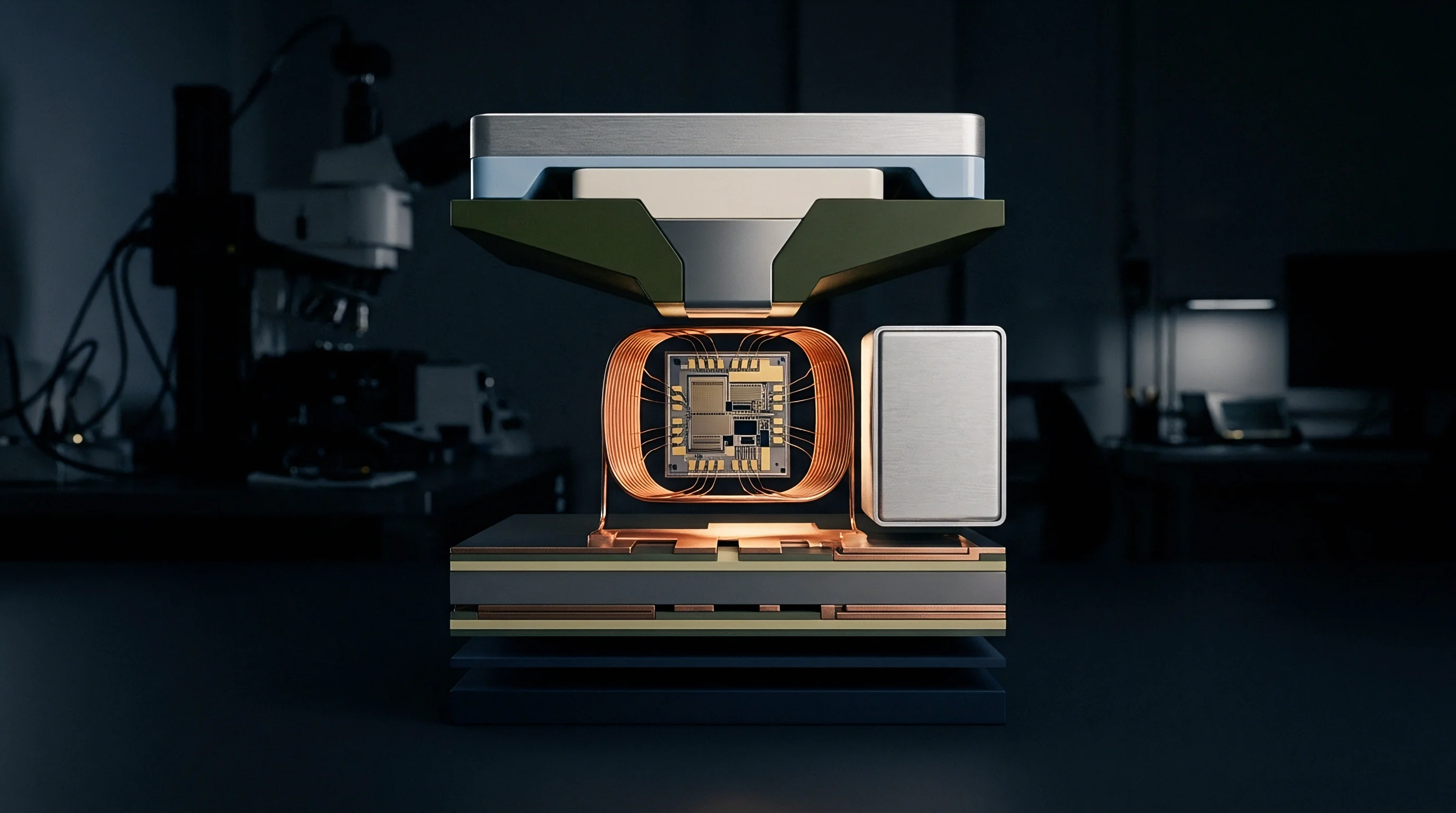
Uncertainty
Quantifying measurement uncertainty in viscoelastic aging parameters is essential for establishing reliable lifetime drift models in high-reliability semiconductor packaging. Experimental inputs from dynamic mechanical thermal analysis, differential scanning calorimetry, and stress relaxation testing carry inherent errors that propagate non-linearly through constitutive finite element calculations. Defining expanded uncertainty budgets for calibrated constitutive parameters prevents false confidence in thermal-fatigue predictions and incoming lot acceptance testing.
Primary sources of experimental uncertainty in dynamic mechanical testing include temperature sensor calibration errors, specimen dimensional tolerance stack-ups, machine compliance artifacts, and force transducer drift. In thin film die attach specimens, measuring cross-sectional area introduces substantial relative uncertainty ~ a 2-micrometer error on a 50-micrometer thick specimen introduces a 4 percent systematic offset into storage modulus measurements. Machine compliance issues become severe when testing high-stiffness glassy polymers, requiring systematic stiffness calibration using rigid steel reference specimens across the full operating temperature range.
| Uncertainty Contribution Source | Probability Distribution Type | Standard Uncertainty Value | Sensitivity Coefficient | Uncertainty Contribution (%) |
|---|---|---|---|---|
| Specimen Thickness Dimensional Measurement | Normal (k = 1) | 1.2 um | 0.084 GPa/um | 38.2 |
| DMTA Temperature Sensor Calibration Drift | Normal (k = 2) | 0.45 K | 0.042 GPa/K | 24.5 |
| DSC Enthalpy Peak Integration Baseline Fit | Rectangular | 0.25 J/g | 0.018 J/g | 14.1 |
| Rheometer Machine Frame Compliance Correction | Normal (k = 1) | 0.08 um/N | 0.026 GPa/Unit | 12.8 |
| Non-Linear Least Squares Prony Spectrum Fit | Normal (k = 1) | 0.015 Fractional | 1.000 Unitless | 10.4 |
Quantifying parameter sensitivity demonstrates that errors in the Williams-Landel-Ferry parameter C1 exert the largest influence on high-temperature life predictions. A 5 percent systematic underestimation of C1 shifts predicted relaxation times by more than half an order of magnitude at elevated operating temperatures, yielding overly optimistic creep life estimates. Uncertainty in the physical aging exponent mu similarly distorts long-term stability projections; overestimating mu artificially accelerates predicted structural stiffening, underpredicting thermal cycle stress relaxation capacity after extended storage.
Dynamic mechanical testing across the complete operating envelope avoids the unquantifiable risks of relying on single-point supplier datasheet properties. To establish rigorous quality control, procurement specifications must mandate supplier submission of complete viscoelastic calibration dossiers including expanded measurement uncertainty figures determined according to ISO/IEC Guide 98-3 guidelines. The decision protocol below guides incoming verification of viscoelastic parameter dossiers:
- Traceability Scope Verification requires validating that test laboratories hold ISO/IEC 17025 accreditation explicitly covering dynamic mechanical thermal analysis and differential scanning calorimetry within their formal scope.
- Thermal History Compliance Check verifies that raw test specimens underwent standardized thermal annealing procedures designed to reset physical aging history prior to dynamic modulus extraction.
- Master Curve Shift Validation confirms that time-temperature superposition shift factors display smooth continuous behavior without slope discontinuities across the glassy-to-rubbery transition zone.
- Non-Linear Fit Convergence Audit checks that extracted Prony series terms utilize positive-definite stiffness coefficients satisfying thermodynamic stability constraints across all temperature steps.
When experimental parameter uncertainty cannot be reduced through laboratory refinement, robust engineering design requires Monte Carlo probabilistic finite element modeling. Sampling material parameters from established multivariate probability distributions allows simulations to generate statistical distributions of package warpage and zero-point sensor drift rather than single deterministic figures. This approach enables quality engineers to calculate realistic yield loss projections and PPM failure rates for field deployments under severe environmental stress profiles.
Standardized qualification testing per IPC/JEDEC J-STD-020 guidelines specifies moisture sensitivity level classification and reflow peak temperature exposure, but fails to define mandatory verification criteria for sub-glass physical aging drift in precision sensor packaging.

Longevity
Selecting thermosetting die attach adhesives for high-reliability microelectronic applications requires balancing initial manufacturing throughput against long-term thermomechanical stability. Formulations optimized purely for sub-60-second cure schedules frequently contain high levels of reactive diluents and asymmetric monomer structures that exhibit pronounced sub-glass physical aging kinetics. High-reliability packaging designs for aerospace, automotive powertrain, and industrial sensing applications require material specifications that govern physical aging rates, maximum stress relaxation drift, and crosslink network stability across multi-year service lifespans.
Material procurement specifications must move beyond simple room-temperature lap shear strength metrics. High initial shear strength measured on a pristine, unaged bondline provides no guarantee of performance after 3,000 hours of thermal soak at elevated operating temperatures. Advanced procurement dossiers require suppliers to certify physical aging shift exponents, temperature shift function constants, and equilibrium rubbery moduli alongside traditional physical properties.
Writing these requirements into early RFQ documentation prevents mid-program material substitutions that introduce unquantified drift failure modes into mature sensor lines.
Accelerated aging test protocols must be designed with metrological rigor to avoid introducing artificial degradation mechanisms not present under actual field conditions. Testing above the instantaneous glass transition point alters the fundamental molecular relaxation mechanism from Arrhenius-governed sub-glass aging to rubbery free-volume expansion, rendering accelerated data useless for predicting room-temperature structural stability. Valid accelerated testing protocols restrict peak thermal soak levels to 15 to 20 Kelvin below the fully cured glass transition point, extending dwell durations to compensate for lower structural relaxation rates.
Field re-calibration logistics present significant commercial costs for remote or embedded sensor installations. Precision pressure transducers, inertial measurement units, and optical transceivers deployed in subsea, aerospace, or automotive environments cannot be returned to a laboratory bench for periodic zero-point adjustment without severe operational disruption. Investing in low-aging die attach adhesive grades, such as high-purity bismaleimide or heavily filled rigid polyimide formulations, increases initial per-unit adhesive material costs by 30 to 70 percent.
This upfront cost increase is offset by eliminating field drift warranty claims and reducing recurring calibration intervals across five-to-ten-year product lifespans.
The landed cost of accuracy in semiconductor packaging reflects the complete chain of design verification, material qualification, incoming lot testing, and field reliability warranty coverage. Omitting non-linear viscoelastic aging terms from initial constitutive modeling suites saves engineering simulation effort during early layout design, yet transfers massive financial risk to product qualification stages. When packaged devices encounter unpredicted thermal stress drift during final customer qualification audits, retrofitting an established package with an alternative die attach chemistry triggers complete re-qualification cycles costing hundreds of thousands of dollars and months of delayed market entry.
Integrating verified temperature-dependent viscoelastic aging models into front-end mechanical simulation routines converts material selection from a reactive trial-and-error process into a predictable quantitative engineering discipline. Quality teams, calibration engineers, and package design leads who insist on uncertainty-attached material parameter sets establish robust microelectronic assemblies that hold specified measurement tolerances across years of severe thermal and environmental exposure.