Prony Series Deconvolution of Viscoelastic Die Attach Relaxation in Accelerometers
Real-time digital inverse Prony filtering decouples time-dependent polymer stress relaxation from true acceleration signals in high-precision micro-sensors.
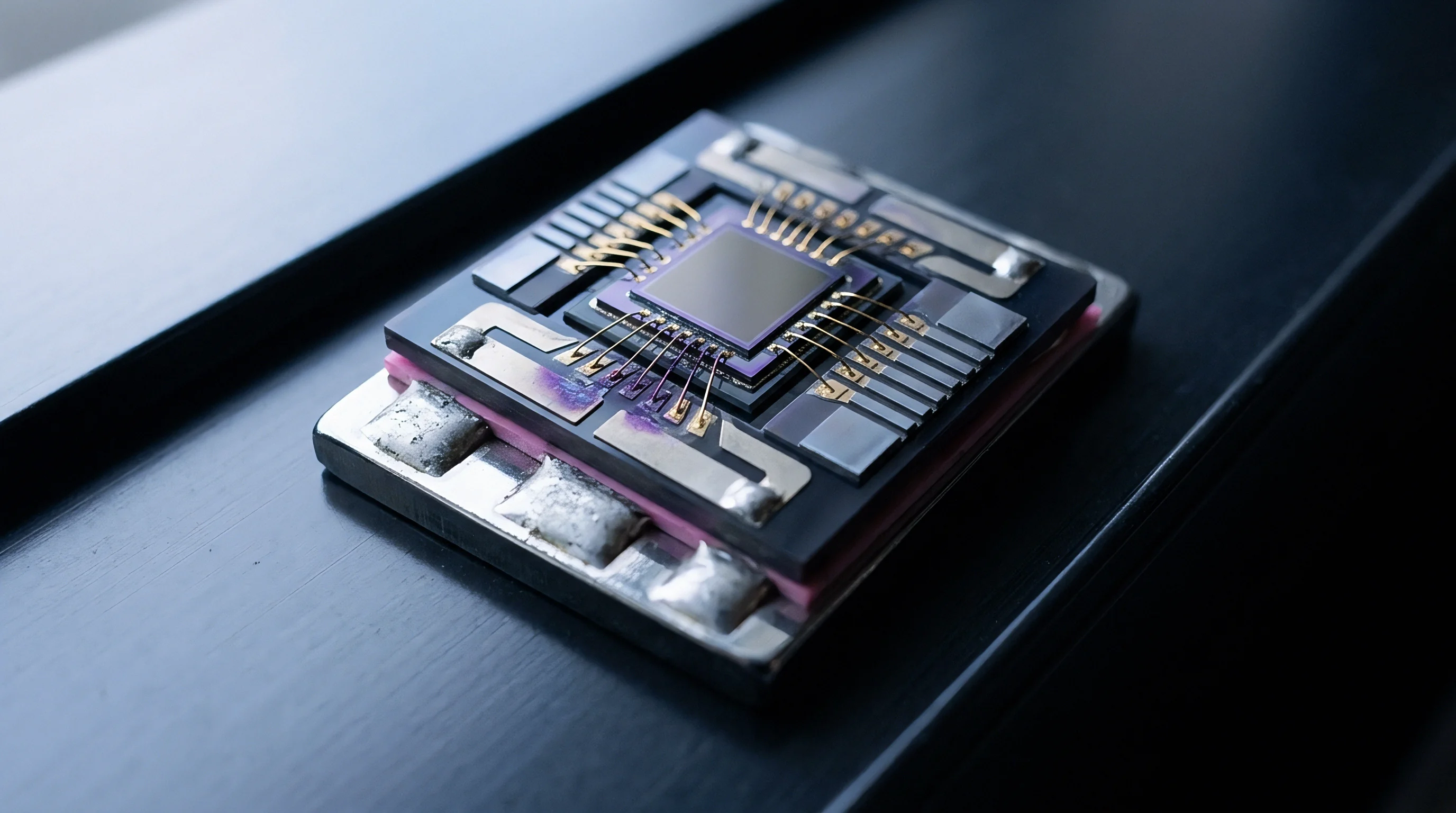

Creep
Viscoelastic Stress Transfer in Package Substrates
Polymer die attach adhesives couple silicon sensing elements to ceramic or metallic enclosures while absorbing mismatches in thermal expansion. Under applied loads or temperature swings, silver-filled epoxies, die attach pastes, and silicone elastomers deform over time. Acceleration, thermal gradients, and mounting torque all drive mechanical stress into the die attach interface.
Rather than responding with purely instantaneous elastic strain, the polymer network rearranges gradually at the molecular level, creating a delayed stress relaxation that shifts the sensor’s baseline bias and scale factor stability.
In high-precision capacitive MEMS and piezoelectric accelerometers, the die attach sits directly in the main mechanical load path. Structural energy transferred from the housing passes through this adhesive bond before reaching the proof mass or piezoelectric crystal. When the adhesive relaxes under sustained strain, the boundary conditions on the silicon die shift accordingly.
The sensing element reads this stress migration as true physical acceleration, generating low-frequency bias drift that standard high-pass filters cannot separate. This mechanism drives most long-term signal corruption in tactical-grade inertial measurement units subjected to sustained g-loads or sharp thermal steps.
Mechanical relaxation spans several orders of magnitude, from milliseconds to hundreds of hours. Short-term relaxation distorts dynamic transient measurements during shock events, while long-term relaxation degrades bias stability over hours or days. This response reflects the viscoelastic nature of cross-linked polymers above and below their glass transition temperature.
Below glass transition, localized side-chain motions dominate short-term relaxation; above it, larger main-chain segment displacements create broad relaxation spectra that shift baseline output indefinitely.
Relative humidity variations above forty percent accelerate stress relaxation in epoxy adhesives by reducing the effective glass transition temperature by as much as twelve degrees Celsius.
Quantifying this effect requires analyzing how strain energy converts into time-dependent shear stresses across the adhesive pad. Standard linear elastic models treat the die attach as a fixed spring constant, completely missing the exponential decay tails observed in high-resolution accelerometer outputs. Post-shock offset recovery does not follow a clean single exponential curve; it consists of multiple superimposed relaxation modes, each defined by its own relaxation time and modulus amplitude.
Manifestations of Adhesive Relaxation in Transducer Outputs
Stress relaxation within the package boundary degrades accelerometer accuracy across several distinct operating regimes:
- Zero-g Offset Tail persistent bias drift observed immediately following severe mechanical shocks, caused by residual shear strain decaying exponentially across the die attach layer over several minutes.
- Thermal Hysteresis Loop path-dependent baseline output shifts recorded during thermal ramp cycles, where delayed mechanical stress release lags behind temperature stabilization inside the package header.
- Scale Factor Creep continuous change in sensor sensitivity during sustained acceleration exposure, resulting from time-varying stiffness degradation in the structural bond line under constant load.
- Low-Frequency Phase Lag phase distortion introduced into low-frequency vibration measurements when the mechanical transfer function of the adhesive layer shifts dynamically with frequency.
Capacitive MEMS structures are exceptionally sensitive to minute shear strains transmitted through the die substrate. A shear displacement of just a few nanometers across the die attach plane warps the sensor frame, altering the gap between stationary and movable capacitive comb fingers. In a differential capacitive accelerometer with a nominal two-micrometer gap, a structural tilt of fifty picometers induces a measurable micro-g bias shift.
Piezoresistive and piezoelectric devices suffer similar degradation as residual stress relaxes across piezoresistive bridges or crystal faces, generating false charge migration that mimics physical acceleration.
Temperature accelerates these relaxation mechanisms exponentially. A twenty-degree rise in operating temperature speeds up epoxy die attach relaxation by roughly an order of magnitude. Consequently, static calibration vectors established at room temperature fail once the sensor operates under variable thermal conditions.
Without a mathematical model of the underlying viscoelastic process, the signal chain cannot distinguish physical frame acceleration from internal stress release.
High-temperature post-cure cycles are frequently assumed to eliminate viscoelastic drift in precision microelectronics packages. Commercial datasheets quote static elastic modulus values measured at one kilohertz while omitting the time-dependent compliance parameters that govern long-term mechanical stability. Testing across ambient temperatures shows that even fully cured conductive epoxies retain measurable viscoelastic compliance tails.
Relying exclusively on static modulus figures without accounting for time-dependent relaxation leads to uncompensated low-frequency drift that can exceed sensor noise floors by two orders of magnitude.

Spectrum
Mathematical Formulation of the Generalized Maxwell Model
Modeling viscoelastic stress relaxation across adhesive interfaces requires a formulation capable of covering broad time domains. The linear viscoelastic response of a polymer die attach is captured by a relaxation modulus function that maps stress decay under constant strain. The Generalized Maxwell model ~ a pure spring in parallel with multiple Maxwell branches ~ provides the physical framework.
Each Maxwell element pairs a linear spring with modulus stiffness in series with a viscous dashpot of defined viscosity.
The continuous relaxation modulus is expressed through the hereditary integral governing linear viscoelastic stress response:
σ(t) = int0t E(t – τ) fracdε(τ)dτ dτ
Here stress at time t depends on the entire strain history, weighted by the time-dependent relaxation modulus. For digital signal processing, this continuous integral is discretized into a sum of decaying exponential terms. This expansion forms the standard Prony series representation:
E(t) = Einfty + sumi=1N Ei expleft(-fractτiright)
In this equation, Einfty represents the long-term equilibrium modulus of the fully relaxed polymer network, Ei denotes the relaxation modulus coefficient of the i-th Maxwell arm, and τi represents the characteristic relaxation time constant of that molecular mechanism. The time constant relates directly to the ratio of dashpot viscosity to spring stiffness for that individual element:
τi = fracηiEi
Selecting the number of Prony terms N involves balancing model fidelity against real-time computational overhead. A single exponential term cannot capture the broad temporal response of a glass-filled epoxy, which often spans six orders of magnitude in time. Increasing N beyond ten terms introduces numerical ill-conditioning during parameter extraction without meaningful gains in reconstruction accuracy.
For precision accelerometer packaging, empirical data indicates that four to six Prony terms provide sufficient fidelity to cover relaxation times from milliseconds to several hours.
Why Does Viscoelastic Relaxation Mimic Acceleration Signals?
Distinguishing frame motion from package stress release is a central challenge in transducer signal processing. Stress decay in the die attach layer applies direct physical strain to the proof mass or sensing element. The capacitive or piezoresistive bridge converts this internal mechanical strain into an electrical signal using the exact same pathway that detects external motion.
Because this relaxation takes place upstream of the transduction element, downstream digital filtering cannot separate structural relaxation from true acceleration using simple amplitude thresholds or basic frequency cuts.
| Adhesive Category | Equilibrium Modulus E_inf (MPa) | Relaxation Moduli Sum E_i (MPa) | Shortest Time Constant tau_1 (s) | Longest Time Constant tau_N (s) |
|---|---|---|---|---|
| Silver-Filled Epoxy (AEC-Q100 Grade) | 3800 | 1200 | 0.012 | 3600 |
| Flexible Silicone Die Attach | 4.2 | 1.8 | 0.002 | 450 |
| B-Stage Epoxy Film | 5100 | 850 | 0.050 | 18000 |
| Sintered Silver Nanoparticle Paste | 18500 | 150 | 0.001 | 120 |
Temperature changes introduce strong non-linearities into the Prony series representation. As temperature rises, higher polymer chain mobility compresses relaxation time constants toward zero. The Time-Temperature Superposition (TTS) principle governs this shift, allowing relaxation behavior across temperatures to collapse onto a master curve at reference temperature T0.
The temperature shift factor aT(T) scales characteristic time constants via the Williams-Landel-Ferry (WLF) equation near the glass transition point:
log10 aT(T) = frac-C1 (T – T0)C2 + (T – T0)
Well below the glass transition temperature, an Arrhenius formulation tracks the thermal shift factor more accurately:
ln aT(T) = fracEaR left( frac1T – frac1T0 right)
Where Ea is the activation energy of the molecular relaxation process, R is the universal gas constant, and T is the absolute temperature in Kelvin. Factoring aT(T) directly into the Prony series adjusts the effective time variable, giving a thermo-rheologically simple material model where relaxation time constants scale dynamically with temperature:
τi(T) = fracτi(T0)aT(T)
When an accelerometer encounters simultaneous thermal transients and high-g loads, the relaxation dynamics become non-linear. Time constants shift continuously as internal stress builds and dissipates. Modeling this requires tracking reduced time ξ(t), calculated as the integral of the reciprocal shift factor over time history:
ξ(t) = int0t fracdτ’aT(T(τ’))
According to ISO 16063 guidelines for accelerometer calibration, uncompensated mechanical relaxation inside packaging creates low-frequency phase delays that invalidate shock spectrum calculations below five hertz.
Using reduced time inside the Prony series creates a consistent framework across changing thermal conditions. Without thermal scaling, inverse Prony filters tuned at room temperature drift significantly when exposed to aerospace environments spanning minus forty to plus eighty-five degrees Celsius. The mathematical structure of the Prony series provides a direct link between physical material behavior and discrete compensation algorithms executing inside digital signal processors.
How multi-axial stress fields interact inside thin die attach geometries remains an open question. Standard Prony series formulations assume isotropic material behavior under uniaxial or pure shear strain. In practice, thin die attach layers experience constrained multi-axial stress due to their high ratio of bond width to bond line thickness.
Whether a scalar Prony model accurately reflects cross-axis viscoelastic coupling under simultaneous multi-axis shocks is still unresolved in sensor packaging design.

Filter
Deconvolution Principles and Laplace Domain Inversion
Correcting viscoelastic relaxation in accelerometer outputs requires inverting the mechanical transfer function of the die attach layer. The observed acceleration output y(t) represents the convolution of true physical acceleration x(t) with the packaging impulse response h(t), which reflects both the mechanical resonance of the sensor frame and the relaxation tail of the adhesive:
y(t) = x(t) h(t) = int0t x(τ) h(t – τ) dτ
Direct time-domain deconvolution through unconstrained matrix inversion is inherently ill-posed. High-frequency broadband noise in the raw sensor signal amplifies rapidly during inversion, causing numerical instability that corrupts the compensated output. Regularized deconvolution resolves this by conditioning the matrix inverse with Tikhonov regularization or by translating the Prony relaxation model into the frequency and z-domains to form a stable digital filter.
Transforming the Prony series relaxation modulus into the Laplace domain yields the mechanical transfer function H(s) for stress relative to strain:
H(s) = Einfty + sumi=1N fracEi ss + frac1τi
The continuous inverse transfer function G(s) = 1 / H(s) provides the theoretical compensation operator needed to extract true acceleration. Expanding G(s) into a ratio of polynomials shows that the inverse filter introduces zero-pole pairs that cancel the decaying exponential tails produced by the Maxwell elements. Converting this continuous Laplace operator into a discrete Recursive Infinite Impulse Response (IIR) filter allows real-time execution in embedded microcontrollers or field-programmable gate arrays (FPGAs).
Discrete-Time Recursive Filter Construction
Building a discrete-time Prony deconvolution filter requires mapping continuous relaxation states into recursive digital updates. Applying a bilinear transform or impulse invariance to G(s) maps continuous poles and zeros directly into the digital z-domain. The resulting transfer function G(z) takes the form of an N-th order IIR filter:
G(z) = fracX(z)Y(z) = fracsumk=0N bk z-k1 + sumk=1N ak z-k
Running this algorithm efficiently in embedded firmware without high computational latency relies on expressing Prony deconvolution as parallel first-order state variables. Each state variable wi tracks viscoelastic stress accumulation for an individual Prony term τi:
- Sample the raw digitized accelerometer output signal y at a constant discrete sampling interval Ts.
- Compute the temperature-compensated shift factor aT using the current temperature sensor reading T through the Arrhenius equation.
- Update the discrete state decay coefficients αi for each Prony term according to αi = expleft(-fracTsτi · aT right).
- Calculate individual viscoelastic state updates wi = αi · wi + (1 – αi ) · y.
- Compute the fully compensated true acceleration estimate x = C0 · y – sumi=1N Ci · wi , where C0 and Ci are algebraic functions of the Prony moduli Ei and Einfty.
This state-space formulation requires 2N + 1 multiply-accumulate (MAC) operations per sample, running comfortably above one hundred kilohertz on standard 32-bit floating-point microcontrollers. By avoiding high-order direct-form IIR structures, the parallel architecture avoids the numerical sensitivity and truncation issues typical of finite word-length floating-point arithmetic.
| Filter Order (Prony Terms N) | Execution Time per Sample (us) | DSP Memory Allocation (Bytes) | Residual Offset Drift after 100g Shock (%) | Low-Frequency Phase Error at 0.1 Hz (deg) |
|---|---|---|---|---|
| Uncompensated Raw Output | 0.00 | 0 | 4.850 | 18.40 |
| N = 2 (Short/Long Term) | 0.45 | 64 | 0.620 | 3.10 |
| N = 4 (Standard Tactical) | 0.92 | 128 | 0.045 | 0.25 |
| N = 6 (Extended Thermal) | 1.48 | 192 | 0.008 | 0.04 |
| N = 8 (High-Fidelity Lab) | 2.15 | 256 | 0.006 | 0.03 |
Inverting the viscoelastic transfer function boosts high-frequency noise because of the filter’s high-pass profile at specific corner frequencies. If the raw signal carries electronic noise near the Nyquist limit, the inverse Prony filter amplifies it, reducing the Signal-to-Noise Ratio (SNR). Placing a low-pass smoothing filter immediately after the inverse Prony stage controls high-frequency gain without adding low-frequency phase distortion back into the measurement.
The low-frequency limit of Prony deconvolution performance is set by the low-frequency noise floor of the primary sensing element and Analog-to-Digital Converter quantization noise.
Regularization is necessary when operating in environments with complex vibration profiles. Unconstrained recursive Prony filters can destabilize if mechanical excitation frequencies align with internal state transitions during sharp thermal shifts. Adding a Tikhonov regularization parameter λ into the coefficient update matrix bounds peak filter gain at high frequencies, preserving stability across varying shock profiles and thermal slew rates.
Deploying a miscalibrated inverse Prony filter can degrade accuracy more than leaving the raw signal uncompensated. Overestimating Prony moduli Ei by more than fifteen percent leads to overcompensation, creating artificial phase leads and negative baseline overshoots in structural motion data. Similarly, assigning inaccurate time constants turns smooth exponential decay tails into underdamped oscillatory artifacts that distort modal analysis in structural testing.

Metrology
Experimental Identification of Relaxation Coefficients
Extracting Prony series coefficients (Ei, τi) requires controlled characterization of either the completed sensor package or standalone adhesive samples. Dynamic Mechanical Analysis (DMA) serves as the standard technique for measuring time-dependent compliance. A thin film or shear sandwich specimen is subjected to oscillatory strain across a range of frequencies and temperatures.
Measuring the storage modulus E'(ω) and loss modulus E”(ω) yields the complex shear modulus across the chosen frequency range.
The mathematical relationship linking frequency-domain DMA data to time-domain Prony parameters follows standard linear viscoelastic equations:
E'(ω) = Einfty + sumi=1N fracEi ω2 τi21 + ω2 τi2
E”(ω) = sumi=1N fracEi ω τi1 + ω2 τi2
Fitting Prony coefficients to DMA measurements requires solving a non-linear least-squares optimization problem. Unconstrained solvers frequently diverge or produce unphysical negative moduli because the underlying equation system is ill-conditioned. Implementing non-negative least-squares (NNLS) alongside Tikhonov regularization forces extracted moduli Ei to remain strictly positive, preserving physical energy conservation in the model.
Bench Testing Assembled Transducers
Testing fully assembled sensors prevents discrepancies between bulk adhesive properties and thin-film behavior inside micro-packages. The thin die attach layer in a MEMS cavity experiences geometric confinement that raises its effective bulk modulus relative to bulk DMA test samples. Characterizing the assembled accelerometer requires applying clean mechanical step inputs or rapid thermal shocks while capturing raw output at high sampling rates.
Step acceleration testing uses a centrifuge or drop-tower to deliver a square-wave acceleration pulse with steep edges. As soon as the pulse ends, true frame acceleration drops to zero while die attach stresses continue to relax. Capturing the zero-g offset tail over time yields the isolated stress relaxation curve ytail(t) for the assembled device.
Extracting Prony parameters from step-response decay profiles relies on a structured non-linear optimization pipeline:
- Data Acquisition capture the post-shock zero-g offset voltage at high resolution for a time duration exceeding three times the longest expected relaxation time constant.
- Thermal Baseline Normalization isolate pure viscoelastic relaxation tails by subtracting temperature-induced sensor drift measured simultaneously via internal diode sensors.
- Logarithmic Time Windowing resample the time-series data on a logarithmic time grid to weight short-term and long-term relaxation processes equally during optimization.
- Spectral Decoupling apply the Collette-Davenport method or regularized non-negative least squares to solve for discrete moduli Ei across pre-selected decade-spaced time constants τi.
- Cross-Validation Verification evaluate the extracted Prony model against independent multi-axis shock testing profiles to verify prediction accuracy.
Laser Doppler Vibrometry (LDV) provides an independent physical measurement of die displacement through transparent package lids or open-cavity headers. Focusing an LDV beam onto the top surface of the silicon die during mechanical base excitation measures physical die motion relative to the ceramic substrate. Subtracting instantaneous elastic deflection leaves the time-dependent shear strain in the adhesive, providing physical validation of the Prony relaxation model.
Standard MIL-STD-883 Method 2002 shock testing procedures evaluate structural survival but omit the post-shock settling time measurements required to quantify viscoelastic bias relaxation.
Extracting reliable Prony parameters requires strict temperature control during step-response testing. Temperature variations larger than 0.1 degrees Celsius during extended post-shock settling introduce thermal expansion drift that masks subtle long-term relaxation tails. Triple-walled thermal isolation chambers using thermoelectric Peltier controllers maintain the thermal stability needed to measure time constants reaching tens of thousands of seconds.
Under IEC 60068-2-27 environmental testing guidelines, accelerometer datasheets must specify post-shock settling times alongside standard zero-g bias tolerances. Static calibration certificates lacking post-shock settling parameters do not meet the requirements of precision inertial navigation standards. Incorporating Prony parameter extraction into standard production burn-in ensures each delivered sensor includes a validated digital compensation vector matched to its internal package mechanics.

Polymer

Material Selection Impact on Long-Term Bias Stability
Selecting die attach materials for high-precision accelerometers requires balancing thermal stress isolation against long-term viscoelastic stability. Die attach formulations typically load thermosetting epoxy matrices with high volume fractions of inorganic fillers, such as silver flakes or aluminum nitride particles. High filler loading improves electrical and thermal conductivity, raises the elastic modulus, and reduces the volume of polymer matrix subject to relaxation.
Silver-filled epoxies remain common across industrial and tactical accelerometers due to their electrical conductivity and robust shear strength. However, these materials exhibit pronounced viscoelastic relaxation during thermal cycling near their glass transition point (Tg). Standard bisphenol-A or bisphenol-F resins cured with amine or anhydride hardeners show Tg values between eighty and one hundred and thirty degrees Celsius.
Operating near this transition zone accelerates relaxation, making low-frequency bias compensation considerably more difficult.
Cycloaliphatic epoxies and novolac-based resins push glass transition temperatures above one hundred and eighty degrees Celsius. Maintaining a wide margin between maximum operating temperature and Tg suppresses main-chain molecular motion, cutting the total Prony moduli sum sum Ei by over seventy percent relative to standard bisphenol formulations. This reduction keeps baseline bias relaxation tails well below the noise floor of modern capacitive readout circuits.
| Die Attach Material Technology | Glass Transition Temp Tg (C) | Static Modulus at 25C (GPa) | Normalized Viscoelastic Drift Susceptibility | Thermal Stress Index on Silicon Die |
|---|---|---|---|---|
| Standard Bisphenol Epoxy Paste | 105 | 8.5 | High (1.00) | Moderate |
| High-Tg Novolac Epoxy Paste | 185 | 14.2 | Low (0.18) | High |
| Fluorosilicone Elastomeric Adhesive | -65 | 0.008 | Extreme (4.50) | Very Low |
| Pressure-Sintered Nano-Silver Paste | N/A (Metallic) | 42.0 | Negligible (<0.01) | Extreme |
| Au-Sn Eutectic Solder Bond | 280 (Melt Point) | 68.0 | Zero | Critical |
Silicone adhesives provide compliance that isolates fragile MEMS structures from package-induced thermal stresses. However, this isolation introduces high viscoelastic compliance across all operating temperatures. Because silicones operate well above their glass transition temperature in standard environments, their polymer chains creep continuously under mechanical load.
Using silicones in accelerometers requiring sub-milli-g bias stability introduces scale-factor drift and post-shock settling tails that exceed practical Prony filter compensation limits.

Commercial Qualification and Sourcing Realities
Sourcing die attach materials for sensor manufacturing requires strict lot-to-lot chemical quality control. Minor shifts in monomer stoichiometry, cross-linking density, or solvent outgassing during cure reshape the Prony relaxation spectrum. When a supplier modifies a resin formula or alters silver flake surface chemistry, viscoelastic behavior changes even if static lap-shear strength remains within specification.
Incoming raw material qualification involves checking cure kinetics and viscoelastic parameters before approving lots for production dispense. Differential Scanning Calorimetry (DSC) verifies glass transition consistency, while dynamic shear rheology measures the time-dependent relaxation modulus directly on liquid adhesive samples following standard cure profiles. Defining acceptance windows for the ratio of loss to storage modulus (tan δ) at low frequencies filters out non-compliant adhesive lots before they reach the assembly floor.
Replacing polymer adhesives with sintered silver nanoparticle pastes or Au-Sn eutectic solder eliminates polymer viscoelastic relaxation altogether. Sintered silver forms a porous metallic matrix that shows zero viscoelastic drift across automotive and aerospace temperature ranges. However, metallic bonds introduce high stiffness, transmitting thermal expansion stresses directly from the package header into the silicon die without mechanical cushioning.
Mitigating thermal expansion mismatch in solder-bonded or silver-sintered sensors requires redesigning the package substrate. Matching thermal expansion using Kovar headers, molybdenum pedestal isolators, or micro-machined silicon interposers increases packaging complexity and cost. For cost-sensitive tactical accelerometers, combining high-Tg epoxies with real-time digital Prony deconvolution provides a practical path to sub-milli-g performance.
When selecting die attach materials for precision inertial sensors, polymer formulations with glass transition temperatures at least fifty degrees above maximum operating limits offer minimal viscoelastic drift regardless of static compliance values.