Nonlinear Viscoelastic Epoxy Hysteresis Calibration under Asymmetric Multi-Axis Thermal Shock Environments
Viscoelastic epoxy hysteresis under multi-axis thermal shock requires dynamic state-space Prony calibration to compensate temperature-dependent zero drift.

Creep
Polymer die-attach adhesives and encapsulation resins undergo stress relaxation and retain instantaneous strain memory under mechanical loads. When thermosetting polymers secure a precision strain gage, capacitive pressure diaphragm, or optical sensing die to a substrate, internal stress in the resin shifts the transducer’s zero-point output. Isolating structural strain from thermal strain is essential for high-accuracy sensing.
Polymer crosslinking networks depart from ideal linear elastic behavior, with both glassy and rubbery phases showing time-dependent deformation under constant load and lagging behind when those loads are removed.
Constitutive Polymer Physics and Time-Temperature Superposition
The viscoelastic strain response of a thermosetting resin involves immediate elastic deflection, delayed micro-Brownian sliding of chain segments, and irreversible viscous flow. Linear viscoelastic models rely on the Boltzmann superposition principle, treating compliance as independent of stress magnitude. Rapid thermal transients, however, generate localized stress peaks that force the packaging resin into non-linear regimes where stress-dependent compliance functions dictate relaxation rates.
Time-temperature superposition assumes thermorheologically simple material behavior, allowing short-term response at elevated temperatures to map onto long-term ambient performance. Near and above the glass transition region, shift factors derived from the Williams-Landel-Ferry equation describe this mechanical relaxation:
log10(aT) = -C1 (T – Tref) / (C2 + T – Tref)
Below the glass transition temperature, structural relaxation follows Arrhenius kinetics driven by an apparent activation energy. Glassy polymers undergo physical aging as their non-equilibrium specific volume contracts toward equilibrium over time. This aging changes mechanical compliance, shifting the relaxation spectrum toward longer time constants across extended thermal cycles.
An uncompensated bisphenol-A epoxy die attach can retain up to 380 microstrain of unrecovered residual strain after a single 180 K thermal shock step at a ramp rate exceeding 40 K per minute.

Nonlinear Shift Factors beyond the WLF Domain
Strong multi-axial stress fields lower the energy barrier required for polymer chain reorientation. Stress-dependent shift factors alter the reduced time scale, accelerating relaxation when thermal expansion mismatch is severe. Accurately modeling this non-linear strain response requires extending standard Prony series representations to account for instantaneous stress invariants.
Material modulus drops sharply near the transition temperature.
State variables track instantaneous changes in free volume during rapid cooling. When the cooling rate outpaces structural relaxation, excess free volume gets trapped in a non-equilibrium state, locking residual stress fields into the packaged sensor assembly.
| Temperature Regime | Storage Modulus (GPa) | Loss Modulus (MPa) | CTE (ppm/K) | Shift Behavior |
|---|---|---|---|---|
| Glassy Domain (T < Tg – 30 K) | 3.5 to 8.2 | 45 to 120 | 25 to 45 | Arrhenius thermal activation |
| Transition Zone (Tg ± 15 K) | 0.8 to 3.2 | 180 to 650 | 50 to 110 | Williams-Landel-Ferry non-linear shift |
| Rubbery Domain (T > Tg + 30 K) | 0.01 to 0.15 | 2 to 15 | 120 to 220 | Rubber elasticity equilibrium modulus |
In dynamic thermal shock conditions, calibration models must separate genuine mechanical strain on a sensor diaphragm from physical relaxation occurring inside the underlying encapsulation matrix.

Asymmetry
Uneven heat distribution across sensor micro-packages creates sharp temperature gradients during rapid thermal shock. Sudden exposure to hot or cold fluid streams expands or contracts the top face of a chip while the underlying substrate remains near its initial temperature. These spatial gradients generate complex multi-axial stress, including out-of-plane bending moments, interfacial shear, and peeling stresses along the die edges.

Thermal Shock Spatial Gradients and Multi-Axis Shear
Standard thermal shock qualification often assumes uniform heating across the component body, but actual operating environments produce directional heat flux. For instance, a pressure sensor subjected to sudden cryogenic fluid injection experiences asymmetric transient heat transfer across its mounting flange, silicon substrate, and epoxy seal.
These thermal gradients induce pronounced directional shear across internal package interfaces.
The resulting strain gradients generate asymmetric shear at the bond line between silicon dies and organic substrates. This shear distorts piezoresistive bridge symmetry, generating false differential pressure signals that persist well after bulk temperatures equalize.

How Do Asymmetric Gradients Accelerate Polymer Relaxation?
Thermal gradients cause uneven relaxation across different regions of the adhesive joint. Quadrants exposed to higher transient temperatures soften first, transferring mechanical load to cooler, stiffer areas of the resin. This uneven load distribution disrupts zero-point symmetry in precision sensors.
Progressive polymer relaxation directly alters baseline output signals over time.
The asymmetric loading trajectory follows different paths during heating and cooling, creating non-symmetric hysteresis loops in stress-strain-temperature space. Standard single-axis calibration models cannot account for these path-dependent drift vectors.
Uncompensated multi-axial thermal shock leads to several distinct mechanical and electrical failures inside packaged sensors:
- Interfacial Die Delamination drives complete structural separation along high-shear corners of silicon substrates during rapid cooling drops.
- Bridge Unbalance Drift causes persistent zero-point offsets in piezoresistive Wheatstone bridges through asymmetric residual stress.
- Micro-Cracking Propagation accelerates fatigue within high-filler resin interfaces under repeated cyclic thermal shear.
- Capacitive Gap Distortion disrupts parallelism between MEMS sensing diaphragms and reference backplates, introducing non-linear scale factor errors.
Matching thermal expansion coefficients across structural axes mitigates thermal shock hysteresis without relying on complex algorithmic compensation.

Chamber
Separating viscoelastic hysteresis from thermal expansion requires test setups capable of controlling spatial thermal gradients. Standard environmental chambers ramp air temperature at up to 5 K per minute, giving internal stresses enough time to relax continuously during testing. Capturing dynamic shock behavior requires air-to-air double-box systems or dual-liquid baths capable of ramp rates beyond 50 K per minute.
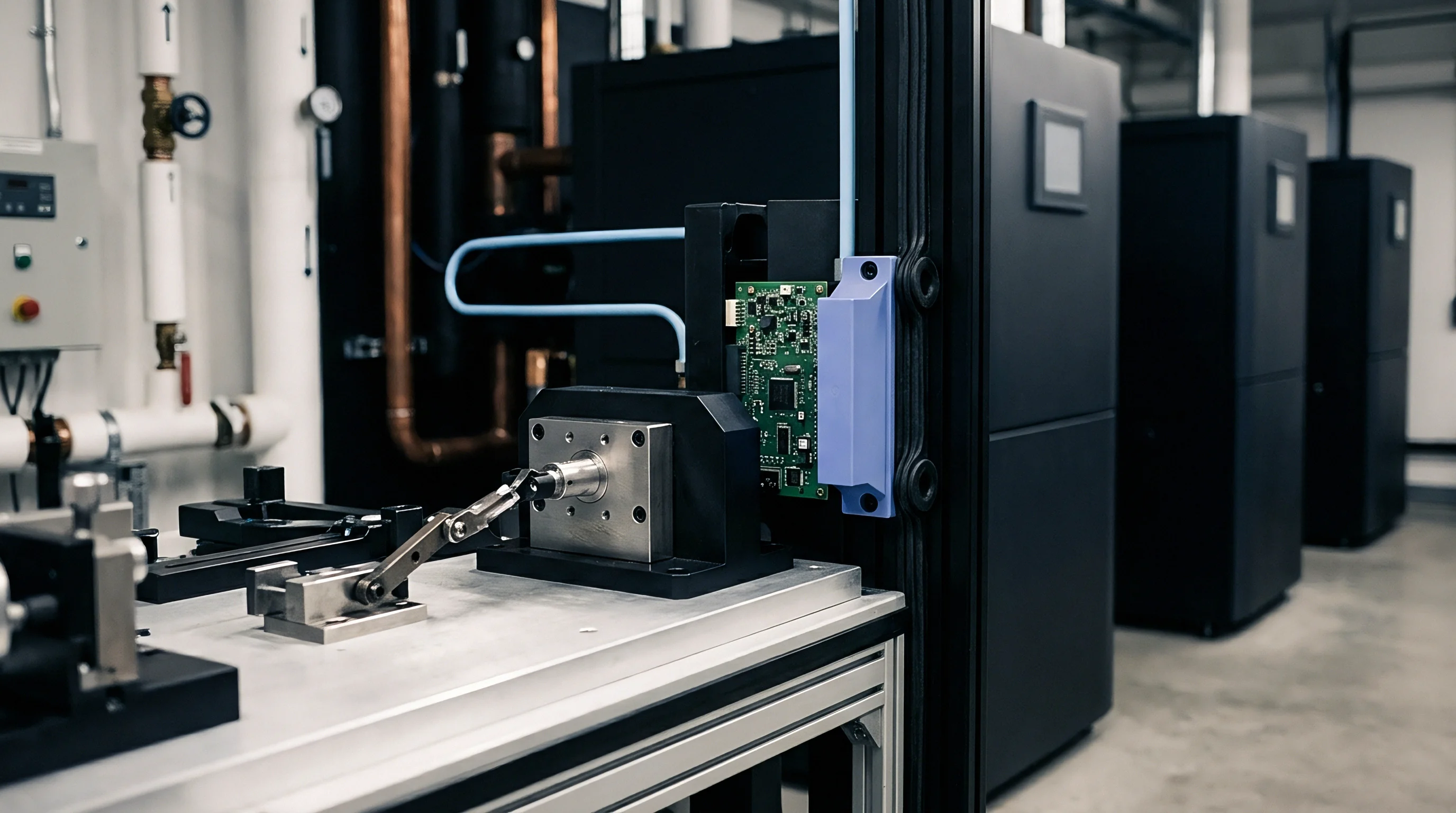
Empirical Test Rigs and Multi-Axis Stress Mapping
Accurate calibration requires measuring multi-axis surface strain while applying controlled asymmetric thermal transients to the package. Combining sub-micron optical deformation mapping via high-speed digital image correlation with embedded fiber Bragg grating strain arrays captures how internal stress fields develop in real time.
Transient heat transfer directly drives physical strain within the package.
Optical ports built into shock chamber walls allow continuous tracking of die warping during fluid transfers. Synchronizing multi-channel optical strain measurement with sub-millisecond temperature logging isolates viscoelastic phase lags from linear thermal expansion.
Failure to specify multi-axis gradient limits under JESD22-A104 Condition N allows packaging to pass qualification in symmetric liquid immersion setups that mask directional shear failures.
Decoupling Transient Thermal Expansion from Viscoelastic Memory
Calibrating viscoelastic hysteresis models requires separating the sensor’s instantaneous thermal response from time-dependent structural drift. Stepped thermal shock sequences help isolate temperature coefficients from underlying creep rates.
Step-wise thermal shock testing maps material response through a defined empirical sequence:
- Soak the sensor package at initial temperature T0 in the primary conditioning zone for sixty minutes to establish baseline mechanical equilibrium.
- Transfer the package to the second temperature zone T1 within three seconds using a pneumatic transfer rail.
- Record sensor bridge output, temperature readings, and optical displacement at one-kilohertz sampling rates for five hundred seconds.
- Apply a mechanical reference pulse at set intervals during isothermal dwell phases to measure instantaneous stiffness decay.
- Return the package to baseline zone T0 and monitor zero-point recovery for two thousand seconds.
Uncorrected viscoelastic drift permanently degrades structural zero-point stability.
Calibrating sensor algorithms solely against symmetric, single-axis chamber profiles leads to field failures when devices encounter directional, multi-axis heat flow.


Kernel
Modeling non-linear viscoelastic hysteresis in real time requires recursive state-space structures suitable for microcontrollers. Storing complete thermal and strain histories demands too much memory for field instruments, making direct convolution impractical. Discrete-time Prony series expansions condense historic strain integration into compact state variable updates calculated at every analog-to-digital sampling frame.
Recursive State-Space Calibration and Prony Expansions
Under changing temperature fields, the time-domain relaxation modulus E(t) translates to a summation of exponential decay elements:
E(xi) = E_infinity + sum(Ei exp(-xi / tau_i))
Here, xi represents reduced time, calculated by integrating inverse thermal shift factors over time:
xi(t) = integral(dt’ / aT(T(t’)))
Converting these continuous integrals into discrete state-space update equations enables real-time processing. Each Prony term tracks an internal state variable representing internal material stress. Updating these states requires only two multiplications and one addition per channel per step.
Calibrating a viscoelastic state space requires driving thermal shock past the glass transition temperature to capture the full relaxation envelope.
Real-Time Matrix Operations in Embedded Signal Chains
High-resolution analog-to-digital converters capture primary sensor bridge outputs alongside localized temperature diode signals. The microcontroller then passes these values through calibration matrices to derive corrected pressure or strain readings.
Interfacial shear gradients induce measurable phase lag in output responses.
State-space hysteresis updates run before polynomial temperature compensation. Correcting raw readings for viscoelastic stress history removes thermal lag errors prior to applying static calibration coefficients.
| Model Architecture | RAM Budget (Bytes) | Execution Time (µs) | Zero-Drift Reduction (%) | Multi-Axis Capability |
|---|---|---|---|---|
| Static 3rd-Order Polynomial | 32 | 1.2 | 12 to 25 | Poor |
| 3-Term State-Space Prony | 128 | 8.5 | 78 to 88 | Moderate |
| 5-Term Non-Linear Prony Matrix | 512 | 24.0 | 92 to 97 | High |
| Hammerstein-Wiener Recurrent Filter | 2048 | 110.0 | 94 to 98 | High |
Epoxy viscoelasticity is sometimes assumed to stabilize after three ambient thermal cycles, which would make mathematical hysteresis modeling unnecessary for standard applications, though uncompensated drift frequently persists under dynamic loads.

Bond
Epoxy chemistry governs the mechanical compliance, glass transition temperature, and long-term creep stability of die-attach layers. Formulating low-hysteresis adhesives requires balancing crosslink density against the inclusion of flexible chain segments. Highly crosslinked rigid epoxies minimize creep but increase the risk of brittle fracture under severe thermal shock.

Formulation Chemistry and Mechanical Stress Matching
Incorporating inorganic micro-fillers like fused silica or aluminum nitride lowers the adhesive’s thermal expansion coefficient, bringing it closer to that of silicon substrates. However, high filler loading alters the rheological compliance network within thin bond lines.
The filler loading fraction directly dictates overall thermal expansion behavior.
Silane coupling agents strengthen interfacial bonding between the polymer matrix and silica particles. If these interfaces are weak, they slip under multi-axial thermal shear, creating localized hysteresis loops that degrade zero-point stability.
Silica filler loading above sixty-five percent by weight reduces thermal expansion mismatch but increases mechanical stiffness and dynamic hysteresis.

Qualification Boundaries under International Shock Standards
Standard electronic component specifications mandate thermal shock testing to verify structural integrity. However, passing routine mechanical stress qualification does not guarantee zero-point stability in high-accuracy sensors.
Asymmetric thermal profiles directly impair zero-point stability over time.
Evaluating packaging behavior under realistic environmental extremes is necessary to ensure signal integrity over the operational lifespan.
| Standard Designation | Temperature Extreme (℃) | Transfer Time (s) | Dwell Time (min) | Target Failure Mode |
|---|---|---|---|---|
| JESD22-A104 Condition N | -55 to +125 | < 10 | 15 | Solder joint cracking, delamination |
| MIL-STD-883 Method 1010 C | -65 to +150 | < 10 | 10 | Die attach fracture, wire bond shear |
| AEC-Q100 Grade 0 Shock | -50 to +150 | < 5 | 30 | Packaging hermeticity, sensor drift |
Selecting encapsulation resins for strain-sensitive transducers requires systematic evaluation of several key material properties:
- Glass Transition Margin ensures operational temperatures stay at least forty degrees Celsius below the resin softening zone.
- Silica Filler Loading specifies a sixty to sixty-eight weight percent spherical filler fraction to balance thermal expansion matching against mechanical stiffness.
- Cure Conversion Ratio requires at least ninety-eight percent crosslinking completion verified by differential scanning calorimetry to prevent room-temperature post-curing.
- Viscoelastic Loss Tangent caps mechanical energy dissipation ratios below 0.02 during dynamic mechanical analysis across expected operating temperatures.
Under AEC-Q100 Grade 0 criteria, any sensor lot exceeding 0.15 percent full-scale zero-point calibration drift after 1,000 thermal shock cycles is rejected.
Dossier
Procuring high-precision sensors for asymmetric thermal shock environments requires auditing vendor resin control procedures. Bulk chemical suppliers produce epoxies with broader property tolerances than precision instruments can accommodate. Batch-to-batch variations in catalyst ratios, monomer purity, or filler size distribution can shift glass transition temperatures by several degrees, altering dynamic hysteresis performance.

Sourcing Risk and Resin Batch Variance
Packaging manufacturers sometimes alter resin formulations to trim costs or navigate material shortages without re-qualifying sensor drift performance. A formulation tweak that maintains structural adhesion can easily double viscoelastic hysteresis under rapid thermal shocks.
Unaccounted memory effects degrade the accuracy of static calibration curves.
Procurement contracts for high-reliability sensor lines must require advance notification for chemical changes and lot-specific dynamic mechanical analysis reports with each shipment. Cold-chain transport monitoring ensures resin stability prior to dispensing.

Audit Verification for High-Reliability Sensor Sourcing
Incoming inspection protocols for precision sensors should pair static calibration checks with dynamic thermal shock sampling. Testing five components per wafer lot under asymmetric thermal shock reveals packaging stress issues before parts enter assembly.
Dynamic thermal stress produces persistent zero-point offset errors.
Specifying mandatory state-space Prony calibration parameters in procurement contracts helps ensure embedded signal chains maintain accuracy across operating temperatures.