Dual Mode Temperature Sensing Architecture for Resonant MEMS Accelerometers
Dual-mode temperature sensing simultaneously tracks two structural resonance frequencies on one silicon element to eliminate spatial thermal lag without extra sensors.
Beam
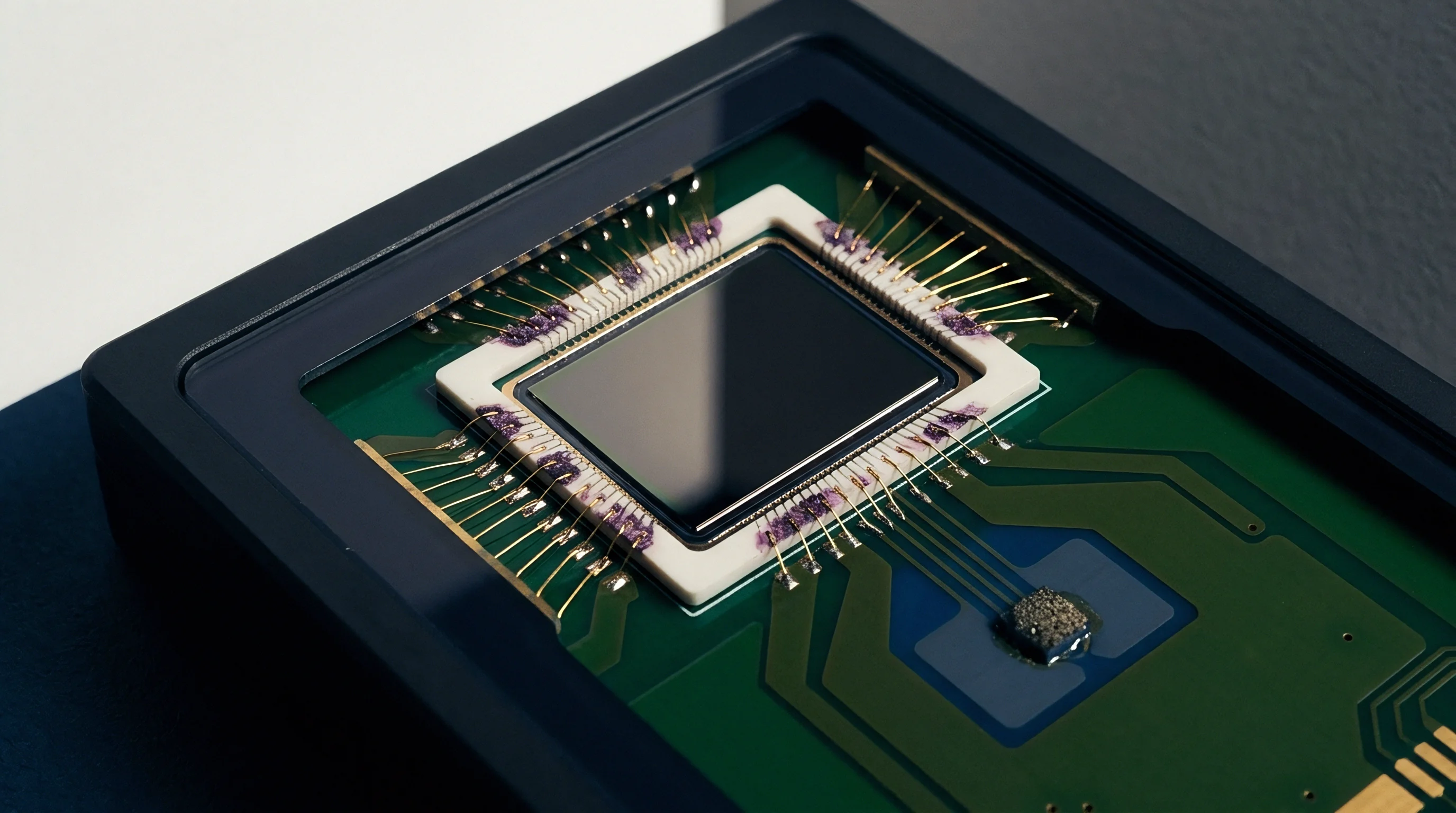
Thermal gradients across a microelectromechanical system degrade measurement repeatability before a signal leaves the silicon. In an acceleration sensor targeting micro-g bias stability, ambient temperature changes distort the suspension, alter residual package stress, and shift the elastic modulus of single-crystal silicon downward by negative sixty parts per million per kelvin. Mounting a discrete thermistor or platinum resistor next to the package reads only the outside ambient, missing localized gradients inside the vacuum cavity.
Resonant MEMS accelerometers measure inertial loads by tracking frequency shifts in micromachined vibrating flexures. Double-ended tuning forks or clamped-clamped micro-resonators couple mechanically to a suspended proof mass. In-plane displacement places the resonator in axial tension or compression, shifting its resonant frequency based on geometric stiffness and effective mass.
Temperature disrupts that same resonant frequency through thermoelastic softening and mismatched thermal expansion between the silicon, gold bond wires, and ceramic header.
Silicon thermal conductance across low-pressure cavities creates persistent internal spatial gradients under rapid exterior thermal ramps.
Dual-mode temperature sensing relies on two distinct vibration modes within the same structure or a matched resonator pair. Because single-crystal silicon is elastically anisotropic, the temperature coefficient of Young modulus depends on crystallographic orientation, modal geometry, and stress distribution. Driving a single beam into its fundamental flexural mode while exciting a higher harmonic ~ or pairing an in-plane mode with an out-of-plane torsional mode ~ produces two responses with different sensitivities to axial strain and thermal variation.
Tracking both frequencies continuously yields two independent observables. The fundamental mode provides high sensitivity to acceleration along the sensitive axis alongside a moderate negative drift with rising temperature. The secondary mode is primarily sensitive to temperature, with muted acceleration sensitivity.
Because both modes exist in the same physical coordinates of the vibrating silicon suspension, the measured thermal state has zero spatial lag, eliminating the heat-transfer delays typical of external compensation loops.

Track
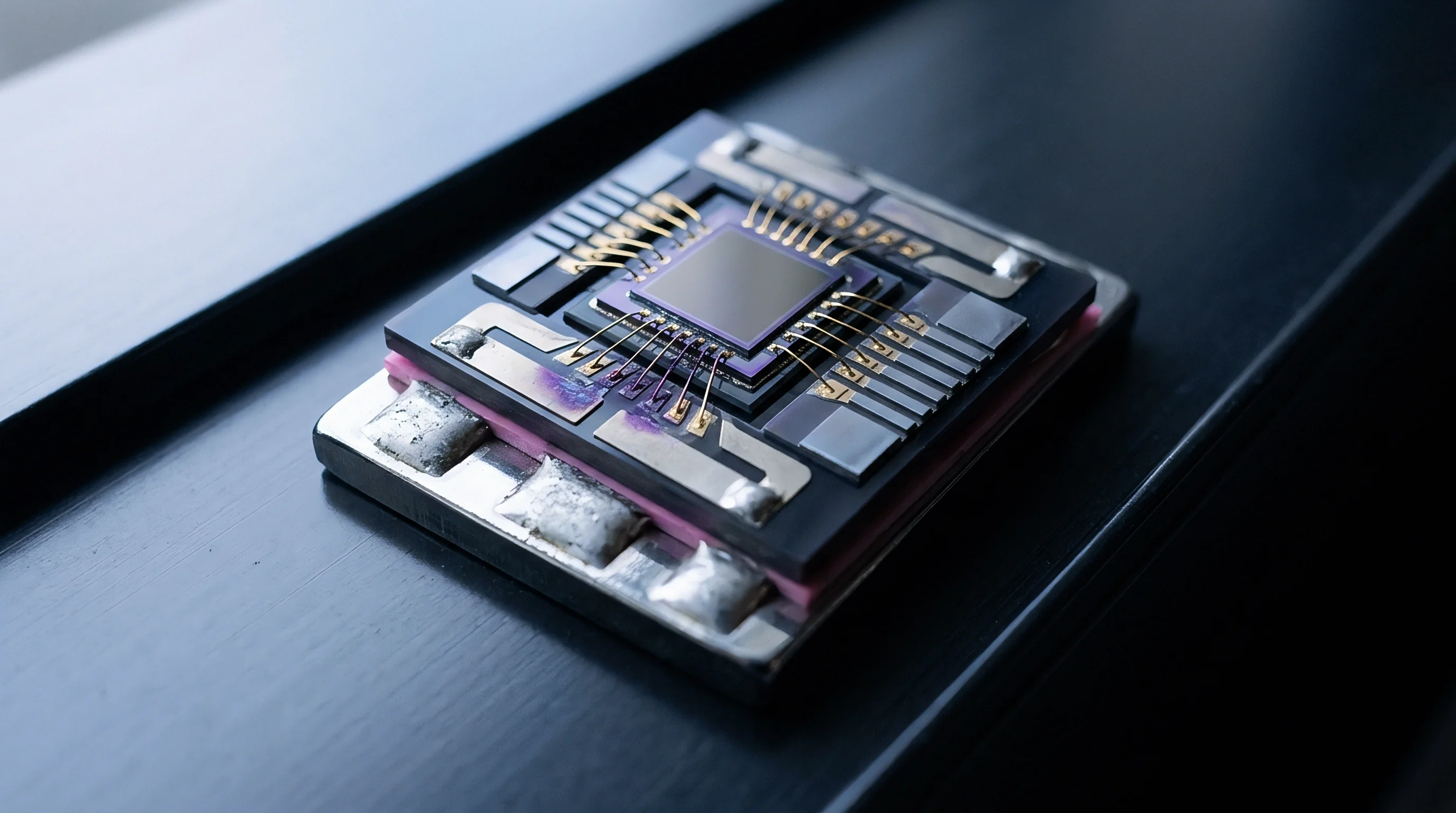
Sustaining two stable vibrations on a single mechanical element requires separate drive topologies and tight phase control. Electrostatic comb drives or parallel-plate capacitive electrodes handle primary actuation using alternating voltages offset by a direct-current polarization bias. Piezoelectric thin films like aluminum nitride deposited on the device layer offer another approach, cutting parasitic feedthrough capacitance while preserving linear transduction at high frequencies.
Will Simultaneous Modal Excitation Induce Intermodulation?
Driving distinct mechanical resonances within one micromechanical beam risks nonlinear coupling. Geometric nonlinearities, electrostatic spring softening, and nonlinear damping introduce crosstalk, sidebands, and phase jitter if drive amplitudes push displacement beyond the Duffing threshold. The resonator must stay within its linear range, while electrostatic actuation circuits segregate drive currents into distinct frequency bands to isolate the fundamental mode from the detection channel.
Dual phase-locked loops or self-oscillating sustaining amplifiers track each resonant peak in real time. Each channel pairs a low-noise transimpedance amplifier with an active bandpass filter centered on the modal pole, an automatic gain control stage to clamp amplitude-to-phase conversion noise, and a phase shifter fixing the loop phase at ninety degrees relative to displacement. The resulting signals emerge as clean frequency-modulated carriers ready for digital counting.
| Vibration Mode Designation | Nominal Frequency | Acceleration Scale Factor | Temperature Coefficient | Loaded Quality Factor |
|---|---|---|---|---|
| Fundamental in-plane anti-phase flexure | 214.5 kHz | 42.8 Hz per g | -28.4 ppm per K | 85,000 |
| Second-order in-plane symmetric flexure | 582.1 kHz | 6.1 Hz per g | -31.2 ppm per K | 120,000 |
| Fundamental out-of-plane torsional mode | 341.8 kHz | 1.2 Hz per g | -46.7 ppm per K | 45,000 |
| Third-order flexural shear mode | 1.12 MHz | 0.4 Hz per g | -58.9 ppm per K | 62,000 |
Demodulating two simultaneous modes requires clean spectral separation. Intermodulation products between the fundamental resonance and the secondary harmonic can degrade phase-detector stability. If an intermodulation product lands inside the passband of either loop, frequency pulling locks the weaker oscillation to the stronger mode’s sideband, ruining dual-mode separation.
- Bandpass Filtering Poles suppress cross-modal spectral energy inside the transimpedance feedback loop, attenuating adjacent signals by at least forty decibels before phase detection.
- Automatic Gain Control Loops keep oscillation amplitude below forty nanometers peak-to-peak, preventing mechanical nonlinearities from coupling energy into unwanted parametric sidebands.
- Piezoresistive Bridge Demodulators cancel electrostatic feedthrough by separating mechanical strain voltages from primary capacitive drive potentials.
The fundamental anti-phase mode yields an acceleration scale factor of 42.8 Hz per g with an unloaded resonator quality factor exceeding 80,000 at ten milliTorr cavity pressure.
Frequency tracking loops feed digital counters clocked by a common oven-controlled crystal reference. Dual-mode architectures do not require an absolute frequency measurement from the reference; ratiometric division between the two outputs cancels common-mode phase noise. This cancellation simplifies the clocking setup, allowing drive loops to run continuously without periodic interruption.
Scale
Converting two frequency streams into calibrated acceleration and temperature data requires solving a coupled system of nonlinear equations. Taking the first frequency as the primary acceleration channel and the second as the temperature-sensitive auxiliary channel, both output frequencies shift together in response to axial force, temperature changes, and residual package stress.
A Taylor series expansion maps these coupled dependencies across an operating range of negative forty to positive eighty-five degrees Celsius, expressing both frequency shifts through sensitivity coefficients:
Change in primary frequency equals the acceleration sensitivity coefficient times acceleration, plus the primary first-order temperature coefficient times temperature change, plus higher-order cross-terms. Change in secondary frequency equals the secondary acceleration sensitivity coefficient times acceleration, plus the secondary first-order temperature coefficient times temperature change, plus corresponding quadratic terms.
| Calibration Parameter | Value | Physical Mechanism | Residual Uncertainty Band |
|---|---|---|---|
| Primary acceleration sensitivity (S_a1) | 42.85 Hz/g | Axial beam tension | 0.005 Hz/g |
| Secondary acceleration sensitivity (S_a2) | 1.18 Hz/g | Residual proof mass moment | 0.002 Hz/g |
| Primary linear temperature coefficient (TC1_1) | -6.09 Hz/K | Silicon thermoelastic softening | 0.012 Hz/K |
| Secondary linear temperature coefficient (TC1_2) | -15.96 Hz/K | Torsional shear modulus drift | 0.018 Hz/K |
| Cross-coupling coefficient (S_aT) | 0.0034 Hz/(g K) | Thermal change of beam stiffness | 0.0004 Hz/(g K) |
| Secondary quadratic temperature term (TC2_2) | -0.0041 Hz/K^2 | Higher-order lattice expansion | 0.0001 Hz/K^2 |
Direct matrix inversion extracts physical variables from the observed frequencies in real time. As long as the determinant of the sensitivity matrix stays well above zero, the equations separate cleanly. The secondary mode functions as an embedded micro-thermometer with millikelvin precision, tracking the exact temperature of the flexure during deflection.
Standard calibration runs the sensor on a rate table inside an environmental chamber, logging frequencies across nine discrete temperatures and eleven tilt angles.
A lot failing thermal calibration protocol IEC 60068-2-14 undergoes immediate rejection prior to multi-axis inertial package integration.
Ignoring the cross-coupling term that links mechanical strain to the temperature coefficient degrades long-term bias stability. Across a sixty-degree temperature swing, a linear-only matrix leaves behind a residual uncompensated bias drift of several milli-g. Because high-performance navigation demands micro-g stability, onboard signal processing requires a third-order polynomial surface fit; skipping cross-coupling terms degrades positioning accuracy by hundreds of meters per hour during autonomous dead reckoning.
Artifact
Physical imperfections disrupt the clean separation between inertial strain and thermal drift. Thermal hysteresis is particularly troublesome in resonant MEMS sensors: after a rapid thermal cycle, output frequencies at twenty-five degrees Celsius often fail to return to their baseline calibration values, leaving a path-dependent acceleration offset.
Where Does Thermal Hysteresis Defeat Frequency Calibration?
Die-attach adhesives and metallic package interfaces undergo inelastic relaxation during thermal cycling. Single-crystal silicon shows almost no mechanical hysteresis below five hundred degrees Celsius, behaving as a virtually perfect elastic material. Ceramic packages, silicon substrates, and gold-tin or glass-frit eutectic seals have mismatched thermal expansion coefficients.
Temperature shifts produce interfacial shear stresses that trigger micro-plastic slip, adhesive creep, and dislocation movement in solder joints. These external stress relaxations alter axial loads on the tuning fork, mimicking true inertial acceleration.
| Sensor Architecture | Thermal Time Constant | Transient Peak Bias Error | Hysteresis Bandwidth | Equivalent Noise Floor |
|---|---|---|---|---|
| External printed circuit board RTD | 4.2 seconds | 1,420 micro-g | 120 micro-g | 4.2 milli-K |
| Co-packaged ASIC bandgap diode | 1.1 seconds | 380 micro-g | 45 micro-g | 12.5 milli-K |
| Monolithic on-chip silicon resistor | 180 milliseconds | 85 micro-g | 18 micro-g | 8.0 milli-K |
| Dual-mode co-located structural resonance | 3 milliseconds | 4 micro-g | 1.8 micro-g | 0.3 milli-K |
Self-heating is another mechanism that decouples resonator temperature from the package frame. Power dissipated in drive electrodes, piezoresistive readout bridges, and transimpedance amplifiers dumps heat into the die substrate. Because the beams operate in high vacuum to maintain quality factors above fifty thousand, heat escapes almost entirely by conduction through narrow silicon anchors to the substrate, making those anchors thermal bottlenecks.
Fluctuations in oscillation amplitude change the energy lost per cycle, altering beam temperature. A five percent shift in drive voltage changes power dissipation enough to cause a thermal shift of several millikelvin along the beam ~ even if ambient temperature stays constant. Dual-mode tracking detects this localized shift immediately, while an off-beam sensor misses it entirely.
Package pressure changes also introduce frequency shifts. Over years in the field, helium permeation or package outgassing can raise cavity pressure from ten milliTorr to hundreds of milliTorr. Squeeze-film and free-molecule gas damping rise accordingly, lowering the quality factor and pulling the natural frequency via phase shifts.
A key question is whether mechanical aging alters the cross-mode sensitivity determinant over a ten-year operational lifespan.
Foundry
Building dual-mode resonant sensors requires micromachining capabilities typical of specialized MEMS foundries. Resonators that demand loaded quality factors between fifty thousand and one hundred thousand require wafer-level vacuum encapsulation with active non-evaporable getters. High-aspect-ratio deep reactive-ion etching forms the tuning-fork beams, where vertical sidewall scallops must remain under twenty nanometers to prevent stress concentration and modal coupling.
Device geometry largely determines volume manufacturing yields. Resonators fabricated on silicon-on-insulator wafers with a forty-micrometer device layer offer sufficient proof mass while retaining high out-of-plane stiffness. Etching four- to six-micrometer beam widths through a forty-micrometer depth requires aspect ratios near ten to one, demanding tight control over passivation cycles to avoid structural undercutting.
- Substrate Inspection Procedures measure incoming wafer resistivity and crystal orientation tolerances within zero point one degrees along the primary mechanical axis.
- Sidewall Roughness Profilometry verifies that deep reactive-ion etching leaves scalloping profiles below twenty nanometers peak-to-valley across the entire vertical thickness of the resonant flexures.
- Getter Activation Thermometry confirms that non-evaporable getter thin films reach four hundred degrees Celsius under high vacuum to guarantee an operational cavity pressure under five milliTorr.
- Ratiometric Frequency Screening tracks individual die frequencies across three thermal setpoints on automated wafer probers to eliminate dies displaying anomalous mode coupling before package dicing.
Wafer dicing stresses shift unconstrained resonant frequencies unless isolation trenches decouple the outer perimeter from the central anchor.
Yield directly affects commercial device pricing. Standard capacitive accelerometers for consumer electronics cost under one dollar in high volume, using mature open-cavity processes without getters. High-precision resonant MEMS accelerometers ~ with vacuum capping, getter activation, and hermetic ceramic packaging ~ occupy a different tier, running from three hundred to over two thousand dollars per axis depending on qualification standards.
ASIC integration splits into monolithic and multi-chip approaches. Multi-chip module architectures place the silicon MEMS die next to a custom mixed-signal ASIC inside a sealed ceramic package. This separation allows independent optimization of the high-voltage MEMS process and the deep-submicron CMOS process.
Monolithic integration ~ building surface micromachined structures directly over CMOS circuits ~ reduces interconnect capacitance, though high silicon-deposition temperatures risk damaging underlying metallization.
Procuring dual-mode resonant accelerometers introduces sole-source risks, as few foundries offer qualified processes for wafer-level epitaxial encapsulation with sub-milliTorr hermetic longevity. When process drift or etch asymmetry alters modal cross-coupling, those geometric variations may still fall within standard foundry run-card tolerances.