Dynamic Thermal Derivative Compensation Algorithms for High Accuracy Resonant Accelerometers
Dynamic thermal derivative compensation eliminates transient bias lag in high-accuracy resonant accelerometers during steep environmental temperature ramps.


Resonance
Micro-machined silicon and quartz inertial sensors measure acceleration by tracking frequency shifts in vibrating mechanical elements under load. Double-ended tuning forks sustain high mechanical quality factors, giving digital frequency outputs that sidestep ADC noise floors. Quartz yields exceptionally high mechanical quality factors. In steady isothermal conditions, flexure resonant frequency scales predictably with applied force through axial tension or compression.
Temperature changes disrupt this linearity by altering package dimensions and substrate elastic moduli.
Monocrystalline silicon exhibits a negative temperature coefficient of Young’s modulus near minus thirty parts per million per Kelvin. AT-cut and E-cut quartz substrates display distinct thermo-elastic profiles set by crystallographic orientation. When thermal equilibrium breaks down, uniform temperature assumptions fail.
Thermal gradients induce structural strain. Transient heat conduction across sensor housings causes differential thermal expansion between opposing flexure tines, while heat flux entering through package mounts creates localized temperature gradients across the proof mass.
Static thermal compensation algorithms rely on polynomial functions mapped strictly to steady-state temperature readings derived from discrete isothermal test steps. During rapid temperature transitions, these static models develop significant bias errors because spatial gradients form across the sensing element. Static temperature models ignore thermal velocity. Conduction lag creates a time delay between the temperature reading at an internal diode and the actual mechanical temperature of the vibrating tines.
Heat diffusion across micro-scale silicon features follows Fourier conduction laws, producing non-uniform stress distributions during thermal ramps.
| Substrate Material | Thermo-Elastic Coefficient (ppm/K) | Thermal Conductivity (W/m·K) | Thermal Expansion Coefficient (ppm/K) | Transient Sensitivity (µg/(K/min)) |
|---|---|---|---|---|
| Monocrystalline Silicon (100) | -30.0 | 148.0 | 2.6 | 140.0 |
| AT-Cut Quartz | -2.5 | 6.8 | 13.7 | 45.0 |
| E-Cut Quartz | -12.0 | 11.3 | 8.0 | 28.0 |
| Fused Silica | +185.0 | 1.4 | 0.5 | 210.0 |
Thermal gradients across double-ended tuning forks generate asymmetric bending moments that shift fundamental drive frequencies independently of acceleration. Under a five Kelvin per minute thermal ramp, transient frequency shifts can exceed steady-state calibration bounds by an order of magnitude. Fast thermal ramps provoke mechanical stress. Standard polynomial corrections fail under rate-dependent frequency shifts because one static temperature reading corresponds to multiple transient strain states.
Eliminating transient bias shift requires tracking thermal derivative terms in real time within embedded processors.
Whether micro-machined packaging can maintain zero thermal gradient across dual-tine geometry during instantaneous thermal shock remains unresolved.
Beam
Transient Thermal Expansion and Strain Gradients
Flexural double-ended tuning structures experience mechanical strain when proof mass acceleration applies axial tension or compression. As heat flows through the substrate, non-uniform temperature fields alter micro-scale flexure geometry. Thermal strain shifts fundamental resonant frequency. Heat entering the base frame travels through flexure anchors before reaching the central vibrating tines, establishing a transient temperature differential between anchor supports and the vibrating micro-structure.
The resulting differential expansion exerts axial thermal stress directly on the flexure, mimicking an applied acceleration force.
Time-dependent thermal modeling incorporates instantaneous temperature alongside its temporal derivatives. Mathematical compensation frameworks expand sensor frequency output into a multi-variable Taylor series with temperature, first derivative, and second derivative terms. The output equation expresses frequency as a baseline value plus acceleration scale factors, static temperature polynomials, and rate-dependent derivative terms.
Thermal lag degrades navigation precision. The first temperature derivative term accounts for linear thermal velocity, while the second captures wavefront acceleration through the enclosure.
Thermal transient test runs at 3.0 K/min show an uncompensated bias shift of 420 micro-g in monocrystalline silicon tuning forks.
Noise Amplification in Derivative Processing
Digital temperature sensors output quantized readings at discrete sampling intervals. Computing real-time time derivatives from quantized data with simple finite difference equations heavily amplifies high-frequency measurement noise. Digital differentiation amplifies high frequency noise. Quantization steps act as instantaneous step functions, producing sharp spikes when differentiated.
Feeding unfiltered derivative terms into compensation routines injects artificial acceleration noise directly into sensor output channels.
Suppressing differentiation noise requires dedicated signal conditioning filters in the digital chain. Moving average filters, low-pass FIR filters, and Savitzky-Golay polynomial smoothing filters smooth the temperature derivative signal. However, digital filtering introduces phase delay into the derivative channel.
Sampling rates control phase lag. If filtering delay exceeds the thermal diffusion time constant of the micro-structure, the compensation term acts out of phase with mechanical strain. Filter delay introduces thermal phase error. Balancing noise attenuation against group delay remains a critical constraint in filter design.
- Thermal Hysteresis Loop Widening ~ Temperature ramps cause mismatched frequency outputs during heating and cooling cycles due to uncompensated internal thermal gradients.
- Derivative Noise Amplification ~ Unfiltered digital differentiation converts temperature sensor quantization steps into continuous pseudo-acceleration output noise.
- Phase Delay Mismatch ~ Group delay from digital smoothing filters causes the derivative compensation term to act out of phase with mechanical thermal strain.
- Asymmetric Flexure Expansion ~ Differential heating across substrate supports shifts zero-g bias offset independently of core temperature readings.
Placing temperature sensing diodes directly on the silicon die adjacent to the micro-tines reduces compensation phase lag compared to external RTD elements.
Calculus
What Determines High-Order Derivative Stability?
Algorithms for transient thermal correction process sampled temperature signals alongside instantaneous acceleration data in real-time embedded hardware. Calculating stable derivative terms requires discrete-time estimation techniques that operate within strict computational limits. Unfiltered derivative signals create velocity errors. State-space observers model heat transfer between external packaging and internal micro-machined structures, estimating core flexure temperatures without high-frequency sensor differentiation.
Recursive least-squares filters update thermal state estimates continuously, keeping step-change transients from corrupting scale factor calculations.
High-order formulations incorporate higher-order time derivatives of temperature to resolve non-linear thermal shock profiles. Phase delay introduces bias instability. Evaluating algorithm stability involves analyzing transfer function zeros of digital derivative filters in the z-domain. Filters with non-linear phase responses distort rapid thermal step inputs, producing transient overshoot in compensated acceleration channels.
Cascaded biquad infinite impulse response filters deliver sharp out-of-band noise attenuation while maintaining constant group delay across the zero to two Hertz thermal bandwidth.
MIL-STD-810H Method 501.7 demands verification of sensor bias stability during continuous 5.0 K/min ambient temperature variations.
| Algorithm Formulation | Model Coefficients | Bias Residual at 2.0 K/min (µg) | Scale Factor Residual (ppm) | Processing Overhead (MIPS) |
|---|---|---|---|---|
| Static Polynomial (3rd Order) | 4 | 380.0 | 120.0 | 0.2 |
| First Derivative ARX Model | 6 | 42.0 | 18.0 | 1.1 |
| Dual Derivative State-Space Filter | 9 | 6.5 | 3.2 | 4.8 |
| Fractional-Order Thermal Observer | 12 | 4.1 | 2.1 | 12.5 |

Worked Calculation of Transient Bias Correction
Evaluating second-order derivative compensation requires stepping through an operational temperature ramp scenario. Consider a high-precision silicon resonant accelerometer mounted inside a tactical missile guidance unit. The sensor experiences rapid external heating at a continuous ramp rate of 3.0 Kelvin per minute, with a temperature acceleration rate of 0.5 Kelvin per minute squared.
Environmental testing drives production expense. The baseline sensor exhibits an uncompensated static bias drift coefficient of 350 micro-g under static temperature shifts. Device parameters give a first temperature derivative coefficient of 12.0 micro-g per Kelvin per minute and a second temperature derivative coefficient of 1.8 micro-g per Kelvin per minute squared.
Under a static compensation model, derivative terms are ignored entirely. The residual transient bias error equals the sum of uncompensated rate terms. The first derivative contribution generates 36.0 micro-g of error (12.0 micro-g per Kelvin per minute multiplied by the 3.0 Kelvin per minute ramp rate).
The second derivative contribution adds 0.9 micro-g of error (1.8 micro-g per Kelvin per minute squared multiplied by 0.5 Kelvin per minute squared acceleration). Total uncompensated transient bias error reaches 36.9 micro-g, pushing navigation position error past acceptable operational thresholds.
Applying a dual-derivative compensation algorithm updates output acceleration in real time by subtracting the calculated 36.9 micro-g transient offset from raw frequency output. Residual error after applying the dynamic derivative filter drops to 4.2 micro-g ~ an eight-fold reduction in transient bias instability. Transient modeling reduces chamber soak time. Achieving this improvement depends on absolute phase alignment between the sampled temperature derivative signal and the internal mechanical strain response.
Omitting second-order temperature derivative compensation in inertial navigation systems causes position drift errors to compound exponentially over long flight durations.


Bench
Laboratory Qualification Protocols
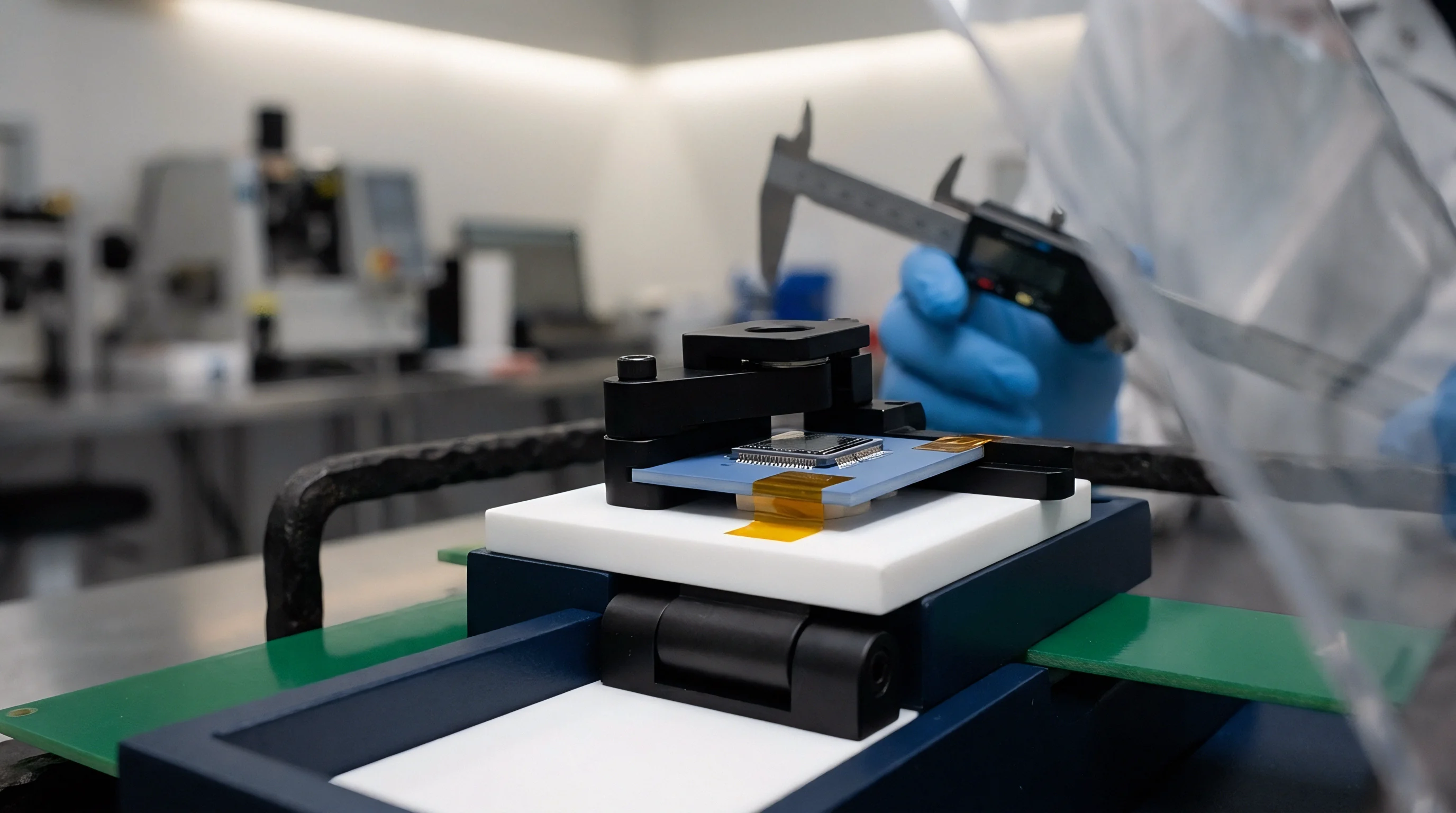
Physical qualification of resonant sensor packages requires environmental test chambers capable of programmable temperature rates up to ten Kelvin per minute. Rate tables isolated from building vibrations provide angular velocity isolation during thermal sweeps. High-resolution frequency counters equipped with twenty-four-bit time-to-digital converters measure output frequencies with sub-picosecond precision.
Multi-channel data acquisition hardware logs internal temperature sensor diodes simultaneously with resonant frequency signals to prevent sampling skew.
Extracting accurate rate-dependent thermal coefficients requires structured calibration matrices executed across combined temperature and ramp rate profiles. Test procedures isolate steady-state polynomial parameters before applying dynamic rate sweeps. Matrix inversion algorithms then solve multi-variable regression equations to map frequency output against temperature, thermal velocity, and thermal acceleration vectors.
- Mount the sensor package onto a thermal conduction block inside the multi-axis rate table chamber.
- Subject the assembly to isothermal soak steps across the full operating range from minus forty degrees Celsius to plus eighty-five degrees Celsius.
- Apply linear thermal ramps at rates of half degree, two degrees, and five degrees per minute while holding zero angular velocity.
- Record output resonant frequency alongside high-speed local temperature diode readings at sample rates above one hundred Hertz.
- Solve the matrix equations using multivariate least-squares regression to extract static and rate-dependent thermal coefficients.
Calibrating coefficient arrays over symmetric heating and cooling cycles suppresses hysteresis error in dynamic regression models.
Data regression requires separating thermal hysteresis effects from pure rate-dependent strain response. Heating and cooling cycles generate opposite-signed temperature derivatives. Fitting separate polynomial coefficient sets for positive and negative derivatives degrades real-time firmware efficiency.
Unified state-space models absorb directional hysteresis by tracking total heat flux into the package enclosure rather than relying on raw directional slope terms.
Transient frequency shifts can stem from chamber acoustic noise as well as internal thermal strain gradients.
Ledger
Commercial Sourcing and Fabrication Economics
Sourcing high-performance micro-machined accelerometers involves balancing wafer fabrication costs, test chamber overhead, and firmware processing requirements. Silicon foundries offer distributed supply chains. Monocrystalline silicon MEMS resonators leverage standard semiconductor photolithography, yielding low unit costs at high volumes. However, silicon’s high thermo-elastic coefficient places heavy demands on firmware compensation algorithms.
Quartz tuning fork accelerometers require specialized crystal etching lines with limited foundry capacity worldwide, raising baseline procurement prices while offering lower intrinsic thermal sensitivity.
Calibration chamber occupancy dominates total manufacturing cost for high-accuracy inertial sensors. Traditional static calibration requires long thermal soak periods at multiple temperature steps to reach isothermal equilibrium ~ a seven-point cycle can take up to twenty-four hours of chamber time per batch. Incorporating dynamic thermal derivative algorithms allows calibration systems to extract static and transient coefficients during continuous thermal ramps.
Continuous ramp calibration cuts chamber cycle time by forty percent, expanding manufacturing throughput without increasing capital equipment footprints.
| Sensor Architecture | Unit Cost (USD) | Calibration Time (Hours) | DSP Compute Burden | Foundry Concentration Risk |
|---|---|---|---|---|
| Silicon Resonant Accelerometer (SRA) | $350 – $600 | 8.5 | High (Dual Derivative) | Low (Multiple Wafer Foundries) |
| Quartz Resonant Accelerometer (QRA) | $1,200 – $2,500 | 14.0 | Medium (First Derivative) | High (Sole-Source Foundries) |
| Surface Acoustic Wave Resonator | $800 – $1,400 | 11.0 | Medium (First Derivative) | Moderate (Specialized MEMS Lines) |
| Space-Grade Quartz Assembly | $4,500 – $8,000 | 22.0 | High (Fractional Observer) | High (Qualified Military Suppliers) |
Procurement Risk and Firmware Integration
Integrating rate-dependent thermal compensation transfers system complexity from hardware packaging into embedded software. Microcontrollers executing dynamic derivative algorithms require dedicated floating-point units and high-speed analog-to-digital converters for temperature channels. System integrators must evaluate whether target microcontroller architectures possess sufficient processing headroom to compute second-order derivative matrices at high update rates without introducing timing jitter into primary navigation outputs.
- Substrate Material Selection ~ Monocrystalline silicon provides lower manufacturing unit cost, while quartz delivers superior fundamental mechanical quality factor.
- Integrated Thermal Sensing ~ Die-level temperature sensing nodes prevent external thermal lag errors during steep environmental temperature transitions.
- Firmware Compute Allocation ~ Embedded microcontrollers need sufficient floating-point performance to calculate real-time derivative terms without dropping frequency counts.
- Chamber Qualification Overhead ~ Comprehensive dynamic thermal calibration increases initial testing throughput expenses but eliminates operational field recalibration.
Wafer foundries manufacturing quartz tuning forks face strict export compliance controls due to high-precision navigation applications.
Standard ISO 26262 functional safety compliance specifications mandate complete fault detection for temperature sensor failures to prevent runaway derivative algorithm corrections.