Viscoelastic Stress Relaxation in Sensor Packaging Polymers
Polymer packaging stress relaxation shifts sensor zero-point calibration over time, requiring compliant submount isolation or factored field recalibration intervals.


Signal
Packaging polymers transfer time-dependent strain directly to active sensor dies. When an epoxy mold compound, die-attach adhesive, or potting resin cures, chemical shrinkage and thermal contraction create an initial residual stress field across the silicon or ceramic sensing element. Over time, polymer chains undergo macromolecular rearrangement.
The material relieves its internal stress state without any change in external assembly dimensions, producing a continuous shift in the baseline mechanical preload experienced by the transducer.
In piezoresistive silicon pressure sensors, zero-pressure offset moves linearly with packaging stress. A die bonded with a high-modulus aromatic amine epoxy experiences initial compressive stresses reaching 80 megapascals at minus 40 degrees Celsius. As the polymer relaxes at room temperature over eighteen months, this baseline compressive field decays by 12 to 28 percent.
The piezoresistive bridge registers this mechanical stress decay as an electrical zero-point drift, typically creating a baseline sensor output shift between 0.35 percent and 1.20 percent of full scale span.
A piezoresistive bridge packaged in bisphenol-A novolac epoxy drifts 0.62 percent of full scale span during five thousand hours at 85 degrees Celsius and 85 percent relative humidity.
The metrological consequence appears during recalibration cycles. Field instrumentation engineers often classify baseline wander as sensor element degradation, piezoresistor junction contamination, or contact metallization aging. The sensing silicon remains electrically intact.
The polymer interface altered its stress transmission characteristic, rendering initial factory two-point zero and span trim coefficients invalid.

Piezoresistive Transduction Mechanics
Stress coupling follows the fundamental piezoresistive tensor formulation for cubic silicon. The relative change in electrical resistivity links directly to normal and shear stress components through longitudinal and transverse piezoresistive coefficients:
delta-rho over rho equals pi-longitudinal multiplied by sigma-longitudinal plus pi-transverse multiplied by sigma-transverse.
For a standard (100) silicon diaphragm oriented along the crystallographic direction, the transverse piezoresistive coefficient pi-44 possesses a nominal magnitude near 138 times ten to the minus eleven square meters per newton at 25 degrees Celsius. A packaging stress relaxation of merely 5 megapascals across the diaphragm perimeter shifts the differential output voltage by 3.45 millivolts under a 5.00-volt bridge excitation, exceeding the total permissible annual drift budget of precision industrial pressure transmitters.

Thermal Mismatch Genesis
Residual stresses originate during post-cure cool-down. Packaging epoxies display coefficients of thermal expansion between 18 and 45 parts per million per kelvin below their glass transition temperature. Silicon exhibits a coefficient of thermal expansion of 2.6 parts per million per kelvin.
Gold, copper, or ceramic leadframes range between 6 and 17 parts per million per kelvin. The thermal mismatch strain freezes into the packaging assembly at the polymer gel point during the curing cycle.
Subsequent storage or operation initiates viscoelastic dissipation. The rate of relaxation tracks the ambient thermal and moisture conditions, accelerating exponentially when operating environments approach the polymer glass transition temperature. Sourcing engineers procuring packaged sensors without defining the die-attach relaxation spectrum accept unquantified zero-point instability that triggers false out-of-tolerance alarms across downstream process loops.


Decay
Viscoelastic stress relaxation in crosslinked amorphous polymers represents a fundamental thermodynamic drive toward conformational equilibrium. Entangled polymer segments undergo localized reptation and free-volume redistributions under sustained internal strain fields. The instantaneous elastic modulus decays toward a long-term equilibrium modulus over logarithmic decades of time.

Why Do Epoxies Shed Internal Packaging Stresses?
Crosslinked packaging adhesives possess a dual mechanical nature, exhibiting elastic spring behaviour and viscous dashpot dissipation concurrently. Below the glass transition temperature, secondary molecular relaxations dominate dissipation rates. These beta and gamma sub-transitions involve local rotations of phenyl rings, glycidyl ether groups, and aliphatic diamine linkages within the cured network.
The packaging compound relieves its localized elastic distortion energy through continuous conformational reorientation.
Moisture absorption accelerates molecular mobility. Water molecules diffuse into the epoxy matrix, breaking interchain hydrogen bonds between adjacent hydroxyl groups. This plasticization depresses the glass transition temperature by 15 to 35 degrees Celsius at saturated equilibrium, shifting ambient operating temperatures into the viscoelastic transition zone where relaxation rates accelerate by two orders of magnitude.
Plasticizer ingress lowers polymer network activation energy, accelerating mechanical stress discharge across the die interface without macroscopic distortion.

Generalized Maxwell Formulations
Analytical modeling of packaging stress decay utilizes the generalized Maxwell model, also formulated as a discrete Prony series. The time-dependent relaxation modulus is expressed through a discrete series of relaxation times and weighting moduli:
E(t) equals E-infinity plus the sum from i equals 1 to n of E-i multiplied by the exponential of negative t divided by tau-i.
Here, E-infinity designates the fully relaxed long-term equilibrium modulus, E-i represents the stiffness modulus of the i-th Maxwell branch, and tau-i represents the characteristic relaxation time of that branch. High-reliability packaging characterization incorporates between five and ten discrete branches to span temporal windows from milliseconds to tens of thousands of operating hours.
| Branch Index | Modulus Weight (MPa) | Relaxation Time (hours) | Decay Ratio |
|---|---|---|---|
| 1 | 1450.0 | 0.01 | 0.290 |
| 2 | 1120.0 | 0.25 | 0.224 |
| 3 | 890.0 | 5.00 | 0.178 |
| 4 | 620.0 | 120.0 | 0.124 |
| 5 | 410.0 | 2500.0 | 0.082 |
| 6 | 180.0 | 45000.0 | 0.036 |
| Equilibrium (Infinity) | 330.0 | Infinite | 0.066 |
The total initial modulus equals 5000 megapascals. Over forty-five thousand operational hours, the effective modulus drops to 330 megapascals under fully constrained strain conditions. A silicon die calibrated twenty-four hours after package mold encapsulation exhibits continuous baseline sensor drift over the subsequent five years as branches 4, 5, and 6 gradually dissipate stored packaging stresses.
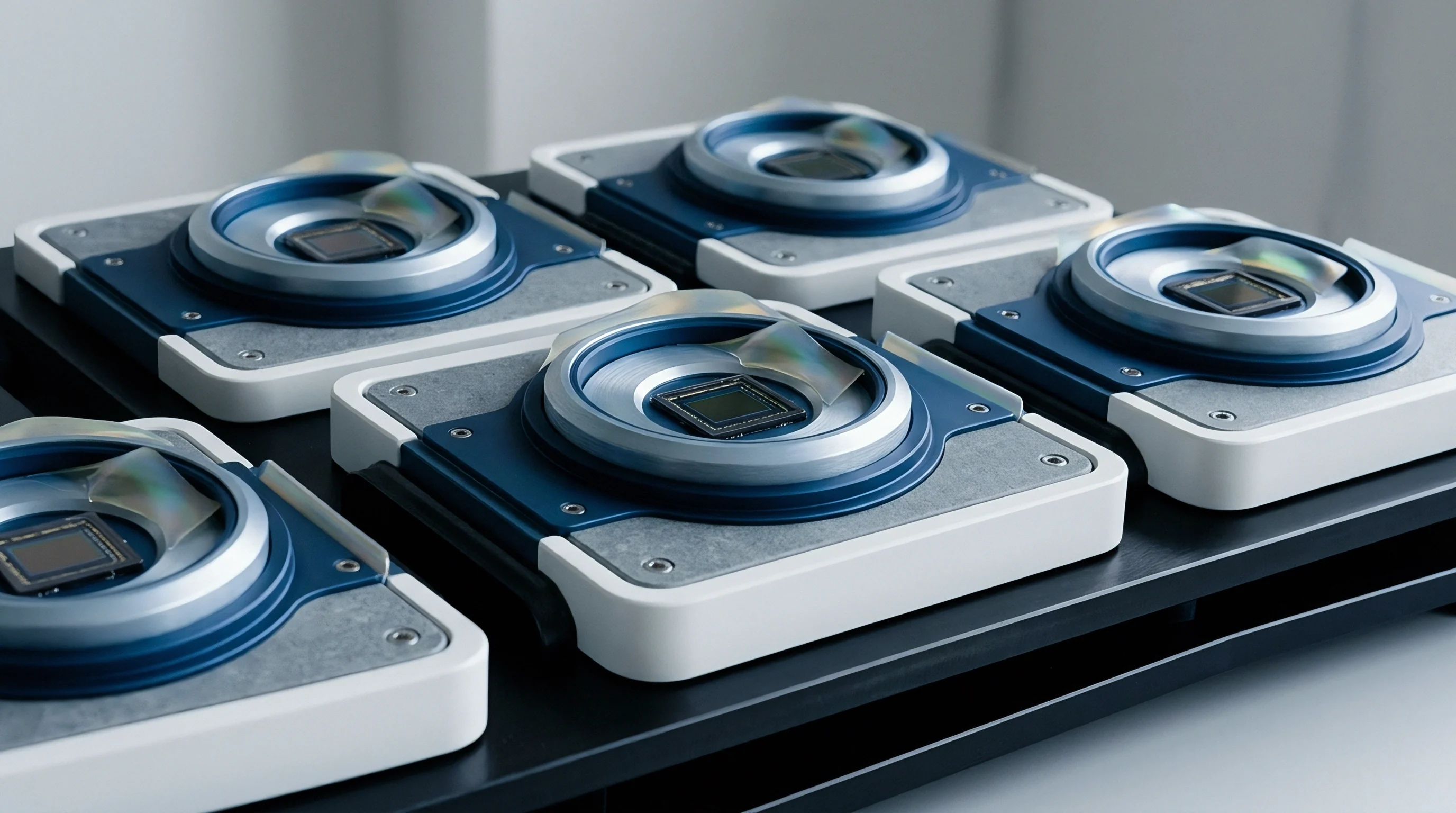
Time-Temperature Superposition Dynamics
Accelerated characterization of relaxation spectra relies on the empirical principle of time-temperature superposition. Dynamic mechanical data gathered across narrow temporal windows at elevated temperatures shift horizontally along a logarithmic frequency scale to construct a master relaxation curve valid for multi-year ambient predictions. The horizontal shift factor a-T follows the Williams-Landel-Ferry equation when working near the polymer glass transition temperature:
log10(a-T) equals negative C1 multiplied by (T minus T-reference), divided by (C2 plus T minus T-reference).
Standard empirical constants C1 and C2 for bisphenol-A thermoset matrices average 17.44 and 51.6 kelvin when referencing the glass transition temperature. Below the sub-glass transition threshold, an Arrhenius relationship supersedes the Williams-Landel-Ferry formulation, requiring an activation energy term between 75 and 130 kilojoules per mole depending on crosslink density and silica filler volume fractions.
Suppliers routinely dismiss long-term drift complaints by stating that initial preconditioning bake cycles stabilize packaging polymers against future drift.
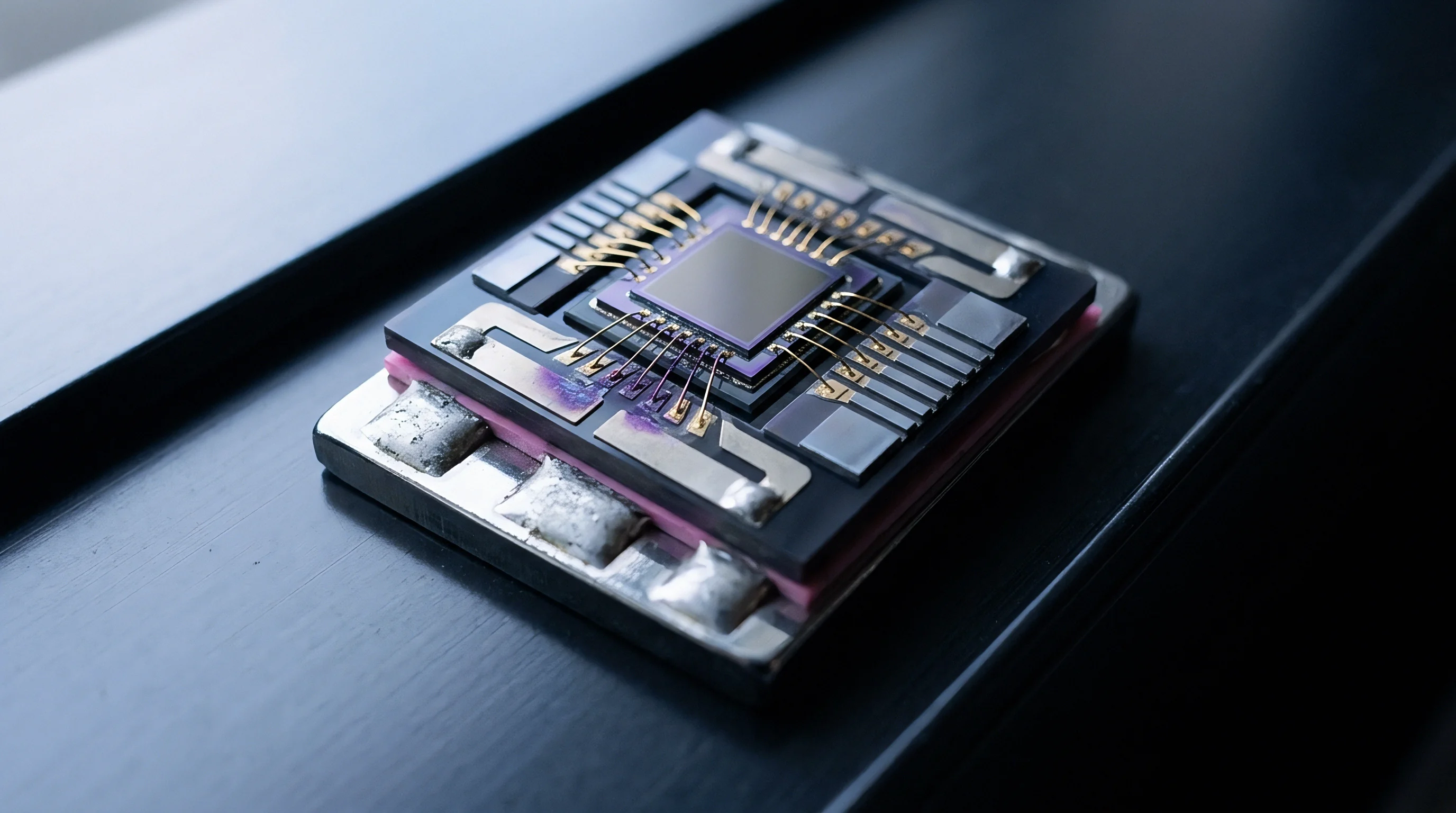
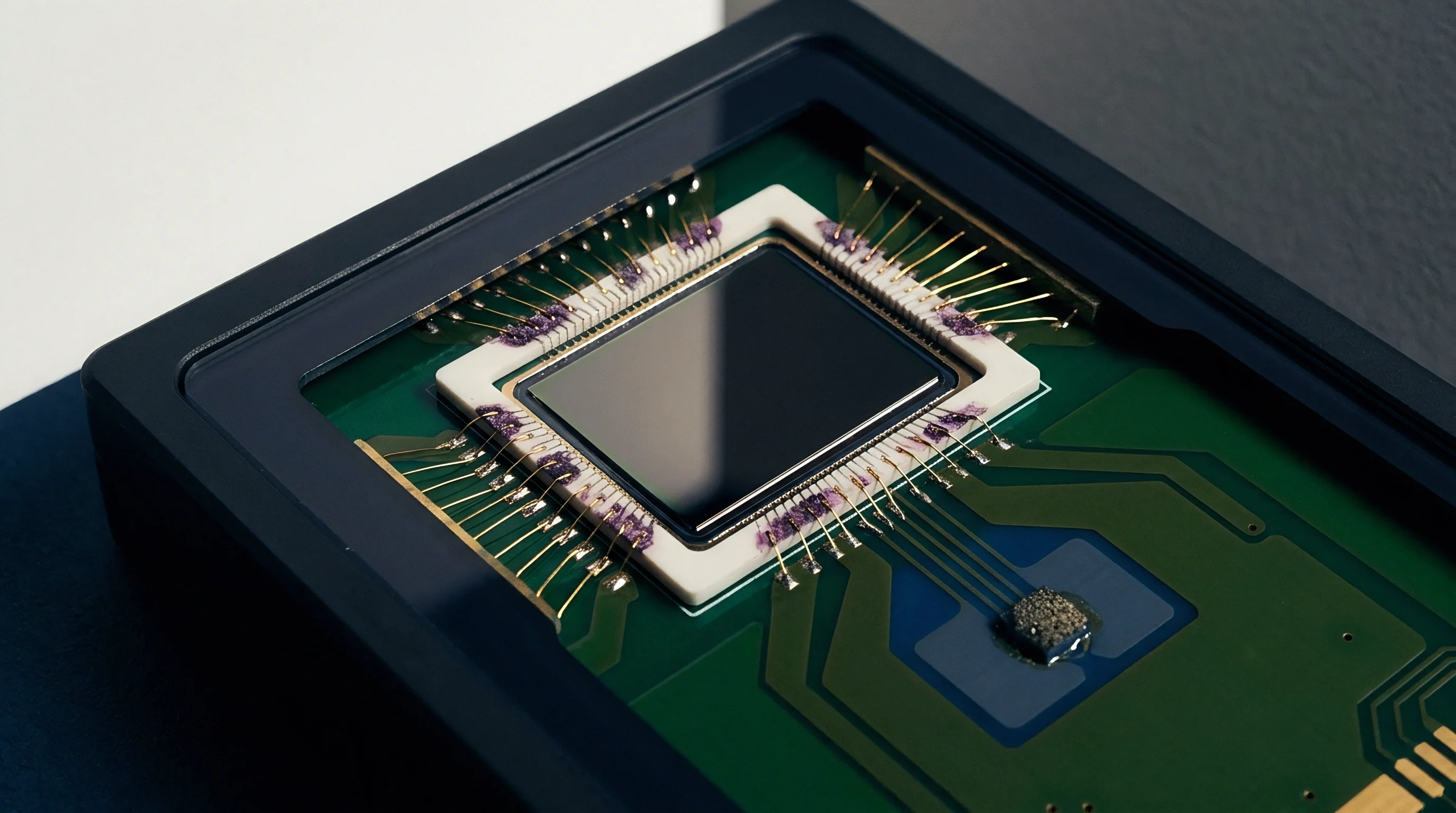
Probe
Dynamic mechanical analysis measures modulus decay across frequency and thermal domains. The test protocol applies a sinusoidal oscillatory strain to a cured polymer coupon, resolving the complex modulus into its real storage modulus and imaginary loss modulus components. Standard test method ASTM D4065 provides the operating baseline for determining viscoelastic dissipation envelopes in electronic packaging polymers.

Master Curve Construction
Constructing an actionable Prony series demands frequency sweeps ranging from 0.01 hertz to 100 hertz across stepped isothermal chambers. Test temperatures advance in increments of 3 degrees Celsius from minus 60 degrees Celsius to 220 degrees Celsius. Software algorithms horizontally translate individual isothermal storage modulus curves along the logarithmic frequency axis until adjacent segments overlap, generating a unified master curve referencing 25 degrees Celsius.
- Cast polymer samples into uniform rectangular bars with dimensional tolerances held within 0.02 millimeters. Edge flaws induce premature localized yields during tension testing.
- Equilibrate the dynamic analyzer at the initial minimum temperature for thirty minutes under continuous dry nitrogen purging to eliminate surface moisture artifacts.
- Run isothermal multi-frequency sweeps while monitoring dynamic amplitude to ensure testing remains inside the linear viscoelastic strain regime. Linear limits for filled epoxies terminate below 0.1 percent strain.
- Compute horizontal shift factors matching storage modulus boundaries between adjacent isothermal intervals. Manual curve fitting introduces significant operator bias into predicted relaxation times.
- Fit discrete Prony series terms using non-linear least squares minimization algorithms. Overfitting results in negative branch coefficients that violate thermodynamic stability criteria.
Nanoindentation offers localized mechanical characterization directly on cross-sectioned sensor packages. A Berkovich diamond indenter drives into the packaging bond line under load-controlled conditions, holding a peak force between 10 and 50 millinewtons for six hundred seconds. Continuous monitoring of penetration depth during the load hold phase captures localized relaxation response within adhesive layers thinner than 30 micrometers.
ISO 14577-1 defines instrumented indentation procedures that eliminate fixture compliance errors when extracting localized creep and relaxation curves within packaged semiconductor bond lines.
Wafer curvature interferometry tracks stress dissipation across full substrate assemblies. A laser reflects from the polished backside of a silicon wafer coated with the candidate packaging polymer during programmed thermal soaks. The Stoney equation maps changes in substrate radius of curvature directly to film stress.
This measurement captures the combined mechanical consequence of cure shrinkage, solvent evacuation, thermal coefficient mismatch, and viscoelastic relaxation under true interfacial boundary conditions.
Section 7.4 of standard contract quality agreements specifies that polymer mechanical property datasheets must state the dynamic test frequency, preload strain level, and conditioning moisture history associated with reported modulus values, preventing vendors from presenting short-term instantaneous moduli as permanent design values.

Gel
Packaging architecture governs the degree of stress transmission from the encapsulating material to the sensing junction. Rigid epoxy molding compounds exhibit high glass transition temperatures and high elastic moduli, providing mechanical protection and environmental isolation at the expense of severe internal stress fields. Die attach elastomers present an opposing mechanical compromise, absorbing substrate deformations through compliant shear deformation.

Is Silicone Die Attach Always Stable Longterm?
Silicone elastomeric adhesives minimize initial packaging stresses due to their extremely low shear modulus, typically between 0.8 and 3.0 megapascals at 25 degrees Celsius. Polydimethylsiloxane networks possess glass transition temperatures below minus 110 degrees Celsius, placing their operational lifespan entirely in the rubbery plateau region. In this thermodynamic state, the equilibrium modulus undergoes minimal relaxation drift because chain segments move with complete conformational freedom.
Silicones present distinct sensor stability risks. Their high coefficient of thermal expansion, ranging from 250 to 400 parts per million per kelvin, generates dramatic volumetric expansion forces when confined within rigid metal or ceramic package cavities. Moisture and low-molecular-weight siloxane oligomers slowly migrate from the bulk silicone matrix onto active sensor diaphragms, causing localized surface mass loading drift in resonant micro-electromechanical sensors.
A compliant material does not guarantee absolute zero-point stability.
- Filled epoxy underfills provide structural reinforcement for solder bump arrays while introducing high localized shear stresses across fragile low-dielectric-constant semiconductor layers during thermal cycling.
- Glob top encapsulants exhibit asymmetric shrinkage geometries that bend the underlying sensor substrate, creating pronounced cross-axis sensitivity errors in multi-axis accelerometer dies.
- Silicone gel potting isolates pressure sensor dies from aggressive ionic working fluids while transmitting hydraulic hydrostatic pressures perfectly across the intended measurement band.
- Anisotropic conductive adhesives yield viscoelastic contact resistance degradation over five thousand operating hours under combined elevated thermal and mechanical shear loads.
Stress-isolation packaging designs utilize intermediate silicon submounts or pedestal headers to isolate the active die from housing distortions. A micromachined silicon pedestal interposed between the sensing chip and the package base concentrates viscoelastic shear relaxation within the thick lower adhesive layer, attenuating the residual stress transferred to the top-surface piezoresistive bridge by up to 92 percent.
| Polymer Class | Tensile Modulus (MPa) | Glass Transition (C) | Linear CTE (ppm/K) | Three-Year Relaxation (%) |
|---|---|---|---|---|
| Aromatic Anhydride Epoxy | 8500 to 12000 | 140 to 175 | 18 to 28 | 14 to 22 |
| Aliphatic Amine Epoxy | 3200 to 5500 | 65 to 95 | 45 to 65 | 35 to 55 |
| Die Attach Polyimide | 2100 to 3800 | 220 to 280 | 35 to 50 | 8 to 15 |
| Crosslinked Polyurethane | 15 to 80 | minus 45 to minus 15 | 120 to 180 | 40 to 65 |
| Polydimethylsiloxane Gel | 0.05 to 0.50 | minus 125 to minus 100 | 300 to 450 | 2 to 6 |
Submount pedestals add production expense and increase mechanical package height. Eliminating the pedestal cuts component bill of materials costs while introducing long-term baseline instability directly into the measurement signal chain.
Compliant packaging materials absorb installation stresses while stiff polymers preserve assembly alignment.


Penalty
Sensor procurement specifications that omit viscoelastic stability boundaries transfer the financial burden of package drift onto field recalibration budgets. Industrial field transmitters deployed in chemical refining or oil and gas processing require guaranteed calibration intervals of thirty-six to sixty months. When packaging stress relaxation induces a zero-point drift exceeding 0.10 percent of full scale span per year, the transmitter fails safety instrumented function audits prior to the scheduled maintenance turnaround.

Worked Lifetime Drift Comparison
A plant operator procures two candidate 10-bar gauge pressure transmitters for an offshore platform processing line, deploying an installation fleet of 400 measurement points.
Transmitter Type A uses an unisolated, direct-glued sensor architecture with an inexpensive aliphatic amine cured epoxy die attach, costing 285 dollars per unit. The packaging polymer undergoes 38 percent relaxation over three years at an average operating ambient temperature of 45 degrees Celsius, generating an annual zero-point wander of 0.32 percent of span. Transmitter Type B utilizes a silicon pedestal submount bonded with a high-temperature polyimide and soft silicone gel top coat, costing 465 dollars per unit.
The stress-isolated package exhibits an annual zero drift of 0.04 percent of span under identical operational exposure.
Transmitter Type A breaches the maximum permissible error threshold of 0.25 percent of span at nine months of operational service. Maintaining safety loop compliance demands recalibration every eight months throughout a six-year operational window. Transmitter Type B maintains operational tolerance across forty-eight months, requiring merely one mid-lifecycle verification check.
Recalibration on an active processing unit carries a verified technical field labor cost of 240 dollars per measurement point, including instrument isolation, bench testing with a portable deadweight tester, trim adjustment, and documented regulatory sign-off. Over six years, Transmitter Type A demands eight recalibration interventions per tag, totaling 1920 dollars in calibration maintenance. Transmitter Type B requires one intervention, totaling 240 dollars.
Initial package savings of 180 dollars per instrument generated an operational maintenance penalty of 1680 dollars per tag, multiplying across the 400-unit fleet into a 672,000-dollar operational deficit.
Acceptance Verification Testing
Sourcing teams must implement incoming qualification protocols that force accelerated viscoelastic dissipation during initial lot acceptance testing. Standard qualification procedures based on short-term accuracy at room temperature fail to expose unstable packaging matrices. Accelerated thermal exposure reveals polymer instability before instruments enter warehouse inventory.
A rigorous incoming stress verification protocol exposes a statistically representative sample to one thousand thermal cycles between minus 40 degrees Celsius and 125 degrees Celsius in accordance with IEC 60068-2-14 test Nb. Measurements of zero-point offset recorded before and after thermal cycling expose residual stress discharge across the packaging assembly. Drift boundaries exceeding 0.15 percent of span under this stress sequence identify incompletely cured polymers, incorrect stoichiometry in two-part adhesive mixing systems, or sub-optimal glass transition temperatures.
How do non-linear filler particle contacts reorganize during multi-year environmental vibrations, and does mechanical excitation fundamentally alter the underlying polymer relaxation spectrum?