Polymer Die Attach Stress Relaxation Modeling for Precision Accelerometers
Polymer die attach relaxation decays mounting stress into silicon frames, causing sub-nanometer anchor warpage that shifts precision accelerometer bias.

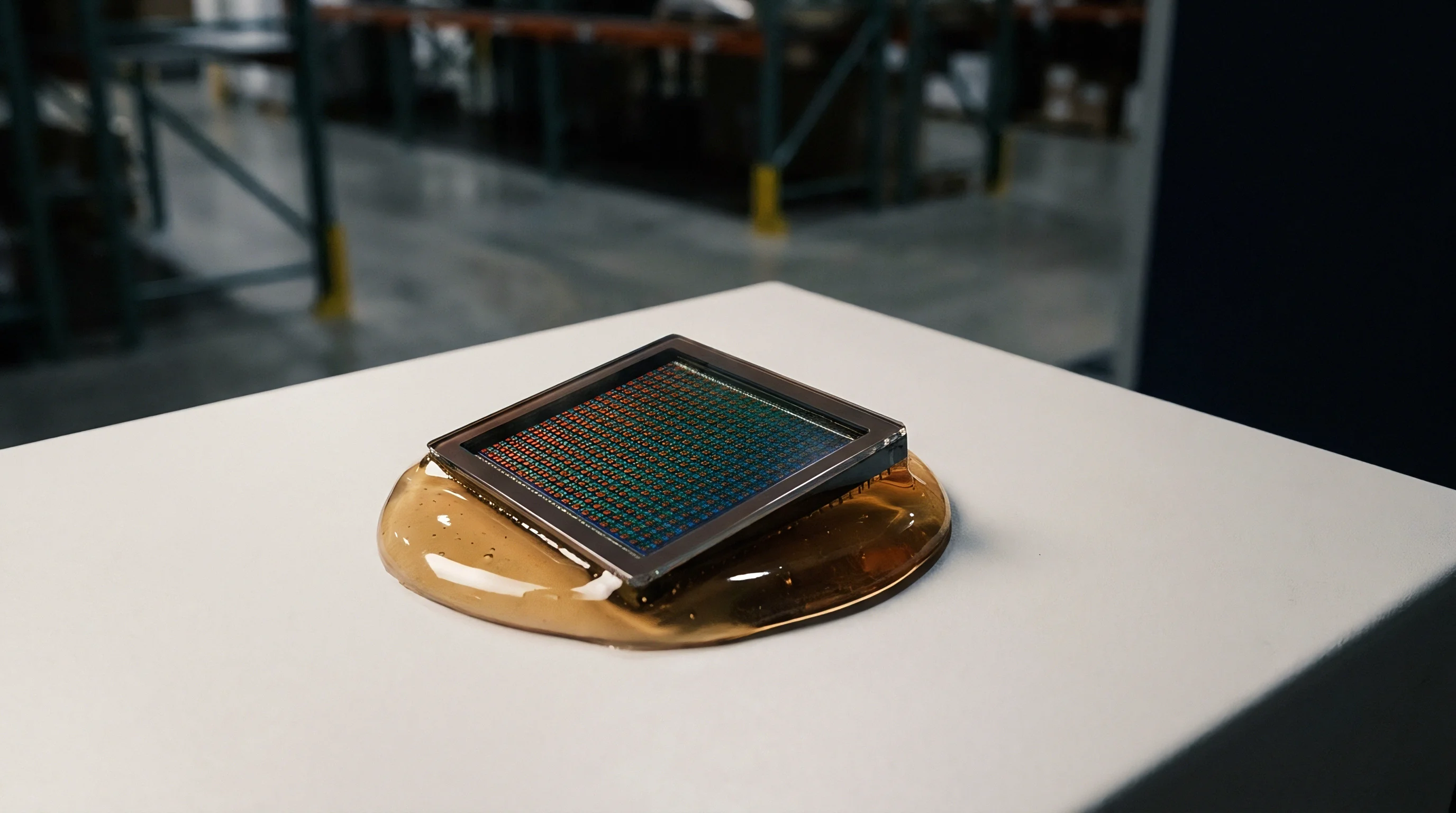
Joint
Precision silicon dies measure 300 to 500 micrometers in thickness and exhibit a linear thermal expansion coefficient near 2.6 parts per million per Kelvin. The alumina or aluminum nitride ceramic headers supporting those dies carry expansion coefficients between 4.5 and 7.1 parts per million per Kelvin. Silver-filled epoxy pastes linking the two materials cure at temperatures between 150 and 175 degrees Celsius, developing cross-linked networks while thermal expansion coefficients sit between 35 and 55 parts per million per Kelvin below the glass transition.
Cool-down to ambient conditions locks in substantial triaxial shear and peel stresses along the bond boundary. Silicon contracts stiffly. The surrounding polymer layer pulls against both the metallized silicon backing and the gold-plated header cavity, producing steep stress gradients concentrated within 150 micrometers of the die corners.
Differential shrinkage generates bending moments. When an adhesive bondline measures 25 micrometers with an uneven fillet geometry, the mismatch in thermal contraction translates directly into mechanical curvature of the substrate plate. In a differential capacitive proof-mass structure, anchor pads sit suspended over or anchored directly to this silicon floor.
Uneven contraction warps the anchor pedestals, tipping capacitive sensing fingers out of parallel alignment. Because the polymer attach layer is not a pure elastic solid, the residual stress locked in during the post-cure cool-down decays over hours, months, and operational thermal exposures. Polymer chains undergo continuous molecular rearrangement to minimize internal strain energy, shedding mechanical load into the neighboring silicon boundary over extended operating intervals.
A 50-nanometer post-cure package deflection induces up to 320 micro-g of zero-bias shift in a differential capacitive suspension at 25 degrees Celsius.
Fillet heights vary across production. Variations in dispense volume, wet spread, and fillet rise govern how stress redistributes during thermal settling. Three distinct structural breakdown mechanisms govern this interface over operating lifespans.
- Interfacial shear delamination initiates at peripheral die edges where localized shear strain exceeds the adhesive fracture toughness, permanently altering the mechanical boundary conditions of the sensor package.
- Cohesive matrix micro-cracking develops within high-stress fillets during repeated thermal shock cycles, generating abrupt discontinuities in anchor pre-load.
- Adhesive void coalescence forms localized compliance zones beneath the die pad, inducing asymmetric tilt across the active proof-mass plane.
Every packaging engineer balancing bias stability must evaluate the underlying constitutive properties of candidate die attach materials. Glass transition temperatures dictate the boundary where polymer behavior shifts from a rigid glassy state to an entropic elastomer. Operating a precision sensor near this transition induces massive variations in storage modulus and creep rates.
| Material Designation | Glass Transition (Celsius) | CTE Below Tg (ppm/K) | CTE Above Tg (ppm/K) | Storage Modulus (GPa) | Poisson Ratio |
|---|---|---|---|---|---|
| Single-Crystal Silicon | None | 2.6 | 2.6 | 165.0 | 0.22 |
| Alumina Substrate (96% Al2O3) | None | 6.8 | 6.8 | 330.0 | 0.24 |
| Aluminum Nitride (AlN) | None | 4.5 | 4.5 | 310.0 | 0.25 |
| Silver-Filled Conductive Epoxy | 115 | 42.0 | 140.0 | 6.8 | 0.37 |
| High-Purity Silicon Die Gel | -120 | 280.0 | 280.0 | 0.002 | 0.49 |
| Aromatic Polyimide Adhesive | 235 | 32.0 | 95.0 | 3.4 | 0.34 |
Formulators frequently state that high glass transition temperatures eliminate long-term drift by keeping the polymer locked in a rigid glassy regime across all field environments, though bench testing reveals that glassy polymers still exhibit significant secondary relaxation peaks.

Viscoelasticity
Mechanical stress in amorphous polymers does not maintain a constant proportional relationship to applied strain over time. The time-dependent response is described through a Generalized Maxwell formulation, representing the material as an array of Maxwell elements in parallel with an equilibrium spring. The relaxation modulus in shear, designated as G(t), is expressed as a Prony series summation where individual Maxwell branches decay exponentially according to discrete relaxation time constants:
G(t) = G_infinity + sum(G_i exp(-t / tau_i))
Here, G_infinity represents the fully relaxed equilibrium shear modulus, G_i denotes the relaxation strength of the i-th Maxwell element, and tau_i denotes the characteristic relaxation time of that branch. Bulk modulus relaxation follows an identical mathematical framework, although experimental characterization often treats bulk modulus as time-invariant when volumetric deformations remain small compared to shear strains. Modulus drops across glass transitions.
Within the glassy zone below the glass transition temperature, secondary molecular motions known as beta and gamma relaxations contribute to short-term stress relaxation, while primary alpha relaxations govern the long-term decay spectrum.
Thermal acceleration alters the effective timescale of relaxation through time-temperature superposition. When testing polymers above their glass transition temperature, the Williams-Landel-Ferry equation provides the empirical shift factor, a_T, relative to a selected reference temperature:
log10(a_T) = -C1 (T – T_ref) / (C2 + (T – T_ref))
Below the glass transition, polymer chains lack the free volume required for cooperative segmental movement. In this glassy regime, an Arrhenius relationship models the temperature dependence of the shift factor:
ln(a_T) = (E_a / R) ((1 / T) – (1 / T_ref))
In this equation, E_a represents the apparent activation energy for sub-Tg structural rearrangement, R is the universal gas constant, and T is the absolute temperature in Kelvin. Glass transitions govern relaxation rates. Under continuous isothermal soak, unannealed polymer matrices undergo physical aging, a process where non-equilibrium free volume slowly contracts toward thermodynamic equilibrium.
Physical aging shifts the relaxation spectrum toward longer timescales, causing the material to stiffen and slowing subsequent relaxation rates.
Why Track Relaxation across Thermal Soak Periods?
Constant exposure to elevated storage temperatures causes continuous redistribution of internal mounting stresses. Consider a worked engineering calculation for a silver-filled packaging epoxy operating at 65 degrees Celsius (338.15 Kelvin) over a continuous 10,000-hour deployment. Assume a five-term Prony series characterized at a reference temperature of 25 degrees Celsius (298.15 Kelvin) with an apparent activation energy of 85 kilojoules per mole.
The equilibrium shear modulus G_infinity equals 1.20 gigapascals, while the instantaneous modulus G_0 equals 6.50 gigapascals, distributed across four relaxing branches: G_1 = 2.10 gigapascals at tau_1 = 10 hours; G_2 = 1.80 gigapascals at tau_2 = 100 hours; G_3 = 0.90 gigapascals at tau_3 = 1,000 hours; and G_4 = 0.50 gigapascals at tau_4 = 10,000 hours.
Calculating the Arrhenius shift factor for 65 degrees Celsius yields an acceleration coefficient:
ln(a_T) = (85000 / 8.314) ((1 / 338.15) – (1 / 298.15)) = 10223.7 (-0.0003964) = -4.0526
Evaluating the natural exponent produces a_T equal to 0.01738. The effective time experienced by the relaxing polymer over a physical soak time of 1,000 hours translates to t_eff = t / a_T = 1,000 / 0.01738, yielding 57,537 hours of equivalent relaxation at room temperature. At 10,000 physical hours at 65 degrees Celsius, the effective exposure time reaches 575,373 hours.
Evaluating the Prony summation at this shifted timescale shows that all four transient branches have dropped to negligible fractions of their initial values, leaving only the equilibrium modulus of 1.20 gigapascals intact. The die attach layer loses over 81 percent of its original shear resistance. Initial assembly stresses dissipate into the silicon frame, permanently shifting the geometric baseline of the inertial sensor.
Time-temperature superposition governs linear regimes. Selecting the appropriate mathematical framework demands evaluating several mechanical criteria.
- Strain amplitude boundaries determine whether linear viscoelastic theory holds or if strain-dependent nonlinear viscoplastic equations become necessary for accurate baseline prediction.
- Operating temperature ranges define whether a single Arrhenius activation energy suffices or if dual-regime Williams-Landel-Ferry formulations must be integrated across the glass transition.
- Physical aging parameters account for structural volume recovery during extended room-temperature storage, which progressively retards the decay rate of residual mounting strains.
- Moisture plasticization coefficients quantify the depression of glass transition temperatures caused by humidity ingress through permeable packaging encapsulants.
Whether physical aging in high-density cross-linked matrices ever reaches a true thermodynamic equilibrium within typical ten-year operating lifespans remains an open point of debate among polymer physicists.

Warpage
Bending moments transmitted through the die backing cause mechanical distortion across the proof-mass suspension. Suhir bimetallic beam theory demonstrates that interfacial shear stresses peak sharply at the outer perimeter of the bonded structure, declining exponentially toward the center of the silicon die. When an adhesive layer exhibits asymmetric geometry, uneven thickness, or irregular corner fillets, the net moment applied to the die generates an out-of-plane twist.
Asymmetry magnifies drift. The silicon substrate bows into spherical or saddle-shaped surfaces, directly displacing the anchor posts that suspend inertial sensing elements.
Capacitive gaps measure micrometers. In an out-of-plane capacitive sensor, a differential pair of electrodes senses acceleration via minute changes in gap spacing between a movable proof mass and stationary counter-electrodes. The nominal capacitive gap typically spans 1.5 to 2.5 micrometers.
Sub-nanometer shifts corrupt bias stability. If stress relaxation within the underlying polymer attach layer relaxes the die curvature by a mere 0.08 nanometers per week across an active 4-millimeter sensing span, the differential capacitance drifts continuously without any external acceleration applied. This mechanical baseline drift masquerades as an apparent zero-g offset shift in the converted digital output.
MIL-STD-883 Method 1010 Condition B thermal shock testing accelerates epoxy rearrangement, triggering contractually binding recalibration penalties under standard defense procurement schedules.
In-plane interdigitated comb finger designs experience distinct degradation paths under die attach relaxation. Out-of-plane curvature tilts opposing fingers relative to each other, introducing vertical offset between interdigitated teeth. This tilt induces an electrostatic cross-axis sensitivity, coupling cross-axis shocks and vibrations directly into the primary measurement axis.
Thermal cycles reset mechanical equilibrium. Repeated excursions between high and low temperatures trigger viscoelastic hysteresis, meaning the structural curvature at 25 degrees Celsius after a cold soak differs measurable from the curvature at 25 degrees Celsius following a hot soak.
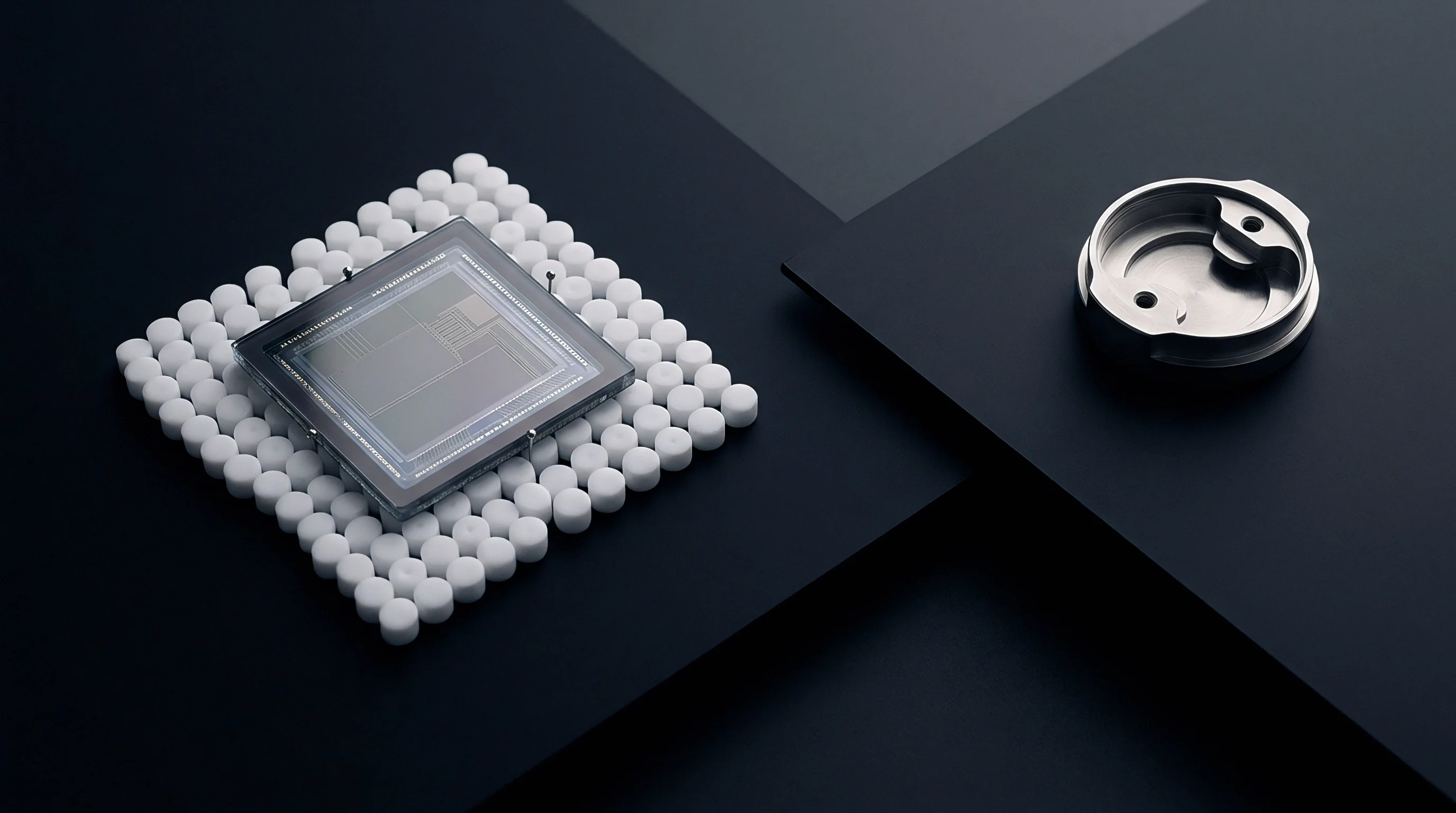
Will Asymmetric Fillets Bias Differential Capacitive Readouts?
Unequal fillet heights along opposing die edges exert unbalanced overturning forces on the perimeter of the silicon structure. During adhesive curing, menisci form along the diced die edges due to surface tension. If dispense centering shifts by as little as 50 micrometers, the adhesive fillet along one boundary climbs 80 percent up the die sidewall, while the opposing fillet reaches only 20 percent of the die height.
The larger fillet contains a greater absolute volume of polymer, exerting higher contracting forces during post-cure cooling and subsequent relaxation periods.
This unbalanced force introduces an unconstrained tilting moment across the central sensing platform. The anchor springs on the high-fillet side experience continuous compressive relief as the thick polymer relaxes, while the opposing springs maintain higher strain states. Over months of passive storage, the proof mass tilts along its torsional axis.
The differential capacitive bridge detects this structural rotation as a persistent monotonic drift in the zero-g bias reading.
| Attach Chemistry Class | Initial Peak Shear Stress (MPa) | Stress Decay After 1,000h (%) | Die Center Bow Change (nm) | Zero-g Bias Drift (micro-g) |
|---|---|---|---|---|
| High-Tg Silver Epoxy (Tg = 150C) | 42.5 | 14.8 | 45 | 280 |
| Low-Modulus Silver Epoxy (Tg = 65C) | 18.2 | 68.4 | 110 | 850 |
| Soft Silicone Elastomer (Tg = -50C) | 2.1 | 82.0 | 12 | 95 |
| Thermoplastic Polyimide Film | 28.6 | 9.2 | 25 | 160 |
| Gold-Tin Eutectic Solder (Au80Sn20) | 85.0 | 1.5 | 4 | 35 |
Selecting an attach polymer based purely on low initial assembly stress without evaluating relaxation rates causes precision navigational sensors to wander outside tactical drift specifications within their first year of depot storage.
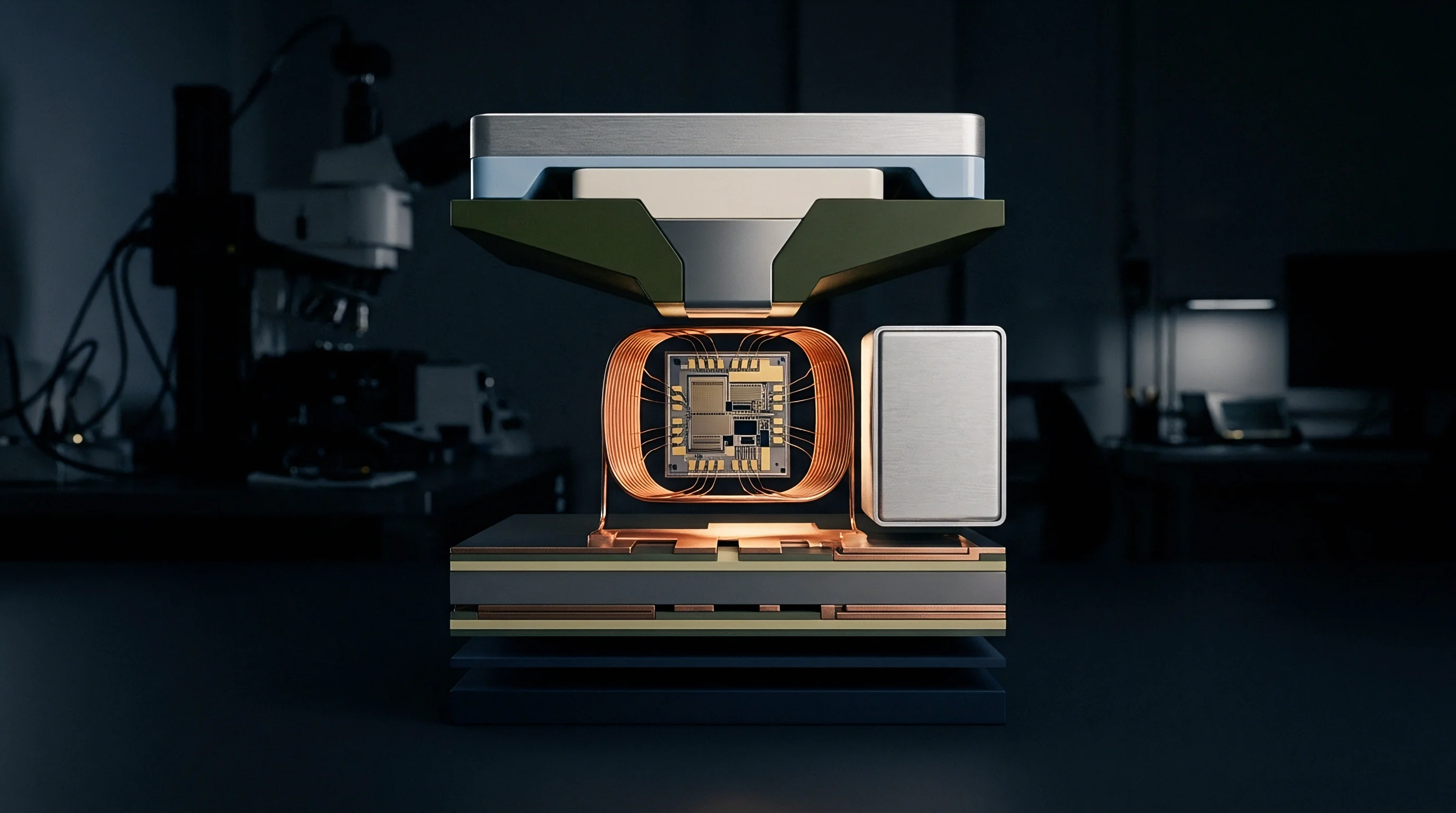
Solver
Numerical simulation of packaging relaxation requires finite element platforms capable of solving coupled thermomechanical time-history problems. Standard linear elastic simulations evaluate only the static residual stress state at room temperature immediately following thermal cool-down. To capture drift mechanics, the material model must incorporate a nonlinear viscoelastic formulation utilizing hereditary integrals or equivalent differential internal state variable equations.
In commercial packages such as ANSYS or Abaqus, viscoelastic behavior is typically defined using user-defined material subroutines or explicit time-domain Prony series input tables paired with temperature shift functions.
Corner singularities demand fine meshing. The mechanical boundary condition between the rigid silicon corner, the compliant adhesive, and the ceramic package base produces an analytical stress singularity where the free surface intersects the interface. If the finite element mesh utilizes uniform element sizing across this corner zone, stress values fail to converge as mesh density increases.
Analysts must implement localized mesh refinement using singular or quadratic elements with edge lengths below 2 micrometers along the outer 50 micrometers of the bondline. Without fine mesh control, calculated shear stresses overestimate local yielding, distorting subsequent viscoelastic relaxation predictions.
Thicker adhesive bondlines reduce transmitted shear stress at the expense of out-of-plane tilt errors under dynamic vibration.
Coupled modeling routines translate computed mechanical displacements directly into electrostatic domain shifts. After computing the time-dependent nodal displacements of the die surface over a simulated 5,000-hour environmental profile, the updated nodal coordinates are mapped into a boundary element or electrostatic finite element mesh of the capacitive comb drives. The solver calculates the electrostatic capacitance between every movable and stationary electrode finger as a function of simulated storage time.
This co-simulation framework extracts the exact voltage or digital word drift delivered by the readout signal-chain electronics.
Simulation teams preparing qualification packages for mission-critical hardware must compile standardized documentation packages before sign-off.
- Constitutive characterization records containing raw dynamic mechanical analysis master curves, shift factor calibrations, and differential scanning calorimetry verification traces across multiple production batches.
- Convergence verification reports demonstrating mesh independence along the singular free-edge perimeter using normalized stress intensity metrics.
- Fillet tolerance sensitivity bounds showing maximum and minimum predicted die tilt angles across the full statistical range of production dispense volumes.
- Experimental curvature correlation data comparing simulated die warpage profiles against white-light interferometry measurements taken over thermal cycling.
A reliable design guideline states that reducing die attach thickness improves thermal conduction and vibration stability, while increasing thickness cushions the sensor against substrate deformation.
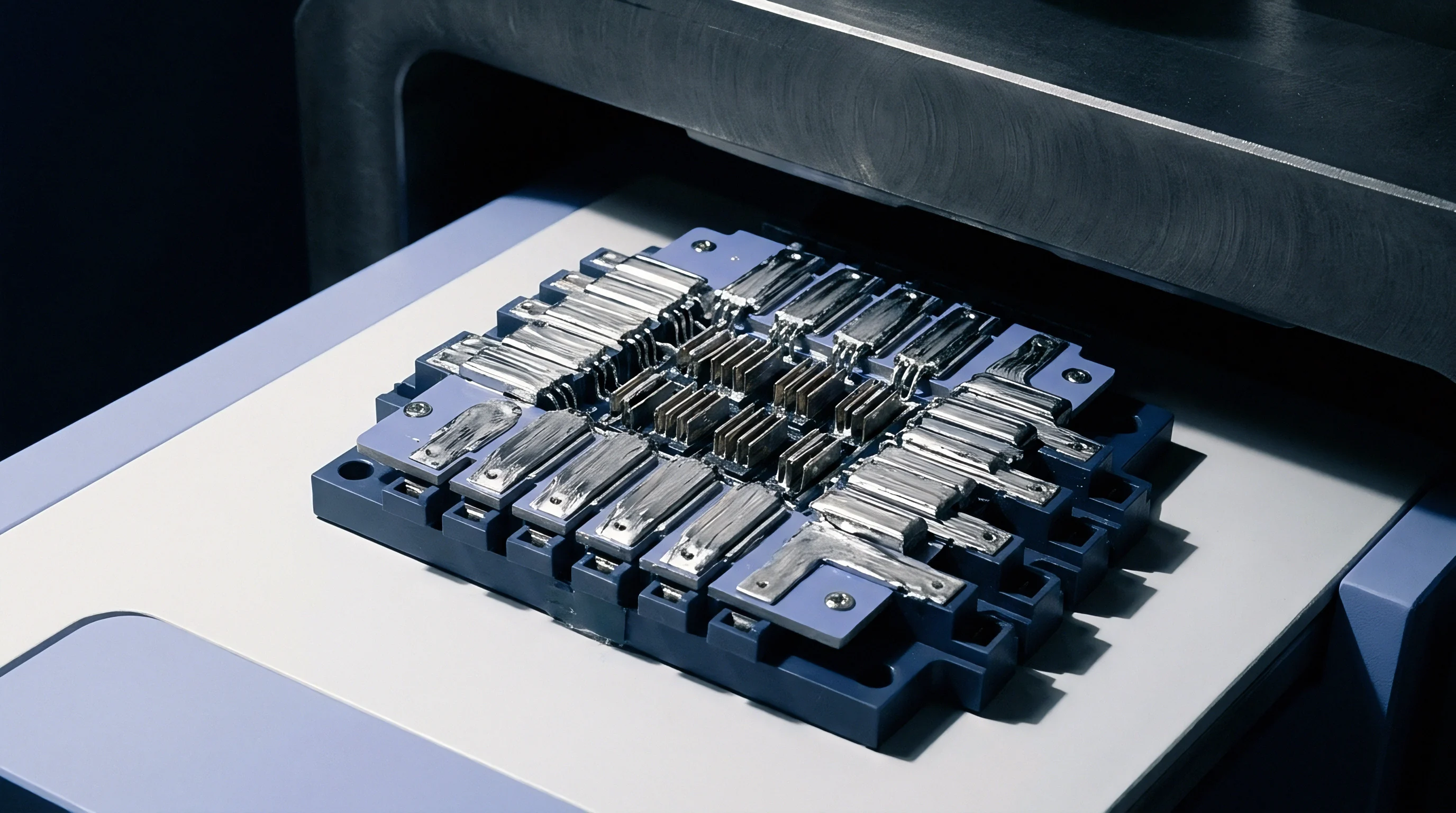
Chamber
Experimental validation of stress relaxation models requires dedicated environmental screening hardware paired with high-precision metrology benches. Dynamic mechanical analysis instruments sweep cured adhesive samples through temperature sweeps from -65 to +175 degrees Celsius across frequencies spanning 0.01 to 100 Hertz. These frequency sweeps construct the linear viscoelastic master curves through time-temperature superposition shifting, providing the foundational Prony constants used in numerical simulations.
However, material behavior in bulk coupon specimens often differs from the behavior of 25-micrometer thin films confined between rigid silicon and ceramic substrates due to altered polymer chain mobility near metallized interfaces.
Interferometry maps warpage directly. Non-contact optical techniques, including digital fringe projection and phase-shifting shadow moiré interferometry, measure full-field out-of-plane die surface warpage inside thermal chambers across active temperature excursions. These optical systems achieve sub-5-nanometer vertical resolution across a 10-millimeter field of view.
By recording the die surface topology immediately after cool-down from cure and monitoring the profile during an extended 1,000-hour dwell at 85 degrees Celsius, test engineers isolate real-time viscoelastic relaxation from thermal expansion artifacts. The decay in central die bow tracks the mathematical decay curves predicted by multi-term Prony models.
Adhesive suppliers formulate resin packages for microelectronic thermal dissipation rather than sub-ppm strain stability across five-year storage windows.
Long-term inertial stability bench testing correlates mechanical relaxation directly with electrical drift. Accelerometer packages placed inside multi-axis test fixtures undergo Allan deviation evaluations inside thermally controlled chambers regulated within 0.05 degrees Celsius. The Allan deviation curve reveals underlying noise mechanisms across varying integration times.
Short integration times display velocity random walk driven by Brownian mechanical noise. At integration intervals exceeding 10,000 seconds, the Allan deviation slope turns upward, dominated by flicker bias instability and long-term ramp drift. Viscoelastic relaxation of the polymer die attach constitutes the primary physical mechanism driving this long-term drift ramp.
Procurement teams sourcing materials for high-reliability sensor manufacturing face severe commercial exposure when chemical formulators alter raw adhesive recipes. Commercial epoxy vendors frequently modify secondary additives, catalysts, or silica filler size distributions to optimize syringe dispense life or reduce retail cost without changing the primary product part number. A minor five percent change in reactive diluent concentration shifts the glass transition temperature by several degrees, radically altering relaxation kinetics below 50 degrees Celsius.
Yield losses multiply rapidly. Sourcing contracts for precision applications must include rigorous change control clauses requiring written notification and complete requalification testing before accepting resin lots containing altered chemical constituents.
Under standard aerospace procurement provisions governed by SAE AS9100 clause 8.4.3, an unnotified modification in adhesive raw materials invalidates production lot acceptance, shifting all downstream subsystem recall and requalification liabilities directly onto the assembly contractor.