Quantifying Elastomer Steam Resistance and Compression Set Metrics
Peroxide-cured EPDM and specialized FFKM elastomers provide optimal resistance to steam degradation when evaluated via ISO 23936-2 compression set metrics.

Steam
High-temperature water vapor under pressure presents one of the most destructive environments for elastomeric seal formulations in industrial fluid processing. When steam enters an elastomeric network, the combined action of thermal expansion, gas diffusion, and hydrolytic degradation alters both physical dimensions and chemical crosslink integrity. Datasheet claims based on dry heat testing fail to reflect seal performance in steam service.
A polymer that exhibits under fifteen percent compression set in hot dry air at two hundred degrees Celsius often experiences complete structural breakdown within seventy-two hours in saturated steam at the same temperature.
Quantifying steam resistance requires separating physical swelling and plasticization from irreversible chemical degradation. Water vapor molecules permeate the polymer matrix, occupying free volume and softening the compound. Saturated water vapor accelerates physical swelling, while chemical scission attacks polymer backbones and crosslinks.
Moisture breaches the polymer. Evaluating seal endurance demands measuring compression set directly inside steam aging vessels rather than relying on post-exposure atmospheric cooling metrics.

Saturated Vapor Test Chamber Dynamics
Phase equilibrium between liquid water and gas phases establishes direct constraints on thermal transfer during elevated temperature laboratory trials. In a sealed autoclave, saturated steam pressure correlates directly with chamber temperature according to Antoine equation relationships. Maintaining saturated conditions at two hundred degrees Celsius produces an internal pressure of approximately 1.55 megapascals.
Small fluctuations in temperature generate immediate shifts in vapor pressure, driving condensation onto test specimens or rapid boiling of liquid phases.
Thermal drift skews readings. Temperature non-uniformity inside the steam autoclave creates localized condensation pockets. Liquid condensate dissolves residual curing agents and filler additives out of the elastomer matrix, artificially accelerating physical volume swell readings.
Bench fixtures demand multi-zone thermal sensing using calibrated platinum resistance thermometers placed directly adjacent to the seal specimen holders to verify that saturated vapor conditions remain constant across multi-week testing cycles.
Pressurized Water Vapor Degradation Pathways
Thermal energy combined with aggressive gaseous environments drives macromolecular backbone scission through acid-catalyzed or nucleophilic chemical attacks. Saturated vapor accelerates breakdown. Elastomer crosslinking systems dictate susceptibility to steam exposure.
Sulfur-cured nitrile and ethylene propylene diene monomer compounds possess low-energy carbon-sulfur and sulfur-sulfur bonds that undergo rapid cleavage above one hundred and twenty degrees Celsius. Peroxide-cured systems establish direct carbon-carbon crosslinks that demonstrate superior bond dissociation energy, resisting steam attack up to one hundred and eighty degrees Celsius.
| Polymer Class | Crosslink System | Continuous Steam Limit (°C) | Hydrolytic Scission Rate | 168h Compression Set (%) |
|---|---|---|---|---|
| EPDM | Peroxide Cure | 150 | Low | 22 |
| EPDM | Sulfur Cure | 120 | High | 78 |
| FKM (Dipolymer) | Bisphenol Cure | 130 | Severe | 85 |
| FFKM (Standard) | Triazine Cure | 160 | Moderate | 45 |
| FFKM (Steam-Grade) | Peroxide/Ether Cure | 260 | Very Low | 18 |
| FEPM (Aflas) | Peroxide Cure | 200 | Low | 28 |
Fluoroelastomer compounds exhibit distinct vulnerabilities based on fluorine content and vulcanization chemistry. Standard bisphenol-cured fluoroelastomer dipolymers experience dehydrofluorination when exposed to steam above one hundred and thirty degrees Celsius. The resulting double bonds in the polymer backbone serve as site locations for subsequent oxygen absorption and chain cleavage.
Tetrafluoroethylene-propylene fluorocarbon elastomers avoid this pathway because the alternating monomer structure prevents dehydrofluorination, holding elasticity across extended exposure to high-pressure steam.
Peroxide-cured EPDM retains over eighty percent of original tensile strength following five hundred hours of exposure to saturated vapor at one hundred and fifty degrees Celsius.
Perfluoroelastomers represent the highest thermal stability tier among commercial sealing materials, yet standard perfluoroelastomer compounds display marked steam sensitivity. Nitrile-cured and triazine-cured perfluoroelastomers undergo hydrolytic ring-opening reactions in saturated steam environments above one hundred and sixty degrees Celsius. Specialized steam-grade perfluoroelastomers utilize ether-based crosslinks or advanced peroxide cures to prevent chemical backbone decay up to two hundred and eighty degrees Celsius.
Compound selection for high-temperature moist vapor environments relies on verifying peroxide crosslinking purity rather than relying on manufacturer temperature ceiling ratings.
Hydrolysis
Main-chain cleavage occurs when aqueous polar molecules attack specific functional groupings within the elastomer network at elevated temperatures. Chain scission destroys elasticity. Hydrolytic degradation reduces effective crosslink density, converting elastic networks into viscous, permanently deformed structures.
Quantifying this degradation involves measuring the decline in elastic recovery alongside changes in crosslink density via swelling ratio equilibrium calculations.
Evaluating chemical breakdown requires isolating pure steam effects from oxidative degradation. Residual oxygen inside high-pressure autoclaves accelerates thermal cleavage, producing misleading degradation kinetics. Metrology procedures mandate thorough deaeration cycles prior to initiating steam exposure trials.
Chemical Cleavage Mechanisms in Polymer Backbones
Fluoroelastomers prepared via bisphenol crosslinking undergo rapid backbone breakdown when exposed to superheated vapor due to dehydrofluorination reactions. Basic species present in steam lines, such as amine boiler additives, extract hydrogen fluoride from the polymer, creating unsaturated carbon bonds. Saturated water vapor adds across these double bonds, splitting the main fluoroelastomer chain.
Peroxide cures resist hydrolysis.
Ester linkages in polyurethane elastomers and specific silicone grades suffer rapid acid-catalyzed cleavage in water vapor. The reaction generates free carboxylic acid groups that act as auto-catalysts, increasing the rate of chain scission exponentially over time. Ethylene propylene diene monomer compounds lack hydrolytically vulnerable backbone ester or ester-like linkages, rendering them chemically immune to pure water vapor cleavage up to their thermal ceiling limit.

Autoclave Deaeration and Thermal Bench Validation
Dissolved oxygen inside high-pressure vessels induces oxidation that distorts pure hydrolytic degradation measurements during standardized testing. Oxidation accelerates physical decay. Achieving pure steam exposure demands purging test vessels with high-purity inert gas followed by boiling deaeration sequences before sealing the chamber.
- Mount polished elastomer ring coupons into corrosion-resistant stainless steel compression fixtures adjusted to twenty-five percent deflection.
- Place loaded fixtures into the autoclave vessel alongside distilled water containing less than five parts per billion dissolved oxygen.
- Seal the vessel and evacuate the chamber head space to a vacuum level below ten kilopascals absolute pressure.
- Sparge nitrogen gas through the liquid phase for thirty minutes to strip remaining entrained atmospheric oxygen.
- Heat the vessel to one hundred degrees Celsius with vent valves open to purge residual gases via positive steam displacement.
- Close exhaust valves and elevate chamber temperature to target test conditions while monitoring pressure sensors.
- Maintain target saturated steam conditions for the specified exposure period within a tolerance of plus or minus 0.5 degrees Celsius.
Pressure drops alter equilibrium. Temperature accuracy inside high-pressure autoclaves dictates test validity. A temperature offset of three degrees Celsius doubles the chemical reaction rate for hydrolytic degradation according to standard Arrhenius kinetic assumptions.
Bench verification requires multi-point thermocouple calibration traceable to national standard references.
Suppliers frequently claim that observed seal volume growth and modulus loss originate from line condensate contamination rather than intrinsic polymer backbone cleavage.
Recovery
Permanent deformation after static deflection measurements indicates the degree of structural damage sustained by an elastomer under thermal load. Compression set metrics quantify the fraction of applied strain that remains unrecovered after releasing compression forces. Standard test methods like ASTM D395 Method B apply a fixed deflection, typically twenty-five percent, to cylindrical test specimens held between parallel ground steel plates.
Crosslinks snap under strain. Compression set values reflect two distinct physical phenomena: reversible viscoelastic stress relaxation and permanent chemical crosslink scission. Disentangling these mechanisms demands precise control over sample cooling and recovery timeframes following steam exposure.
Distinguishing Physical Creep from Permanent Crosslink Scission
Reversible viscoelastic chain sliding returns to initial dimensions over extended cooling timeframes when crosslinks remain intact. Permanent chemical scission leaves polymer chains unable to exert entropic recovery force. Performing recovery measurements at elevated exposure temperatures isolates instant chemical set, whereas ambient recovery measurements after twenty-four hours combine physical creep recovery with permanent structural loss.
Uncertainty budgets reveal error. Standard compression set calculations use initial specimen thickness, spacer height, and final recovered thickness. Measuring recovered thickness with dial gauges or optical micrometers introduces measurement uncertainty.
Bench protocols mandate micrometer contact force limits below 0.2 newtons to avoid compressing softened steam-conditioned test samples during thickness determination.

Stress Relaxation Vs Standard Compression Deflection
Continuous force decay measurements capture instantaneous sealing force loss without requiring test specimen unloading. Standard compression set testing measures specimen height after stress release, providing a static end-point value. Stress relaxation testing according to ISO 3384 measures the decline in counterforce exerted by the compressed elastomer over time inside the steam environment.
Compliance with ISO 815-1 Method B requires continuous temperature control within one degree Celsius across the entire test fixture to prevent artificial variance in compression set measurements.
| Elastomer Compound | Exposure Time (h) | 30-Min Set (%) | 24-Hour Set (%) | Volume Swell (%) | Hardness Change (Shore A) |
|---|---|---|---|---|---|
| Peroxide EPDM 70 | 168 | 24.2 | 21.5 | +1.8 | -2 |
| Peroxide EPDM 70 | 500 | 38.6 | 34.1 | +3.2 | -5 |
| Bisphenol FKM 75 | 168 | 88.4 | 86.2 | +18.5 | -14 |
| Aflas FEPM 80 | 168 | 31.0 | 27.8 | +2.1 | -3 |
| Steam FFKM 75 | 500 | 21.3 | 18.9 | +0.9 | -1 |
Dry heat tests lie. Sealing force decay proceeds faster in steam than in dry air for fluoroelastomers. Continuous stress relaxation curves reveal rapid early-stage force loss driven by water absorption and plasticization, followed by a secondary steady-state slope representing chemical crosslink degradation.
Static compression set tests miss the early force drop, underreporting initial sealing risk in pressurized steam systems.
Misassembling stress relaxation rates with standard dry compression set leads to premature seal leakage, unscheduled line shutdown, and batch contamination across processing facilities.

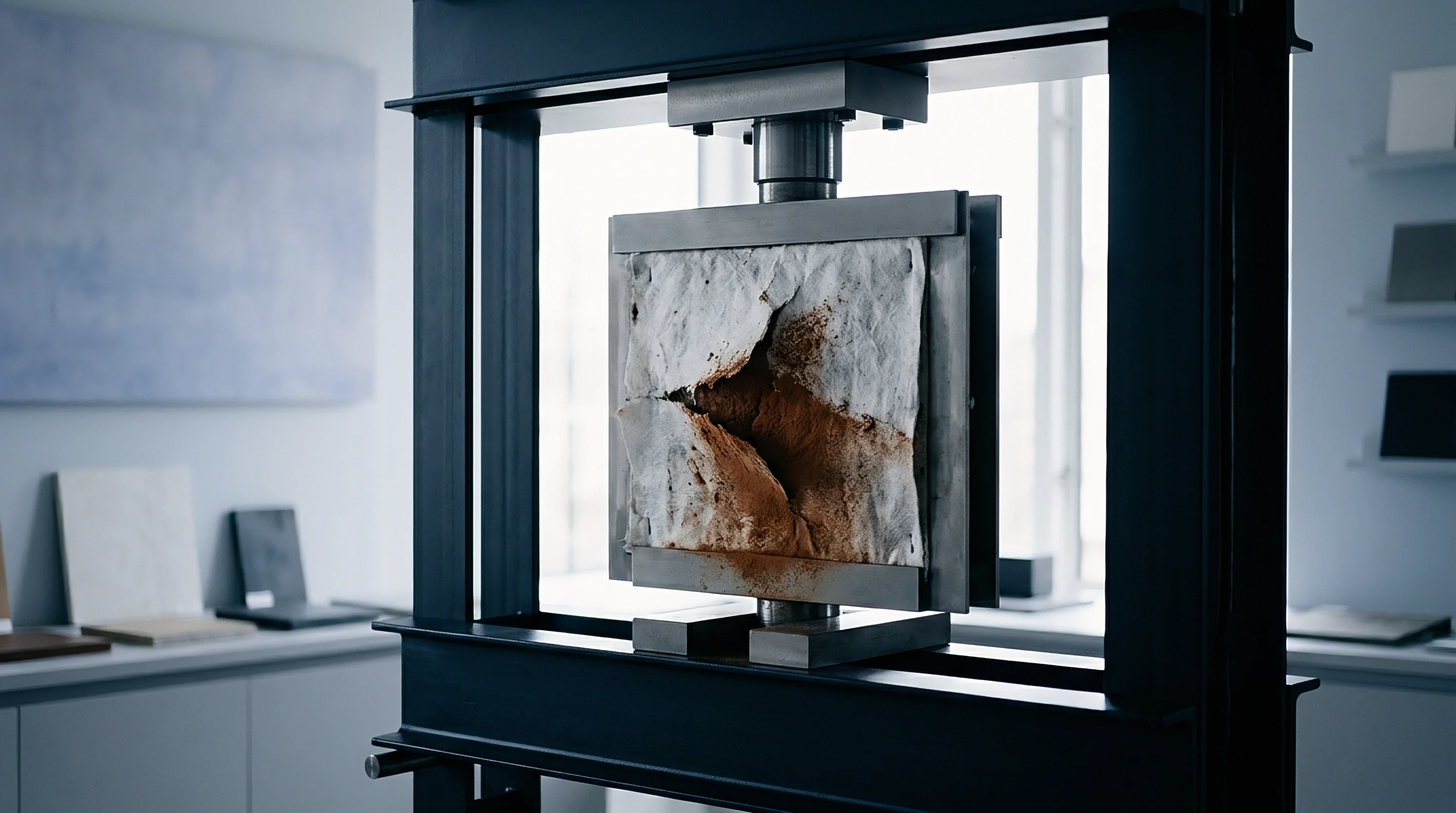
Metric
Standardized indices like ASTM D395 Method B quantify residual deformation following constant strain exposure. Calculation relies on the ratio of recovered thickness to applied deflection. Expressing compression set as a percentage provides a standardized metric for comparing polymer performance across different compound formulations and exposure conditions.
Formula execution uses exact specimen dimension variables:
Compression Set = ((t_0 – t_i) / (t_0 – t_n)) 100
where t_0 represents original specimen thickness, t_i represents final recovered specimen thickness, and t_n represents parallel spacer bar height establishing applied deflection. Precision spacer ground tolerances of plus or minus 0.01 millimeters prevent initial strain variance across multi-specimen test jigs.
Where Do Test Duration Limits Distort Compression Set Estimates?
Short exposure intervals of twenty-four hours frequently obscure long-term chemical degradation profiles in high-performance polymers. Initial deformation during short tests reflects primary viscoelastic relaxation rather than chemical backbone damage. Extending test intervals to five hundred or one thousand hours allows slow hydrolytic reactions to manifest as steep rises in permanent set.
Data sheets overstate endurance. Extrapolating long-term lifespan from short test runs assumes linear degradation rates. Chemically driven steam degradation often exhibits induction periods where physical metrics remain stable before undergoing sharp degradation acceleration once antioxidant packages exhaust.
Standard qualification guidelines require testing across minimum intervals of 168, 500, and 1000 hours to capture non-linear kinetics.
Compression set measured under dry heat drastically underestimates seal degradation in pressurized water vapor environments due to unmeasured hydrolytic scission.

Temperature Calibration Uncertainty in High Pressure Autoclaves
Sensor placement relative to heating elements creates thermal gradients across multi-specimen test fixtures. A two-degree temperature variation within the steam vessel shifts local reaction rates, introducing significant measurement spread across identical elastomer ring samples. Standardizing test methodology requires mapped thermal profiling across the entire autoclave working space.
- Temperature sensor placement ~ Positioning reference Pt100 RTD sensors within five millimeters of test specimen fixtures captures true localized thermal exposure.
- Autoclave pressure tracking ~ Calibrated digital pressure transducers confirm saturated vapor conditions by matching measured pressure against steam table saturation points.
- Spacer bar tolerances ~ Ground stainless steel spacer blocks held within plus or minus 0.005 millimeters eliminate applied strain variability across specimens.
- Thickness measurement protocol ~ Automated micrometer fixtures operating at fixed contact force eliminate operator bias in post-exposure thickness determination.
- Deaeration verification lines ~ Online dissolved oxygen meters confirm vessel head space oxygen content drops below target thresholds before heating starts.
Uncertainty budgets for compression set metrics combine strain fixture dimensional tolerances, micrometer accuracy, and autoclave thermal stability. Combined expanded uncertainty typically lands between plus or minus 2.5 percent set value when using accredited calibration routines. Uncalibrated test benches frequently introduce measurement errors exceeding ten percent set value.
Incorporating ISO 23936-2 Annex C testing guidelines into procurement contracts forces suppliers to prove 1000-hour compression set endurance at maximum operational pressure before lot release.

Exposure
Simulating multi-year operational lifespans demands rigorous extrapolation models grounded in chemical reaction kinetics. Accelerated aging protocols expose elastomer specimens to elevated temperatures above continuous operational ratings to speed up hydrolytic degradation reactions. Mathematical modeling projects compression set values and sealing retention over multi-year periods at normal operating temperatures.
Accelerated aging assumes that chemical reaction mechanisms remain identical across elevated test temperatures. Exceeding polymer glass transition or thermal degradation thresholds introduces secondary reaction pathways that corrupt model accuracy. Saturated vapor testing demands ceiling temperatures below polymer decomposition limits to ensure valid kinetic extrapolation.
Worked Degradation Model for Severe Process Service
Arrhenius relationship calculations project seal life expectancy based on accelerated elevated temperature trial data. The natural logarithm of reaction rate constants plotted against the reciprocal of absolute temperature yields activation energy values for hydrolytic scission.
Model assumptions for a process seal evaluation case:
Target continuous operational environment: Saturated steam at 140°C (413.15 K).
Failure metric threshold: 50 percent compression set under 25 percent strain deflection.
Trial dataset collected via ISO 23936-2 autoclave steam exposures:
Test Temperature 1: 180°C (453.15 K), time to 50% compression set = 120 hours.
Test Temperature 2: 160°C (433.15 K), time to 50% compression set = 450 hours.
Calculating reaction rate constants k1 = 1/120 = 0.00833 h^-1 and k2 = 1/450 = 0.00222 h^-1.
Applying Arrhenius activation energy formula:
E_a = (R ln(k1 / k2)) / ((1 / T2) – (1 / T1))
Using universal gas constant R = 8.314 J/(mol·K):
E_a = (8.314 ln(0.00833 / 0.00222)) / ((1 / 433.15) – (1 / 453.15))
E_a = (8.314 1.322) / (0.0023087 – 0.0022068) = 10.991 / 0.0001019 = 107,860 J/mol (107.86 kJ/mol).
Extrapolating reaction rate constant k_target at 140°C (413.15 K):
ln(k_target / k2) = (E_a / R) ((1 / T2) – (1 / T_target))
ln(k_target / 0.00222) = (107860 / 8.314) ((1 / 433.15) – (1 / 413.15))
ln(k_target / 0.00222) = 12973.3 (0.0023087 – 0.0024204) = 12973.3 (-0.0001117) = -1.449
k_target / 0.00222 = e^(-1.449) = 0.2348
k_target = 0.00222 0.2348 = 0.000521 h^-1.
Projected operational lifespan to 50% compression set at 140°C:
Time = 1 / k_target = 1 / 0.000521 = 1,919 hours (approximately 80 days).
The Arrhenius model demonstrates that while the compound survives short steam cleaning cycles at one hundred and eighty degrees Celsius, continuous operation at one hundred and forty degrees Celsius yields seal failure under three months. Operational lifespans drop sharply under continuous load.
| Uncertainty Parameter | Standard Uncertainty (±) | Sensitivity Coefficient | Uncertainty Contribution (%) | Verification Method |
|---|---|---|---|---|
| Temperature Distribution | 0.8 °C | 2.1 %/°C | 1.68 | Multi-point RTD mapping |
| Micrometer Thickness Gauge | 0.003 mm | 1.2 %/mm | 0.36 | Gauge block calibration |
| Spacer Block Height | 0.005 mm | 1.5 %/mm | 0.45 | Optical comparator check |
| Pressure Control Stability | 0.02 MPa | 0.8 %/MPa | 0.16 | Transducer calibration |
| Dissolved Oxygen Level | 2.0 ppb | 0.05 %/ppb | 0.10 | Electrochemical probe audit |
- Extrapolation error from non-linear kinetics ~ Assuming constant activation energy across thermal transitions leads to overestimating seal lifespan by factors of three or four.
- Condensate erosion of filler matrices ~ High-velocity steam flow strips silica and carbon black reinforcement from compound surfaces, reducing sealing force independent of main chain scission.
- Plasticizer leaching volume reduction ~ Extraction of low-molecular-weight processing aids into steam condensate causes net volume shrinkage, accelerating leak pathways.
- Crosslink density loss from amine additives ~ Alkaline corrosion inhibitors in boiler feedwater attack fluoroelastomer vulcanization sites, accelerating chemical compression set.
Perfluoroelastomer compounds formulated with nitrile crosslinks experience total sealing force loss when operating in superheated water vapor above two hundred degrees Celsius.
Compound choice determines lifespan. Quantitative exposure modeling bridges laboratory bench testing with field reliability expectations, ensuring seal compound selection rests on mathematical evidence rather than promotional datasheet ratings.
The long-term synergistic interaction between cyclic pressure pulsing and localized steam condensation in perfluoroelastomer seal grooves remains an open question in high-temperature process metrology.
Valuation
Financial decisions surrounding elastomer selection balance initial component price against maintenance overhead and process downtime. Overspecifying compound grades incurs unnecessary procurement expense, while underspecifying leads to catastrophic line leakage and emergency shutdowns. Establishing rigorous compression set metrics in steam service allows quality engineering teams to select cost-effective compounds that meet operational lifespan targets.
Batch variability shifts results. Tighter tolerances raise price. Evaluating total cost of ownership demands factoring calibration verification, incoming batch sampling, and qualification testing fees into the landed component price.
Commercial Cost Penalty of Overspecifying Perfluoroelastomer Compounds
Material expenses for fully fluorinated elastomers exceed standard EPDM formulations by factors of thirty to fifty. Installing premium steam-grade perfluoroelastomer O-rings in process lines operating at one hundred and twenty degrees Celsius yields negligible operational lifespan gains compared to properly peroxide-cured EPDM components. Engineering teams purchase unnecessary thermal resistance when EPDM compounds provide identical steam endurance at a fraction of component cost.
Seal failure stops processing. Procurement specifications should align polymer selection with maximum process exposure conditions. Standardizing on peroxide-cured EPDM for medium-temperature steam lines reserves high-cost perfluoroelastomer compounds strictly for high-temperature processes containing aggressive chemical solvents alongside superheated steam.

Incoming Lot Certificate Audits and Batch Acceptance
Certificate of analysis documentation requires independent bench verification when sealing integrity affects process safety. Manufacturer lot certificates frequently quote dry heat compression set values measured per ASTM D395 Method B, omitting steam exposure metrics entirely. Requesting lot-specific steam compression set data or running incoming bench verification on specimen coupons guards against batch-to-batch curing variance.
Incoming verification protocols test sample coupons from each production batch in miniature steam autoclaves for seventy-two hours at process operating temperature. Measuring volume swell and recovered thickness verifies crosslink density consistency before authorizing warehouse release for line installation.
Standardizing incoming verification on high-pressure steam test coupons protects process line investments while maintaining strict quality control across every procurement cycle.