Quantifying Hygromechanical Stress Shifts in Encapsulated Piezoresistive Pressure Diaphragms
Polymer encapsulant swelling induces parasitic diaphragm stresses that drive zero-offset drift requiring hydrophobic materials or multi-variable digital compensation.

Resin

Polymer Moisture Sorption Kinetics
Protective encapsulants on piezoresistive pressure diaphragms take up ambient water across exposed polymer surfaces. Moisture diffusion through thermosetting epoxies, silicones, and polyimides follows Fickian kinetics under steady atmospheric conditions, with mass transfer set by temperature-dependent diffusion coefficients and material saturation limits. Water molecules fill free volume voids within the cross-linked network, while hydrogen bonding with polar functional groups alters intra-chain spacing.
Within an encapsulant layer of thickness L exposed to ambient relative humidity, the mass concentration of absorbed water develops non-uniform spatial profiles over time according to solutions of Fick’s equation. As liquid water or vapor enters the lattice, the polymer expands volumetrically in direct proportion to local concentration gains.
Volumetric strain from moisture uptake follows a linear relation set by the coefficient of hygroscopic swelling. Expressed in strain per unit mass fraction of absorbed moisture, this coefficient captures how the polymer matrix expands as water penetrates it. Absorbed water also acts as a plasticizer, lowering glass transition temperatures, reducing the effective shear modulus of the encapsulant, and accelerating viscoelastic relaxation.
In piezoresistive sensors, this drop in glass transition temperature alters the package’s baseline mechanical response across its operating temperature envelope.
Relative humidity steps from 10 percent to 85 percent at 60 degrees Celsius induce an offset voltage shift of 1.8 millivolts per volt in uncompensated polyimide-coated silicon pressure diaphragms within 72 hours of exposure.
Interactions at the interface between the polymer encapsulant and the underlying single-crystal silicon diaphragm convert isotropic volumetric expansion into anisotropic shear and normal stresses. Chemical adhesion at the silicon dioxide passivated surface prevents sliding, constraining the expanding resin layer. Out-of-plane swelling thus creates strong in-plane compressive stresses around the diaphragm perimeter alongside out-of-plane tensile forces over active sensing elements.
These interfacial stresses scale directly with the moisture concentration gradient near the contact surface.
- Fickian Saturation Limit Ambient relative humidity dictates the equilibrium water mass fraction in the encapsulant, setting the maximum stress shift possible at a given temperature.
- Temperature Dependence Diffusion rates follow Arrhenius behavior, accelerating saturation kinetics at higher temperatures without changing the ultimate swelling coefficient.
- Plasticization Drop Absorbed moisture lowers the polymer glass transition temperature, driving time-dependent drops in elastic modulus that alter stress transfer across the silicon interface.
- Interfacial Adhesion Constraint Direct chemical bonding between the encapsulant and passivation layer turns free volumetric expansion into parasitic shear and normal stress fields across active piezoresistors.
Hygroscopic swelling strains create displacement profiles that directly oppose or reinforce the strain fields caused by external fluid pressure. In low-range differential pressure sensors operating below 100 kilopascals, these parasitic swelling stresses often reach magnitudes comparable to full-scale pressure signals. Tracking the transient diffusion front inside the encapsulant is essential for separating environmental moisture drift from true pressure changes.


Mechanics
Piezoresistive Stress Tensor Transformations
Silicon piezoresistors aligned with the crystallographic directions of a (100) silicon plane change resistance in response to normal and shear stresses. The fractional change in resistance reflects the tensor product of piezoresistive coefficients and localized stress changes. Hygromechanical stress fields imposed by swelling polymer encapsulants produce a full three-dimensional stress state, including normal stresses along orthogonal axes and out-of-plane shear stresses.
Interfacial strain continuity forces the top surface of the silicon diaphragm to follow the dimensional expansion of the adhering polymer.
Calculating zero-point offset shifts requires resolving stress tensor components at each arm of the Wheatstone bridge. The longitudinal and transverse piezoresistive coefficients govern resistance changes parallel and perpendicular to current flow in the diffused or implanted resistors. Uniform diaphragm expansion under symmetrical heating cancels out in a balanced bridge, but non-uniform hygromechanical stress profiles disrupt that symmetry.
Moisture diffusion fronts moving in from package edges create asymmetrical stress fields that directly shift the zero-pressure differential output voltage.
| Material Parameter | Symbol | Nominal Value | Measurement Units |
|---|---|---|---|
| Longitudinal Piezoresistive Coefficient | π11 | +6.6 × 10⁻¹¹ | Pa⁻¹ |
| Transverse Piezoresistive Coefficient | π12 | -1.1 × 10⁻¹¹ | Pa⁻¹ |
| Shear Piezoresistive Coefficient | π44 | +138.1 × 10⁻¹¹ | Pa⁻¹ |
| Coefficient of Hygroscopic Swelling | β | 0.28 | strain / (kg/kg) |
| Polymer Encapsulant Modulus (Dry) | E_dry | 3.4 | GPa |
| Polymer Encapsulant Modulus (Wet) | E_wet | 2.1 | GPa |
Stress profiles across thin circular or rectangular diaphragms depend heavily on boundary constraints at the clamped edges. Swelling encapsulants exert surface traction vectors across the diaphragm face, altering edge moment distributions and center deflection. For a diaphragm of thickness t and edge length a, surface shear stress from hygroscopic expansion introduces a bending moment that alters surface strain distributions.
This bending component shifts the pressure sensitivity scale factor by modifying the structural stiffness of the diaphragm assembly.

Viscoelastic Stress Relaxation Dynamics
Thermosetting encapsulation polymers display pronounced viscoelastic behavior, decaying in stress over time under constant applied strain. When a sensor sees a step change in ambient relative humidity, moisture uptake initially drives rapid stress build-up from volumetric swelling. As water molecules penetrate deeper into the polymer lattice, increased chain mobility triggers stress relaxation that lowers interfacial stress.
This time-dependent relaxation creates complex hysteresis loops during cyclic humidity exposure.
Modeling viscoelastic stress relaxation requires expressing the time-dependent shear relaxation modulus through a Prony series. The total mechanical stress in the encapsulant integrates the history of moisture-induced strain increments against the time-varying relaxation modulus. The stress state of an encapsulated diaphragm therefore depends not just on current relative humidity, but on the humidity path the package experienced over previous days or weeks.
Standard ISO 16750-4 environmental testing exposes uncompensated pressure transducers to severe humidity cycling, producing baseline shifts that exceed initial calibration tolerances by factors of three.
Viscoelastic relaxation rate constants increase exponentially with temperature, following time-temperature-humidity superposition principles. At elevated temperatures, stress decays rapidly, bringing the sensor to a quasi-steady baseline faster while increasing residual strain left behind upon sudden desiccation. This asymmetry between absorption and desorption stress pathways is a primary source of unrepeatable zero-point drift in the field.


Metrology
Differential Environmental Test Methodologies
Isolating hygromechanical stress shifts from purely thermal effects requires precise environmental test procedures using specialized chambers and high-accuracy reference transducers. Calibration laboratories execute controlled step changes in relative humidity while holding dry-bulb ambient temperature constant within 0.05 degrees Celsius. Continuous tracking of Wheatstone bridge output voltages, excitation currents, and diaphragm surface temperatures lets metrologists separate thermal expansion stresses from humidity-induced swelling shifts.
Measurement protocols establish dry baseline values by keeping sensors inside sealed desiccation chambers at less than 5 percent relative humidity until output voltages fully stabilize. After recording the dry baseline, the test volume steps to target humidity levels while monitoring sensor output over extended soak periods. The difference between dry baseline readings and equilibrium wet output signals defines the raw hygromechanical offset shift for that humidity level.
| Uncertainty Component | Standard Uncertainty | Probability Distribution | Sensitivity Coefficient | Uncertainty Contribution |
|---|---|---|---|---|
| Chamber Relative Humidity Control | ± 0.8 % RH | Normal (k=1) | 0.024 mV/V per % RH | 0.0192 mV/V |
| Chamber Temperature Stability | ± 0.03 °C | Rectangular | 0.110 mV/V per °C | 0.0019 mV/V |
| Reference Pressure Standard | ± 0.005 kPa | Normal (k=2) | 0.080 mV/V per kPa | 0.0002 mV/V |
| Bridge Excitation Voltage Supply | ± 12 µV | Rectangular | 1.000 mV/V per V | 0.0007 mV/V |
| Data Acquisition Quantization | ± 0.5 µV | Rectangular | 0.200 mV/V per mV | 0.0001 mV/V |
| Combined Expanded Uncertainty (k=2): ± 0.0386 mV/V corresponding to 0.048% of Full Scale Span | ||||
Characterizing long-term stability requires continuous recording over multi-week soak cycles to separate true Fickian equilibrium from slow polymer aging. Transient response analysis yields diffusion time constants specific to the profile of the encapsulant bead. Fitting non-linear least-squares algorithms to raw output curves isolates the ultimate equilibrium shift and the effective diffusion coefficient under operating boundary conditions.
Hygroscopic hysteresis testing cycles sensors through step increments from 10 percent to 90 percent relative humidity, followed immediately by reverse steps back to 10 percent. The maximum divergence between ascending and descending output curves defines the hygroscopic hysteresis error ~ a value that quantifies uncertainty in field measurements where past humidity exposure is unknown.
Quality management standards operating under ISO/IEC 17025 require calibration scopes to state expanded measurement uncertainties inclusive of environmental humidity variations when certifying piezoresistive pressure devices.
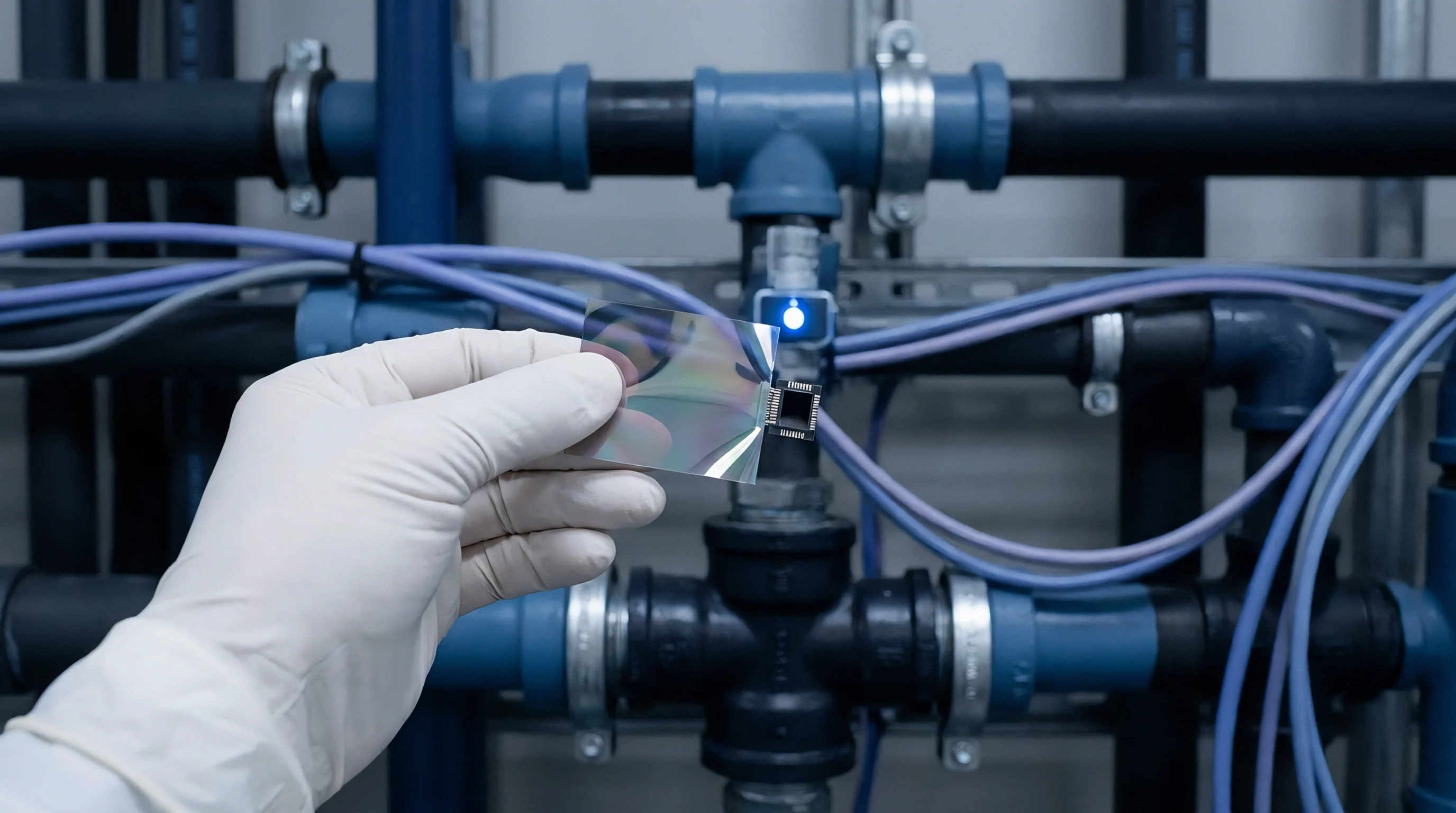
Advanced metrology setups place thin-film capacitive moisture sensors right at the silicon diaphragm edge to track local moisture arrival. Localized sensing eliminates ambiguity over whether output drift stems from slow chamber stabilization or delayed diffusion through thick encapsulation covers. Matching local humidity readings with instantaneous bridge offset values yields reliable empirical transfer functions for real-time compensation.
Desiccation

Structural and Material Mitigation Protocols
Reducing hygromechanical stress shifts relies on structural packaging changes, low-swelling encapsulant chemistries, and integrated moisture barriers. Synthesizing modified silicone gels and fluorosilicone formulations with lower polar hydroxyl concentrations drops water solubility limits. Replacing traditional high-swelling epoxy molding compounds with hydrophobic resin matrices decreases baseline hygroscopic swelling coefficients by over 60 percent.
Modifying diaphragm geometry reduces mechanical coupling between expanding encapsulants and active piezoresistors. Etching stress-isolation grooves around the perimeter of the active diaphragm decouples surface shear traction before it reaches the sensitive Wheatstone bridge area. Alternative package designs use thin metallic, oil-filled isolation diaphragms, shifting the polymer moisture interface away from the micromachined silicon element entirely.
- Fluorinated Encapsulant Formulations Fluorocarbon substitutions in polymer backbones lower overall moisture solubility while preserving necessary die-attach adhesion.
- Perimeter Stress Isolation Grooves Micromachined channels etched into die surfaces block interfacial shear stress from propagating from outer encapsulation areas to inner sensing elements.
- PECVD Silicon Nitride Passivation Dense plasma-enhanced chemical vapor deposition nitride films act as impermeable moisture barriers directly over active Wheatstone bridge resistors.
- Compliant Interfacial Buffer Coatings Applying ultra-low modulus silicone buffer layers under rigid glob-top encapsulants absorbs hygroscopic expansion strains without transferring force to the silicon.
Optimizing the passivation layer offers a direct way to block moisture from reaching sensitive piezoresistive regions. Depositing multi-layer stacks of plasma-enhanced chemical vapor deposition silicon nitride and aluminum oxide forms hermetic barriers over the underlying silicon crystal. These thin inorganic coatings keep moisture vapor transmission rates below detection limits, preventing water from reaching the silicon-dielectric interface where piezoresistors sit.
Tight process control during dispense and cure cycles maintains uniform material thickness across the diaphragm surface. Asymmetrical dispense geometry creates unbalanced swelling forces that amplify zero-point offset drift as environmental humidity shifts. Automated optical inspection and volume verification keep coating symmetry within tight tolerances across volume production runs.

What Calibration Protocols Neutralize Environmental Humidity Drift?
Neutralizing hygromechanical stress shifts in the field relies on multi-variable digital compensation embedded within signal-conditioning ASICs. Sensor electronics store multi-point calibration matrices incorporating ambient temperature, operating pressure, and onboard relative humidity sensor inputs. Mathematical compensation models evaluate polynomial expansions to compute real-time offset and span corrections, cancelling errors caused by polymer moisture absorption.
Factory calibration uses automated thermal-humidity mapping across grid matrices of temperature and relative humidity setpoints. Test systems record raw bridge outputs at each matrix node after allowing enough dwell time for encapsulant moisture to reach equilibrium. Digital signal processors calculate individual correction coefficients for each sensor, storing lookup table parameters in non-volatile memory on the sensor package.
Deploying predictive compensation algorithms requires embedding real-time models of Fickian diffusion directly into sensor firmware. The onboard microprocessor tracks relative humidity exposure over time, solving discrete diffusion equations to estimate instantaneous moisture concentration profiles within the encapsulant. This continuous tracking enables accurate dynamic stress correction even during rapid ambient humidity transitions before physical equilibrium occurs.

Resolution

Commercial Acceptance Specifications and Procurement Risk
Sourcing high-precision encapsulated pressure sensors requires turning metrological findings into enforceable commercial specifications and incoming inspection standards. Generic datasheet accuracy statements frequently omit environmental humidity parameters, presenting initial calibration tolerances achieved exclusively under dry laboratory conditions. Technical procurement documents need to mandate explicit drift caps across full operational relative humidity ranges over multi-year service lifespans.
Specifying acceptable performance limits requires defining maximum allowable zero-point offset drift, span sensitivity variation, and hygroscopic hysteresis as percentages of full-scale output. Supplier qualification dossiers should include accredited test reports demonstrating compliance with extended thermal-humidity soak standards. Engineering teams then evaluate these reports against expected operational exposure profiles in end-use automotive, industrial process, or aerospace environments.
| Accuracy Grade Standard | Max Hygromechanical Drift (% FSO/yr) | Encapsulation Technology | Calibration Standard Requirements | Relative Unit Cost Ratio |
|---|---|---|---|---|
| Industrial Standard (Grade C) | ± 1.25 % FSO | Standard Silicone Gel | 2-Point Thermal Trim (Dry Only) | 1.0 x |
| Enhanced Process (Grade B) | ± 0.35 % FSO | Low-Swelling Fluorosilicone | Multi-Point Thermal-Humidity Matrix | 2.8 x |
| Metrology Grade (Grade A) | ± 0.05 % FSO | Oil-Filled Isolated Diaphragm | Full Traceable ISO 17025 Certificate | 7.4 x |
Calculations of total landed cost must balance unit purchase price against long-term field recalibration expenses and warranty risk. Uncompensated low-cost sensors deployed in high-humidity environments incur substantial maintenance overhead from frequent drift-induced re-zeroing. Investing in advanced encapsulation architectures or factory-compensated digital devices increases initial bill-of-materials costs, but substantially lowers life-cycle operational expenditure.
Supply agreements should incorporate explicit rejection thresholds for incoming batch testing based on statistical acceptance sampling. Quality control inspectors subject sample units from incoming lots to accelerated steam-soak tests or elevated humidity exposure routines to verify encapsulant stability. Catching anomalous swelling behavior before system integration protects manufacturing pipelines from widespread field failures.
A supplier quote matching low initial price targets often masks severe humidity drift that ruins measurement accuracy in field service.