Piezoresistive Pressure Sensor Packaging Mechanics and Hygroscopic Drift
Hygroscopic expansion in packaging polymers causes piezoresistive sensor zero drift; specifying low-sorption adhesives and humidity testing controls drift.


Swell
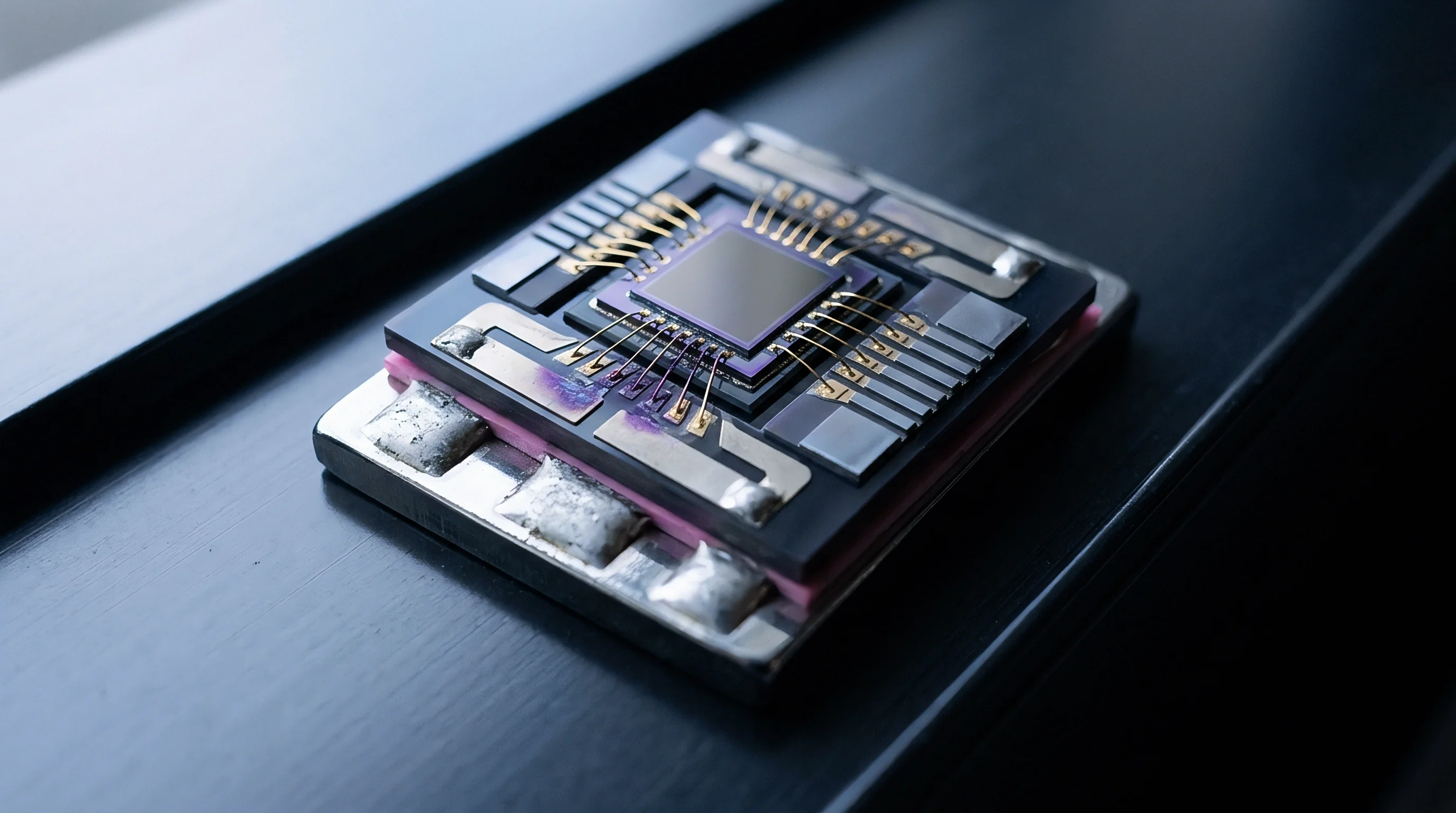
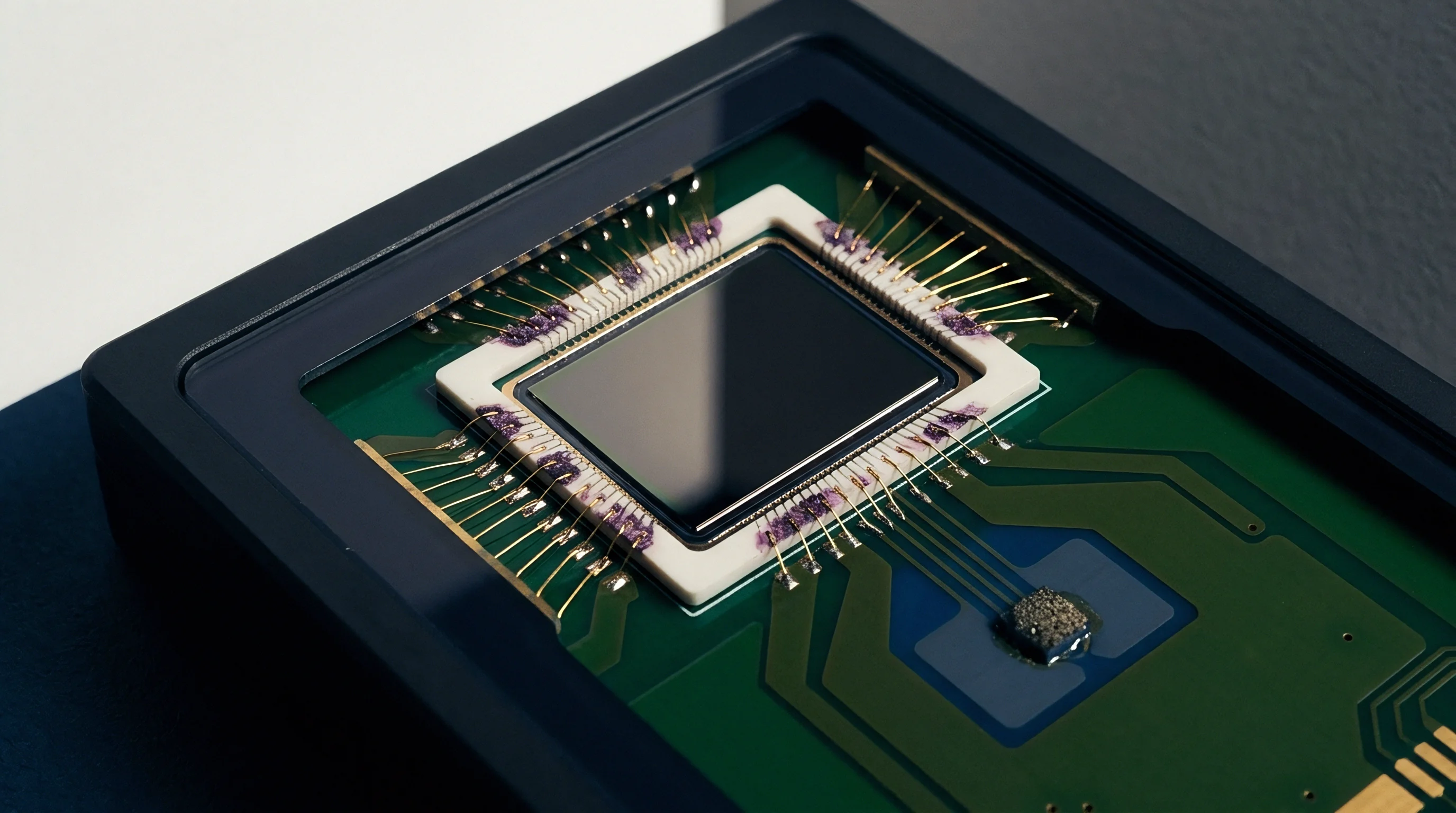
Polymer matrix materials inside micromachined pressure transducer assemblies absorb atmospheric moisture during exposure, triggering structural changes at the molecular interface. In a MEMS piezoresistive pressure sensor, the silicon sensing element attaches to a substrate ~ typically ceramic or TO-header glass-to-metal mounts ~ using organic die-attach adhesives like epoxy or polyimide resins. Surrounding the silicon die is a soft encapsulant gel, often a silicone or fluorosilicone polymer matrix, which isolates wire bonds and active piezoresistive traces from corrosive media while transmitting fluid pressure.
As moisture diffuses into these packaging components, it causes volumetric growth governed by the Coefficient of Hygroscopic Swelling.
Water uptake within polymeric packaging layers follows Fickian diffusion kinetics under standard storage conditions. As water molecules permeate the polymer mesh, hydrogen bonding disrupts existing crosslinks. This sorption increases the physical volume of the die-attach line and protective gel coatings while altering the intrinsic density of the packaging stack.
During transient humidity shifts, spatial moisture distribution across an adhesive layer remains non-uniform, establishing internal concentration gradients across the die boundary.
Polymer networks expand as they absorb ambient moisture.
The magnitude of moisture-induced expansion scales with relative humidity and temperature. Under high ambient humidity, the die-attach resin expands along exposed edges before reaching equilibrium across the bond pad area. The silicon sensor die itself exhibits near-zero hygroscopic expansion.
This expansion mismatch across the die-substrate joint generates high mechanical shear stress along the adhesive plane.
The steady-state saturation limit of standard optical-grade silicone gel encapsulants reaches zero point three percent by weight under eighty-five percent relative humidity conditions.
Substrate materials vary in their susceptibility to moisture. Circuit board materials like FR-4 absorb up to zero point four percent water by weight and flex under humidity changes, whereas Direct Bonded Copper alumina ceramics show negligible sorption. When saturated, polymer die-attach adhesives and gel encapsulants degrade through distinct mechanisms:
- Die-attach volumetric expansion induces asymmetric lifting forces on the perimeter of the silicon die, bending the diaphragm plane directly beneath the etched piezoresistive bridge.
- Encapsulant gel plasticization lowers the shear modulus of the protective silicone, changing how mechanical stress passes from the packaging housing to the sensor surface.
- Substrate hygroscopic warping flexes the base substrate, transmitting structural displacement through the die adhesive layer to the silicon die.
- Passivation interface moisture trapping creates localized micro-void swelling between the silicon nitride surface coating and the gel cover, concentrating strain over individual piezoresistors.
Initial baseline zero changes during high-humidity exposure are often attributed to transient thermal offset rather than water sorption mechanics, on the assumption that ambient drying steps fully restore sensor output to baseline values.
Transfer
Mechanical strain generated within swelling package components reaches the piezoresistive bridge circuit through elastic coupling across the adhesive interface. Silicon piezoresistors ion-implanted into a single-crystal diaphragm rely on piezoresistive coefficients to translate mechanical deformation into proportional electrical resistance changes. When packaging polymers undergo volumetric moisture expansion, they exert parasitic mechanical forces on the silicon crystal lattice.
These non-pressure-induced strains shift the baseline electrical resistance of the four-arm Wheatstone bridge.
Die-attach resins expand as water infiltrates the bond line.
The strain state induced by packaging expansion depends heavily on the spatial distribution of the die-attach adhesive. A void-free adhesive layer creates a continuous strain field, whereas bond line voids concentrate stress along localized crystalline axes. Silicon demonstrates high piezoresistive sensitivity along specific crystallographic directions, notably the 110 direction in p-type silicon diaphragms.
Parasitic compressive or tensile stress aligned with these sensitive axes shifts the uncalibrated zero-pressure output voltage, mimicking an applied pressure signal.
| Material Class | Water Sorption (wt%) | Dry Elastic Modulus (MPa) | Wet Elastic Modulus (MPa) | CHS (ppm/%RH) |
|---|---|---|---|---|
| 0.12 to 0.35 | 0.05 to 0.20 | 0.04 to 0.15 | 15 to 40 | |
| 0.08 to 0.20 | 0.10 to 0.40 | 0.08 to 0.32 | 10 to 25 | |
| 0.30 to 0.85 | 3500 to 8000 | 2200 to 5500 | ||
| 1.20 to 2.50 | 2800 to 4500 | 1800 to 3200 |
As moisture penetrates an epoxy die attach, the glass transition temperature drops significantly. This structural softening alters the mechanical transfer function between the housing and the silicon die. At elevated relative humidity, the reduced elastic modulus of the adhesive partially decouples external mounting stress, yet simultaneously increases zero-point stability errors due to viscoelastic creep under sustained mechanical preload.
A twelve micron expansion in epoxy bond line thickness under eighty-five percent relative humidity generates an uncompensated zero-point shift exceeding zero point six percent of full scale span in a one bar piezoresistive sensor.
The geometry of the pressure-sensing diaphragm governs its sensitivity to packaging stress. High-pressure sensors featuring thick diaphragms resist packaging-induced deformation more effectively than low-pressure sensors with thin, highly compliant diaphragms. In sensors rated below 100 millibar, strain from die-attach hygroscopic swelling often matches the magnitude of the full-scale strain produced by measured fluid pressure.
Ignoring mechanical strain transfer mechanisms across the die attach layer leads to field failure rates exceeding eight percent in unheated outdoor industrial pressure transmitters subjected to seasonal humidity changes.
Drift
Electrical output changes over prolonged exposure manifest as zero offset instability, span coefficient alterations, and pronounced humidity hysteresis loops. Zero offset drift occurs when hygroscopic expansion forces produce an asymmetrical strain distribution across the four piezoresistors of the Wheatstone bridge. Slight dimensional mismatches in die-attach fillet geometry lead to differential strain between opposing bridge arms, driving continuous wander in the uncompensated zero-pressure voltage.
Silicon piezoresistors detect sub-microstrain changes caused by packaging movement.
How Does Absorbed Moisture Translate to Zero Offset?
Moisture entering the encapsulant gel shifts the dielectric constant around high-impedance silicon traces while applying volumetric swelling pressure to the diaphragm face. Water possesses a relative permittivity near eighty, whereas dry silicone gel exhibits a value near two point7. Accumulation at the die surface creates secondary parasitic capacitance paths and potential leakage currents between bond pads, compounding mechanical strain drift with electrical offset shifts.
Asymmetric swelling alters the bridge resistance balance.
| Packaging Architecture | Initial Zero Offset (%FS) | Hygroscopic Drift Shift (%FS) | Post-Bake Recovery Offset (%FS) | Dominant Instability Mode |
|---|---|---|---|---|
| ±0.15 | +0.82 | +0.21 | Permanent Die Attach Creep | |
| ±0.10 | +0.24 | +0.04 | Reversible Gel Swelling | |
| ±0.05 | +0.02 | +0.01 | Substrate Surface Sorption | |
| ±0.08 | +0.01 | 0.00 | Hermetic Seal Integrity |
Humidity hysteresis complicates calibration. When a sensor cycles from thirty percent to ninety percent relative humidity and back to thirty percent, the output voltage fails to trace the original path. Water absorption proceeds faster than desorption due to hydrogen bonding within the dense adhesive matrix, creating a time-dependent memory effect inside the package that shifts baseline output based on past exposure.
Hysteresis loops widen noticeably in high-humidity environments.
Thermal-hygroscopic cross-sensitivity complicates electronic compensation strategies. Temperature coefficients of offset are traditionally mapped during factory calibration under dry nitrogen or low-humidity conditions. In field service, elevated moisture content changes both the thermal expansion coefficient and the elastic modulus of internal packaging polymers.
Standard linear temperature compensation algorithms fail to correct for this dynamic response, leaving uncompensated zero and span errors in humid environments.
The extent to which chemical degradation of the die-attach polymer matrix permanentizes this zero drift after complete thermal bake-out remains a contentious baseline question in long-term sensor calibration reliability studies.
Barrier
Mitigating hygroscopic instability requires careful material selection and structural isolation geometries that prevent mechanical strain from reaching the silicon sensing element. Packaging design choices dictate the rate and volume of water ingress. Standard dimethyl silicone gels offer excellent stress relief due to their ultra-low modulus, but their high moisture permeability permits rapid water transport directly to the active die face.
Replacing standard silicones with fluorosilicone gels lowers solvent permeability and moisture sorption, reducing gel expansion under damp heat conditions.
Unisolated die assemblies drift faster in humid environments.
Die-attach technology provides the primary defence against substrate-borne strain. Eutectic gold-tin solder die bonding eliminates organic polymers from the primary load path entirely, providing a hermetic, zero-sorption interface that isolates the silicon die from moisture-induced expansion. Where cost constraints demand organic adhesives, ultra-low-sorption epoxies modified with hydrophobic silane additives shorten the moisture diffusion length and reduce swelling-induced strain.
Fluorosilicone gels significantly reduce moisture-driven volumetric swelling.
Parylene C conformal coatings applied via vapor deposition create a barrier over the silicon die prior to gel dispensing. Pin-hole free Parylene layers measuring two to five microns in thickness impede moisture access to sensitive surface passivation layers. Physical stress isolation structures etched directly into the silicon die substrate, such as isolation trenches or glass pedestal mounts, lengthen the mechanical path over which packaging strain dissipates before reaching the piezoresistive Wheatstone bridge.
- Fluorosilicone gel selection minimizes water uptake and solvent swelling across broad operating temperature ranges.
- Parylene C thin-film deposition blocks moisture contact with active die passivation traces.
- Stress-isolated ceramic pedestal mounting decouples external housing displacement from diaphragm strain.
- Hermetic TO-8 header glass pin sealing prevents moisture intrusion along electrical lead-through paths.
Isolating the piezoresistive element with a hydrophobic conformal barrier prevents surface dielectric loading and dampens mechanical stress transfer from gel swelling.
Oil-filled isolated housing designs place the piezoresistive element inside a sealed metallic cavity filled with silicone oil, separated from the process media by a thin stainless steel diaphragm. This architecture removes organic packaging gels from direct atmospheric contact, replacing them with an incompressible fluid medium. The metallic outer housing forms an absolute barrier against moisture diffusion, preventing hygroscopic zero drift over long operational lifespans.
Eliminating organic die attach resins from the primary strain path permanently prevents moisture-induced zero offset wander.

Dossier
Establishing traceable calibration limits for piezoresistive pressure sensors requires environmental stress testing protocols that isolate hygroscopic drift from long-term mechanical creep. Sourcing specifications must define acceptable zero offset drift under explicit relative humidity parameters. Standard factory calibrations performed in climate-controlled environments at thirty to fifty percent relative humidity mask latent hygroscopic drift vulnerabilities that emerge only after prolonged exposure to humid field conditions.
Calibration documentation specifies ambient humidity levels during testing.
Qualification frameworks specify environmental stress testing using IEC 60068-2-78 damp heat steady-state standards. Standard test conditions require continuous exposure to forty degrees Celsius and ninety-three percent relative humidity for a minimum of 1,000 hours. Evaluating sensor stability during damp heat testing requires taking baseline zero and span measurements immediately upon removal from the environmental chamber, followed by sequential measurements after twenty-four, forty-eight, and one hundred sixty-eight hours of ambient dry-out to separate reversible gel expansion from permanent adhesive creep.
Extended dry nitrogen bakes drive off absorbed moisture.
Incoming verification of piezoresistive sensor lots follows a standardized screening protocol to ensure baseline zero stability across batch runs:
- Record baseline zero-pressure output voltage and full-scale span at twenty-three degrees Celsius and forty percent relative humidity.
- Bake units at eighty-five degrees Celsius under dry nitrogen for twenty-four hours to establish a dry baseline reference state.
- Subject test samples to eighty-five degrees Celsius and eighty-five percent relative humidity for two hundred forty hours under constant power bias.
- Measure zero-pressure voltage offset immediately within fifteen minutes of removal from the environmental chamber.
- Store samples at standard laboratory conditions for seventy-two hours and measure baseline recovery output to quantify permanent drift offset.
Sensors failing to recover within zero point one percent of full scale span after a seventy-two hour ambient dry-out carry unacceptably high die-attach plasticization rates.
Procurement specifications for high-accuracy applications specify strict environmental drift limits over service life. Incorporating explicit hygroscopic drift boundaries into purchasing agreements protects against unverified packaging modifications by suppliers. A robust technical procurement clause defines operational tolerances across environmental limits:
Contracts specifying compliance with IEC 60770-1 mandate that combined zero offset drift and humidity hysteresis must not exceed zero point twenty-five percent of full scale span following two hundred forty hours of steady-state damp heat exposure.