Interfacial Hygroscopic Swelling Stress Analysis in Surface Mount Encapsulants
Interfacial hygroscopic swelling stress arises from differential moisture expansion, compounding thermal mismatch and driving package delamination during reflow.
Matrix
Surface mount encapsulants rely on polymeric matrices ~ typically highly cross-linked epoxies filled with fused silica micro-particles ~ to protect semiconductor dies from shock and atmosphere. During amine or anhydride curing, the epoxy forms polar hydroxyl and amine groups along its backbone. These polar sites hydrogen-bond with ambient water migrating into the package.
Moisture enters through the free volume between polymer chains, filling micro-cavities across the cross-linked network until reaching an equilibrium governed by ambient relative humidity and temperature.
Water resides inside the molding compound in two thermodynamic states: unbound free water in the interstitial free volume, and bound water hydrogen-bonded directly to the resin backbone. Unbound moisture moves through molecular voids without changing chain spacing, but bound water disrupts inter-chain hydrogen bonding, forcing polymer chains apart. This expansion generates volumetric strain ~ hygroscopic swelling ~ that scales linearly with moisture concentration up to a saturation limit defined by maximum water absorption by weight percentage.
Adding fused silica particles to epoxy molding compounds reduces overall hygroscopic expansion by replacing moisture-absorbing polymer matrix with inorganic material. Compared to the organic resin, silica absorbs virtually no water. Raising silica filler loading from 70 percent to 90 percent by weight significantly drops total saturated moisture content.
Higher loading also restricts the movement of adjacent resin chains, reducing local free volume and altering moisture uptake kinetics, while stiff silica spheres physically constrain the swollen resin to reshape internal stress distribution.
Dynamic mechanical behavior shifts as water accumulates within the compound. Absorbed moisture acts as a plasticizer, depressing the glass transition temperature of the cured resin by 15 to 25 degrees Celsius for every weight percent of water, depending on exact formulation. As glass transition drops toward operating or testing temperatures, the encapsulant’s elastic modulus drops significantly.
This stiffness loss combined with volumetric expansion sets up a complex internal strain state before thermal cycling or assembly reflow even starts.
Matrix chemistry dictates moisture affinity over a component’s operational life. A high density of polar cross-links increases maximum water absorption capacity even as it maintains structural stiffness, which is why epoxy novolac resins absorb more moisture than biphenyl epoxies with lower hydroxyl group densities. Formulators balance resin and hardener combinations to manage mechanical toughness, thermal stability, and hygroscopicity, knowing uncontrolled moisture uptake compromises package integrity through dimensional change.

Diffusion
Ambient moisture moves through a molded plastic package via mass diffusion driven by concentration gradients between the outside environment and internal interfaces. Transient moisture concentration across the encapsulant thickness obeys Ficks second law, where the rate of concentration change over time matches the spatial derivative scaled by the material diffusion coefficient. Transport remains isotropic in homogeneous resin matrices, though aligned filler particles can introduce directional variation in diffusion rates.
Boundary conditions during environmental exposure govern how the moisture profile evolves. Standard reliability pre-conditioning specifies target temperature and humidity levels: exposure at 85 degrees Celsius and 85 percent relative humidity accelerates moisture ingress compared to standard shop-floor environments of 30 degrees Celsius and 60 percent relative humidity. Saturated moisture concentration represents the maximum mass of water the molding compound can hold per unit volume when fully equilibrated with surrounding air.
At 85°C and 85% relative humidity, epoxy molding compounds absorb up to 0.45 percent water by weight at saturation.
Temperature dictates diffusion rates through an Arrhenius relationship, where the diffusion coefficient scales exponentially with the inverse of absolute temperature based on the formulation’s activation energy. Higher ambient temperatures speed up moisture ingress without altering the final equilibrium capacity. Lower temperatures slow water drive, requiring much longer exposure to reach equilibrium at internal package interfaces.
| Material Category | Filler Fraction (wt%) | Diffusion Coeff at 85°C (mm²/s) | Saturation Conc at 85°C/85%RH (mg/cm³) | Activation Energy (eV) |
|---|---|---|---|---|
| Standard Epoxy Novolac | 75 to 80 | 1.2e-6 to 1.8e-6 | 4.2 to 5.8 | 0.38 to 0.42 |
| Low-Stress Biphenyl | 82 to 86 | 8.0e-7 to 1.2e-6 | 2.8 to 3.9 | 0.41 to 0.45 |
| High-Thermal Multi-Functional | 88 to 90 | 4.5e-7 to 7.5e-7 | 1.9 to 2.6 | 0.44 to 0.48 |
Until full saturation is reached, moisture distribution inside the package remains uneven. Concentration gradients generate differential swelling strain, causing outer resin layers to expand while the dry inner core resists. This uneven expansion creates self-equilibrating stresses ~ tensile forces near the surface and compression at the core.
The time moisture takes to reach the critical die-attach interface increases quadratically with the distance from the outer mold surface.
Gravimetric sorption testing quantifies these transport parameters. Disc specimens in environmental chambers are weighed periodically on analytical balances to chart mass gain. Plotting normalized weight gain against the square root of time gives an initial diffusion coefficient from the slope.
Any departure from linear Fickian behavior indicates anomalous transport, which occurs when moisture plasticizes the polymer or micro-void filling alters internal transport mechanics.
- Non-Fickian Moisture Transport Anomalous diffusion occurring when resin structural relaxation rates match or exceed water molecule transport rates through polymer matrix voids.
- Boundary Interface Saturation Instantaneous concentration step change occurring at outer package surfaces upon immediate exposure to humid environments.
- Desiccation Kinetic Hysteresis Retarded moisture desorption rates relative to absorption rates caused by bound water hydrogen retention within matrix molecular sites.
- Dual-Stage Sorption Behavior Secondary weight gain slope appearing after initial saturation plateau, driven by moisture aggregation inside micro-cavities and filler-matrix micro-cracks.
Testing fully cured test discs under static room temperature conditions rather than dynamic reflow thermal cycles frequently understates actual moisture absorption. Standard laboratory measurements miss the structural relaxation that occurs under combined humidity and thermal stress. Proper qualification requires transient moisture modeling validated against mass measurements on actual package geometries.
Strain
The Coefficient of Hygroscopic Swelling defines the volumetric strain produced per unit change in absorbed moisture concentration. Like the Coefficient of Thermal Expansion, it converts moisture mass fractions into mechanical strain fields. While thermal expansion responds transiently to temperature swings, hygroscopic strain persists over extended periods, matching the slow absorption and desorption cycles of ambient water.
The total strain tensor in an encapsulant is the direct linear superposition of thermal and hygroscopic strains.

How Do Mismatched Swelling Coefficients Induce Interfacial Delamination?
Silicon dies, copper leadframes, and ceramic substrates show zero hygroscopic swelling in humid environments. As the plastic encapsulant absorbs water and expands against these dimensionally stable inorganic materials, the dimensional mismatch creates severe shear and normal stresses along the interface. The resin tries to expand in all directions, but bonding to rigid silicon or copper restricts movement at the interface.
Compliance with IPC J-STD-033 mandates dry packing for packages exceeding moisture sensitivity level two prior to board reflow.
While solder joints resist thermal fatigue, hygral strain alters the baseline stress state of the encapsulated package assembly. In a dry state at room temperature, molding compounds remain under net compression relative to silicon dies due to thermal contraction during post-mold cure cooling. Moisture-induced expansion offsets this compression, shifting internal stress toward tension and lowering the energy required to initiate adhesion failure along metal-plastic boundaries.
- Determine local moisture concentration fields across package geometry using transient finite-element diffusion analysis.
- Calculate volumetric hygroscopic strain vectors by multiplying concentration values by material swelling coefficients.
- Superimpose temperature-dependent thermal expansion strains corresponding to current thermal environment.
- Solve structural equilibrium equations under constrained interface boundary conditions to extract local interfacial stress components.
Temperature-dependent material properties complicate this combined stress analysis. Below the glass transition temperature, molding compounds remain stiff, converting hygroscopic strain directly into high internal stress. Above glass transition, encapsulant stiffness drops by more than an order of magnitude, which relaxes absolute stress levels but increases strain magnitude.
Dynamic mechanical analysis provides the temperature-dependent storage modulus values required for accurate stress calculations.
Reliability assessments must account for hygroscopic stress components in engineering documentation. Procurement specifications define maximum allowable hygroscopic swelling coefficients alongside standard thermal expansion limits, requiring suppliers to certify swelling limits using optical strain measurements on conditioned specimens within specified environmental bands.
Reflow
As surface mount assemblies pass through lead-free reflow ovens, temperatures surge to peak values between 245 and 260 degrees Celsius. Trapped water in free volume voids and interfaces vaporizes rapidly, with vapor pressure climbing non-linearly to exceed 4.7 megapascals at 260 degrees Celsius. This pressure acts directly against the surrounding molding compound and package interfaces.
Vapor pressure generated inside micro-voids combines with pre-existing hygro-thermal mechanical stresses to drive package damage. Thermal expansion mismatches between the silicon, leadframe, and mold compound create high peel stresses at package corners, while moisture swelling accrued during storage adds directly to this load. When combined internal pressure and stress exceed adhesion strength, delamination initiates at vulnerable interfaces.
| Package Sub-System | Thermal Stress Component (MPa) | Hygroscopic Stress Component (MPa) | Vapor Pressure Component (MPa) | Total Peak Interface Stress (MPa) |
|---|---|---|---|---|
| Die Attach / Leadframe Interface | 18.5 to 24.0 | 6.2 to 9.5 | 3.5 to 4.7 | 28.2 to 38.2 |
| Encapsulant / Die Top Surface | 12.0 to 16.5 | 4.1 to 7.2 | 2.8 to 4.2 | 18.9 to 27.9 |
| Encapsulant / Leadframe Paddle | 22.0 to 28.5 | 8.0 to 11.4 | 4.0 to 4.7 | 34.0 to 44.6 |
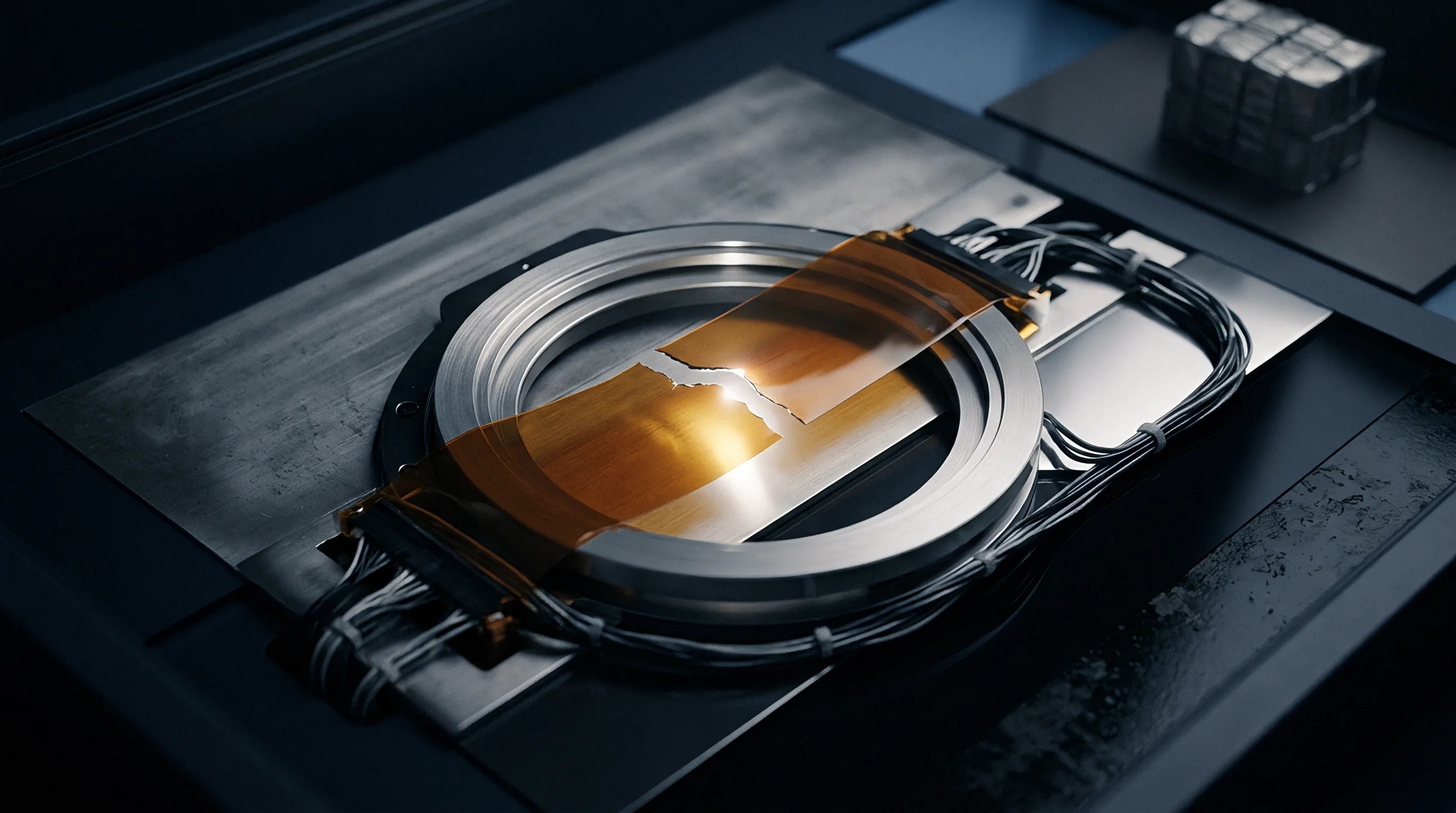
Popcorning is the visible, destructive failure mode caused by unchecked steam accumulation. Once delamination creates a void, trapped steam expands into the opening, turning the thin plastic wall into a pressure vessel. Bending stress across the encapsulant section eventually triggers sudden brittle fracture, venting steam with an acoustic pop.
These cracks break wire bonds, sever internal trace runs, and breach the environmental seal.
Interfacial adhesion drops rapidly when ambient moisture accumulation exceeds half the saturation limit before reflow.
Interfacial fracture mechanics governs how cracks propagate through package layers. The strain energy release rate defines the energy available to drive a crack along material boundaries, with crack initiation occurring once this rate exceeds critical interfacial fracture toughness. Reflow temperatures significantly reduce fracture toughness, lowering the barrier to rapid crack growth just as internal vapor pressure peaks.
Failing to control pre-reflow moisture accumulation can result in complete batch loss during assembly reflow, destroying active dies, incurring rework labor costs, and triggering severe line stoppage penalties.
Shear
Interfacial shear concentrates at geometric discontinuities. Mismatched expansion between plastic encapsulants and rigid die structures generates concentrated shear near edges. Suhir analytical models show shear stress dropping to zero at the package center and ramping up exponentially toward die corners.
Peak values depend on encapsulant thickness, elastic moduli, temperature differentials, and total hygroscopic strain.
Consider a sample calculation evaluating interfacial shear at a silicon die corner in a Quad Flat No-Lead (QFN) package. Assume a die half-width of 3.5 millimeters, an encapsulant thickness of 0.8 millimeters, and a moisture exposure yielding a uniform 0.25 percent moisture weight concentration. The encapsulant has an elastic modulus of 15 gigapascals and a Coefficient of Hygroscopic Swelling of 0.28 strain per unit concentration, while the silicon die shows zero hygroscopic expansion and a Youngs modulus of 130 gigapascals.
Calculating longitudinal hygroscopic strain yields 0.0007 strain units within the encapsulant. Constrained by the die edge, the effective strain differential between expanded resin and unexpanded silicon matches this value. Applying Suhir’s bi-material assembly formulation, where interfacial shear scales with the square root of joint stiffness, gives a peak shear stress at the die corner of 14.2 megapascals from hygroscopic strain alone.
Combining this hygroscopic shear stress with thermal stress from cooling from 175 degrees Celsius down to ambient 25 degrees Celsius alters net shear. Thermal contraction creates an inward shear vector that opposes outward hygroscopic expansion, mitigating net shear stress at room temperature. During reflow heating to 260 degrees Celsius, however, thermal and hygroscopic expansion align in direction, driving combined peak shear above 32 megapascals at the die perimeter.
- Silane Coupling Agents Chemical surface primers applied to leadframes to enhance covalent bonding with epoxy molding compound matrices.
- Leadframe Surface Roughing Chemical etching processes creating mechanical interlocks to increase critical interfacial fracture toughness under shear loads.
- Polyimide Die Passivation Stress-buffer coatings applied over active silicon surfaces to absorb interfacial shear strain and prevent passivation cracking.
- Corner Radius Filleting Molded geometry modifications designed to reduce stress concentration factors at sharp silicon corner boundaries.
Although desiccant bags delay saturation, interfacial shear stress analysis relies on material property inputs that show substantial batch-to-batch scatter. Dynamic mechanical analysis and hygroscopic expansion testing can vary by up to 15 percent across resin batches, while the impact of local chemical degradation under repeated humidity exposure remains a key uncertainty in long-term lifespan prediction.

Margin
Because package thickness delays drying cycles, component sourcing requires balancing moisture sensitivity limits against assembly logistics costs. Components rated at Moisture Sensitivity Level 1 offer unlimited floor life below 30 degrees Celsius and 80 percent relative humidity, whereas parts with higher ratings, such as Moisture Sensitivity Level 3 or 5, require controlled handling, dry-bag packaging, desiccant pouches, and humidity indicator cards to ensure safe reflow.
| Encapsulant Grade | Typical MSL Rating | Unit Price Premium Factor | Floor Life Limit | Bake Cycle Penalty at 125°C |
|---|---|---|---|---|
| Standard Commercial Grade | MSL 3 or MSL 4 | 1.00x (Baseline) | 168 hours to 72 hours | 24 hours to 48 hours |
| Low-Hygroscopy Industrial | MSL 2 or MSL 2a | 1.18x to 1.32x | 1 year to 4 weeks | 12 hours to 24 hours |
| Ultra-Low Moisture Automotive | MSL 1 | 1.45x to 1.70x | Unlimited | None required |
Desiccant packaging protects sensitive parts during transit and storage. If dry bags are punctured or exceed shelf life, components absorb ambient humidity and must undergo thermal baking before board placement. Baking components at 125 degrees Celsius drives out moisture, but it also causes thermal aging, accelerates intermetallic growth in wire bonds, and degrades lead finish solderability.
Thicker plastic body envelopes accumulate higher total moisture volume while retarding the rate of core desiccation during bake cycles.
Specifying higher-grade molding compounds with lower hygroscopic swelling coefficients increases unit prices by 15 to 45 percent. Lowering a component’s moisture sensitivity rating removes floor-life tracking overhead, eliminates off-line baking, and reduces scrap rates. In high-volume surface mount production, these savings and higher assembly yields typically offset the higher upfront component cost.
Procurement specifications balance component moisture sensitivity against assembly line capabilities. Facilities with active environmental controls maintain reliable floor-life margins, allowing lower package grades without risking reflow popcorning. Effective sourcing protocols audit line controls, storage conditions, and packaging documentation to ensure long-term reliability across manufacturing sites.