Evaluating Hygroscopic Swelling Stresses in MEMS Pressure Sensor Assemblies
Hygroscopic swelling in packaging polymers transfers parasitic shear into MEMS diaphragms, causing zero-point drift that demands pedestal isolation.
Mechanics

Piezoresistive Transduction under Parasitic Substrate Loads
Silicon piezoresistive pressure dies convert diaphragm deflection into differential voltage through four doped resistors arranged in a balanced Wheatstone bridge. When pressure flexes the micromachined membrane, longitudinal and transverse stresses alter the electrical resistivity of the silicon crystal along specific crystallographic orientations, typically the positive 110 direction on 100 wafers. Output sensitivity ranges from 10 to 25 millivolts per volt of bridge excitation across full-scale pressure.
Because the piezoresistive coefficients of p-type silicon reach values up to 71.8 times 10 to the power of negative eleven square meters per newton, the diaphragm cannot distinguish between membrane strain induced by applied media pressure and in-plane shear forces transmitted upward from the die paddle.
Polymeric adhesives used to bond the silicon die or its intermediate borosilicate glass pedestal to the package substrate expand when exposed to ambient moisture. Epoxy die-attach layers and epoxy mold compounds absorb atmospheric water vapor through intermolecular free volume. As water molecules form hydrogen bonds with polar hydroxyl and amine groups within the crosslinked polymer network, the polymer matrix expands volumetrically.
This physical expansion, termed hygroscopic swelling, creates displacement at the die-attach interface.
Leadframe stiffness resists lateral polymer swelling.
The rigid copper leadframe or alumina ceramic substrate constrains the expanding polymer on its lower boundary. The silicon die constrains the upper boundary. Because the adhesive layer is physically restrained from expanding freely in the lateral plane, compressive stresses develop within the adhesive bulk, transferring interfacial shear stress into the base of the silicon die.
The resulting bi-material bending moment deflects the micromachined membrane upward or downward depending on die-attach fillet geometry, adhesive thickness uniformity, and die placement tolerance.
Moisture absorption alters polymeric die-attach volume and transmits spurious shear into silicon membranes.
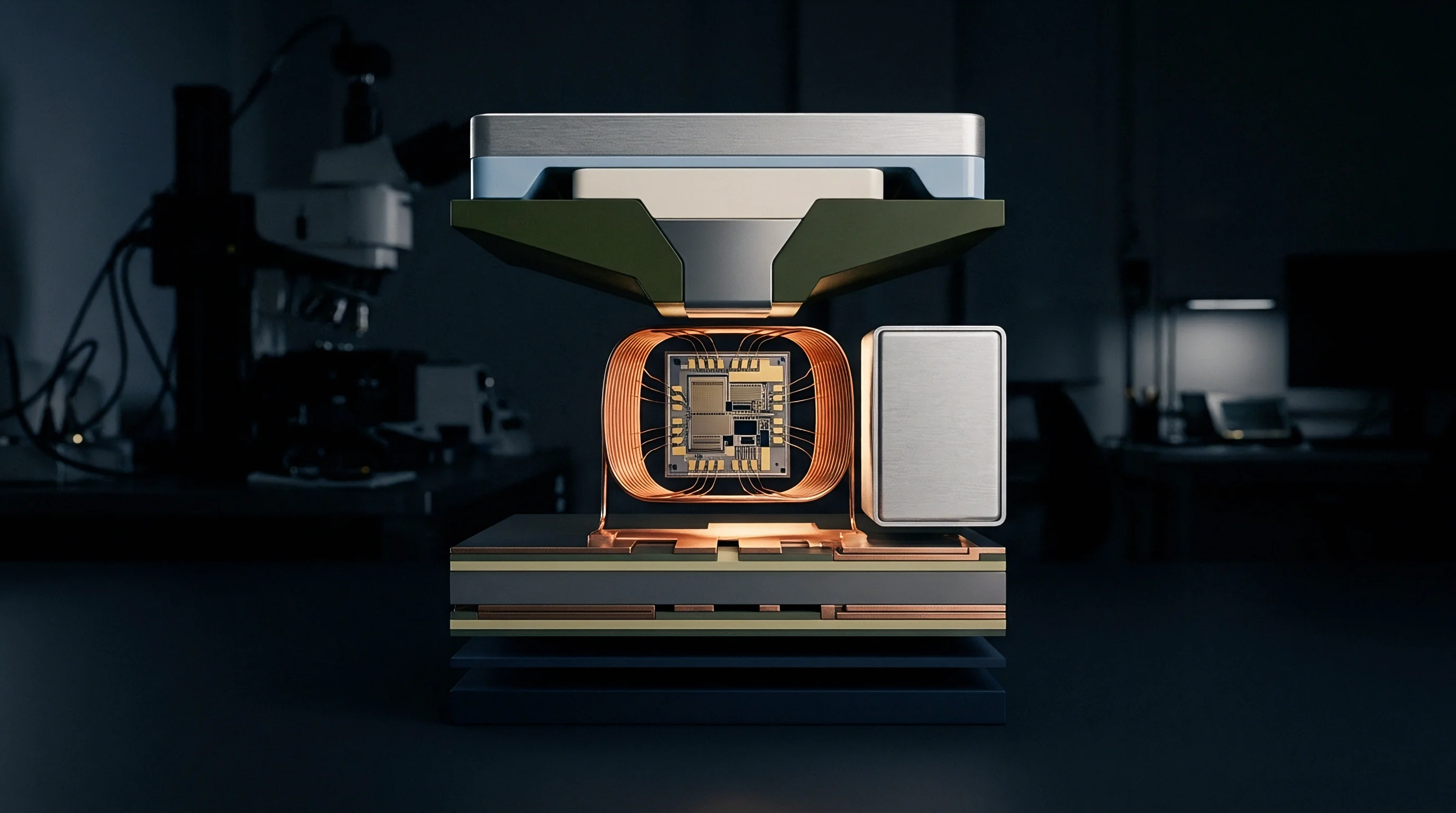
Assembly architecture determines the magnitude of stress transmission from the packaging materials to the sensing element. In barometric and differential pressure assemblies, three distinct mechanical pathways govern this strain propagation:
- Interfacial Shear Propagation develops along the planar boundary between the die attach adhesive and the bottom polished face of the silicon substrate, inducing localized bending that tilts the diaphragm support rim.
- Fillet Asymmetry Bending occurs when adhesive squeeze-out climbs unequally up opposing vertical die sidewalls during die placement, creating unbalanced lateral forces that tilt the neutral axis of the sensing die.
- Substrate Warp Transmission originates from moisture absorption inside multi-layer printed circuit boards or plastic molded headers, forcing global assembly curvature that deflects the attached sensor die.
A zero-point offset shift follows directly from these parasitic loads. Factory calibration performed on dry parts at twenty-five degrees Celsius sets the initial bridge null using laser trimming or electronic register values stored in integrated application-specific integrated circuits. When parts deploy into industrial or automotive environments, ambient moisture ingresses through housing apertures and plastic packaging over hundreds of hours.
Diaphragm bending generates false differential pressure.
The sensor interprets packaging-induced strain as actual media pressure. In low-range differential pressure sensors with full-scale spans of ten kilopascals, hygroscopic swelling stresses within the die attach produce zero-point shifts exceeding three hundred pascals. This shift consumes the entire allowable operational uncertainty budget before the sensor records an actual process variable.
Sourcing departments evaluating low-cost sensor assemblies without moisture-isolated pedestal architecture face field rejection rates exceeding fifteen percent when deployed in humid geographic zones.

Sorption
Fickian Diffusion Dynamics and Polymer Water Uptake
Atmospheric moisture ingress into microelectronic packaging materials follows gradient-driven diffusion governed by Fickian transport formulations. Water vapor penetrates exposed polymeric boundaries, migrating inward toward the sensor die cavity at rates dictated by temperature-dependent diffusion coefficients. The concentration profile within an epoxy mold compound or adhesive bond line varies as a function of exposure duration, ambient relative humidity, and material boundary geometries.
Epoxy resins absorb water molecules directly.
Under constant ambient temperature and humidity, the fractional moisture gain of a thin adhesive layer correlates with the square root of time during initial exposure periods. Saturation occurs when the internal chemical potential of the absorbed water reaches thermodynamic equilibrium with the surrounding partial pressure of atmospheric water vapor. The saturation moisture concentration scales with ambient relative humidity according to Henry-type sorption laws.
The physical relationship between absorbed moisture concentration and dimensional deformation is quantified by the coefficient of hygroscopic swelling. This material parameter represents the linear strain induced per unit change in moisture concentration. Silica fillers lower the swelling coefficient.
| Material Class | Saturated Moisture Content (wt %) | Diffusion Coefficient (mm²/s) | Coefficient of Swelling (mm³/mg) | Tensile Modulus at Saturation (GPa) |
|---|---|---|---|---|
| Silica-Filled Epoxy Mold Compound | 0.32 to 0.48 | 2.1 × 10⁻⁶ | 0.22 to 0.28 | 18.5 to 22.0 |
| Standard Epoxy Die Attach | 1.25 to 1.80 | 4.5 × 10⁻⁶ | 0.42 to 0.55 | 3.2 to 4.8 |
| Silver-Filled Conductive Epoxy | 0.65 to 0.95 | 3.8 × 10⁻⁶ | 0.31 to 0.39 | 5.5 to 7.2 |
| Fluorosilicone Encapsulant Gel | 0.08 to 0.15 | 1.8 × 10⁻⁵ | 0.04 to 0.08 | 0.001 to 0.003 |
| Polyimide Passivation Coating | 2.10 to 3.20 | 8.2 × 10⁻⁷ | 0.58 to 0.68 | 2.8 to 3.4 |
Moisture absorption degrades the mechanical stiffness of polymer matrices. Ingressing water plasticizes the crosslinked chains, depressing the glass transition temperature of epoxy formulations by twenty to forty degrees Celsius. While plasticization lowers the tensile modulus and partially moderates the transmission of thermal mismatch stresses, the simultaneous increase in physical volume through the swelling coefficient counteracts this stress relief.
The net result is a persistent mechanical force exerted against the perimeter and bottom of the sensing element.
A humidity excursion from thirty to eighty-five percent relative humidity at eighty-five degrees Celsius produces a zero-point offset shift of eighty-five pascals in unshielded piezoresistive cells.
Sorption rates diverge sharply from thermal response rates. Thermal equilibrium across a miniature sensor assembly occurs within several seconds due to high thermal conductivity in silicon and metal leadframes. Moisture saturation across a two-millimeter epoxy mold body or through a hundred-micrometer bond line requires weeks or months of continuous exposure.
Hygroscopic expansion induces tensile surface stress.
Incoming inspection benches testing pressure sensors inside short three-minute environmental cycling chambers fail to detect hygroscopic instability. Because the polymer surface reaches thermal equilibrium while remaining virtually dry in its interior, the recorded zero-point offset reflects purely thermal coefficients of expansion. Calibration certificates issued under rapid temperature sweeps state offset performance figures that dissolve once the assembly absorbs ambient moisture in service.
Supplier sales representatives frequently dismiss initial zero-point wander as minor assembly settling that will stabilize over time.
Coupling

Does Mold Compound Expansion Distort Diaphragm Stress?
Surrounding encapsulation geometries alter the stress state of silicon membranes through direct mechanical contact and structural constraint. Overmolded plastic packages place epoxy mold compound in direct contact with the inactive boundaries of the silicon die, while open-cavity architectures isolate the diaphragm, leaving only the die attach adhesive as the primary mechanical coupling vector. When mold compound absorbs atmospheric water, multidirectional volumetric expansion exerts compressive normal forces against the die edges and tensile shear across the top surface passivation.
Anisotropic swelling shifts bridge balance points.
Silicon is an anisotropic material whose piezoresistive coefficients depend strictly on the orientation of applied stress tensors relative to the crystal lattice. Piezoresistors positioned at the edges of a square micromachined diaphragm respond differently to orthogonal stress components. Equal planar stresses produce canceled bridge offsets when resistor orientations are balanced.
Packaging-induced hygroscopic stresses break this structural symmetry because adhesive bond lines exhibit non-uniform thickness, voiding, and edge-fillet variation.
Viscoelastic creep complicates stress recovery curves.
Polymeric packaging materials exhibit time-dependent viscoelastic relaxation under sustained deformation. When moisture uptake forces an adhesive bond line to expand against rigid silicon, the instantaneous elastic stress relaxes over time as polymer chains rearrange. When the assembly dries, desorption removes the moisture, but the polymer cannot instantly return to its initial geometric configuration.
A permanent zero-point offset shift remains, accompanied by inverted hysteresis loops during subsequent humidity cycles.
- Bake the unmounted sensor assembly at one hundred twenty-five degrees Celsius for forty-eight hours to desorb all moisture and establish a verified dry baseline.
- Record the zero-pressure differential output voltage across the Wheatstone bridge inside an environmental chamber at twenty-five degrees Celsius and twenty percent relative humidity.
- Step chamber humidity to eighty-five percent relative humidity while maintaining twenty-five degrees Celsius to isolate hygroscopic strain from thermal expansion.
- Log zero-point bridge offset voltage continuously at one-hour intervals across five hundred hours until diffusion reaches steady-state saturation.
- Return chamber humidity to twenty percent relative humidity and log offset recovery across an identical five-hundred-hour duration to quantify residual viscoelastic hysteresis.
Evaluation of hygroscopic stress coupling requires separating pure moisture expansion from thermal coefficients of expansion. Piezoresistive sensor dies exhibit substantial temperature coefficients of resistance and offset, typically running between one thousand and two thousand parts per million per degree Celsius. Conducting humidity evaluations under strict isothermal chamber control eliminates thermal confounders from the measurement signal.
Thin adhesive bonds attenuate transmitted displacement.
Calculations of piezoresistive drift utilize numerical stress coupling factors derived from finite element simulations. The stress coupling factor represents the ratio of induced diaphragm stress to the free hygroscopic strain of the packaging adhesive. Higher coupling factors mean that packaging expansion translates directly into diaphragm deformation.
Isolation pedestals made from fused silica or borosilicate glass cut this coupling factor by an order of magnitude by mechanically distancing the active silicon membrane from the expanding adhesive joint.
Compliant silicone die-attach adhesives isolate sensor diaphragms better than rigid epoxies, but they introduce mechanical tilt under high acceleration and burst pressure loads.

Pack

How Rapidly Does Die Attach Moisture Equilibrate?
Package architecture dictates the ingress route and boundary exposure of hygroscopic materials inside pressure assemblies. Cavity plastic designs admit moisture through atmospheric vents or media ports directly into the internal volume, exposing both the die surface and the adhesive fillet to ambient vapor. Overmolded structures force water to diffuse through several millimeters of dense epoxy mold compound before reaching the die boundaries, slowing ingress while increasing the total volume of expanding packaging material surrounding the sensor.
Unshielded dies experience severe zero drift.
To evaluate packaging resilience against hygroscopic offset instability, sourcing engineers compare zero-point wander across standardized exposure conditions. The standard automotive qualification condition involves exposure to eighty-five degrees Celsius and eighty-five percent relative humidity across one thousand hours. In unconditioned commercial sensors, this exposure generates significant bridge offset drift.
| Package Construction | Die Attach Material | Pedestal Structure | Peak Zero Drift (% Span) | Unrecovered Offset (% Span) |
|---|---|---|---|---|
| Cavity Premolded Plastic | Silver-Filled Epoxy | None (Direct to Leadframe) | +1.85 to +2.40 | +0.62 |
| Cavity Premolded Plastic | Low-Modulus Silicone | None (Direct to Leadframe) | +0.35 to +0.55 | +0.08 |
| Hermetic Ceramic DIL | Gold-Tin Eutectic | Glass Pedestal (Pyrex 7740) | +0.02 to +0.05 | +0.01 |
| Overmolded Leadframe | High-Tg Epoxy Paste | None (Direct Die Attach) | +2.80 to +3.65 | +1.15 |
| Premolded with Gel Fill | Silver-Filled Epoxy | Fused Silica Pillar | +0.12 to +0.18 | +0.03 |
| Test baseline established after 48-hour dry bake at 125°C; offset measured at 25°C differential full-scale span of 100 kPa. | ||||
Direct die attachment to metallic leadframes generates the highest hygroscopic instability when rigid epoxies are specified. As the epoxy layer expands against the copper substrate, interfacial shear induces concave warpage across the silicon die base. Adding a borosilicate glass or fused silica pedestal creates an intermediate mechanical buffer.
Borosilicate glass matches the thermal expansion coefficient of silicon at approximately 3.25 times 10 to the power of negative six per kelvin, while its inorganic molecular structure absorbs zero moisture, blocking strain transmission from the underlying leadframe adhesive.
JEDEC J-STD-020 classification defines allowable moisture absorption limits to prevent delamination during reflow assembly.
Encapsulant gels placed inside the cavity protect the bond wires and aluminum metallization from chemical attack by condensed water. Fluorosilicone and dimethylsilicone gels transmit ambient media pressure hydrostatically while shielding internal surfaces. Silicone gels exhibit minimal hygroscopic expansion.
Water vapor penetrates through the bulk of silicone gels due to high gas permeability, reaching the underlying adhesive bond line. The presence of gel does not prevent moisture absorption in underlying epoxies, but it eliminates surface tension forces from liquid moisture condensation across the silicon diaphragm. Assemblies utilizing gel over rigid epoxies still suffer zero-point drift if the die-attach material possesses a high swelling coefficient.
Procurement documentation specifying pressure sensor assemblies for safety-critical systems must mandate environmental compliance under IPC/JEDEC J-STD-020 moisture sensitivity level standards, requiring suppliers to deliver qualification data verifying zero-point offset stability across MSL 1 or MSL 3 preconditioning profiles.

Bake
Desorption Kinetics and Offset Recovery Behavior
Thermal conditioning drives absorbed moisture out of polymeric packaging materials, reversing swelling-induced mechanical strains. Elevating sensor assembly temperature accelerates desorption by increasing the diffusion coefficient of water through the epoxy matrix. When moisture desorbs, volumetric contraction pulls the polymer chains back into closer proximity, relieving the interfacial shear stress acting on the silicon die base.
Post-cure bake desorbs unbound water molecules.
Reversibility remains incomplete in assemblies that have undergone long-term moisture exposure. Extended exposure to high humidity at elevated temperatures triggers secondary chemical mechanisms within amine-cured epoxies, including plasticizer leaching, chain hydrolysis, and post-cure crosslink advancement. When the moisture departs during thermal baking, the polymer matrix exhibits higher crosslink density and volumetric shrinkage relative to its initial post-assembly baseline.
The resulting stress state does not mirror the original factory-trimmed condition. Instead of zero strain, the diaphragm experiences increased residual tensile stress, shifting the dry zero-point offset in the direction opposite to the original hygroscopic swelling drift. This phenomenon creates calibration divergence that field re-zeroing routines cannot correct without tracking operating history.
Baking drives out absorbed moisture but leaves residual volumetric shrinkage that redistributes diaphragm stress.
Thermal cycling accelerates moisture ingress rates.
To separate reversible hygroscopic swelling from permanent material degradation, qualification protocols employ multi-stage baking profiles. Sensor lots undergo baseline calibration, extended exposure to high-humidity environments, and structured post-exposure baking at one hundred degrees Celsius. Comparing bridge offset measurements before exposure, at peak humidity saturation, and after complete dry-out reveals the exact partition between pure hygroscopic expansion, viscoelastic creep, and irreversible chemical shrinkage.
Whether advanced finite element models can accurately predict localized hygroscopic stress distributions in asymmetrical die-attach fillets without empirical micro-strain measurements remains an open question in sensor packaging engineering.