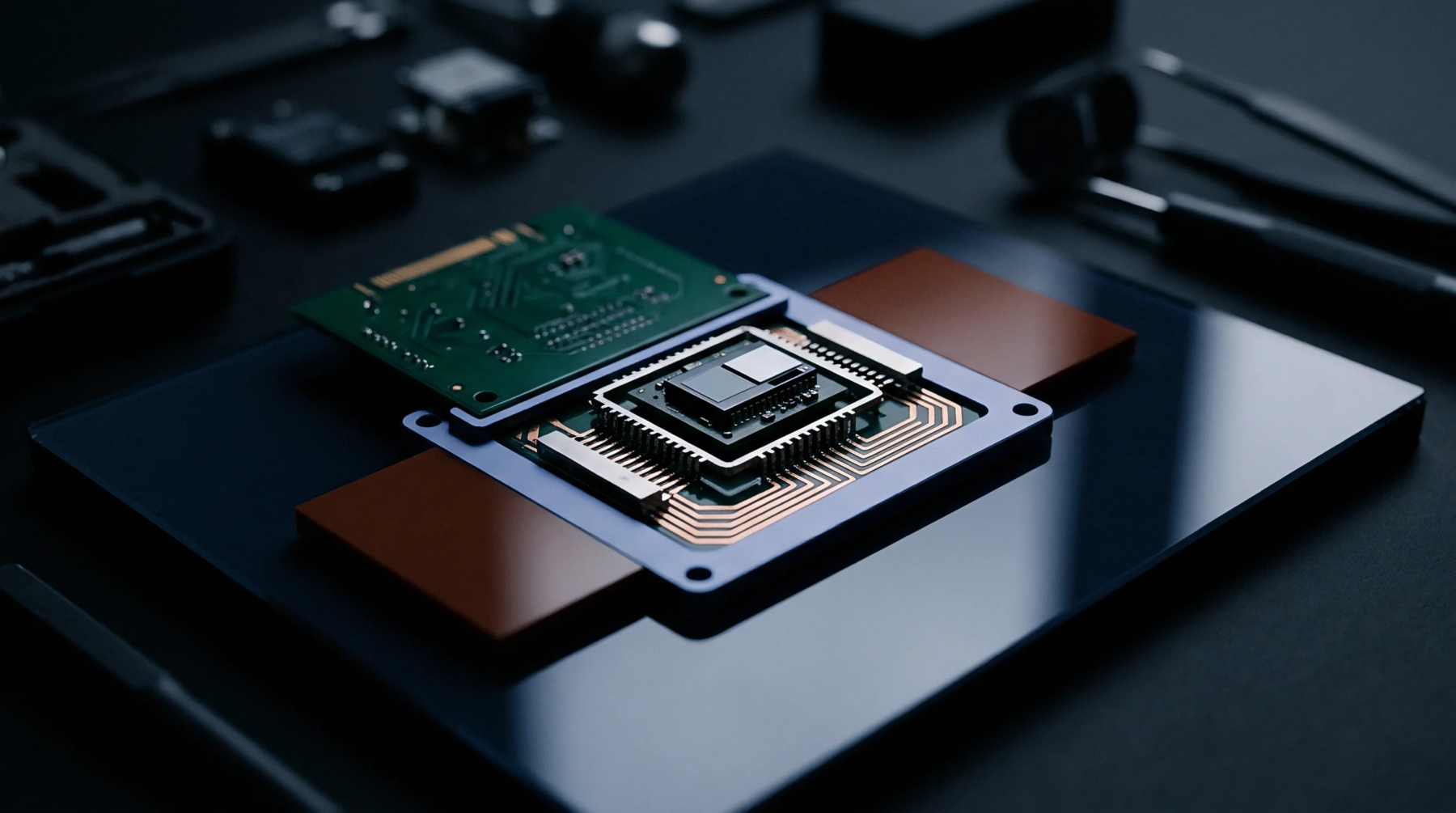
Dynamic Carrier Recombination and Optical Pulse Lag in Semiconductor Emitters
Dynamic carrier accumulation and recombination rates cause optical pulse lag, demanding DC pre-bias and active reverse charge shunts for picosecond timing.
Dynamic carrier accumulation and recombination rates cause optical pulse lag, demanding DC pre-bias and active reverse charge shunts for picosecond timing.
Substrate thermal expansion mismatches and mold compound shrinkage warp sensor boards, transferring parasitic strain into silicon dies and driving signal drift.

Scalar gravity norm tumble test algorithms decouple MEMS accelerometer bias, scale factor, and cross-axis misalignments without requiring precision angular tracking hardware.

Dual sourced sensor phase distortion corrupts fusion pipelines through unmodeled group delay mismatches, requiring dynamic transfer function verification.

Unannounced silicon steppings alter register maps and bus timing within catalog limits, driving massive firmware rework unless gated by contract terms.

Spatial thermal gradient mapping in micro-machined accelerometer arrays decouples linear motion from external board heat using differential thermopile matrices.

Heavy boron doping above 1e19 cm-3 stabilizes piezoresistive gauge factor thermal decay, allowing passive current-bias drift compensation.

MEMS thermal hysteresis creates non-repeatable zero-g offset shifts up to 3 mg, driving uncompensable arcsecond tilt errors in static leveling systems.

Analytical error bounds combine accelerometer bias tilt projection and latitude secant gyrocompassing equations to establish deterministic spatial uncertainty limits.
Retrofitting capacitive pressure transducers introduces hydraulic dead-volume delay and digital ASIC filter lag that erodes control loop phase margin.

External analog load currents extract direct current and charge pulses from internal bandgap reference nodes, inducing static droop and transient conversion errors.

Substituting high-grade physical sensors with multi-element algorithms saves unit cost but adds firmware overhead, thermal drift risks, and qualification expenses.
Expertise is a utility, not a secret. sentiention™ publishes its working knowledge as open reference: intelligence layer covering the materials it sources, the markets it enters, and the reference that serves both.