
Interferometric Gyroscope Optical Fiber Potting Basics
Compliant potting matrices eliminate interstitial voids and stabilize quadrupole fiber geometry to suppress Shupe thermal drift and vibration rectification.
Compliant potting matrices eliminate interstitial voids and stabilize quadrupole fiber geometry to suppress Shupe thermal drift and vibration rectification.

Optical scale factor in closed-loop IFOGs locks rotation velocity to digital ramp resets bounded by coil geometry, source wavelength, and 2π reset accuracy.
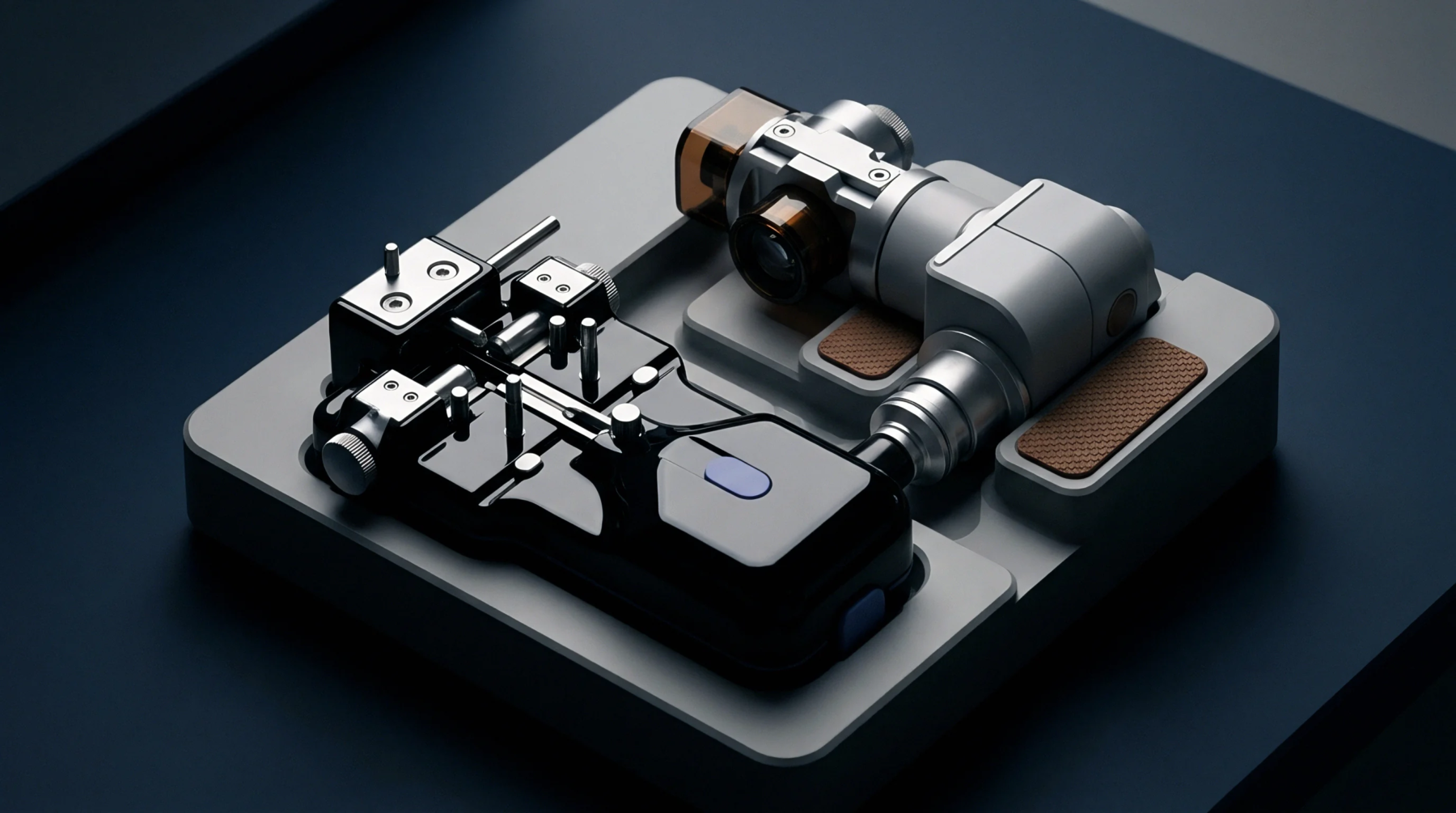
Finite element transient strain modeling predicts internal coil viscoelastic phase delays, suppressing tactical optical gyro thermal hysteresis below 0.01 deg/h.

Dynamic thermal gradient bias in PM fiber coils stems from asymmetric path delay and demands quadrupolar winding paired with multi-point state compensation.

Quadrupolar winding cancels symmetric thermal gradients, leaving elasto-optic drift manageable via compliant potting and multi-point sensor compensation.
Select low-modulus addition-cure silicones with sub-minus 100 Celsius glass transitions to decouple thermal stress from quadrupolar gyroscope fiber coils.

Quadrupolar winding cancels thermal Shupe non-reciprocity by spatially pairing symmetric fiber segments equidistant from the coil center.

Non-dynamic thermo-mechanical stress drift in IFOG fiber spools originates from viscoelastic matrix hysteresis and CTE mismatch, requiring stress-state relaxation modeling beyond rate-proportional Shupe compensation during rapid thermal ramps.
Expertise is a utility, not a secret. sentiention™ publishes its working knowledge as open reference: intelligence layer covering the materials it sources, the markets it enters, and the reference that serves both.