Interferometric Gyroscope Optical Fiber Potting Basics
Compliant potting matrices eliminate interstitial voids and stabilize quadrupole fiber geometry to suppress Shupe thermal drift and vibration rectification.
Symmetry
Interferometric fiber optic gyroscopes measure angular velocity through the Sagnac phase difference between counter-propagating optical waves inside a coiled single-mode or polarization-maintaining fiber. When temperature shifts alter the refractive index and physical length unevenly across opposing propagation paths, the resulting differential phase delay generates nonreciprocal phase shifts. This dynamic thermal perturbation, known as the Shupe effect, creates a false rotation signal proportional to how far the affected fiber segment sits from the coil midpoint.
Quadrupole winding mitigates this sensitivity by pairing fiber symmetrically from the center outward, putting segments equidistant from the midpoint right next to each other. Even so, geometric winding by itself cannot stop local conduction imbalances or loop displacement under acceleration. Potting fills the voids between adjacent turns and layers with a structural viscoelastic matrix, locking the position of every loop relative to the spool.
A thermal transient of one degree Celsius per minute produces a peak nonreciprocal phase bias exceeding two degrees per hour in an unpotted eight-hundred-meter quadrupole coil.
Silica glass has a thermal conductivity near 1.38 W/(m·K), whereas primary acrylate coatings sit around 0.2 W/(m·K). Without an interstitial compound, micro-gaps between circular fiber claddings produce uneven contact resistance across the pack. Heat entering through the spool flange or outer perimeter then propagates unevenly, distorting the spatial symmetry of the quadrupole layout.
Filling those gaps with a polymeric adhesive establishes continuous thermal paths throughout the coil cross-section.
Mechanical shock and acoustic excitation create secondary non-reciprocal phase errors by way of photoelastic modulation. External vibration disturbs unbonded loops, driving differential microbending and local polarization coupling. A potting matrix adds mechanical damping to suppress internal loop resonances that would otherwise convert vibration into rectifying rate bias.
Without it, dynamic shock during operation can degrade navigation-grade gyroscopes down to tactical performance tiers.
Resin
Selecting a polymer matrix involves balancing a low elastic modulus against thermal expansion compatibility over an operating range from minus forty degrees Celsius to plus eighty-five degrees Celsius. Standard optical fibers feature a silica cladding 80 to 125 micrometers in diameter, covered by an acrylate, polyimide, or silicone buffer expanding to 165 or 250 micrometers. Silica glass carries a coefficient of thermal expansion of 0.55 × 10⁻⁶ /K, whereas dual-layer UV-curable acrylate buffers range from 80 × 10⁻⁶ /K to 120 × 10⁻⁶ /K.
Silicone elastomers see frequent use as potting adhesives because of their compliance and low glass transition temperatures. Two-part addition-cure polydimethylsiloxanes, for instance, keep an elastic storage modulus below 5 MPa across the standard operating envelope. If the compound drops below its glass transition temperature, however, the modulus jumps by two to three orders of magnitude, exerting high radial compressive stress on the cladding.
That compression increases optical attenuation through microbending and shifts fiber birefringence via the photoelastic tensor.
| Polymer Chemistry | Young Modulus (MPa) | CTE (ppm/K) | Tg (°C) | Viscosity (mPa·s) | Outgassing TML (%) |
|---|---|---|---|---|---|
| Addition-Cure Silicone | 1.2 to 3.5 | 280 to 320 | -115 to -50 | 1,000 to 4,500 | 0.12 |
| Modified Epoxy | 15.0 to 120.0 | 65 to 95 | -20 to 45 | 300 to 1,200 | 0.45 |
| UV-Curable Acrylate | 4.0 to 18.0 | 140 to 180 | -35 to 15 | 500 to 2,200 | 0.85 |
| Polyurethane Elastomer | 2.5 to 8.0 | 190 to 240 | -45 to -10 | 800 to 3,000 | 0.60 |
Epoxy systems have lower thermal expansion coefficients than silicones, limiting volumetric expansion inside tight spool housings. Unmodified epoxies possess high Young moduli above 1,000 MPa, driving severe stress-induced birefringence shifts during thermal ramps. Flexible epoxies use aliphatic additives to lower crosslink density, bringing tensile moduli down to between 15 MPa and 50 MPa.
Low mixed viscosity is essential here, allowing complete penetration into tight turn-to-turn gaps smaller than 10 micrometers.
Potting matrices with glass transition temperatures inside the operating temperature band produce non-linear bias shifts that digital compensation models cannot track.
Outgassing metrics define long-term stability in hermetically sealed enclosures containing electro-optic phase modulators and superluminescent diodes. Volatiles condensing onto optical ferrule faces lead to rising insertion loss and back-reflection spikes over time. Formulations must meet ASTM E595 standards, keeping total mass loss below 1.0 percent and collected volatile condensable material under 0.1 percent.
- Low Tensile Modulus protects the silica core from hydrostatic pressure spikes that shift baseline modal birefringence during cool-down periods.
- Linear Thermal Expansion suppresses sudden volumetric yield points that fracture internal spool bondlines during rapid thermal cycling.
- Extended Working Pot Life permits uninterrupted winding and matrix impregnation across coil fabrication runs spanning twelve to thirty-six hours.
- Chemical Neutrality prevents degradation or swelling of the underlying primary fiber buffer coat over decades of continuous field deployment.
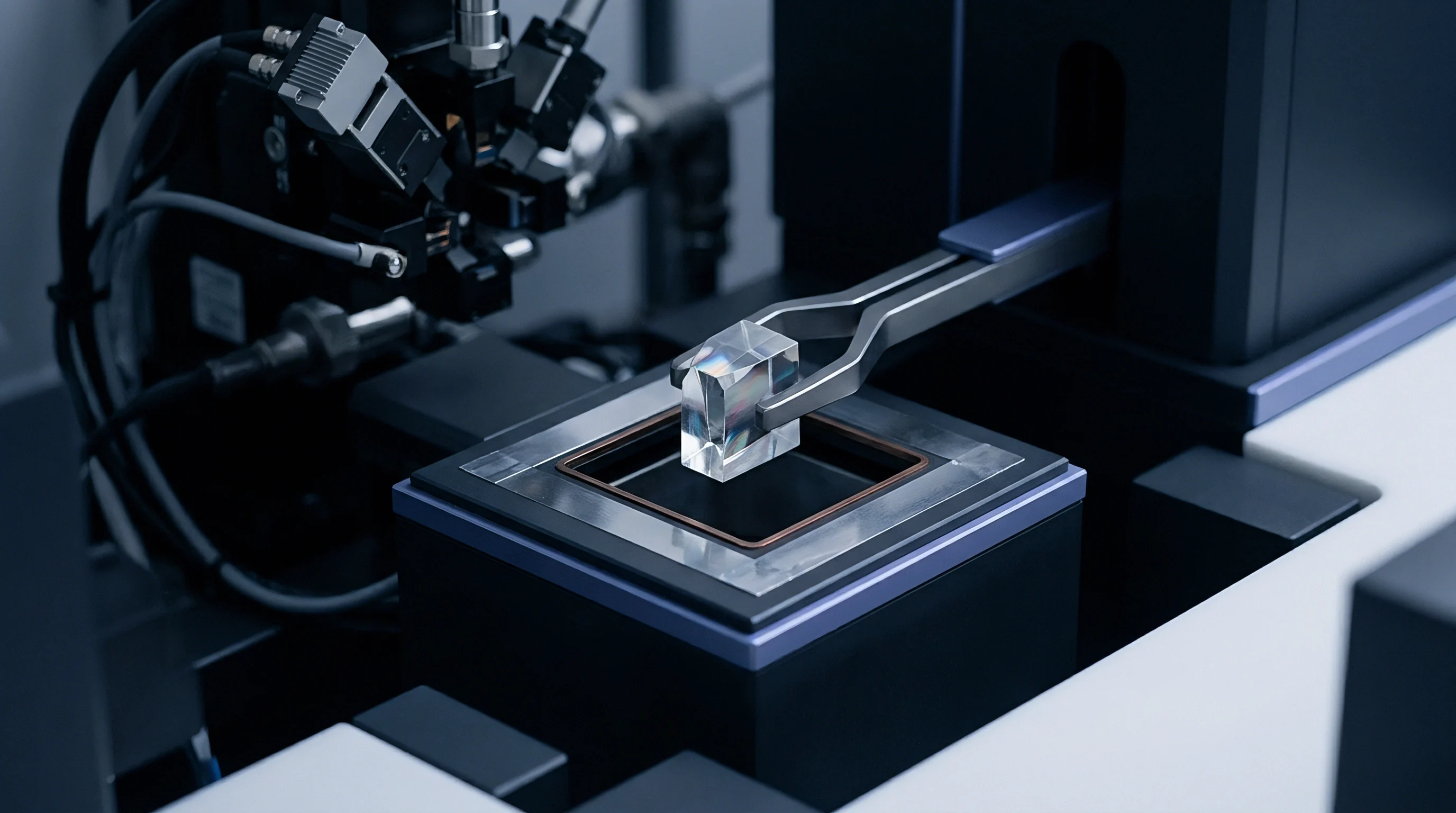
Compliant adhesives with low glass transition temperatures absorb differential expansion without altering fiber positions on the spool.
Cure
Coil impregnation generally follows one of two routes: wet-winding or post-winding vacuum impregnation. In wet-winding, an automated nozzle dispenses a bead of liquid adhesive onto the fiber just before it reaches the spool. Metering pumps balance delivery rate against linear winding speed to maintain a steady wetting meniscus, while automated wipes remove excess resin pushed out between turns to prevent uneven buildup.
Post-winding vacuum impregnation treats dry-wound coils inside precision fixtures. Winding dry avoids liquid drag, allowing faster laydown speeds and tighter geometric packing. The dry coil is evacuated below 10 Pa to pull out trapped air between inner turns, after which degassed polymer is admitted under pressure differential, saturating interstitial channels by capillary action and positive overpressures up to 0.5 MPa.
Will Degassing Pressure Compromise Fiber Buffer Integrity?
Deep vacuum cycles can strip plasticizers and volatile stabilization agents from the primary acrylate buffer. Sudden pump-down rates cause solvent boiling in volatile adhesives, producing micro-frothing at turn junctions. Using a controlled two-stage evacuation schedule pulls out volatiles while preserving enough background pressure to keep the liquid blend stable.
Vacuum impregnation removes air pockets from dense fiber packs before thermal polymerization locks mechanical stresses into the light path.
- Tooling Evacuation pulls absolute chamber pressure down to 50 Pa across forty minutes to outgas residual humidity from the dry-pack spool assembly without blistering the primary polymer coating.
- Controlled Backfill admits degassed potting compound under hydrostatic gravity feed, submerging the coil base to initiate bottom-up vertical capillary displacement.
- Positive Overpressurization introduces dry nitrogen at 0.4 MPa for sixty minutes, forcing the liquid matrix through tight inner-layer corners before gelation initiates.
- Staged Thermal Ramp elevates ambient air at 0.5°C per minute to the initial curing plateau, mitigating thermal shock and avoiding violent exotherm reactions in large polymer volumes.
Is Symmetrical Curing Kinetic Profile Achievable in Production?
Polymerization shrinkage is a primary source of residual stress in the potted coil. Addition-cure silicones show linear shrinkage from 0.1 percent to 0.5 percent, while free-radical UV acrylates shrink between 1.5 percent and 4.0 percent upon crosslinking. If cure proceeds inward from outer layers to the spool core, volumetric contraction pulls inner turns outward, introducing microbending losses and uneven pre-stresses that skew thermal calibration curves.
Thermal management during cure requires dual-zone heating applied to both the central mandrel and the outer mold collar. Balancing reaction kinetics along both boundaries forces the reaction front to meet symmetrically at the coil mid-depth. Variations in tooling thermal conductivity routinely yield uneven gel points, while seasonal shifts in room humidity or fixture wear introduce subtle changes in baseline zero-bias drift.
Defect
Transduction defects in potted coils usually trace back to structural non-uniformities in the composite matrix. Interstitial voids are the most damaging: a single 50-micrometer air bubble inside a central quadrupole turn creates a localized thermal barrier. As ambient temperature changes, heat flow deflects around the void, creating an asymmetric gradient between adjacent turns that breaks the mathematical cancellation of the quadrupole layout.
Localized stress concentrations create elasto-optic phase perturbations through stress-induced birefringence. Silica fiber exhibits stress-optic coefficients in which orthogonal stress differentials split the refractive index between polarization axes. In polarization-maintaining coils built with panda or bow-tie stress rods, anisotropic pressure from shrinking adhesive distorts this internal stress field, causing cross-coupling between slow and fast modes.
| Defect Mechanism | Transduction Phenomenon | Bias Instability (°/h) | ARW Penalty (°/√h) | Detection Technique |
|---|---|---|---|---|
| Isolated Matrix Void | Asymmetric Shupe Gradient | 0.015 to 0.080 | 0.001 to 0.003 | Micro-CT X-Ray Scanning |
| Matrix Delamination | Localized Birefringence Shift | 0.040 to 0.250 | 0.005 to 0.012 | Optical Backscatter Reflectometry |
| Asymmetric Polymer Cure | Radial Thermal Expansion Bias | 0.020 to 0.110 | 0.002 to 0.006 | Thermal Ramp Chamber Testing |
| Turn Crossing Pinch | Microbending Polarization Loss | 0.005 to 0.035 | 0.004 to 0.015 | Polarization OTDR |
Delamination between matrix and fiber surface is another ongoing failure mode. During thermal cycling between minus forty degrees Celsius and plus eighty-five degrees Celsius, shear stresses concentrate at the boundary between the high-expansion polymer and the primary buffer. When this bond shears, a physical gap opens, altering local heat conduction and relieving baseline compressive pre-load.
Vibration rectification converts mechanical oscillation into quasi-static rate bias. If the potting matrix lacks stiffness or exhibits density variations, axial vibration causes asymmetric displacement between outer and inner turns. This uneven movement modulates optical path length at the vibration frequency, generating non-reciprocal phase noise that rectifies into DC rate bias via synchronous demodulation errors.
Whether automated optical backscatter reflectometry can reliably separate harmless adhesive density variations from early turn-to-turn delamination during rapid thermal qualification remains a point of debate among test engineers.
Yield
Qualification of potted sensor coils relies on non-destructive testing alongside thermal stress screening. Micro-focus X-ray computed tomography maps three-dimensional density through the pack, revealing internal voids down to five micrometers. Scanning an eight-hundred-meter coil requires rotational staging under continuous X-ray exposure to reconstruct turn positions and verify matrix wetting across every layer transition.
Optical low-coherence reflectometry and distributed polarization crosstalk analysis measure stress uniformity along the full fiber length non-destructively. Broadband light launched into the polarization axes highlights discrete mode-coupling spikes caused by winding pinches or curing hot spots. These defect locations map directly to individual turns, pointing back to specific steps in the winding and dispensing cycle.
Inspection under IEEE 952 requirements demands continuous scale-factor linearity tracking during environmental temperature excursions.
Environmental screening subjects cured coils to thermal shock and continuous temperature ramps while interrogating the optical circuit in real time. Soak cycles hold the assembly at operational temperature limits to stabilize viscoelastic relaxation within the adhesive. Uncompensated rate bias, thermal hysteresis, and scale factor shifts must all stay within specified limits before the coil can be integrated into an inertial measurement unit.
Potting yields depend on tight controls over adhesive lot consistency, fiber coating concentricity, and dispensing volumes. Contracts requiring compliance with IEEE Std 952 environmental test methods force verification of thermal sensitivity coefficients across consecutive resin lots, preventing unvetted material reformulations from reaching the assembly line.