Evaluating Moisture Ingress Mechanics in Hermetic and Potted Sensor Assemblies
Hermetic seals prevent moisture ingress via inorganic barriers; potted assemblies slow liquid ingress but saturate via vapor diffusion within months.


Barrier
Hermetic metal cans hold an internal water concentration below five thousand parts per million for twenty years when the seal leak rate stays below 1.0e-9 standard cubic centimeters per second of helium. Potted elastomeric blocks reach external relative humidity equilibrium in four hundred hours under continuous damp heat exposure at eighty-five degrees Celsius and eighty-five percent relative humidity. Sourcing teams frequently treat encapsulation potting compounds as direct substitutes for glass-to-metal or ceramic braze seals to lower bill-of-materials costs on pressure, temperature, and chemical sensing probes.
Organic potting matrices absorb moisture continuously through bulk diffusion, whereas true hermetic packages limit ingress exclusively through localized molecular bypass paths such as weld microfissures or grain boundary voids.
The difference in protection mechanisms dictates how sensory signals decay over operating life. Potted assemblies rely on polymeric materials like polyurethanes, silicones, and structural epoxies that exhibit water vapor transmission rates between 1.0 and 50.0 grams per square meter per day at standard atmospheric test conditions. True hermetic enclosures built with Kovar headers, gold-tin solder preforms, or resistance-welded cold-rolled steel cans present bulk transmission rates of zero.
Evaluating the protection mechanism requires measuring moisture transport not as a static shield rating, but as a time-dependent partial pressure curve at the internal silicon die face.
Corrosion reactions on unpassivated bond pads initiate when internal relative humidity exceeds sixty percent at ambient operating temperatures.
Engineering teams select packages based on unit cost without auditing moisture accumulation kinetics. A standard four-pin TO-39 header with borosilicate compression seals adds 3.20 to 5.80 dollars to a raw silicon transducer build at five thousand pieces. An overmolded liquid silicone rubber casing adds 0.45 dollars at identical batch volumes.
That cost reduction introduces a bulk diffusion front that reaches unpassivated aluminum trace geometries on the die within months of field deployment. When water vapor bypasses the passivation layer, hydrolytic breakdown produces ionic contamination, baseline signal drift, and bridge resistance imbalance across piezoresistive and capacitive transducer networks.
The sourcing specification defines whether a sensor survives damp industrial environments or suffers latent electrical failure. Procurement contracts that specify ingress protection codes like IP67 or IP68 fail to guarantee long-term dry operation on internal electronics. IP codes quantify resistance to bulk liquid penetration under static hydrostatic head over short periods, typically thirty minutes at one meter depth.
They leave water vapor diffusion through polymeric walls completely unchecked. True hermeticity evaluation demands MIL-STD-883 Method 1014 fine leak helium mass spectrometry coupled with internal water vapor analysis per Method 1018.
Overlooking vapor permeability yields field returns where assemblies show no liquid water inside the housing, yet wire bonds exhibit extensive intermetallic oxidation and dendritic silver growth across adjacent trace spaces.


Pathway
Transport of water molecules into encapsulated sensor cavities follows two distinct physical trajectories: interstitial diffusion through the bulk polymer network and accelerated capillary flow along material interfaces. Bulk permeation through polymers obeys Fickian diffusion mechanics, driven by the water vapor partial pressure gradient between ambient air and the internal cavity. The flux of water molecules per unit area depends on the material solubility coefficient and diffusion coefficient, both governed by thermal activation following an Arrhenius relationship.

Capillary Advection along Lead Wires
Interface boundaries represent the fastest ingress path in potted sensor packages. The junction between copper-alloy lead frames, gold-plated pins, and potting resins forms an active capillary channel when chemical adhesion fails during curing shrinkage or thermal cycling. Polymers exhibit volumetric shrinkage during polymerization, ranging from 0.1 percent in filled epoxies to 3.5 percent in unfilled polyurethane resins.
This shrinkage creates shear stress along smooth pin walls, separating the resin from the metal lead and opening microscopic voids with widths between 10 and 500 nanometers.
Moisture moves through these annular interfacial micro-gaps by capillary condensation and advection at rates ten to one thousand times faster than Fickian bulk diffusion. Moisture wicked along the pin interface reaches the printed circuit board assembly or wire bonds directly, bypassing the bulk protective thickness of the encapsulation entirely. Preventing interfacial tracking demands chemical surface treatment on the metal feedthroughs, such as organofunctional silane coupling agents or mechanical feature knurling that forces tortuous path geometry.

Hermetic Feedthrough Weld Cracking
In glass-to-metal and ceramic-to-metal hermetic headers, fluid ingress bypasses the bulk inorganic materials completely. Molecular transport occurs through mechanical fractures within the glass meniscus or intergranular cracks in the fusion weld pool. Matched glass seals join Kovar pins to Kovar outer bodies using borosilicate glass formulations with matched coefficients of thermal expansion around 5.0e-6 per Kelvin between minus fifty and four hundred degrees Celsius.
Compression seals employ cold-rolled steel outer bodies with high thermal expansion coefficients alongside low-expansion glass, relying on radial compressive stress to maintain the seal.
| Package Construction | Dominant Ingress Mechanism | Typical Transport Rate | Primary Failure Site |
|---|---|---|---|
| Kovar Glass-to-Metal Header | Interfacial micro-cracks in glass | 1.0e-11 to 1.0e-8 atm-cc/s He | Meniscus fracture under lead flex |
| Epoxy Potted Aluminum Shell | Interface delamination and bulk permeation | 1.0 to 10.0 g/m²/day H₂O | Lead wire feedthrough interface |
| Silicone Overmolded Probe | Fickian bulk diffusion | 20.0 to 45.0 g/m²/day H₂O | Bulk polymer cross-section |
| Ceramic Braze SMD Cavity | Grain boundary micro-porosity in braze | 1.0e-12 to 1.0e-9 atm-cc/s He | Au-Sn solder preform perimeter |
| Polyurethane Potted Brass Body | Hydrolytic adhesive breakdown | 5.0 to 18.0 g/m²/day H₂O | Casing inner wall boundary |
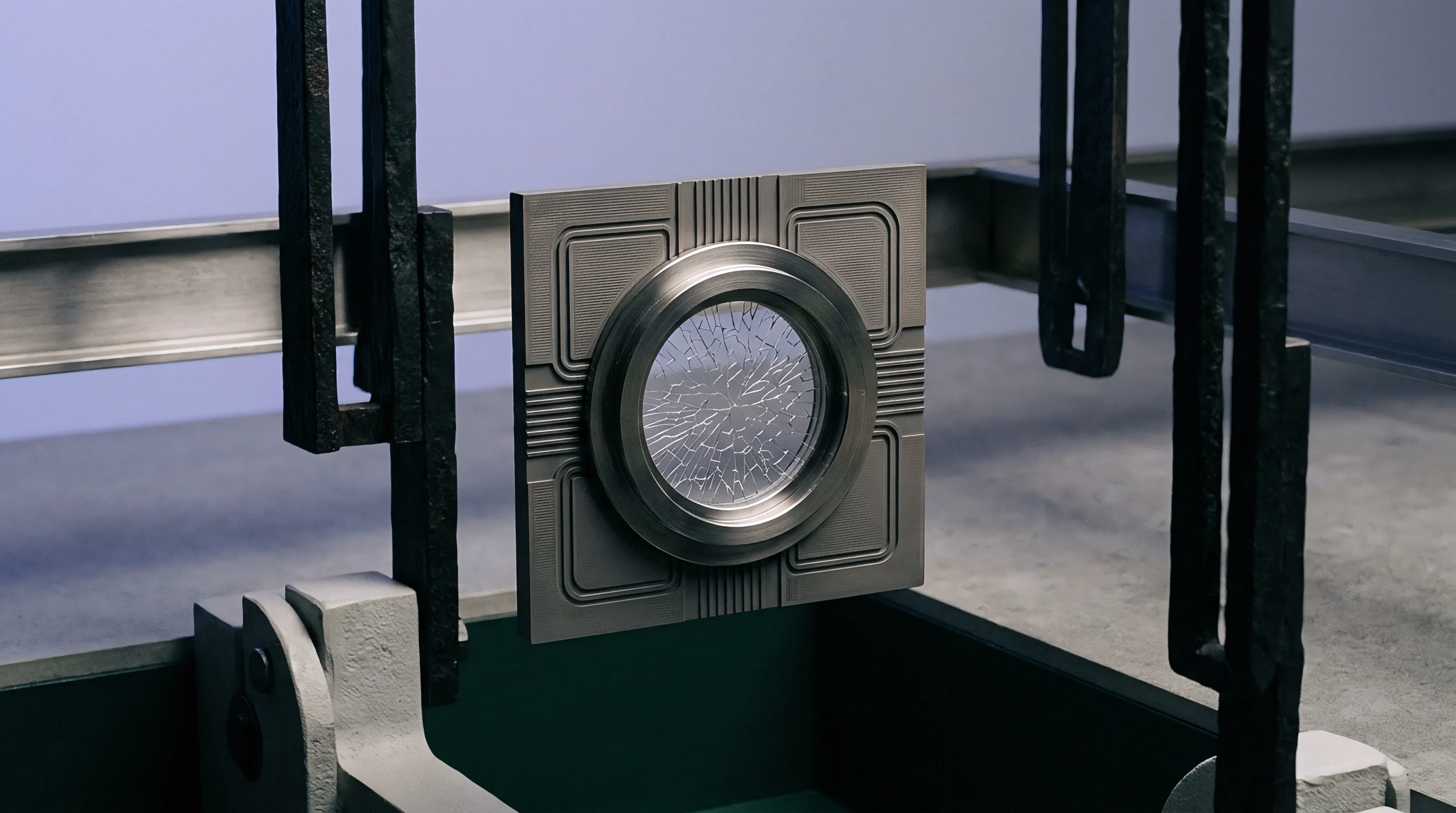
Mechanical stress during lead trimming, terminal bending, or rough harness handling easily fractures the brittle glass meniscus. A single radial crack exceeding 0.5 micrometers in width transitions the package from a molecular diffusion barrier to a viscous flow leak path. Viscous gas flow admits humid ambient air under barometric pressure cycling, carrying moisture directly into the internal gas volume.
Packages qualified below 1.0e-8 standard cubic centimeters per second helium leak rates at final inspection routinely fail in the field when downstream manufacturing applies unconstrained bending torque to the connector pins.
Polymer-sealed assemblies cannot maintain dry internal cavities indefinitely under high humidity. Sourcing engineers evaluating lifetime performance calculate the saturation timescale using the effective path length and the material diffusion coefficient. For a five-millimeter-thick encapsulation layer of standard electronic-grade epoxy with a diffusion coefficient of 2.0e-8 square centimeters per second at forty degrees Celsius, water molecules traverse the membrane and reach internal equilibrium in less than one year of ambient field service.
When engineers specify potting to cut package costs, suppliers respond that their compound provides a hermetic seal against environment, conflating liquid water shedding with molecular vapor exclusion.

Distortion
Moisture reaching the interior of a sensor package alters both the electrical behavior of the sensing circuit and the mechanical stress field applied to the die. The presence of water molecules induces parasitic electrical leakage across high-impedance circuit nodes. Pure condensed water exhibits a resistivity near 18.0 megaohm-centimeters, but water dissolving trace surface salts from flux residues or ionic extractables drops below 0.1 megaohm-centimeters.
A surface leakage path of ten megaohms placed across a bridge transducer output node degrades accuracy from 0.1 percent full scale to over 2.0 percent full scale.

Hygroscopic Swelling Induced Offset
Polymeric potting materials absorb water into their molecular matrix, producing volumetric expansion known as hygroscopic swelling. The coefficient of hygroscopic swelling for electronic potting epoxies spans 0.15 to 0.45 percent strain per percent moisture weight gain. Silicon piezoresistive pressure dies, micro-electro-mechanical gyroscopes, and resonant beam accelerometers operate by measuring stress fields in micro-machined silicon structures.
Hygroscopic strain transfers directly from the potting compound through the die attach adhesive into the active sensing membrane.
Per MIL-STD-883 Method 1018, packages exhibiting internal moisture concentrations above five thousand parts per million fail qualification because condensation causes irreversible leakage shifts.
Consider a micromachined silicon pressure sensor die measuring 2.0 millimeters square by 0.4 millimeters thick mounted inside an epoxy-filled cavity. As the epoxy absorbs 1.5 weight percent water under tropical ambient conditions, the resulting expansion imposes an asymmetric compressive stress across the die surface. Piezoresistive bridge circuits convert this mechanical strain into an electrical offset voltage.
The zero-pressure output shifts unpredictably by twenty to fifty millivolts, an error indistinguishable from true process pressure change that cannot be zeroed out in firmware because internal moisture content tracks ambient relative humidity with a phase lag of several days.
Dielectric Alteration in Capacitive Nodes
Capacitive sensor structures experience direct measurement shifts due to the physical dielectric properties of water. Liquid water possesses a relative permittivity near eighty at room temperature, compared to a value of 1.0 for dry air and 3.0 to 4.5 for cured potting polymers. When moisture enters the internal cavity, vapor condensation or volumetric dissolution increases the effective dielectric constant of the medium surrounding micromachined sense fingers or package trace runs.
Trace runs on ceramic sub-mounts or printed circuit boards routed beneath a potted sensor exhibit increased mutual capacitance. High-frequency analog lines, such as those carrying bridge excitation or pulse-width modulated oscillator signals, experience rise-time degradation and parasitic phase shifts. When water condenses between gold wire bonds spaced one hundred micrometers apart, capacitance between the conductors increases by an order of magnitude.
If the sensor architecture uses high-impedance analog paths rather than localized on-die digital conversion, the front-end signal-to-noise ratio collapses entirely.
Design teams encounter severe register drift on digital sensor modules due to supply rail droop. Dendritic growths formed by ionic migration bridge adjacent printed circuit traces, generating intermittent resistive short circuits that pull the sensor supply line below the brown-out reset threshold of internal state machines, causing bus timeouts on I2C and SPI buses.


Protocol
Validating moisture exclusion in sensor packages requires combining physical leak rate testing with long-term accelerated environmental exposure. Qualification methods split strictly between hermetic inorganic assemblies and non-hermetic polymeric enclosures. Applying hermetic gas leak testing to potted assemblies yields meaningless data because helium adsorbs onto and diffuses through polymer matrices, generating false leak readings that do not correlate with molecular bypass channels.

How Do Fine and Gross Leak Procedures Verify Cavity Integrity?
Hermetic packages undergo dual-stage testing per MIL-STD-883 Method 1014 or MIL-STD-750 Method 1071. Sourcing engineers specify both tests because neither method covers the full spectrum of leak dimensions. Fine leak testing uses helium mass spectrometry.
Units are placed in a pressure vessel, bombed with pure helium gas at four to five atmospheres for several hours, removed, cleared of surface helium, and tested in a vacuum chamber connected to a calibrated mass spectrometer.
- Vacuum bombing forces tracer gas through micro-cracks into the package cavity under elevated differential pressure over dwell times up to twenty-four hours.
- Chamber evacuation purges residual surface helium from external package seams to prevent background signal saturation during mass measurement.
- Spectrometric detection measures the helium exhaust flow rate, rejecting packages showing flow rates exceeding 1.0e-8 standard cubic centimeters per second.
- Fluorocarbon immersion exposes the package to heated liquid fluorocarbon at one hundred twenty-five degrees Celsius, identifying large gross leaks through bubble emission.
- Optical interferometry checks package lid deflection under pressure as an alternative dry inspection method to eliminate fluid contamination.
A package with a very large leak defect cannot retain helium during the transfer window between the bombing chamber and the spectrometer chamber. The tracer gas escapes entirely before measurement begins, producing a false passing reading on the fine leak tester. The gross leak test catches these large pathways.
Subjecting units to heated fluorocarbon fluid boils fluid that entered the cavity during high-pressure liquid immersion, producing visible streams of bubbles that operators or automated optical sensors detect.
Accelerated Damp Heat Environmental Stress
Potted and overmolded assemblies demand continuous high-temperature, high-humidity aging protocols such as JEDEC JESD22-A101 steady-state temperature-humidity bias life testing. Assemblies are exposed to eighty-five degrees Celsius and eighty-five percent relative humidity under operational electrical bias for one thousand hours. Applying voltage bias during humidity exposure accelerates electrochemical migration, dendrite formation, and galvanic corrosion on metallic conductors.
| Test Protocol | Standard Reference | Operating Parameters | Target Defect Mechanism |
|---|---|---|---|
| Helium Fine Leak | MIL-STD-883 M1014 | 4.0 to 5.0 atm bomb, vacuum read | Glass seal micro-fractures, weld voids |
| Fluorocarbon Gross Leak | MIL-STD-883 M1014 | 125°C indicator bath, visual read | Cracked headers, failed lid braze seams |
| Temperature-Humidity-Bias | JEDEC JESD22-A101 | 85°C, 85% RH, nominal bias, 1000 hrs | Bulk diffusion, dendritic migration |
| Autoclave / Pressure Cooker | JEDEC JESD22-A102 | 121°C, 100% RH, 2.0 atm, 96 hrs | Polymer matrix hydrolysis, delamination |
| Internal Vapor Analysis | MIL-STD-883 M1018 | Cavity puncture, mass spectrometer read | Residual processing moisture, outgassing |
Highly Accelerated Stress Test procedures per JESD22-A110 shorten qualification timelines by increasing test cell pressure and temperature to one hundred thirty degrees Celsius and eighty-five percent relative humidity under thirty-three pounds per square inch absolute. The elevated water vapor pressure accelerates diffusion kinetics through polymers by a factor of twenty over standard eighty-five degree conditions. Non-hermetic potted sensors that survive eighty-five percent relative humidity for two hundred hours routinely suffer total potting matrix softening, bond wire pull-off, and interfacial delamination under the aggressive steam conditions of HAST testing.
A potted sensor qualified to IP68 rating can absorb water vapor to the point of internal saturation while fully preventing liquid droplets from entering the outer enclosure.
Internal moisture analysis per MIL-STD-883 Method 1018 serves as the ultimate benchmark for hermetic cavity integrity. In this procedure, an evacuated fixture punctures the hermetic metal can or ceramic cavity at one hundred degrees Celsius, drawing the internal headspace gas directly into a calibrated mass spectrometer. Packages exhibiting internal moisture contents above five thousand parts per million at the puncture temperature fail qualification.
Moisture levels above that threshold guarantee that as the sensor cools down to its lower operating temperature boundary of minus forty degrees Celsius, the internal atmosphere reaches its dew point, depositing liquid water droplets directly onto the active silicon die.
Suppliers that quote passing leak rates without stating the dwell time between helium bombing and chamber readout provide invalid verification data.


Tradeoff
Choosing between a hermetic package and a potted sensor assembly represents a direct trade-off between upfront bill-of-materials cost, packaging volume, manufacturing lead times, and operating longevity. An engineering team evaluating a piezoresistive differential pressure transmitter faces distinct integration pathways depending on whether the architecture uses a discrete surface-mount hermetic component, a fully potted sensor probe, or a custom welded stainless steel header assembly.

Worked Sourcing Economics for Harsh Environment Sensor Packages
Evaluating total landed cost requires examining how the packaging choice affects downstream surface-mount processing, yield losses, and incoming quality audits. Consider a design project requiring ten thousand environmental pressure sensing nodes deployed in harsh outdoor agricultural or marine settings over a target operational life of seven years. The evaluation compares three physical packaging approaches for housing an identical silicon pressure die.
- Hermetic TO-8 Header Variant ~ The silicon die mounts on a gold-plated Kovar header sealed with a resistance-welded nickel cap. Cost stands at 14.50 dollars at ten thousand units. The part requires manual through-hole pin soldering or a secondary flex-circuit carrier, adding 1.85 dollars in board space and placement labor. Minimum order quantities from specialized glass-to-metal seal manufacturers run at five thousand pieces with lead times of twenty-two weeks. Zero humidity ingress occurs over the seven-year field deployment, yielding estimated warranty return rates below 0.05 percent.
- Potted Polyurethane Module Variant ~ The same silicon die mounts on a standard FR4 PCB, covered with a plastic cup and filled with two-part electronic-grade polyurethane resin. Piece price stands at 4.20 dollars in identical volumes. Assembly onto the primary mainboard occurs using standard automated surface-mount pick-and-place lines, costing 0.15 dollars per unit. Lead times run eight weeks with minimum orders of one thousand pieces. Accelerated testing indicates water vapor equilibrium inside the potting occurs within fourteen months in tropical zones, driving field calibration drift and an estimated warranty replacement rate of 4.2 percent across seven years.
- Ceramic LCC Surface-Mount Cavity ~ The die mounts inside a 5.0 by 7.0 millimeter hermetic leadless ceramic chip carrier with a gold-tin solder-brazed Kovar lid. Unit price sits at 8.75 dollars. SMT tape-and-reel packaging feeds standard high-speed placement lines directly with zero labor penalty. Minimum order quantities run at two thousand five hundred pieces with sixteen-week factory lead times. Helium testing guarantees integrity below 1.0e-9 atm-cc/s. The seven-year warranty return rate holds at 0.12 percent.
The polyurethane module saves 10.30 dollars per node at procurement checkout compared to the TO-8 header assembly. For the ten thousand unit deployment, that represents 103,000 dollars in gross component savings. SMT placement efficiency adds another 17,000 dollars in manufacturing savings.
The potted sensor choice yields an immediate production savings of 120,000 dollars.
The operational penalty arrives during field deployment. A 4.2 percent return rate across the ten thousand unit fleet represents four hundred twenty failed modules. In industrial field applications, truck rolls and certified technician labor cost an average of 450 dollars per service call to isolate, extract, replace, and recalibrate a failed environmental probe.
The field service expenditure totals 189,000 dollars, wiping out the initial 120,000 dollars in manufacturing savings and producing an operational deficit of 69,000 dollars over the product warranty lifecycle.
The ceramic LCC format emerges as the optimal compromise for this operating envelope. At 8.75 dollars per unit, component procurement adds 45,500 dollars compared to the potted alternative, but eliminates through-hole secondary labor while offering true hermetic protection. The low warranty return rate limits field service expenditures to approximately 5,400 dollars.
Sourcing the ceramic surface-mount format achieves the lowest total landed cost over the required seven-year operating envelope.
Procurement teams must audit incoming hermetic shipments against MIL-STD-883 Method 2009 external visual criteria, as minor plating flaking or cracked glass fillets below the minimum acceptable radius invalidate the manufacturer warranty when packages leak after board reflow.

Intake
Managing supply chains for hermetic and environmental sensor packages requires rigorous receiving verification protocols. Suppliers frequently ship parts that pass factory outbound checks but degrade during transport, storage, or secondary lead forming operations. Ingress protection failures observed at final qualification often originate on the receiving dock through unverified package storage conditions or mechanical damage during handling.
Can In-House Receiving Detect Latent Hermeticity Failures?
Standard incoming inspection procedures rely on simple dimensional checks and surface visual screening, which fail to detect compromised hermetic interfaces or pre-saturated potting materials. Implementing an effective receiving inspection protocol demands sampling incoming reels or trays for physical seal validation before stock moves to active surface-mount assembly lines.
- Solderability and Meniscus Visual Audit inspects glass seals under forty-power magnification per IPC-A-610 criteria to verify that no radial cracks traverse more than fifty percent of the distance between the lead pin and the outer header wall.
- Fine Leak Acceptance Sampling subjects an ANSI/ASQ Z1.4 General Inspection Level II sample to helium bombing and vacuum mass spectrometry, rejecting lots that demonstrate equivalent standard leak rates above 1.0e-8 atm-cc/s.
- Moisture Barrier Bag Verification confirms that desiccated moisture barrier bags containing moisture-sensitive non-hermetic sensors arrive below ten percent internal relative humidity per J-STD-033 indicator cards.
- Pre-Assembly Solder Preform Inspection verifies that gold-tin or silver-copper braze fillets on surface-mount ceramic packages show complete perimeter wetting with voiding levels below fifteen percent of the total joint interface.
Non-hermetic potted sensors require strict tracking of open storage times on the production floor. Epoxy and polyurethane formulations absorb atmospheric moisture during ambient factory exposure. When moisture-saturated potted assemblies pass through lead-free solder reflow ovens peaking at two hundred sixty degrees Celsius, the absorbed water trapped within the polymer volatilizes instantly into high-pressure steam.
This internal pressure spike causes rapid delamination, wire bond shearing, and internal polymer micro-cracking, a destructive phenomenon known as popcorning.
Incoming inspection personnel must enforce floor life tracking for non-hermetic environmental assemblies per JEDEC J-STD-020 classifications. Components rated at Moisture Sensitivity Level 3 permit an open floor life of one hundred sixty-eight hours at thirty degrees Celsius and sixty percent relative humidity. If incoming shipping bags arrive punctured, with humidity indicator cards showing pink at the ten percent dot, the entire lot must undergo an eighty-degree Celsius stabilization bake for forty-eight hours prior to automated assembly placement.
Solder joint fractures during thermal reflow peak when moisture-saturated potted packages experience internal vapor pressure spikes exceeding three atmospheres.
Contract manufacturing agreements should incorporate specific clauses assigning financial liability for latent package failures to the supplier if internal moisture levels exceed five thousand parts per million upon receipt. Purchasing documentation must mandate that suppliers include tracer gas bombing certificates and mass spectrometry calibration logs with every shipped lot code. Sourcing teams that secure these contractual verification requirements prevent their production lines from absorbing the substantial costs of packaging defects originated at foreign assembly facilities.
The boundary between a minor handling defect and an active molecular leak path rests on the mechanical clearance maintained at the package pins during secondary lead forming operations.