Modeling Non-Linear Multiaxial Viscoelasticity and Environmental Degradation in Hermetic Die Bondlines
Multiaxial viscoelasticity and environmental degradation in hermetic die attach layers require triaxial stress modeling and verified moisture kinetics.
Shear
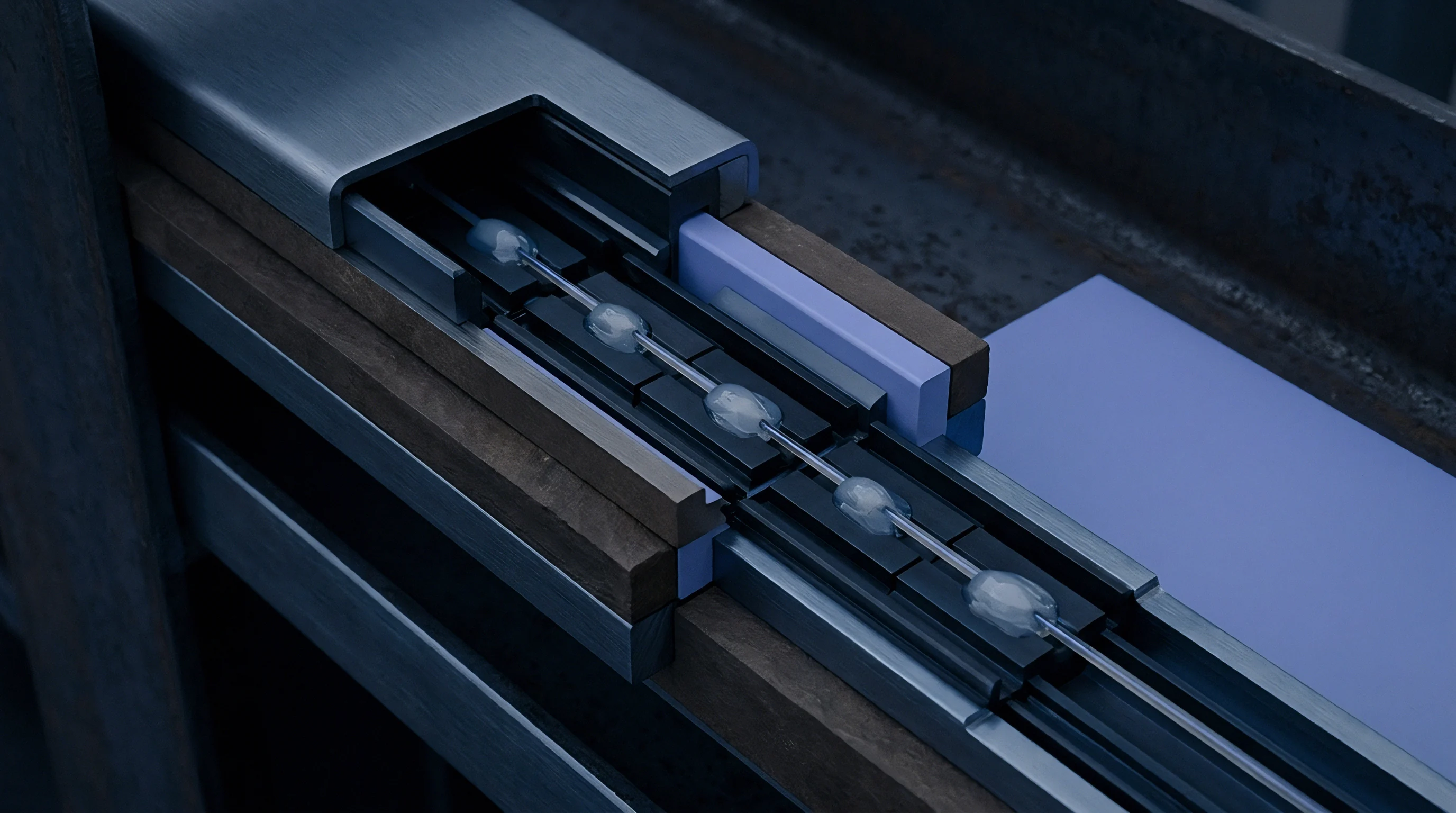
In microelectronic packaging, die attach adhesives undergo complex three-dimensional deformation governed by the geometrical constraint of the bondline. When the ratio of die width to bondline thickness exceeds twenty, lateral thermal expansion during temperature sweeps generates severe hydrostatic tension alongside out-of-plane strain. Standard uniaxial constitutive laws fail to predict stress relaxation under these conditions because hydrostatic pressure directly alters the matrix free volume, shifting the internal relaxation spectrum.
Bondline geometry constrains strain.
Kinematic Formulations for High Aspect Ratio Geometries
Lateral confinement forces the polymer network into a state where deviatoric shear couples directly with volumetric expansion. In thin die attach layers, the displacement field produces high stress triaxiality, defined as the ratio of hydrostatic stress to equivalent von Mises stress. High triaxiality restricts chain mobility, delaying physical aging recovery and elevating the effective stiffness of the bondline above values measured in bulk tensile bars.
Hydrostatic tension expands matrix volume.
To capture this effect, kinematic formulations decompose the total deformation gradient tensor into thermal, elastic, and viscoelastic components. The volumetric strain governs the instantaneous compressibility, while the deviatoric tensor drives time-dependent flow. When the die width is significantly larger than the bondline thickness, edge shear concentration zones trigger localized non-linear yields, redistributing mechanical load toward the center of the die.

Non-Linear Viscoelastic Constitutive Relations
Representing time-dependent behavior across broad stress regimes demands non-linear integral formulations based on Schapery theory. The stress state alters reduced time through a stress-dependent shift factor, modifying the relaxation function response. Deviatoric stress invariants accelerate viscoelastic flow by lowering activation energy barriers, whereas positive hydrostatic pressure suppresses relaxation rates.
Free volume governs relaxation rates.
| Parameter | Physical Mechanism | Uniaxial Baseline Range | High-Triaxiality Shift | Test Standard Reference |
|---|---|---|---|---|
| Instantaneous Shear Modulus (G0) | Unrelaxed elastic response of polymer network | 1.2 to 3.5 GPa | Increases by 15% to 30% under lateral confinement | ASTM D4065 |
| Equilibrium Shear Modulus (G_infinity) | Fully relaxed long-term network stiffness | 10 to 80 MPa | Remains matrix-dominated with minimal pressure shift | DMA Isothermal Creep |
| Pressure Sensitivity Coefficient (beta) | Free volume alteration via hydrostatic stress | 0.02 to 0.08 MPa^-1 | Governs relaxation delay under triaxial tension | Multiaxial Shear Bench |
| Deviatoric Stress Factor (g2) | Non-linear strain acceleration threshold | 1.00 to 1.85 | Scales non-linearly near die package corners | ISO 6721-4 |
| Values reflect silver-filled epoxy die attach materials tested between minus forty degrees Celsius and one hundred fifty degrees Celsius. | ||||
The total stress tensor emerges from the hereditary integral combining instantaneous elastic response with historical strain history. Material parameters governing the shift functions require calibration under multiaxial stress states, as uniaxial tensile data systematically underpredicts the confinement stiffness observed in bonded die assemblies.
At eighty degrees Celsius and five megapascals hydrostatic pressure, the effective relaxation time shifts downward by two orders of magnitude compared to unconstrained tension.
Thin bondlines subjected to rapid thermal transients experience localized yield near the die edge long before the bulk material reaches its nominal stress limit.


Diffusion
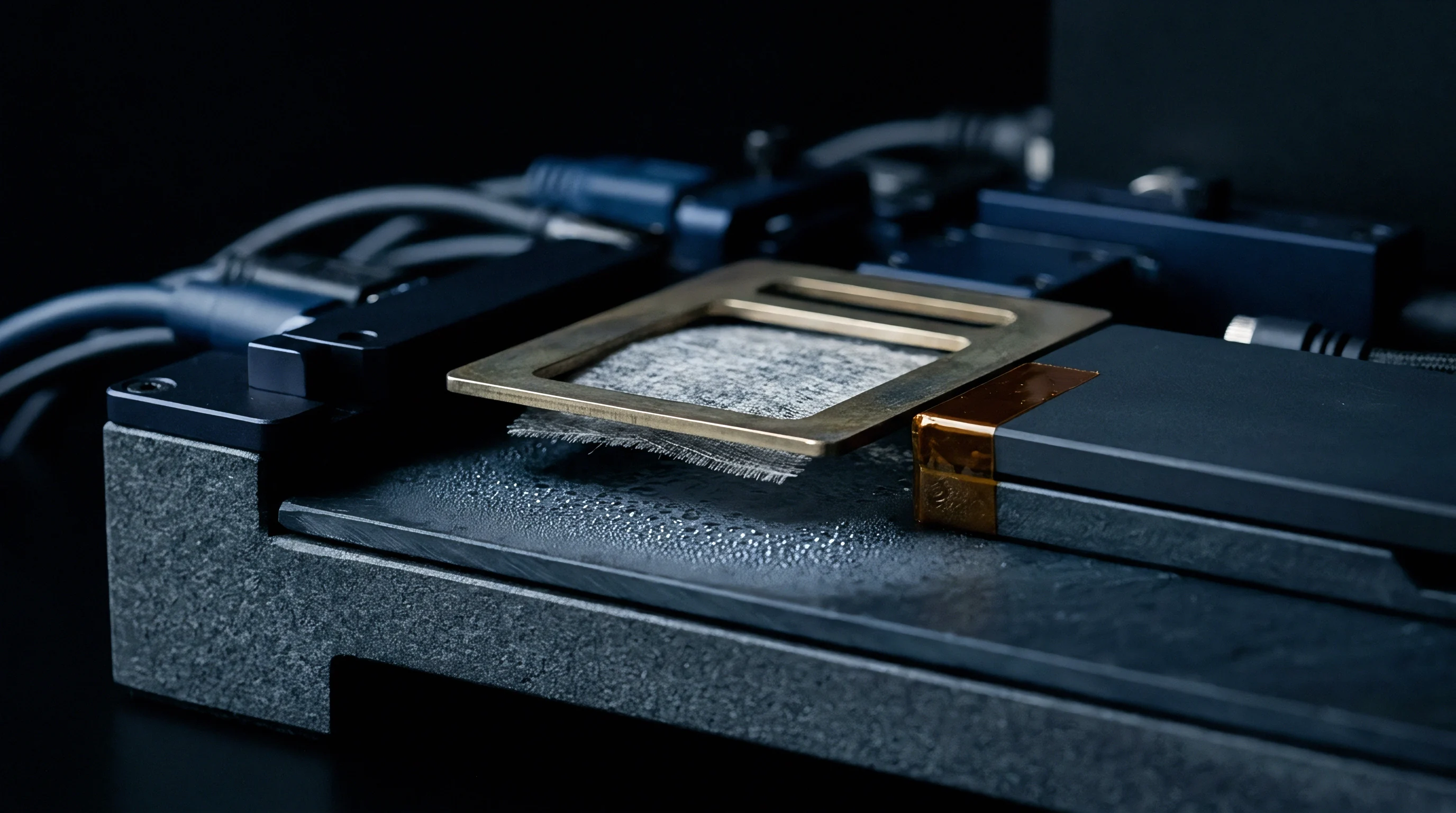
Polymeric die attach compounds absorb moisture from ambient environment during assembly storage and post-packaging operations. Water molecules penetrate the polymer network, filling free volume voids and interacting with polar functional groups along the backbone. Moisture lowers glass transition limits.

Moisture Sorption and Plasticization Dynamics
Transport behavior within cross-linked epoxies deviates from classic Fickian behavior at elevated relative humidity. Langmuir dual-site sorption kinetics model this process by categorizing absorbed water into mobile molecules residing in free volume pockets and bound molecules attached via hydrogen bonding to the resin matrix. Mobile molecules increase free volume, accelerating chain mobility and acting as a physical plasticizer.
Bound water severs polymer chains.
Plasticization depresses the glass transition temperature, shifting the entire viscoelastic relaxation spectrum toward lower temperatures. A ten-degree drop in glass transition temperature corresponds to an effective thermal acceleration of relaxation processes, reducing the stress-carrying capability of the bondline under elevated ambient operating conditions.

Glass Transition Depression and Hydrolytic Degradation
Continuous exposure to moisture at high temperature initiates irreversible chemical degradation alongside reversible physical plasticization. Water molecules attack ester and amine linkages within the epoxy network through hydrolysis, breaking covalent bonds and reducing cross-link density. Lower cross-link density causes a permanent reduction in glass transition temperature and equilibrium shear modulus.
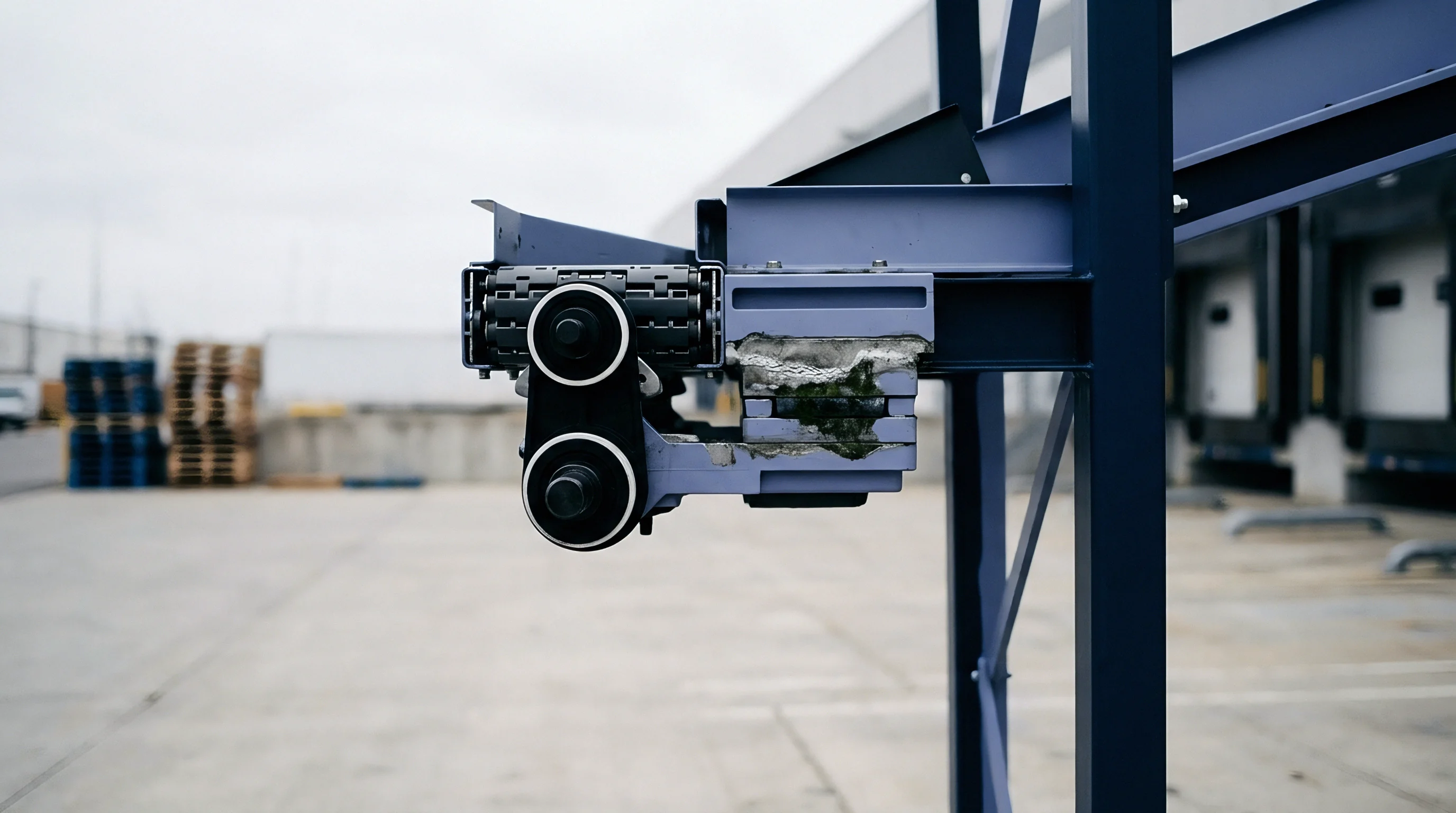
Unbound water at metallic sublayers alters adhesion performance.
- Interfacial Delamination Moisture accumulates at gold or copper leadframe plating interfaces, lowering critical strain energy release rates and driving bondline lifting during rapid thermal shock exposure.
- Die Tilt Deviation Asymmetrical moisture absorption across the package footprint induces non-uniform swelling strain, shifting optical sensor alignment relative to the optical axis.
- Fillet Microcracking Hydrolytic scission embrittles the outer fillet boundary, initiating sub-surface cracks under thermal cycling conditions.
- Ionic Migration Leached hydrolytic byproducts carry mobile halide ions across the bondline thickness, causing electrical leakage paths between adjacent die pads.
Adhesive manufacturers routinely report moisture absorption percentages measured on bulk specimens after twenty-four hours of immersion, ignoring interfacial transport rates along thin metallic sublayers.
Fatigue
Thermal cycling generates cyclic shear strains inside the die attach layer due to mismatch in coefficient of thermal expansion between the silicon die and substrate material. Over extended operating lives, microscopic void growth and micro-crack coalescence degrade structural integrity. Creep accelerates near die edges.
Continuum Damage Mechanics under Cyclic Thermal Loading
Constitutive modeling incorporates damage accumulation through a internal scalar variable, scaling the nominal stress tensor down to an effective stress tensor. Damage evolution functions link incremental strain energy dissipation per thermal cycle to microstructural voiding. At high stress triaxiality, micro-void growth dominates, whereas deviatoric shear drives micro-crack propagation near die corners.
Standard thermal screens fail here.
Cyclic shear strain amplitude interacts with viscoelastic stress relaxation during dwell periods at temperature extremes. High temperature dwell periods allow stress relaxation, converting elastic strain energy into creep strain work that accelerates damage evolution.

Coupled Environmental and Mechanical Damage Accumulation
Environmental exposure amplifies mechanical damage accumulation by lowering the critical energy threshold needed for micro-crack propagation. Water molecules at crack tips accelerate bond scission under mechanical stress, a process known as stress corrosion cracking in polymeric networks. Moisture plasticization increases creep strain amplitude per thermal cycle, escalating energy dissipation per loop.
| Material Class | Dry Tg (Celsius) | Saturated Tg (Celsius) | Moisture Diffusion Coefficient (mm^2/s) | Activation Energy for Scission (kJ/mol) |
|---|---|---|---|---|
| Silver-Filled Conductive Epoxy | 145 | 112 | 2.4 x 10^-6 | 78.5 |
| High-Purity Polyimide Attach | 260 | 225 | 8.1 x 10^-7 | 105.2 |
| Insulating Epoxy Paste | 120 | 88 | 4.2 x 10^-6 | 65.0 |
| B-Stage Epoxy Film | 135 | 105 | 1.8 x 10^-6 | 82.1 |
Predicting total service lifetime obligates integrating both physical aging history and hydrolytic damage rates into the finite element step calculation. Models relying purely on mechanical fatigue curves underpredict degradation when operational environments contain relative humidity above sixty percent.
Qualification under MIL-STD-883 Method 1014 condition C mandates leak rate testing below five times ten to the minus eight atmospheric cubic centimeters per second, yet passing this screen guarantees nothing regarding internal bondline shear degradation after eight thousand thermal cycles.
The precise point at which moisture-induced plasticization transitions from a reversible physical effect into permanent chemical bond rupture during cyclic thermal exposure remains unresolved across current constitutive modeling frameworks.

Identification
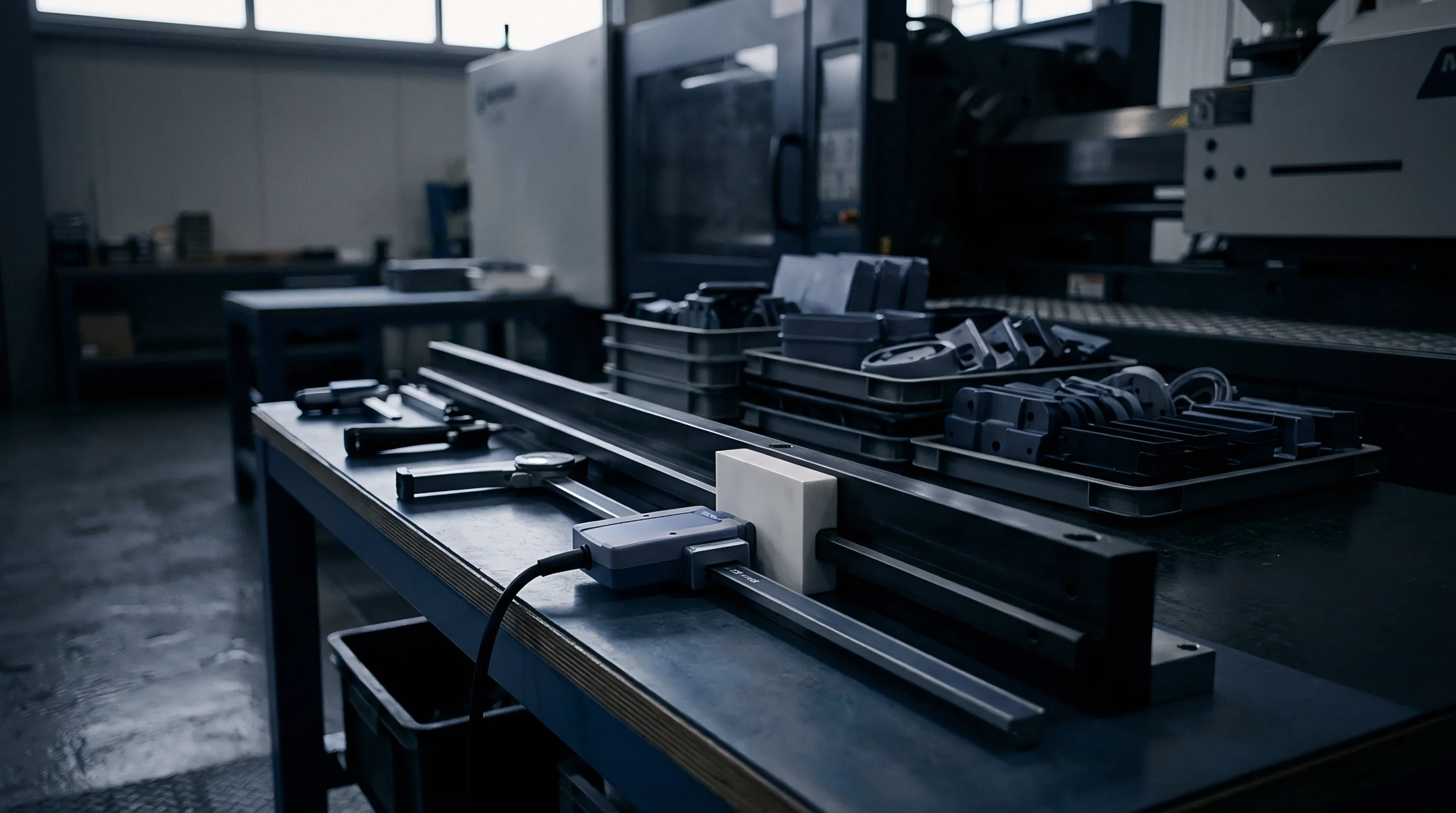
Determining non-linear multiaxial viscoelastic parameters demands isolated laboratory testing under strictly controlled environmental environments. Dynamic mechanical analysis determines storage modulus, loss modulus, and loss factor across temperature sweeps. Lab measurements require calibrated tools.
Test chambers hold set humidity.
Dynamic Mechanical Analysis and Time-Temperature Superposition
Constructing linear viscoelastic master curves relies on the Williams-Landel-Ferry equation or Arrhenius shift functions to extend effective frequency ranges beyond physical measurement limits. Thermally simple materials exhibit identical shift factors for both storage and loss moduli, allowing horizontal superposition along the logarithmic frequency axis.
Superposition validity requires steady state.
When physical aging or moisture ingress alters the internal matrix structure during the test duration, simple time-temperature superposition breaks down. Vertical shift factors must account for changes in equilibrium modulus caused by plasticization or cross-linking shifts.

Parameter Extraction Protocol for Non-Linear Constitutive Law
Extracting stress-dependent shift parameters demands isothermal shear relaxation experiments at multiple discrete stress levels. High-precision load cells and optical strain measurements prevent fixture compliance errors from corrupting bondline displacement figures.
Master curves constructed without verifying thermo-rheological simplicity systematically overestimate high-frequency relaxation moduli at sub-zero temperatures.
- Condition thin bondline specimens in an environmental chamber at thirty percent relative humidity until mass equilibrium establishes.
- Perform isothermal stress relaxation tests in pure shear at five temperature steps spanning from forty degrees below zero to one hundred fifty degrees Celsius.
- Fit linear viscoelastic Prony series coefficients to low-stress relaxation curves to establish baseline relaxation spectra.
- Apply stepped multiaxial stress loads to extract non-linear stress-dependent shift functions and yield surface parameters.
- Validate extracted parameters against independent cyclic thermal strain profiles measured with digital image correlation.
Calibration of laboratory test equipment against standards traceable to national metrology institutes ensures measurement reproducibility across supplier manufacturing sites. Uncalibrated compliance in shear fixtures introduces displacement errors that flatten the observed relaxation curve, leading to incorrect Prony series parameters.
Compliance with ASTM E1356 for glass transition measurement obligates testing laboratories to record the midpoint temperature during the second thermal scan, preventing un-reacted monomer curing from masking pre-existing moisture degradation.
Simulation
Finite element implementation of non-linear multiaxial viscoelasticity uses specialized user subroutines embedded in continuum solver mechanics. Numerical integration schemes calculate stress tensors at each integration point using historical state variables stored from prior time steps. Subroutines demand stable step sizes.
Coarse meshes underpredict corner stresses.
Which Constitutive Models Capture Multiaxial Stress States?
Selecting appropriate constitutive equations depends on the stress triaxiality level and strain rates expected during product service. Schapery integral models capture non-linear stress dependence under moderate strains, whereas Pipkin-Rogers formulations accommodate dynamic loading histories with variable strain amplitudes. When pressure sensitivity dominates, modified Drucker-Prager yield surfaces coupled with Prony relaxation series represent the transition from viscoelastic response to plastic flow.
Incremental step algorithms convert continuous hereditary integrals into recursive sum series, saving memory storage requirements across large model meshes. The exponential algorithm ensures stable integration even when calculation time steps exceed the shortest material relaxation time.
| Element Type | Integration Scheme | Triaxiality Accuracy at Corners | Computation Time per Cycle | Volumetric Locking Risk |
|---|---|---|---|---|
| Linear Hexahedral (C3D8) | Full Integration | Poor (underpredicts by 35%) | 1.0x (Baseline) | High under constraint |
| Reduced Integration Hex (C3D8R) | Hourglass Control | Moderate (mesh sensitive) | 0.4x | Low |
| Hybrid Formulation Hex (C3D8H) | Mixed Pressure-Displacement | High (within 3% of analytical) | 2.1x | Negligible |
| Quadratic Tetrahedral (C3D10) | Full Integration | Good (requires fine density) | 4.5x | Moderate |
| Evaluated on a die attach bondline measuring 10 mm by 10 mm by 0.015 mm under thermal shock conditions from minus fifty-five to one hundred twenty-five degrees Celsius. | ||||

Numerical Stability and Integration Strategies in Finite Element Analysis
High aspect ratios in thin bondline meshes create stiff system matrices, increasing numerical sensitivity. Selective reduced integration or hybrid pressure-displacement element formulations eliminate artificial volumetric locking caused by near-incompressible viscoelastic behavior during initial rapid elastic response.
Mesh refinement near die corners is essential for capturing steep shear stress gradients. Spatial discretization errors at die package boundaries lead to false convergence assessments if mesh density sensitivity studies are omitted.
Selecting an isotropic linear viscoelastic material model for a high aspect ratio die bondline under predicts peak interfacial shear stress by up to forty percent, causing field delamination in optical sensor assemblies prior to warranty expiration.
Settlement
Commercial acceptance of high-reliability die attach materials links microstructural stability modeling to quantifiable product performance metrics. Viscoelastic stress relaxation alters die curvature over time, introducing strain shifts in sensitive micro-electromechanical devices or optical transmitters. Parasitic strain drives output drift.

Tolerance Budgeting and Zero-Point Drift Calculations
Translating material relaxation rates into electrical zero-point drift budgets allows sensor engineers to set realistic operating lifetime guarantees. Mechanical drift models calculate package-induced stress changes over three years of continuous field service, converting stress shifts into millivolt output drift through piezoresistive coupling coefficients.
Yield losses steepen unit prices.
Tightening allowable zero-point drift limits forces material suppliers to narrow glass transition temperature limits and batch-to-batch viscosity ranges. Procurement contracts translate these physical constraints into direct unit cost adjustments.
Procurement Requirements and Lot Acceptance Protocol
Supply agreements specify lot acceptance protocols based on verified material parameters rather than static datasheet claims. Certificates of analysis must provide verified Dynamic Mechanical Analysis data for each manufacturing batch.
Tightening die attach bondline thickness tolerance from fifteen micrometers to five micrometers triples raw substrate preparation costs while reducing thermal stress variability by half.
- Thermal History Certification Suppliers provide continuous temperature logging records covering refrigerated transit from chemical synthesis through final bench delivery.
- Viscoelastic Parameter Dossier Each material batch submission carries verified Prony series relaxation parameters derived from dynamic mechanical testing executed within thirty days of lot shipment.
- Interfacial Shear Proofing Acceptance testing mandates die shear strength verification per MIL-STD-883 Method 2019 following eighty-five percent relative humidity conditioning.
- Outgassing Verification Hermetic package compliance requires total mass loss measurements below zero point one percent under ASTM E595 thermal vacuum testing.
Money moves on verified stability.
Final commercial settlement rests on balancing the financial penalty of field sensor drift against the upfront yield losses of enforcing tight bondline thickness controls during high-speed automated die placement.