Viscoelastic Stress Relaxation Fundamentals in Silicon Transducer Packaging
Die-attach stress relaxation transfers decaying mechanical strain into silicon sensing diaphragms, creating irreversible zero-point drift during thermal dwell.


Rheology
Micromachined silicon dies behave as almost perfectly elastic bodies below five hundred degrees Celsius, exhibiting negligible mechanical hysteresis or internal friction across standard industrial operating limits. Polymeric packaging materials bonded to these dies display pronounced time-dependent and temperature-dependent viscoelasticity. When an adhesive, glob top, or molding compound undergoes deformation during assembly cure cool-down, the mismatch in thermal expansion coefficients produces substantial internal stress fields.
Over time, polymer chains undergo macromolecular rearrangement, converting stored elastic strain energy into localized viscous flow. This stress dissipation changes the boundary forces acting on the edges of the silicon die, directly disturbing micromachined diaphragms, cantilever beams, and suspended proof masses.
Silicon remains purely elastic at room temperature. The surrounding packaging materials continually relax under load.
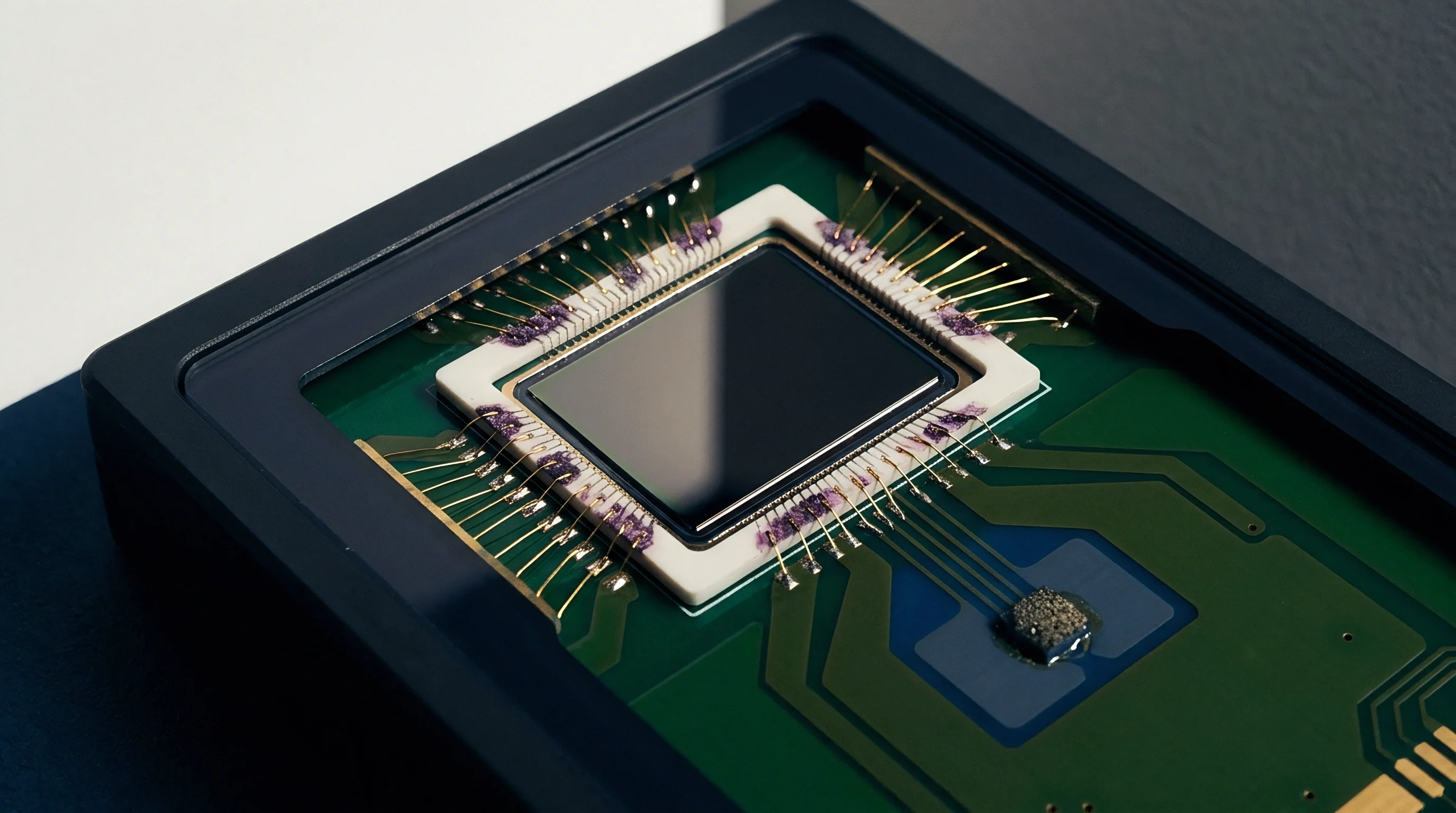
Time Dependent Parasitic Strain Transmission
Packaging layers couple mechanically to the perimeter and backside of transducer dies through shared interface surfaces. In a typical piezoresistive pressure die bonded to an alumina header, cooling from an adhesive cure temperature of one hundred fifty degrees Celsius down to twenty-five degrees Celsius imposes compressive planar stresses exceeding fifty megapascals. The polymeric die attach experiences high sustained shear strains along die corners.
Under constant mechanical boundary displacement, the viscoelastic polymer relaxes its internal shear modulus over days, months, and operational thermal cycles. As the adhesive relieves its internal stress, the bending moment applied to the neutral axis of the silicon die changes. The resulting parasitic strain transmits directly into the active sensor membrane, corrupting the mechanical zero point without any external pressure application.
Silicon piezoresistive pressure sensors exhibit zero-point drift rates of twelve microvolts per volt per thousand hours when packaged with standard bisphenol epoxies at eighty-five degrees Celsius.
Capacitive microelectromechanical systems face identical structural degradation. A capacitive accelerometer senses sub-nanometer displacements between stationary stator fingers and a suspended proof mass. When package stress relaxes non-uniformly across die anchors, the silicon frame warps out of plane.
Even a fractional micrometer angular tilt shifts the electrostatic comb finger overlap, producing uncalibrated zero-g acceleration bias. The rate of this shift correlates directly with the relaxation spectrum of the die attach material, accelerating dramatically when ambient operating temperatures approach the polymer glass transition region.

Equilibrium Modulus and the Glassy Limit
Polymer mechanics dictate that the relaxation process spans two distinct physical limits. At temperatures well below the glass transition, long-chain polymer segments remain frozen in glassy configurations, yielding an instantaneous storage modulus typically ranging between three and twelve gigapascals. Under these glassy conditions, stress relaxation occurs at exceptionally slow rates governed by localized secondary molecular rotations.
At temperatures above the glass transition, thermal energy activates large-scale conformational slipping of polymer backbones, dropping the rubbery equilibrium modulus down to three to thirty megapascals. The transition between these domains spans several decades of relaxation time, dictating whether package stress dissipates within minutes or persists over product lifetimes.
Neglecting relaxation kinetics during transducer package layout yields field recalibration recalls when zero drift exceeds three percent of full scale span over five hundred thermal operating hours.

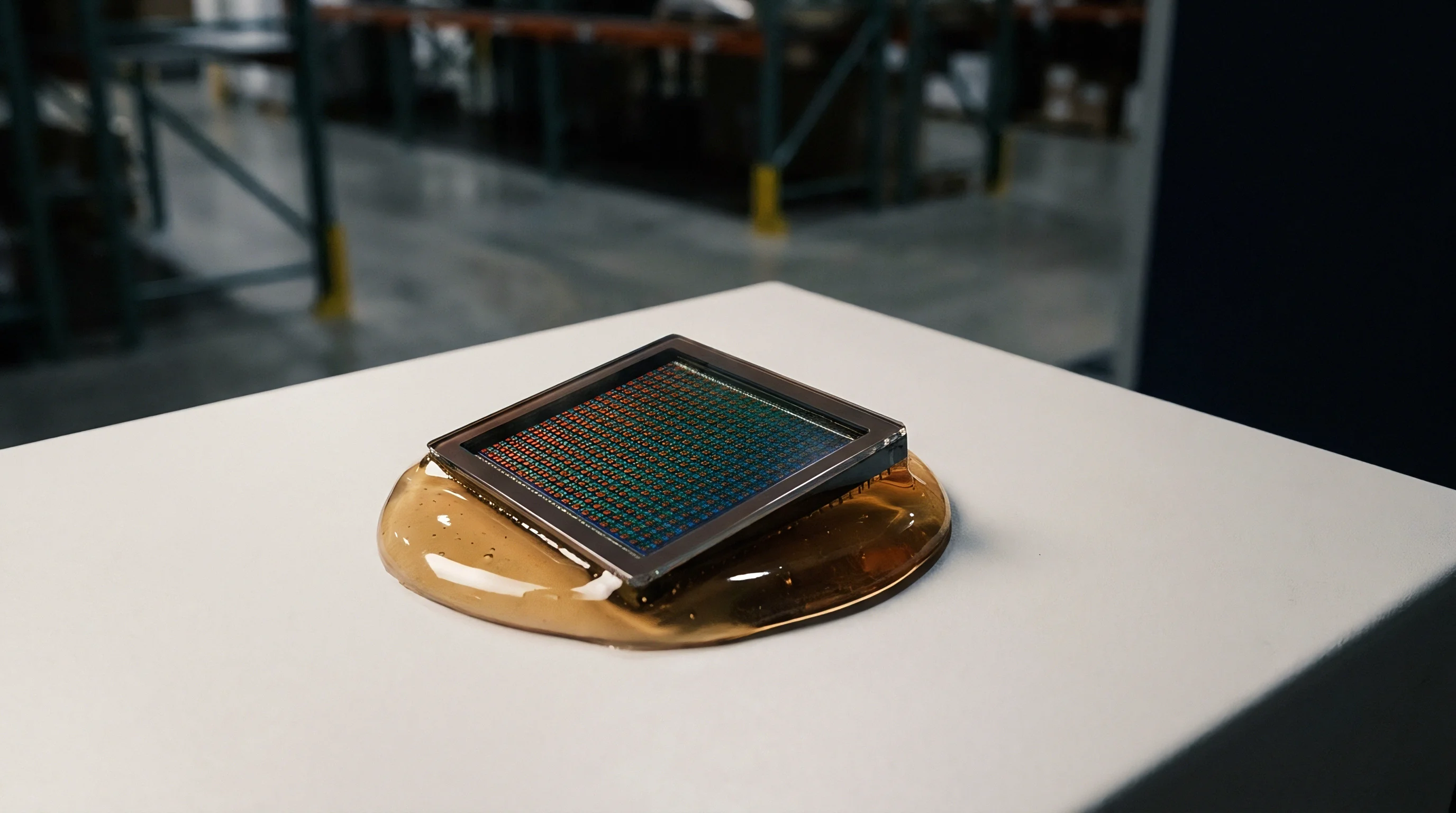
Adhesive
Die attach selection determines the mechanical boundary stability of every silicon transducer assembly. Package architects balance structural bond strength, thermal conductivity, application dispense speed, and mechanical compliance against the operational stability demands of the sensing element. Hard bonding agents like gold-tin eutectics provide near-zero viscoelastic relaxation while transferring extreme thermal mismatch stresses directly into the silicon substrate.
Organic die-attach adhesives absorb thermal mismatch stresses through low shear stiffness, introducing long-term viscoelastic relaxation and drift into the instrument signal chain.
Epoxies relax under sustained mechanical deflection.
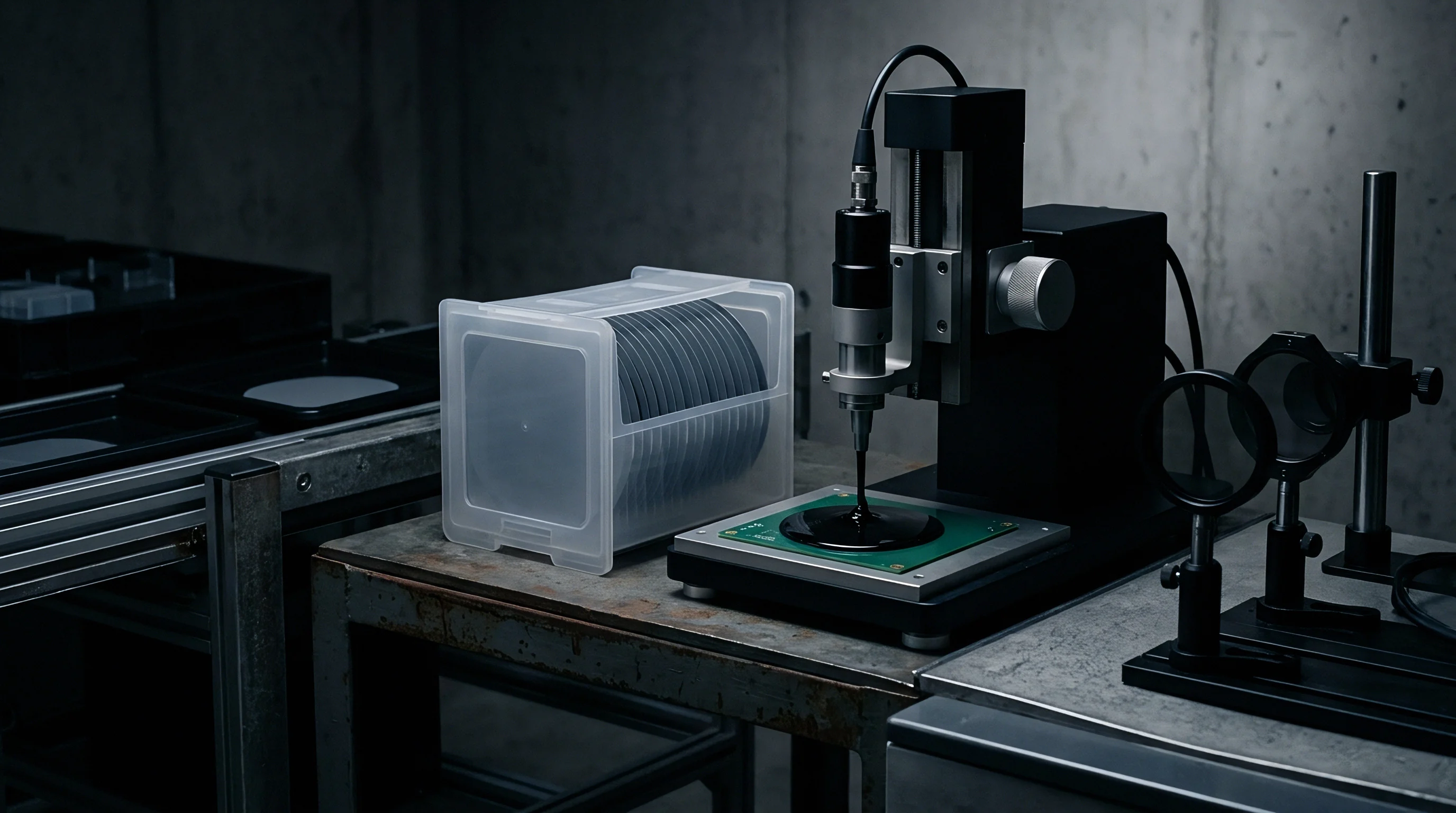
Polymer Chemistries across Operating Temperature Bands
Formulators tailor structural die attach materials using distinct polymer backbones, reactive diluents, and inorganic filler fractions. Commercial electronic adhesives segregate into distinct functional classes based on resin chemistry, modulus, and crosslink architecture:
- Moisture plasticization disrupts secondary hydrogen bonding across the epoxy backbone, depressing transition temperatures by up to twenty degrees Celsius and accelerating strain relief.
- Differential thermal contraction generates multiaxial interface shears between silicon dies and ceramic substrates during cool-down, driving continuous room-temperature dimensional recovery.
- Incomplete thermoset crosslinking leaves residual monomer chains free to diffuse, altering the rubbery modulus during subsequent operational heat cycles.
- Adhesive filler settling creates localized modulus gradients across the bondline, concentrating mechanical distortion directly beneath sensitive micromachined membrane margins.
Crosslink density governs the final plateau. Moisture ingress lowers the glass transition. Cyanate esters resist hydrolytic plasticization.
Gold tin solders eliminate viscoelastic relaxation.
| Material Chemistry | Glass Transition (°C) | Instantaneous Modulus (GPa) | Equilibrium Modulus (MPa) | CTE Below Tg (ppm/K) | One-Year Stress Loss (%) |
|---|---|---|---|---|---|
| Bisphenol Epoxy | 125 to 165 | 4.5 to 8.5 | 15 to 45 | 35 to 55 | 18 to 32 |
| Filled Silicone Elastomer | -120 to -45 | 0.002 to 0.015 | 0.8 to 2.5 | 180 to 320 | 65 to 88 |
| Cyanate Ester | 180 to 240 | 5.0 to 9.2 | 25 to 60 | 30 to 45 | 8 to 14 |
| Thermoplastic Polyimide | 220 to 280 | 2.8 to 4.2 | 80 to 180 | 40 to 60 | 12 to 22 |
| Sintered Nano-Silver | Not Applicable | 28.0 to 45.0 | 26000 to 42000 | 18 to 22 | 0 to 2 |
Adhesives with higher glass transition values preserve transducer zero-point baseline stability during elevated thermal dwell.

Why Do High Glass Transitions Suppress Relaxation?
Elevating the glass transition temperature moves the operational thermal band deeply into the polymer glassy plateau. In this region, coordinated cooperative motions of long polymer segments cease due to steric hindrance and limited free volume within the cured resin network. Relaxation kinetics remain restricted to secondary localized vibrations with activation energies exceeding one hundred kilojoules per mole, reducing dimensional drift rates by orders of magnitude over fifty-thousand-hour operating lifespans.
Material vendors routinely attribute observed zero shifts to unoptimized customer solder reflow profiles rather than inherent polymer chain reorganization.

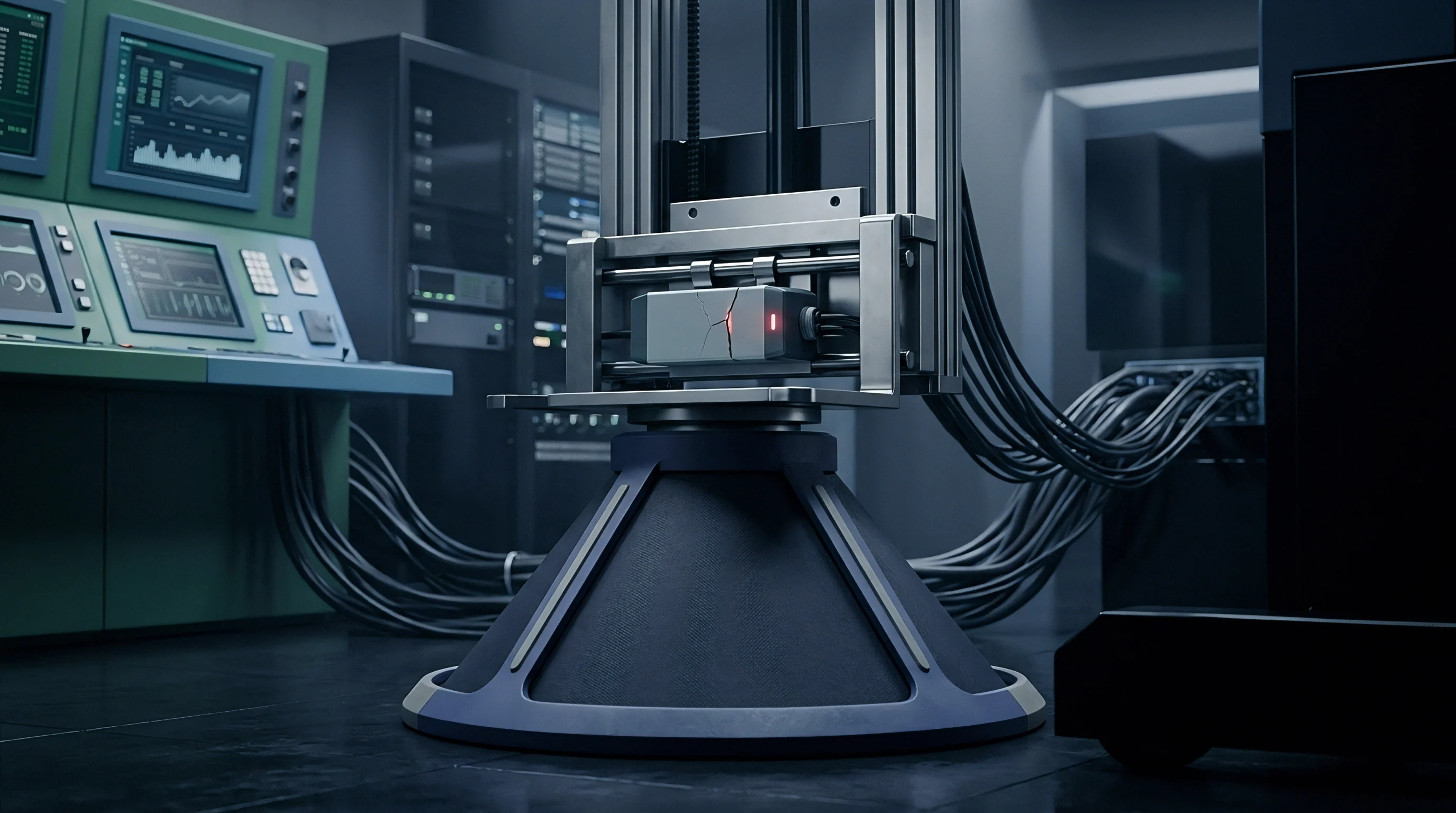
Hysteresis
Static calibration curves rarely repeat perfectly when sensors undergo thermal cycling under real operating conditions. When an assembled transducer experiences a temperature swing from twenty-five degrees Celsius up to one hundred twenty-five degrees Celsius and back to baseline, the output voltage trace displays a characteristic loop. This offset discrepancy originates in the path-dependent deformation history of the organic packaging materials.
At elevated temperatures, internal bonding stresses relax toward zero; upon returning to ambient room temperature, the polymer contracts elastically, establishing a reverse stress state that takes days or weeks to dissipate.
Thermal hysteresis degrades factory offset calibrations.
Polymer packaging layers experience progressive mechanical redistribution under repeated temperature swings until physical aging establishes an apparent dimensional plateau.
Piezoresistive Bridge Offset and Gap Distortions
Silicon piezoresistors convert mechanical package stress into electrical voltage unbalance through crystallographic piezoresistive coupling coefficients. When longitudinal and transverse residual stresses alter their magnitude following viscoelastic relaxation, the four legs of a Wheatstone bridge drift unevenly. A net differential surface stress shift of merely one hundred kilopascals across a p-type resistor ring on a (100) silicon diaphragm produces an offset voltage shift of roughly sixty microvolts per volt of bridge excitation.
This shift directly competes with analog-to-digital converter resolution in precision industrial transmitters.
Piezoresistive coefficients vary with crystallographic orientation. Capacitive gaps demand sub-micron geometric stability.
| Transducer Architecture | Active Element Topology | Die Attach Formulation | 100-Hour Drift (% Span) | 1000-Hour Drift (% Span) | Post-Thermal Recovery Half-Life |
|---|---|---|---|---|---|
| Piezoresistive Pressure | Diaphragm Wheatstone Bridge | Standard Flexible Epoxy | 0.42 | 1.18 | 72 Hours |
| Piezoresistive Pressure | Diaphragm Wheatstone Bridge | High-Tg Cyanate Ester | 0.08 | 0.19 | 180 Hours |
| Capacitive Accelerometer | Differential Comb Drive | Soft Silicone Gel | 0.85 | 2.45 | 12 Hours |
| Capacitive Pressure | Sealed Cavity Membrane | Rigid Anisotropic Conductive Film | 0.28 | 0.74 | 96 Hours |
| Silicon Resonant Beam | Double-Ended Tuning Fork | Glass Frit Bond | 0.01 | 0.03 | 0 Hours |
Mechanical compliance variations influence transducer topology performance across changing packaging environments:
- Piezoresistive diaphragm topologies demand symmetrical stress fields to avoid unbalancing Wheatstone resistor rings under uniform package compression.
- Capacitive cavity designs tolerate moderate planar shear but suffer severe signal degradation from asymmetric anchor tilting that alters parallel plate gaps.
- Resonant beam transducers amplify package relaxation into output shifts by directly converting baseplate stress relief into uncalibrated structural frequency detuning.
- Suspended optical membranes isolate their central sensing zones from package-induced shear but demand rigid perimeter seals that concentrate bondline creep at the frame boundaries.
Thermal Cyclic Drift and Offset Recovery
When thermal cycling tests run over hundreds of consecutive profiles, zero-point baseline values exhibit exponential decaying trajectories. The peak offset shift recorded immediately upon cooling from an excursion decays back toward an equilibrium baseline over hours of dwell time. The recovery curve represents the superposition of multiple relaxation mechanisms operating simultaneously across distinct molecular scales.
A rapid initial elastic recovery gives way to slow logarithmic room-temperature relaxation. In field applications subject to random thermal duty cycles, these overlapping recovery curves prevent simple lookup-table compensation routines from canceling zero-point baseline shifts.
Whether dynamic firmware stress compensation algorithms can reliably separate environmental pressure inputs from lingering viscoelastic package relaxation over fifteen years of field operation remains unresolved across industrial sensing applications.

Kinetics
Characterizing the rate of time-dependent stress relief requires rigorous mathematical formalisms capable of tracking multi-decade mechanical phenomena. Rheologists utilize mechanical analogs consisting of linear Hookean springs and viscous Newtonian dashpots arranged in parallel or series configurations. The Maxwell element, comprising a single spring and dashpot in series, provides the elementary basis for describing stress relaxation under invariant strain conditions.
Real crosslinked polymers do not relax along a single exponential decay curve. Their complex molecular chain length distributions demand generalized representations across broad temporal spectra.
Shift factors scale logarithmically with temperature. Master curves collapse decades of testing.

Prony Series Parameterization for Finite Element Models
Finite element simulations of silicon package reliability implement the Generalized Maxwell model, expressing time-dependent shear modulus relaxation through a discrete Prony series expansion. The governing mathematical formulation represents the shear modulus G as a function of time:
G(t) = G_inf + sum(i=1 to N, G_i exp(-t / tau_i))
In this formulation, G_inf represents the fully relaxed long-term equilibrium shear modulus, G_i defines the relaxation modulus coefficient of the i-th Maxwell element, and tau_i denotes the characteristic relaxation time constant of that respective branch. The instantaneous shear modulus G_0 equals the sum of G_inf and all G_i components. Implementing this material model within structural solvers enables accurate prediction of how internal bondline stress distributions redistribute over months of environmental exposure.
| Branch Index (i) | Relaxation Time tau_i (Seconds) | Normalized Modulus (G_i / G_0) | Shear Modulus Component (MPa) | Bulk Modulus Component (MPa) |
|---|---|---|---|---|
| 1 | 1.0E-01 | 0.142 | 355.0 | 710.0 |
| 2 | 1.0E+01 | 0.215 | 537.5 | 1075.0 |
| 3 | 1.0E+03 | 0.188 | 470.0 | 940.0 |
| 4 | 1.0E+05 | 0.165 | 412.5 | 825.0 |
| 5 | 1.0E+07 | 0.124 | 310.0 | 620.0 |
| Infinite Equilibrium | Infinity | 0.166 | 415.0 | 830.0 |
| Values extracted from dynamic mechanical analysis frequency sweeps between 0.01 Hz and 100 Hz calibrated at reference temperature 25°C with instantaneous shear modulus G_0 = 2500 MPa. | ||||

Master Curves and Time Temperature Superposition Bounds
Dynamic mechanical testing cannot feasibly record empirical relaxation data continuously across ten years of operational service life. Laboratory characterization relies on the Time-Temperature Superposition Principle to construct extended master curves from short-term isothermal frequency sweeps. The technique shifts frequency-dependent modulus curves along the logarithmic time axis using empirical shift factors a_T.
Near the glass transition temperature, the Williams-Landel-Ferry equation models shift factor behavior:
log10(a_T) = -C1 (T – T_ref) / (C2 + (T – T_ref))
Below the glass transition, molecular motion shifts into secondary Arrhenius kinetics where the shift factor follows the activation energy of glassy state rearrangement:
ln(a_T) = (E_a / R) (1 / T – 1 / T_ref)
Extracting these parameters requires systematic experimental execution across calibrated dynamic mechanical instrumentation:
- Mount the dynamic mechanical analyzer specimen inside the environmental test chamber and equilibrate the test fixture at the lowest target temperature for thirty minutes.
- Apply a constant sinusoidal strain within the linear viscoelastic limit of one-tenth percent across a decade frequency sweep spanning one-tenth hertz to one hundred hertz.
- Record the storage modulus and loss modulus isotherms at discrete ten-degree temperature intervals ascending through the complete operational range.
- Apply the Williams-Landel-Ferry transformation to shift isothermal compliance curves along the logarithmic time axis relative to the selected reference temperature.
- Fit a five-term Maxwell Prony series to the unified master curve using nonlinear least-squares regression to extract discrete relaxation times and shear moduli.
Packages operating closer to their adhesive glass transition accumulate greater unrecoverable offset error during transient thermal excursions.

Screening
Sourcing engineers face severe commercial liabilities when qualifying sensor packages assembled with uncharacterized organic adhesives. Datasheets from adhesive suppliers routinely quote room-temperature tensile strength, lap shear strength, and thermal conductivity while omitting viscoelastic relaxation rates, Prony coefficients, and long-term creep parameters. Procuring transducers for mission-critical industrial process monitoring, automotive powertrain sensing, or medical instrumentation demands rigorous qualification protocols that force unrelaxed packaging stresses into early saturation prior to factory zero trimming.
Post-mold curing accelerates initial polymer stabilization. Uncontrolled humidity accelerates long-term drift rates.
Thermal Bake Regimes and Accelerated Aging Proofs
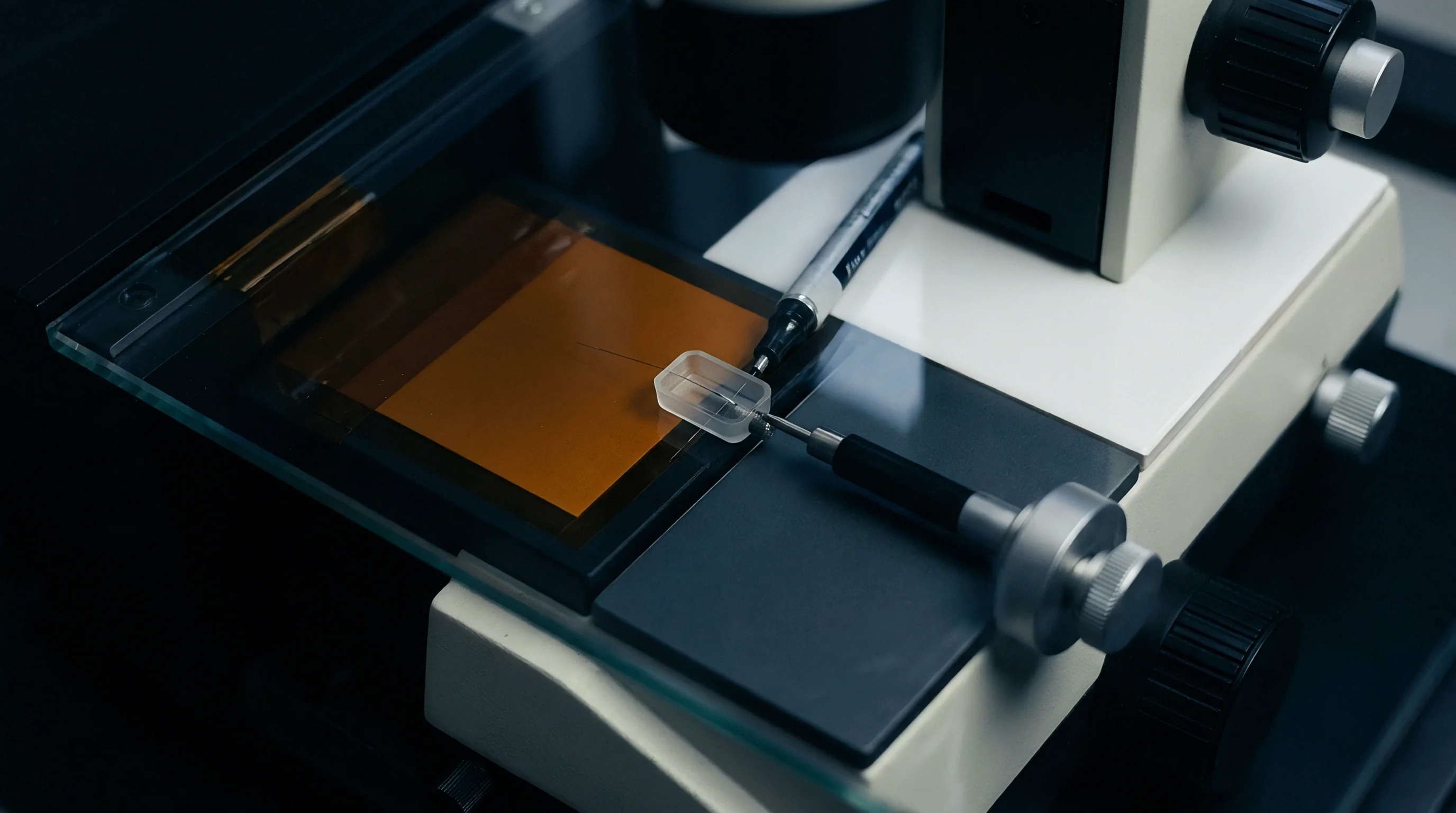
Package stabilization relies on pre-calibration thermal bake profiles designed to burn in structural relaxation. Exposing assembled sensor modules to temperatures ten to twenty degrees above their anticipated maximum operational limit accelerates polymer chain reorganization through time-temperature scaling factors. A high-temperature bake at one hundred twenty-five degrees Celsius for ninety-six hours relaxes out ninety percent of initial assembly cure shear stresses.
When the sensor subsequently undergoes calibration at ambient room temperature, the residual stress field remains positioned on the flat, asymptotic tail of the relaxation curve, drastically reducing subsequent zero-point drift during field deployment.
Procurement clauses referencing MIL-STD-883 method 1008 condition C stabilize organic die-attach bondlines before baseline electrical calibration trims zero-point resistor bridge errors.
How Do Sintered Metallic Joints Resist Creep?
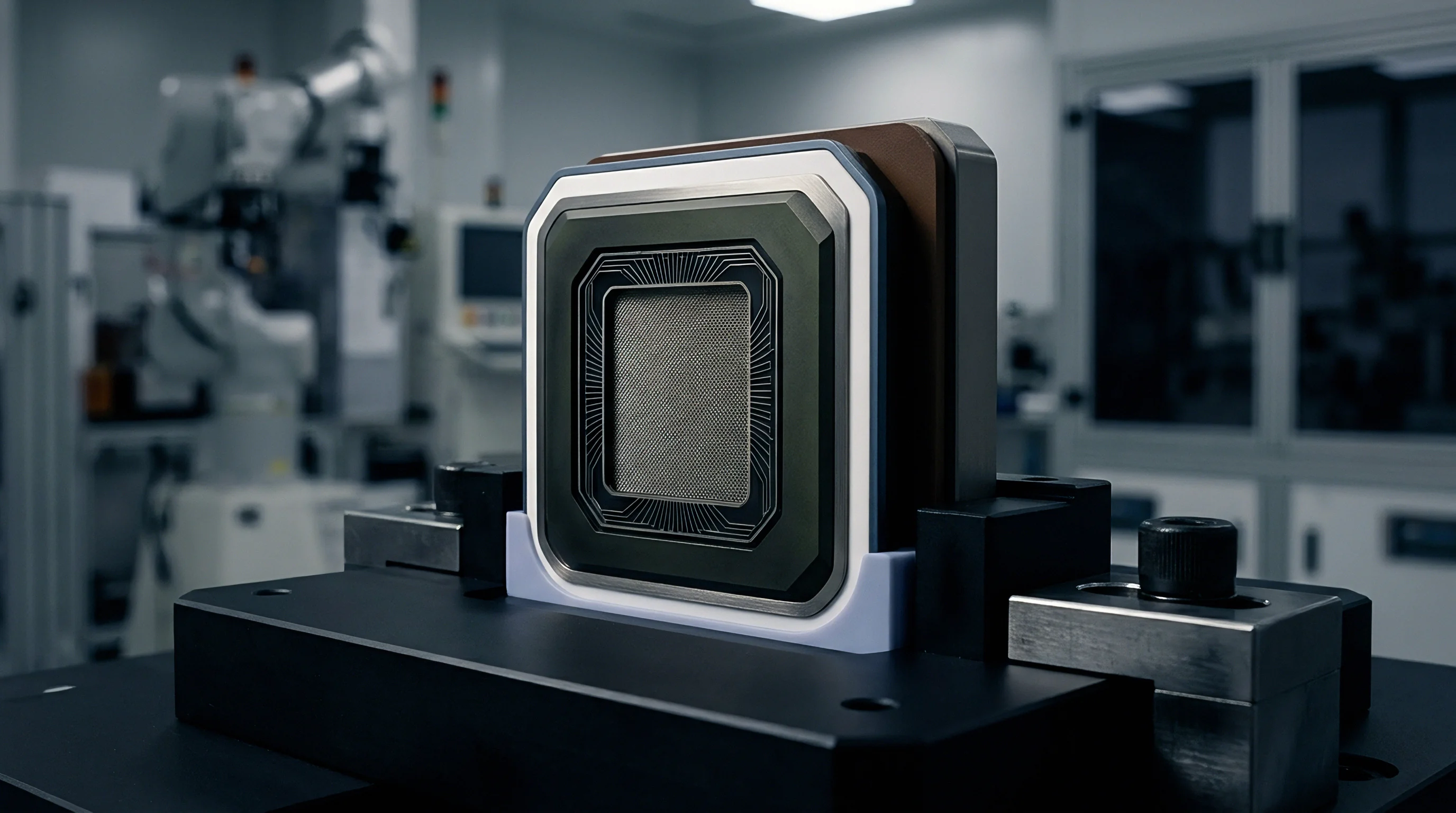
Packaging designs demanding sub-ppm zero stability bypass organic adhesives entirely by adopting inorganic sintered nano-silver or transient liquid phase bonding. Sintered silver forms rigid porous networks. Sintered silver joints exhibit no polymer glass transitions, maintaining purely metallic crystalline bonding networks that suppress viscoelastic relaxation mechanisms across normal operating ranges.
Creep in sintered silver occurs only through dislocation glide and Coble grain boundary diffusion at temperatures exceeding two hundred degrees Celsius, ensuring absolute geometric stability across conventional automotive and industrial operational environments.
Invoking AEC-Q103-002 section 4.3 obligates the supplier to document baseline zero drift across one thousand hours of high temperature storage, rejecting lots that exhibit post-test offset shifts greater than one millivolt.