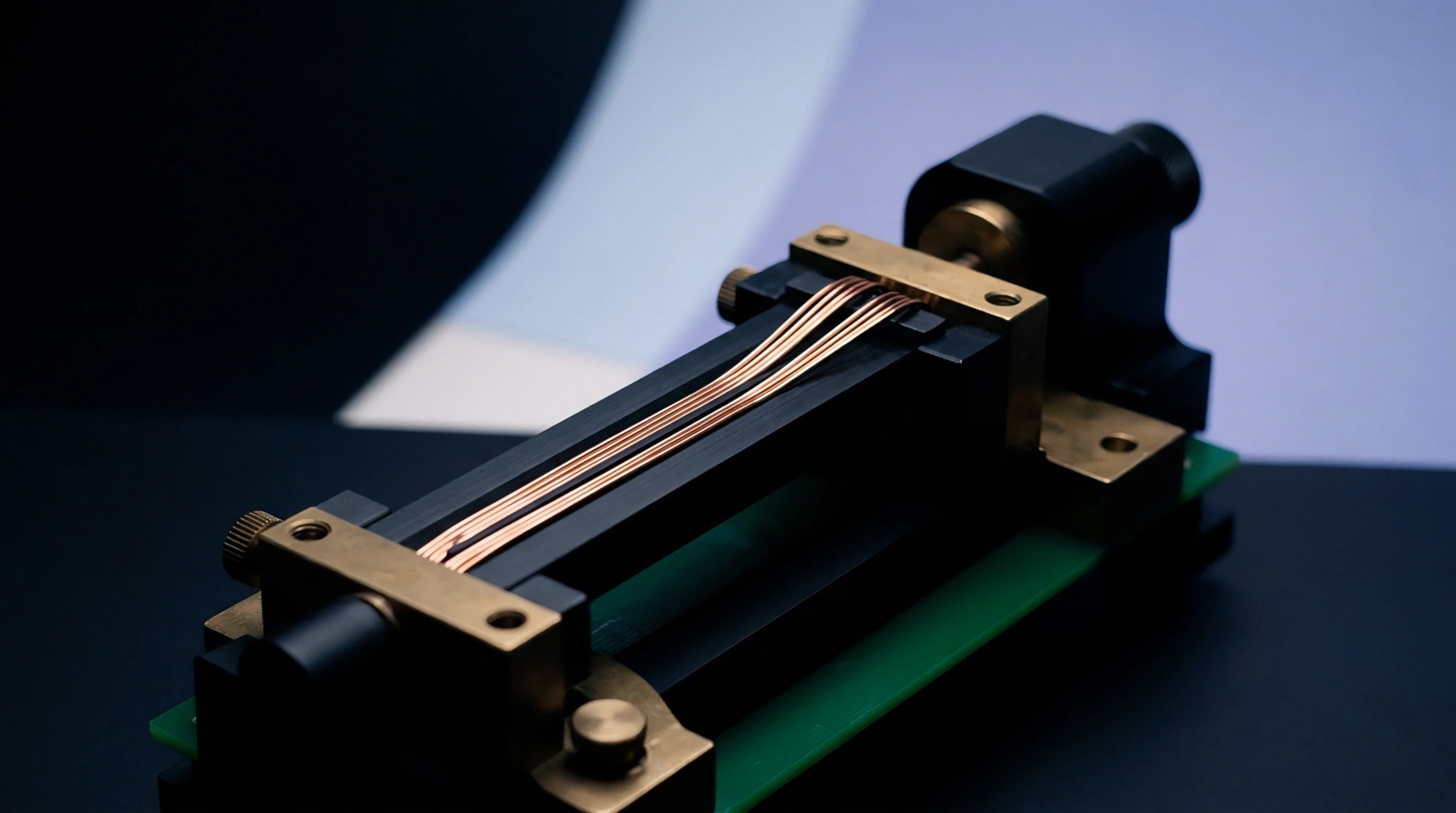
Dynamic Protocol
A strain rate jump test is a mechanical characterization procedure that alters crosshead velocity mid-test to quantify the immediate stress response of a material to a sudden change in deformation speed. This metrological method evaluates strain rate sensitivity by imposing rapid velocity shifts during uniaxial tension or compression, capturing transient flow stress spikes before the material stabilizes at a new steady state. Modern load frames execute these abrupt transitions through closed-loop servohydraulic or electromechanical actuators that must maintain high sampling frequencies to record rapid load relaxations or hardening surges accurately.
Actuation Mechanics
Hydraulic servo valves and digital signal processors govern the velocity transition phase, where command signals step from an initial displacement rate to a target magnitude within milliseconds. Load cell transducers and optical encoders monitor the resulting force and displacement fluctuations simultaneously, transmitting voltage changes to acquisition boards at rates exceeding ten kilohertz. Thermal expansion within the load train and compliance in the load frame introduce systematic errors during the high-speed transient phase, requiring rigorous post-test correction algorithms to isolate true material behavior from machine dynamics.
Calibration Drift
Transducer calibration curves degrade over extended operational cycles due to cyclic fatigue in load cell elements and optical encoder signal attenuation. Environmental temperature fluctuations alter fluid viscosity in hydraulic actuators, shifting command response profiles and introducing velocity lag during the jump interval. Metrology technicians verify actuator displacement rates against laser interferometers annually, ensuring that command step inputs match actual crosshead translation profiles within strict percentage tolerances set by materials testing standards.
Boundary Constraints
Inertial ringing in the load train distorts force measurements immediately following the velocity step, establishing a strict upper bound on usable strain rates before signal noise obscures the transient flow stress response. High-speed testing protocols assume isothermal conditions, but adiabatic heating during rapid plastic deformation alters local yield strength and invalidates strain rate sensitivity calculations if heat dissipation is neglected. Thermal feedback compensation algorithms mitigate temperature-induced resistance drift in strain gage conditioning circuits, maintaining measurement fidelity across extended testing intervals.