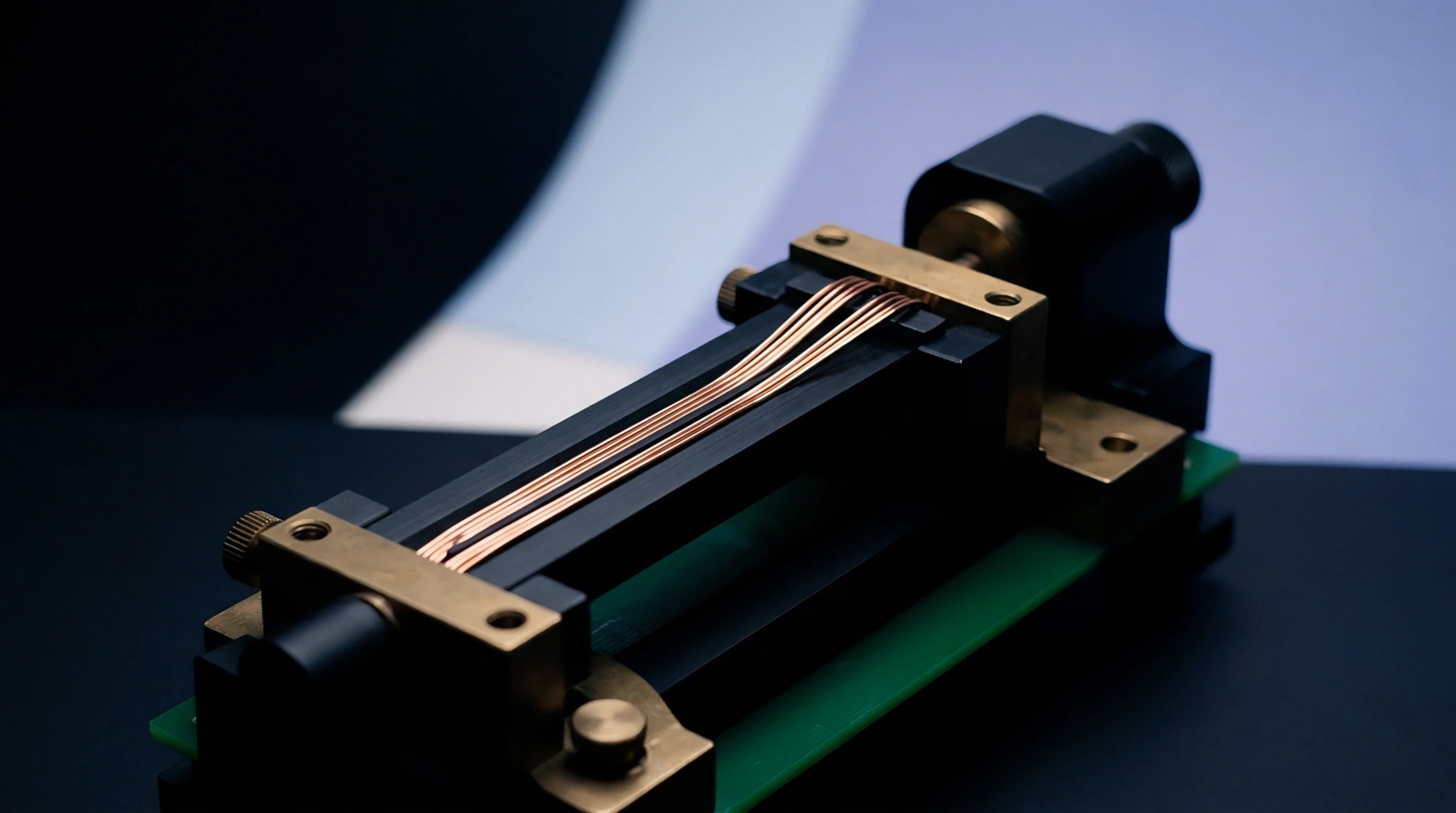
Permanent Deformation
Permanent deformation describes the residual geometric change remaining in a material after the removal of an applied load. Inelastic strain represents this non-recoverable displacement occurring once the internal stress exceeds the proportional limit of the crystalline lattice. This measurement quantifies the degree of permanent internal reorganization within a specimen.
It serves as a metric for assessing material fatigue and structural integrity under high load conditions.
Measurement Protocol
Sensors like high-precision extensometers or foil strain gauges capture the total deformation during a load cycle. These instruments distinguish between recoverable elastic displacement and the inelastic strain that persists when the force returns to zero. Calibration routines ensure that the sensor offset accounts for thermal expansion or mechanical drift before the test begins.
Verification occurs by comparing the initial baseline measurement against the final physical dimensions after unloading.
Process Influence
Metallurgical processing or thermal treatment alters the density of dislocations within the internal structure. These microscopic features determine how the material distributes the load and resists permanent displacement. Excessive inelastic strain typically indicates a breach of the operational tolerance established by industrial standards for load-bearing components.
Design engineers calculate this limit to prevent component failure during cyclic loading operations.
Calibration Variance
Metrological drift influences the accuracy of these readings when sensors operate outside their certified temperature range. Incorrect mounting pressure on a strain gauge creates a systematic bias that obscures the true value of the non-recoverable displacement. Proper alignment of the measuring instrument against the axis of force ensures that the data accurately identifies the onset of yielding.
A properly calibrated system produces reliable data for determining the total life cycle of a component under stress.