Quantifying Long Term Sensor Drift Driven by Viscoelastic Strain Redistribution
Viscoelastic stress relaxation in packaging adhesives redistributes mounting strains over time, driving zero drift that requires thermal pre-aging to stabilize.
Rheology
A piezoresistive pressure cell stored in dry nitrogen exhibits an unprovoked zero-point shift of 0.42 percent of span across 1,000 hours at 85 degrees Celsius. Chemical oxidation plays no role in that atmosphere, and the silicon remains purely elastic. The drift originates in the cross-linked epoxy bond line securing the die to the ceramic header.
During initial curing at 150 degrees Celsius, thermal expansion mismatch generates heavy thermoelastic stresses across the structural stack. Over time at elevated or even ambient temperatures, the polymer chains slowly rearrange into lower-energy conformations, bleeding off locked-in shear stress. This relaxation alters boundary loading on the silicon substrate and introduces parasitic strain across the piezoresistors, pulling the zero point off calibration.
Transient Modulus Equations in Die Mounts
Stress relaxation describes the time-dependent drop in internal mechanical stress under fixed boundary strain. In linear viscoelastic regimes, this behavior is modeled through the Maxwell-Wiechert series, expressing the relaxation modulus across a discrete series of exponential decay modes:
E(t) = E_infinity + Sum_{i=1}^{m} E_i exp(-t / tau_i)
Here, E_infinity represents the fully relaxed equilibrium modulus, E_i is the relaxation strength of the i-th mechanical arm, and tau_i is the characteristic relaxation time governed by internal molecular friction. The glass transition temperature marks the boundary where relaxation rates shift by orders of magnitude. Below this threshold, glassy polymers display relaxation times that span decades; near or above it, relaxation times collapse to hours or minutes.
Filled adhesives exhibit broad spectra spanning six to ten logarithmic decades of time.
A die-attach layer of 50 micrometers thickness relaxes 28 percent of its residual shear stress over 8,760 hours at 50 degrees Celsius, yielding a 140 microstrain redistribution across the sensing diaphragm.
Sensor packaging designs constantly trade thermal dissipation against mechanical isolation. Alumina substrates, silicon dies, and copper leadframes have widely divergent coefficients of thermal expansion, leaving the bond layer to absorb the mismatch. Specifying a high-modulus adhesive eliminates mechanical compliance but locks in severe shear loads during cooldown from cure, which then discharge as parasitic strain over operational life.
Conversely, choosing an overly compliant elastomer introduces hysteresis and creep under dynamic pressure cycles, making bond thickness the critical compliance lever.
| Adhesive Polymer Chemistry | Glass Transition (Celsius) | Instantaneous Modulus (MPa) | Fully Relaxed Modulus (MPa) | Dominant Relaxation Time (Hours) |
|---|---|---|---|---|
| Silver-Filled Bisphenol-A Epoxy | 125 to 145 | 6,800 | 4,200 | 1,400 to 3,200 |
| Alumina-Filled Anhydride Epoxy | 155 to 175 | 9,200 | 6,100 | 4,500 to 9,000 |
| Flexible Polyimide Adhesive Film | 210 to 240 | 3,100 | 2,400 | 8,000 to 18,000 |
| Dielectric Polydimethylsiloxane | -45 to -30 | 4.5 | 1.2 | 0.08 to 0.50 |
Mechanical design rules demand matching the assembly thermal expansion coefficients before adjusting glue chemistry.

Joint
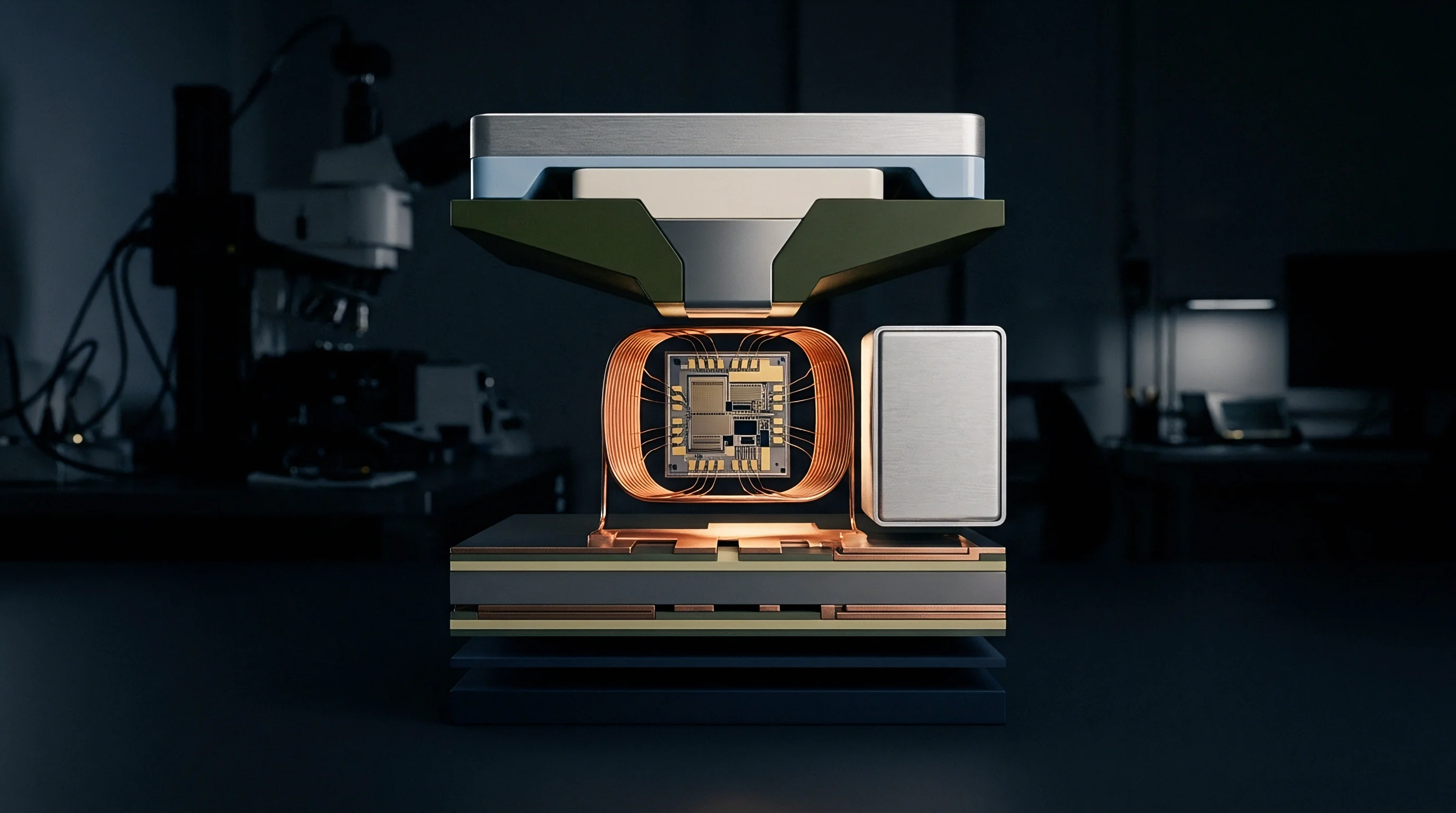
Structural adhesives, metallic solders, and filled potting compounds establish the mechanical interface between a sensing element and its housing, sustaining non-uniform stress distributions across their geometric footprints. During factory calibration, the transduction element records the composite strain produced by applied physical pressure, mounting torque, and frozen-in packaging stresses combined. When the mounting joint yields over time, stress relief proceeds unevenly: unconstrained edges and corners relax faster than the geometric center, driving asymmetric strain fields that directly induce offset error.
Interfacial Tractions across Bond Lines
Differential displacement between the die and its carrier induces high shear traction concentrated within three bond-line thicknesses of the die edge. As high edge shear relaxes, load shifts toward the die center, altering the curvature of the silicon substrate. Because symmetrical four-arm Wheatstone bridges rely on balanced strain across complementary arms to maintain electrical balance, this uneven redistribution breaks layout symmetry and registers as drift.
Packaging joints exhibit specific mechanical vulnerabilities that drive bridge drift:
- Void nucleation along interfaces generates localized stress concentrations that alter nearby silicon strain fields during isothermal storage.
- Adhesive fillet asymmetry induces an unbalanced bending moment across the chip perimeter, magnifying zero-point wander as the fillet relaxes.
- Moisture-induced plasticization lowers the polymer glass transition temperature, speeding up relaxation rates at moderate operating temperatures.
- Solder joint microstructural coarsening relaxes residual mount loads through grain boundary sliding in lead-free alloy matrices.
Solders relax primarily through dislocation glide. High-temperature solders such as gold-tin eutectic provide stable mechanical joints with negligible room-temperature creep, though their high melting point locks in extreme initial stress during solidification. Polymer adhesives avoid those severe assembly loads but sacrifice long-term dimensional stability to continuous viscoelastic relaxation, and post-cure baking cannot completely eliminate subsequent drift over multi-year deployments.
Decay
Mathematical extrapolation of time-dependent stress loss relies on generalized relaxation spectra. Because the rate of strain redistribution slows with the logarithm of elapsed time, assemblies can appear deceptively stable during brief factory acceptance tests, only to drift steadily along an extended logarithmic decay curve across three to five years of operational service.

Logarithmic Attenuation and Time Temperature Equivalence
Accelerated qualification requires translating high-temperature test data into long-term room-temperature predictions. Under the principle of time-temperature superposition, viscoelastic mechanisms operating at elevated temperatures correspond directly to those operating at lower temperatures over longer timescales. The horizontal shift factor, a_T, translates experimental relaxation curves along the logarithmic time axis.
For temperatures above the glass transition, the Williams-Landel-Ferry equation defines the shift relationship:
log10(a_T) = -C1 (T – T_ref) / (C2 + (T – T_ref))
For temperatures comfortably below the glass transition, where sensor packaging polymers typically operate, an Arrhenius formulation governs the shift factor:
a_T = exp((E_a / R) (1 / T – 1 / T_ref))
In this expression, E_a is the apparent activation energy for segmental relaxation, R is the universal gas constant (8.314 J/mol K), and T represents absolute temperature in Kelvin.
An activation energy of 85 kilojoules per mole accelerates viscoelastic relaxation by a factor of 31 when elevating test temperature from 25 to 65 degrees Celsius.
Consider a worked calculation for a piezoresistive pressure transmitter utilizing an unfilled epoxy die-attach layer. Assume a 4.0 mm square silicon die mounted to an alumina header with a 35 micrometer thick bond line. Assembly curing at 130 degrees Celsius followed by cooling to 23 degrees Celsius establishes an initial thermal shear stress of 24.5 MPa near the die corners.
The adhesive exhibits an apparent activation energy of 88 kJ/mol, an initial storage modulus of 4,200 MPa, and an equilibrium relaxed modulus of 2,100 MPa distributed across three dominant relaxation modes: tau_1 = 120 hours, tau_2 = 1,800 hours, and tau_3 = 24,000 hours at 23 degrees Celsius. The piezoresistive bridge exhibits a transverse strain sensitivity of 0.018 millivolts per volt per microstrain.
At 8,760 hours (one operating year) at an average operating temperature of 45 degrees Celsius, the Arrhenius acceleration factor reaches 8.94 relative to 23 degrees Celsius, yielding an effective aging exposure of 78,314 hours. Under this exposure, the first two relaxation modes have fully discharged, and the third mode has completed 96 percent of its relaxation path. Total shear stress relaxation at the die interface reaches 18.2 MPa out of the initial 24.5 MPa.
Finite element strain transfer models indicate that this 18.2 MPa boundary relaxation relieves 94 microstrain of differential compression across the active bridge resistors. Multiplied by the transverse bridge sensitivity and a 5.0 V bridge excitation, the unprovoked zero-point output shifts by 8.46 millivolts, representing a permanent zero drift of 8.46 percent of span on a 100 mV full-scale device.
| Storage Temperature | Predicted Modulus Loss (%) | Predicted Bridge Drift (% Span) | Measured Bridge Drift (% Span) | Measurement Uncertainty (k=2) |
|---|---|---|---|---|
| 23 Degrees Celsius | 6.2 | 0.31 | 0.34 | +/- 0.05 |
| 55 Degrees Celsius | 22.8 | 1.14 | 1.21 | +/- 0.08 |
| 85 Degrees Celsius | 58.4 | 2.92 | 2.86 | +/- 0.12 |
| 105 Degrees Celsius | 74.1 | 3.70 | 4.15 | +/- 0.18 |
Subsea telecommunication repeaters balance internal amplifier stresses across twenty-year lifespans using matched crystalline mounts. Precision industrial instrumentation rarely receives such expansive engineering budgets.
Drift predictions derived from continuous baseline monitoring over 5,000 hours remain sensitive to manufacturing variations. If the cure conversion ratio during production varies by even three percent, the glass transition temperature drops by eight degrees, shifting the acceleration factor by 45 percent and invalidating single-point drift projections. Activation energy values extracted from four-week thermal soaks remain unreliable because secondary curing mechanisms distort short-term relaxation data, leading buyers to specify multi-temperature Arrhenius screening spanning at least three distinct thermal plateaus.
Non-affine polymer chain rearrangement under prolonged thermal dwell gradually alters the underlying strain state, corrupting higher-order bridge compensation terms that assume static packaging stress.

Chamber
Thermal screening regimens must isolate mechanical relaxation from concurrent chemical deterioration. Environmental qualification chambers often conflate multiple drift drivers: humidity absorption causes polymer swelling, elevated temperatures induce post-curing or oxidation, and mechanical stress relaxation dissipates assembly pre-loads. An engineer isolates viscoelastic strain redistribution by executing test sequences in inert gas atmospheres at dry zero-percent relative humidity.
Screening Schedules and Isothermal Soaks
A rigorous qualification sequence separates reversible thermoelastic output shifts from non-reversible viscoelastic drift. The process demands methodical staging:
- Run baseline characterization across full operating temperature range to document initial non-linearity, span, and zero offset under dry nitrogen.
- Dwell at maximum storage temperature for 168 hours to release steep, short-term relaxation components and achieve secondary curing stability.
- Recalibrate sensor cell at reference temperature of 23 degrees Celsius to record permanent post-bake zero shifts.
- Subject device to an isothermal soak at 70 degrees Celsius for 1,000 hours under continuous bridge voltage logging.
- Return device to 23 degrees Celsius for 48 hours to eliminate transient thermoelastic recovery lags.
- Perform final calibration sweep to verify that remaining drift velocity does not exceed 0.05 percent of span per thousand hours.
IEC 60068-2-2 dry heat testing identifies gross mechanical relaxation but allows manufacturers to mask long-term log-time strain transfer behind short 96-hour exposures.
Moisture complicates baseline stability. Ingress of atmospheric water vapor plasticizes die-attach epoxies, lowering the glass transition temperature and initiating hygroscopic swelling stresses that oppose thermal cure shrinkage. Executing aging trials in unconditioned ambient humidity generates contradictory drift trajectories where mechanical relaxation and moisture expansion cancel each other temporarily.
Once the sensor enters a dry field environment, moisture desorbs and the underlying viscoelastic zero-point drift reasserts itself rapidly.
Failure to isolate viscoelastic relaxation during incoming qualification transfers unbudgeted recalibration campaigns directly to field service operations.

Settlement
Procurement specifications for precision transducers frequently separate initial accuracy from three-year field stability. Calibration certificates establish performance only for the day a unit leaves the test bench. When a contract fails to bound maximum permissible drift under defined thermal conditions, the buyer assumes financial liability for zero wander caused by packaging strain relaxation.
Allocation of Long Term Tolerance Budgets
Sourcing engineers evaluate the total uncertainty budget across the instrument deployment lifecycle. Viscoelastic drift represents a systematic, monotonic loss of zero stability. Unlike random noise, it consumes the allowable tolerance envelope in one direction over time.
| Packaging and Stabilization Method | Unit Surcharge (USD) | Expected 3-Year Drift (% Span) | Recalibration Interval (Months) | 5-Year Field Maintenance Cost (USD) |
|---|---|---|---|---|
| Standard Die Epoxy with No Post-Cure Bake | Base Price | 1.80 to 3.50 | 6 to 12 | 142,000 |
| Controlled Post-Cure Bake (150 C for 24 Hours) | 14.50 | 0.60 to 1.10 | 18 to 24 | 58,000 |
| High-Tg Polyimide Film with 100-Hour Thermal Burn-In | 38.00 | 0.25 to 0.45 | 36 to 48 | 21,000 |
| Eutectic Gold-Tin Solder on Ceramic Submount | 82.00 | 0.08 to 0.15 | 60 | 0 |
Procurement decisions require evaluating total lifecycle cost rather than initial invoice price. Standard packaging epoxies without post-cure burn-in show steep early relaxation curves. Incorporating a 24-hour thermal soak at 150 degrees Celsius shifts the component past its steepest logarithmic decay phase prior to factory calibration, leaving only long-period, low-amplitude decay mechanisms active during actual field operation.
When selecting suppliers for critical pressure, torque, or force instrumentation, quality teams implement a definitive qualification checklist:
- Glass transition temperature margin exceeding the maximum rated storage limit by at least 30 degrees Celsius.
- Accelerated drift datasets containing multi-temperature Arrhenius projections spanning a minimum of 2,000 equivalent thermal hours.
- Bond-line geometry controls governing adhesive bond thickness tolerances to within plus or minus 5 micrometers across production lots.
- Batch-level post-cure verification documenting the exact thermal ramp and dwell history for every adhesive lot.
A procurement contract specifying that long-term zero drift shall not exceed 0.15 percent of span per annum across the operating range of minus 20 to plus 70 degrees Celsius compels the sensor manufacturer to absorb burn-in processing costs and adopt low-relaxation packaging architectures.